
Look at this recent post on X:
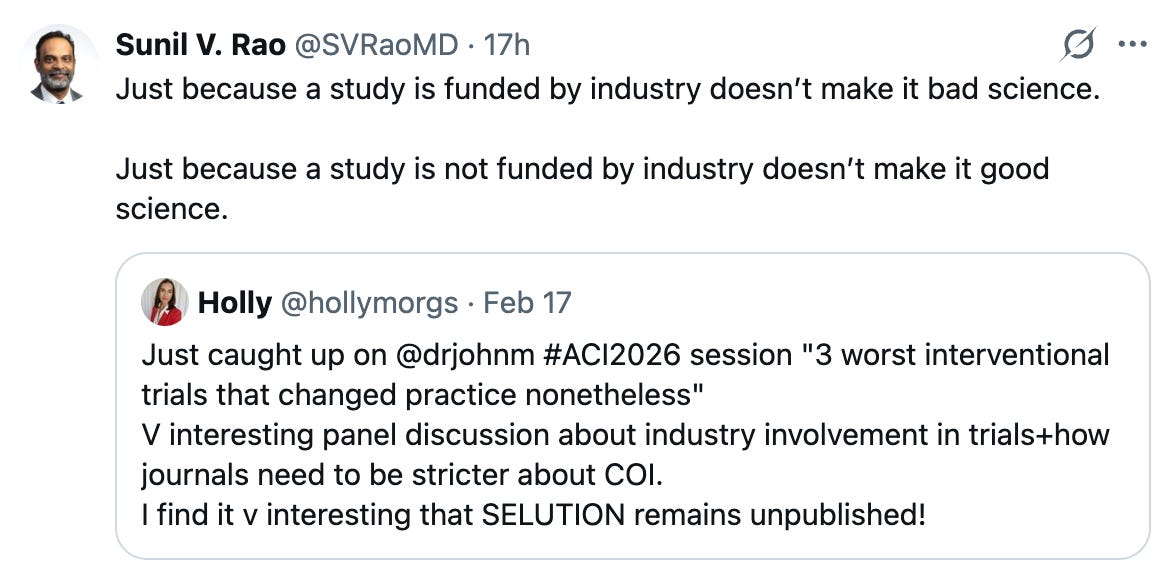
Dr Holly Morgan is cardiologist and researcher in the UK and was an author on one of the best cardiology trials of our time—the REVIVED BCIS2 trial.
Dr Sunil Rao is a cardiologist and researcher who has published many important trials in cardiology, both industry and government funded.
Today we address the tension in the two types of science funding.
Dr. Morgan commented on my lecture at the recent BCIS meeting in London. It was not my idea to speak on “the three worst interventional cardiology trials that changed practice nonetheless.” I could have easily and happily spoke on the three best interventional trials; but this was not my assignment.
My choice for the three worst trials in interventional cardiology were: FAME-2, TRILUMINATE, and EARLY TAVR.
FAME-2 established the use of physiologic measures of coronary stenoses. TRILUMINATE created enthusiasm for clipping tricuspid valves to reduce leakiness. EARLY TAVR tempted cardiologists to change the rule that we wait for patients with aortic stenosis to have symptoms before operating on the valve.
All three of these trials were industry supported. All three were designed to be positive before the first patient was enrolled.
And therein lies the core problem between industry and non-industry funded trials: industry funds trials to sell products.
Dr Rao is exactly right in his post on X. This does not necessarily mean industry-funded science equals bad science. In many cases (ICD, primary stenting for MI, statins, most HF meds), the confluences of interest between profit and societal benefit align. And industry-funded science leads to huge advances.
But. But. Profit and societal gain are not always aligned. In my opinion, profit takes precedence in industry-funded science. This is a problem because in the ideal world of medical science, experimenting with human subjects should only be to answer an important question.
There is some empirical evidence that I am correct. For instance:
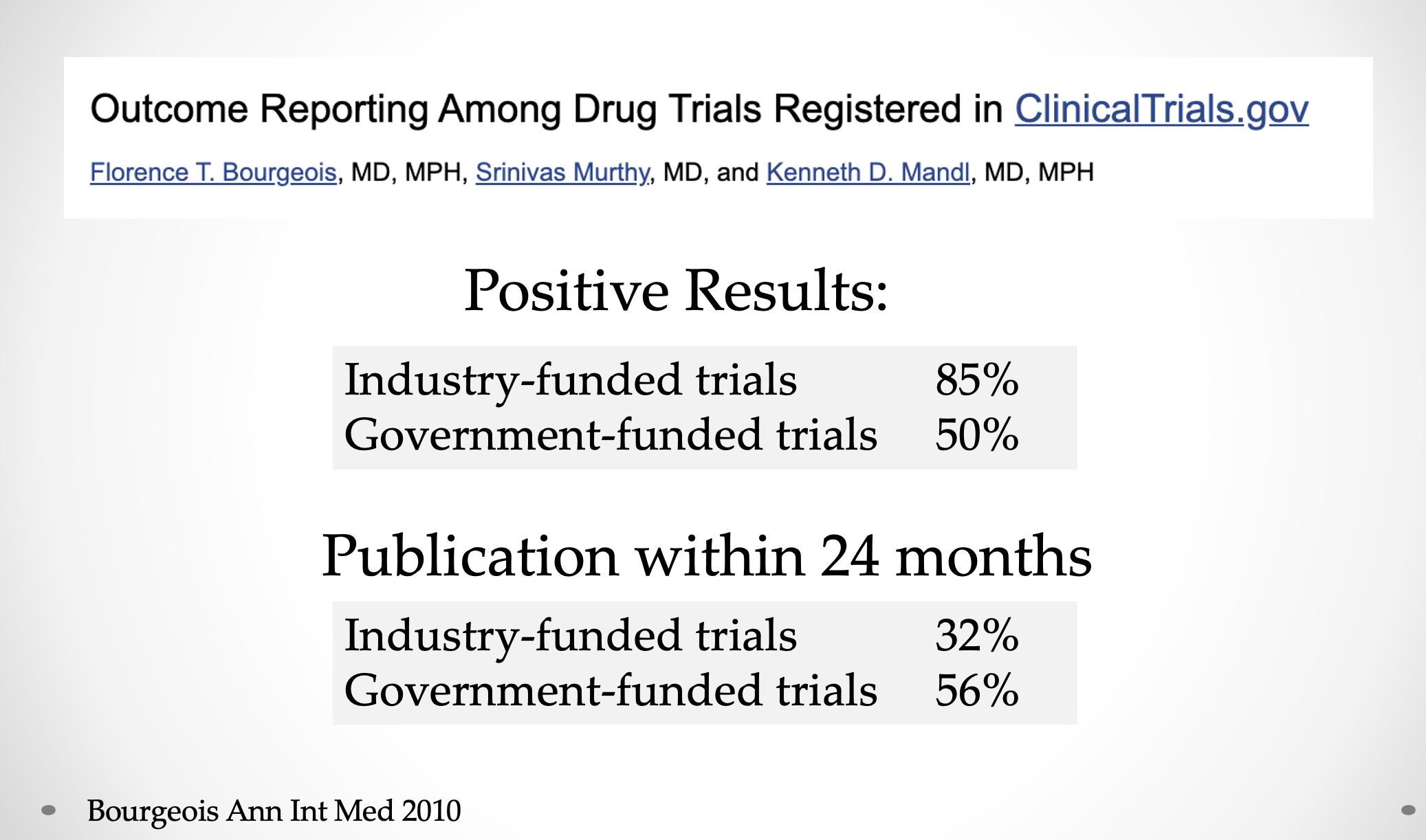
In my lecture in London, I spell out how trial design guaranteed positive results of the three trials.
One glaring example was in the TRILUMINATE trial of tricuspid valve clipping vs meds in patients with severe tricuspid valve regurgitation. One group got an invasive procedure with the clipping tool and one group got only meds. Patients knew their treatment. Imagine being in the meds group. Your brain thinks…crap I didn’t get the best option.
The primary endpoint included hard endpoints like death and heart failure and soft endpoints like a quality of life questionnaire. The results favored the invasive procedure but only on subjective quality of life measures. This design, of course, fails high school science because it ignores the placebo effect.
What bothers me most is that EVERYONE involved in TRILUMINATE knew this and went ahead with the trial anyways. It so happens that tricuspid valve regurgitation is super common. So the gain to the company that makes the clipping tools and the doctors who do the procedure are enormous.
The easy solution would have been to have a sham arm where one group had a placebo procedure. As a potential patient some day, this is the trial I would want. Because I believe there probably are a select few people with severe valve disease who would benefit. But with a biased trial, we will never know.
Non-industry funded trials, on the other hand, are far more likely to be done to answer a question.
Dr Morgan’s REVIVED BCIS2 trial, for instance, studied hard outcomes in two strategies (stents or meds) for treating patients with severe coronary disease and left ventricular dysfunction. Most of us believed these patients should have their blockages stented to improve blood flow to weak heart muscle. Yet the cardiology community was surprised, no shocked, that simple medicines performed as well.
The Solution for You and I
If we lived in an ideal world, all trials of new therapies would be conducted by independent research teams. That’s unlikely to ever happen.
So, I would propose the following specific approaches:
Start the evaluation of a trial with an open mind. You know industry exists to make a profit. This is normal. It does not (always) equate to a biased trial.
Evaluate the trial design and procedures in a neutral manner. In the seminal ICD trials, one group got an ICD and the other group did not. In the end, they measured the number of people who died. That’s mostly free of bias. The trials were positive and led to increased use of the ICD. Since it saved lives, both industry and society won.
After looking at the design and procedures of a trial, consider the authors’ conclusion. Did they stay true to the primary endpoint? Or did they employ spin—distraction from null results on the primary endpoint. RITA 2 was the whopper of all examples of spin.
The more global general approach is:
To become better consumers of medical science. This is the goal of Stop and Think. It is the goal of Sensible Medicine. And the This Week in Cardiology podcast.
I did 8 procedures yesterday. All of them were easier and more likely to help patients than procedures I did 10 years ago. Industry innovation is largely responsible for these advances. So industry is not bad. We want industry to innovate; profits are not an enemy of medical science.
Yet we are Bayesians. Profit motive is a prior we must consider in the evaluation of a trial. But the prior is only a prior; the main question is the nuts of the bolts of the actual trial.
Appraisal of evidence is not a speciality. Not being bamboozled is one of the main jobs of the modern clinician. It is a lifelong pursuit.
No posts
Comments
Nothing yet. Say the first thing.
Sign in to join the conversation.