
May 1, 2026
I start with a confession of sorts: I named my newsletter Behavioral New World as a riff on Brave New World. I’m not sure that anyone has ever gotten the reference. Marketing is obviously not a strength of mine.
My first post, on May 1, 2020, was titled “Confirmation bias and the coronavirus” (as Covid was known then). Confirmation bias is the tendency we have to be open to information that confirms beliefs that we already have, while being resistant to information that does not support those beliefs.
I selected the topic because I perceived a polarization of beliefs about issues such as social distancing, lockdowns, quarantines, travel bans, and the efficacy of masks. I did not take a position on these issues but did suggest trying to keep an open mind, an approach I call “epistemic humility” in a later newsletter.
I decided that the newsletter would be monthly. I have made some mid-month posts, some of which relate to behavioral economics, some not. This newsletter is the 88th Behavioral New World post. As a subscriber, you have access to all of them.
On this six-year anniversary, I’ve decided to discuss an academic paper of mine. Among my publications, it is one of my favorites and continues to be cited nine years after its publication. “Old Age and the Decline in Financial Literacy” was published in the journal Management Science. It was co-authored with Michael Finke and Sandra Huston.
The title gives away most of the story—our financial literacy declines as we age. This finding explains the results of earlier studies, one of which reports that “even the healthiest of elders showed profoundly compromised decision-making…” (link). And it explains why scamsters often target the elderly.
Another contribution of my paper is shown in this graph, courtesy of a TIAA webinar on February 28, 2025:
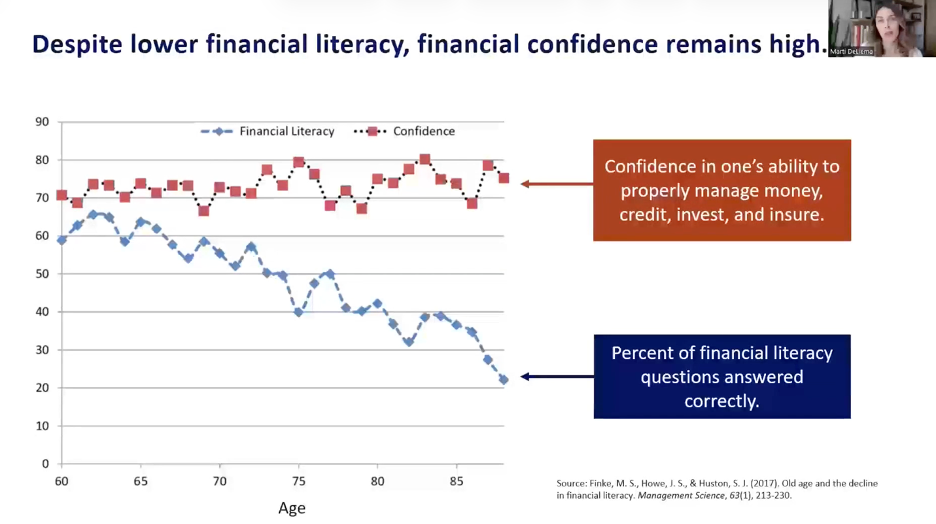
Ugh, doubly bad news: As we age, our financial skills decline, but our confidence in them does not (and arguably even increases). That’s a potentially deadly one-two punch for financial well-being, particularly for retirement.
In each of my behavioral economics newsletters, I provide ideas about how to mitigate distortions to our decision-making that stem from a particular bias.[1] My initial suggestion in all cases is to be fully aware: 1) that the given bias exists, and 2) that all of us are susceptible to it. Only with those premises accepted can you move on to grasping a bias by the lapels and wrestling it to the mat.
In the case of age-related decline in financial literacy, a largely automated investment strategy, such as investing in target-date funds, removes much of the decision-making. More generally, I’m a fan of passive investing, regardless of age (see my book The Foolish Corner, available on Amazon).
Another tactic would be to delegate financial decisions to a trusted advisor (who is presumably younger 😊). It is hard to say with high confidence at what age this transfer of responsibility should take place. Looking at the graph, the falloff in financial literacy starts in one’s early 60s. But keep in mind that there is individual variation around the averages shown in the graph, so earlier might be best for some people while others can wait a bit longer.
Based on their years of experience, the elders in society often find a positive role dispensing wisdom to the young. But be wary of financial advice from your grandparents, no matter how financially successful they’ve been!
[1] One might argue that the decline in financial literacy is not a bias. But it clearly affects decision-making, an umbrella that includes behavioral economics.
No posts
Comments
Nothing yet. Say the first thing.
Sign in to join the conversation.