

Once again the ranch is in a state of low-grade chaos, with brother against brother, alpaca against alpaca, and the chickens henpecking everyone. Some of the herd have become big fans of a show called Louder With Crowder, a mix of comedy and politics hosted (usually) by comedian Steven Crowder. It’s sort of Jon Stewart for conservatives, but without the nice suits and prized late night time slot. It’s the twenty-first century and the guys in the logo T-shirts are now the Republicans, while the secret lair under the volcano has been sublet to a cabal of Democrats. It’s truly a world turned upside down.
Mr. Crowder was out of the office recently having his funny bone replaced, which is apparently located in the rib cage rather than near the elbow as was previously believed. During his absence the T-shirt tiki torch was passed to an associate, who covered a topic disturbingly dear to the alpacas—the war in Ukraine. Apparently grazing contentedly all day is boring so they’ve taken up studying geopolitics, with the exact result one would expect from a species of herd animals. Regardless of whether they even understand the question they all either agree or disagree strongly about the answer. They also all have accounts on X (which they still call Twitter) so by default they are Experts On Everything.
The unanimity of the herd has been destroyed, however, by one of the claims made by the host pro tempore. According to him “Russia is suffering 30 to 45,00 casualties per month for no gain.” This number is far in excess of reported Ukrainian casualties in a war now dominated by artillery and small drones. That’s somewhat hard to swallow given even the Ukrainians admit the Russians build many times more shells, drones, bombs, missiles, and everything else that blows people up than they do.
We may be skeptical, but the folks at Louder With Crowder have provided a list of references for all key claims made in their show (as is their custom), and two of those address this topic. So today we’re doing another round of Check the References to see if Crowder’s team is any more circumspect than a typical university professor. Based on a quick set of quotes shown on the screen the claim of 30 to 45,000 per month comes from an estimate of 1,000 to 1,500 casualties per day (the highlighted bit on the lower right side).
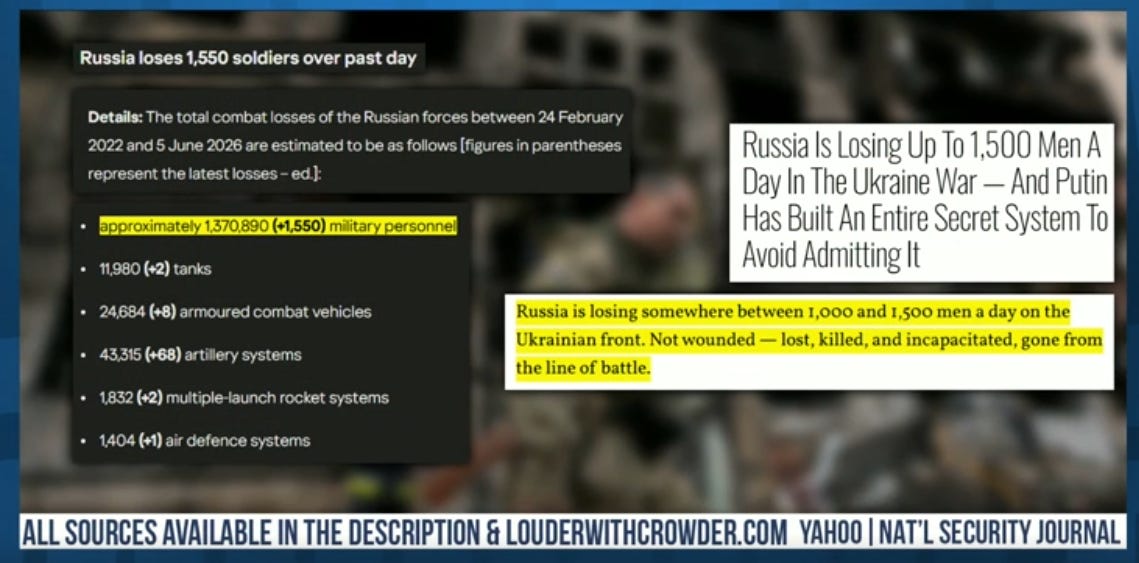
The loss numbers on the left of the screen come from a June 4, 2026 Yahoo! News story titled Russia Loses 1,550 soldiers over past day. This is a list of estimated losses for a single day, and the screenshot leaves out the part of the story where their source is listed. Here’s the relevant quote from the Yahoo! News article:
Russia has lost 1,550 soldiers killed and wounded over the past day, bringing its total number of personnel losses to 1,370,890.
Source: General Staff of the Armed Forces of Ukraine on Facebook. (Diakonov, 2026)
This isn’t helpful at all; the 1,550 casualties is a claim for a single day rather than a daily or monthly average. As explained further down in the article, the 1,370,890 total casualties covers losses from 24 February 2022 to 5 June 2026. This is 1,562 days (per this online calculator) for an average of 878 per day. The source for this is the Ukrainian armed forces, who per our understanding are the guys fighting the Russians. The Public Relations office of one side’s military is not, to be blunt, a valid reference for the losses of the other side. The alpacas aren’t very bright, but they do understand the idea that one side might want to exaggerate the losses of the other side or minimize their own.
This first reference isn’t really a news story at all; it’s just Yahoo! News posting numbers from the General Staff of the Armed Forces of Ukraine without comment or independent verification. We could ask the Russian military the same question and would no doubt receive the same answer, but in reverse. Even grazing livestock can tell the difference between a reporter and a stenographer, and this is the latter not the former. At least the Yahoo story gives a link to the original source, the Facebook page of the General Staff of the Armed Forces of Ukraine. Welcome to modern war, where Facebook is our primary source for key battle data. We’ll know when the nukes come because Aunt Betty’s status will change to “irradiated.”
The other reference was much more fun to check. The link provided on Crowder’s website is to a story in the National Security Journal with the title shown on the screen: Russia Is Losing Up to 1,500 Men a Day in the Ukraine War — and Putin Has Built an Entire Secret System to Avoid Admitting It (Latham 2026). Unfortunately for the morbidly curious, the Latham article doesn’t really explain the second part of its title about the system to hide casualties. The alpacas were expecting gruesome stories about giant cremation ovens or hidden graveyards in the frozen tundra of Siberia. However the “system” being described is just the several different recruitment paths being used, and the writer implies using these various tools is a mechanism to hide enormous casualty numbers.
The referenced article is really just about the recruitment mechanisms and is not an analysis of battlefield casualties. The quote used by Team Crowder is the only mention of total casualty numbers, but it does at least include a link to its source.
Russia is losing somewhere between 1,000 and 1,500 men a day on the Ukrainian front. Not wounded — lost, killed, and incapacitated, gone from the line of battle. (Latham 2026)
Luckily the alpacas have mastered the hoof dexterity necessary to click an internet link, which led us to a data brief from the Center for Strategic & International Studies (CSIS) titled “Russia’s Grinding War in Ukraine” (Jones & McCabe, 2026). That report doesn’t actually provide a per-day or per-month number of casualties so it’s not clear where Latham obtained his 1,000 to 1,500 per day estimate. The CSIS report lists total casualties (dead and wounded) for the war through December 2025, total casualties for just 2025, and the total of just fatalities through December 2025.
Assessing casualties and fatalities in wartime is difficult and imprecise, and various sides have incentives to inflate or shrink the numbers for political purposes. According to CSIS estimates, Russian forces suffered nearly 1.2 million battlefield casualties, which include killed, wounded, and missing, between February 2022 and December 2025, as highlighted in Figure 2. There were roughly 415,000 Russian casualties in 2025 alone, with an average of nearly 35,000 casualties per month. In addition, there were roughly 275,000 to 325,000 Russian battlefield fatalities between February 2022 and December 2025. (Jones & McCabe, 2026)
We went back to that handy online calculator and found from 24 February 2022 to the end of December 2025 is 1,406 days. Dividing this into the 1.2 million casualties number from CSIS gave us an average of 853 casualties per day. If we just look at the estimate for 2025 (and taking the 415,000 number at face value) we get about 1,137 per day for that whole year.
Alpaca wool isn’t itchy but we’re still scratching our heads trying to figure our where Latham found his 1,000 to 1,500 estimate, because it’s not directly in this data brief. Our best guess is that he used alpaca math and rounded 853 up to 1,000. Alternately, he may have decided to split the difference between the total for the whole war and the total just for 2025 and arrived at 1,000 per day. Who knows? We have no clue about the 1,500 number since nothing in the CSIS report he links to supports it. Perhaps he also saw a Yahoo! News story, or simply felt this was a reasonable upper limit. Latham doesn’t explain, he just drops the numbers like a Monaco prostitute quoting hourly rates.
The CSIS report at least has some numbers in the correct range for the lower end of the claim, but where did they get their estimates? Of course (we note with sarcasm) the data brief itself isn’t the original source for the casualty figures. The CSIS quote above has three distinct claims, and each includes a footnote. All three notes have exactly the same wording, and the second is the only one to include a link to a specific source. According to all three their sources are:
CSIS estimates; UK Ministry of Defense; analysis of data collected by Russian news outlet Mediazona and the BBC Russian Service; and interviews with U.S., European, Ukrainian, and other government officials. (Jones & McCabe, 2026)
We were of course expecting something sensible, like a reference to other reports generated by CSIS where they show how these numbers were calculated. What UK report? Which BBC or Mediazona news stories? This footnote is basically “trust us, bro” from people who refuse to show their work.
So we have no idea how Jones and McCabe compiled their numbers, and they have given us almost nothing we can use to verify their claims. Once again the Ukrainian government is one of the listed sources, making us suspect they’re the original source for all these claims. The single link the authors provide is at the end of the second footnote, and like the puck in a game of Link Hockey we’re off to yet another source. That source is a campaign assessment by the Institute for the Study of War (ISW) titled Russian Offensive Campaign Assessment, December 9, 2025 (ISW, 2025). Anyone expecting this reference to be useful will be disappointed—the word “casualties” only occurs twice in the entire assessment, in a paragraph near the beginning.
ISW has observed evidence to assess that Russian forces have seized roughly 4,669 square kilometers since January 1, 2025. Data from the Ukrainian General Staff (emphasis added) indicates that Russian forces have suffered a total of 391,270 casualties in that time – or about 83 casualties per square kilometer. (ISW, 2025)
The only listed source from ISW is the Ukrainian General Staff, so we’ve circled all the way back to the other side’s propaganda office for data on Russian casualties. The ISW assessment itself is an overview of the campaign, not an analysis of battlefield casualties, and makes no attempt to verify the Ukrainian claim. The 391,270 casualties in the ISW report is through December 9, and this became 415,000 total casualties in 2025 in the CSIS report. Naturally no explanation is given by CSIS; once again the alpacas were forced to whip out their giant abacus, and prorating for the remainder of December would mean 416,372 total for the year.1
We’ve checked Crowder’s sources but haven’t found anything to support the claim of 30 to 45,000 per month in casualties—or at least, anything we can verify. The upper end of the daily average just magically appears in one of the sources, and that source’s own reference doesn’t support the claim. The CSIS report gives us a vague list of sources but no raw numbers, no spreadsheet of totals, nothing showing how they arrived at their numbers. For all we know they’re just Facebook friends with the Ukrainian General Staff, grabbing casualty numbers from screens intermingled with recipes for The World’s Best Pound Cake.
In fact all the casualty claims come filtered through a series of sources who appear to be pointing back to the same PR office of the Ukrainian military.2 To be perfectly blunt, what Crowder’s team is reporting are the claims made by the Ukrainian military about Russian casualty numbers, nothing more. At no point have we found hard evidence of an independent assessment by any credible and unbiased source. What we found instead is a kind of source-laundering, where we follow link after link but no specific source providing actual numbers is ever named except one.
We here at the ranch don’t dislike Steven Crowder—he’s a funny guy. But his assertion about backing up all factual statements with references is not really accurate. The casual watcher, confronted with the long lists of references provided for each show, may be impressed (or intimidated, depending). Few of the more skeptical viewers will have the time to check every one of these references to see if they actually support the claims. In this example a claim from a dubious source has not only been passed along as verified truth, the number has also been stretched slightly beyond the claims of the original sources.3
If this is typical of the sourcing used by the show then they don’t really have useful sources at all. Repeating this process for every claim would mean hours of reading to verify the claims from each show, which (again, if typical) would mean it’s not a useful source of information. There’s noting inherently wrong with that, but in the end it’s no different from The Daily Show (the funny Jon Stewart version, not the terrible Stephen Colbert version) in that facts and sources can be used selectively to paint whatever picture they wish.4 It’s sometimes entertaining, but it’s not news. We should all take care to recognize the difference.
From 1 January to 9 December 2025 is 343 days, so 391,270 casualties in 343 days is about 1,141 casualties per day. Using this to estimate the remaining 22 days in December gives 25,102 additional casualties, for a yearly total of 416,372. Hey CSIS, was showing that so hard? You put in a footnote but left out your own calculation.
As a little historical side note, at the Battle of Verdun in 1916 the Germans thought they were crushing it because they recorded so many different French units being put into the front line. Clearly (they thought) they were inflicting huge casualties on the French army. What was really happening was the French were rotating units through the front line (the battle lasted almost ten months) to both give soldiers experience and to prevent them from becoming exhausted and therefore ineffective. Is this happening again today in Ukraine?
The highest daily average we can reasonably calculate from the Ukrainian data is 1,141 per day for 2025 (from the ISW report, see footnote 1 above). Expressing this as “between 1,000 and 1,500 a day” implies a daily average of 1,250, or about one hundred more than the original claim. If we average Crowder’s monthly claim of 30 to 45,000 casualties (37,500) we get 450,000 per year, higher than the 415,000 per year claim from CSIS. This is how propaganda works, slowly inching the numbers up every time they’re repeated.
It pains me to admit this, but one could argue Jon Stewart’s The Daily Show was slightly more honest by not thoroughly providing sources. The addition of sources adds a layer of legitimacy to the presentation on Louder With Crowder, which—as this example has shown—may not be fully justified.
No posts
Comments
Nothing yet. Say the first thing.
Sign in to join the conversation.