
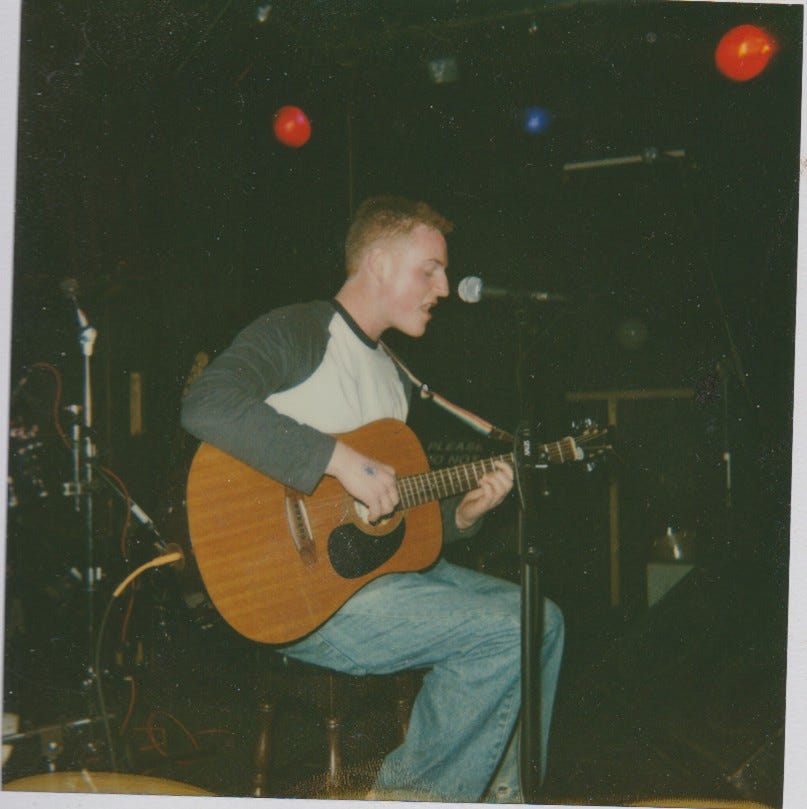
Image: Me gigging in central London as an undergraduate about five minutes ago in the early 2000s
As a man now in my mid-forties, I notice young people — especially people in their twenties, because that was me about five minutes ago — and I feel something I don’t especially like.
It isn’t lust, nostalgia, or resentment. It’s envy.
The envy of unspent futures.
What I envy is not youth itself, but the density of open paths that still surround it. The sense that many lives are still available. That one can, for a while at least, revel in everything one might yet become.
I see physical gifts — height, beauty, athleticism — taken entirely for granted, yet quietly conferring value before a word is spoken. I hear voices that carry confidence regardless of content. I see a seriousness about ideals, a clarity of belief not yet tempered by pragmatism or disillusionment. I notice parents who know how institutions work and explain them casually. A place at a prestigious university that opens doors and will forever illuminate a CV. Someone entering a field just as it is emerging or expanding — and I find myself thinking that if I were twenty years younger, I might have pivoted that way myself.
I notice friendships that emerge spontaneously and assume permanence without needing to be secured or worked at. I watch people start an evening tired and end it energised. I see roles emerge organically in group play. I see people become briefly best friends with someone they’ve just met. There is emotional elasticity — feeling deeply and recovering quickly. The ability to imagine falling in love and building a life with someone unknown. A spiritual openness not yet disciplined into doctrine or dismissal. Above all, a feeling of being early in a story rather than late.
This envy is not entirely sour. Alongside it, I feel a genuine reverence. The potential of people in their twenties is magnificent — their youth, their promise, their sense of arrival into possibility.
And yet — if I’m honest — I also know something they don’t yet know. In twenty years’ time, most of them will be just as boring as I am.
Not because they will have failed, but because they will have chosen. They will have committed to certain pathways, fulfilled some potentials, and allowed many others to wither on the vine. Much of what is currently possible for them will never be realised. And I must admit to a quiet, morally awkward schadenfreude in this knowing — not out of cruelty, but as a way of tolerating my own losses.
So what do I mean by potential?
I think of it as an unopened box of tools.
A blank notebook.
A forest of saplings that cannot all survive.
Potential is abundance before selection. It is richness before constraint. And constraint, sooner or later, is unavoidable.
Some of this potential has to do with opportunity and environment — particularly for those of us lucky enough to grow up in relatively privileged contexts. But some of it is more basic than that. It has to do with phenotype: our genetic endowment, the nervous systems, bodies, and temperaments we happen to arrive with, and which our upbringing may or may not bring into expression.
These are not achievements. They are invitations. They make certain lives feel easier to step into. And when you’re young, it can feel as though all invitations can be accepted.
When I was fifteen, a film called Gattaca came out, and I became briefly obsessed with it. Its premise was simple and terrifying: a future in which most children were conceived through genetic screening, only the “best” embryos selected, their advantages then amplified by institutions designed to recognise and reward them. Society split neatly in two — the genetically validated and the naturally conceived — with the latter permanently marked as inferior.
The hero of the film is one of these “in-valids,” a man who manages to pass as genetically superior through discipline, self-denial, and willpower. At the time, I recognised myself immediately. I experienced many of my contemporaries as effortlessly gifted — brighter, smoother, more naturally entitled to the future — and I quietly assumed I belonged to the other tier. What Gattaca offered me was not hope of equality, but a different promise: that potential might still be realised through sheer application, that willpower could compensate for endowment.
That fantasy had far more valence for me in my twenties than it does now.
At 44, I have to own that I often feel disappointed in myself. Not a disappointment linked to a bad decision or a morally dubious act, but rather just a general sadness with who I am. Don’t get me wrong, I am proud of what I have built, the life I have chosen, the responsibilities I have taken on. But I also know that this is as good as I get. There may be twists and turns ahead, but the broad outline is visible now.
Potential does not disappear because we are lazy or weak. It disappears because life demands commitment. To realise anything is to foreclose everything else. Potential is not something you either fulfil or fail; it is something you must continuously kill off in order to live at all. What withers on the vine does so not through neglect, but because the organism cannot feed every branch.
There is a strange liberation in accepting that this is as good as I get. Other seeds will come after me. Other lives will carry forward what I cannot.
I embrace the descriptors my children give me — “sappy” “cringe” Daddy. That’s who I am supposed to be. The boring forty-four-year-old is not someone who failed; they are someone who chose repeatedly. And I will continue to choose throughout the remaining decades of my life. In long, healthy, and privileged lives, we may yet get the opportunity to realise different aspects of our phenotype at different times. But never all of them at once.
Meaning does not emerge from keeping options open. It emerges from closing them with care. From committing to a certain life rather than hovering on the periphery of many possible lives. Half a leap falls in the ditch.
It is not our task to live every kind of life, like a tourist ticking items off a bucket list. We are challenged instead to live a certain kind of life, and to live it well — and to feel pride, generosity, and even joy when others live their own particular lives well too.
That, I think, is what potential is finally for: not endless possibility, but the raw material from which a single, imperfect, but evolving and committed life is shaped.
No posts
Comments
Nothing yet. Say the first thing.
Sign in to join the conversation.