
I can see a woman in a waterproof jacket walking down an empty street, past a few shops that have people living in the flats above. The sky is grey, and the streets are grey, and her head is down as she makes her way to an appointment. She’s in her early twenties, with hair that falls straight and unremarkable, and a face that fades into the background unless you choose to notice it.
And the wind is channelled down the street, picking up litter, and then depositing it simultaneously, as the gust dies down. It’s like the street’s breathing, though it may be more accurate to say the street is sighing. The peace is intolerable in a place that yearns for something, almost anything, to happen.
She happens to catch a face in a window above a shop – an old man with his hair combed neat – his face is so close to the glass he must be sat on the edge of his chair, but he’s not looking at her, he’s just looking out. She looks up to him and gently smiles but he seems not to have noticed.
She arrives at a small complex of apartments built by the council to house the elderly – they were built with very little love, all pebble-dashed and boxlike. She walks along through the small lobby of the ground floor and knocks on the door of the first apartment. She’s surprised by how quickly Jean manages to get to the door.
The door opens to a little old lady hunched forwards as it seems she can’t straighten her back, she’s wearing a bright green cardigan.
“Hello Jean,” says Grace.
“Oh hello love! Come in,” says Jean, who has already turned and is walking back into the kitchen, she’s been expecting her.
Grace follows her through Jean’s impossibly small lounge, absolutely full of relics and ornaments – a whole jumble sale of artefacts that the lady has amassed throughout her life. The armchair faces the TV in the corner, alongside the window, and a little gas fire makes the room almost uncomfortably warm, and so Grace takes off her jacket.
Jean is in her eighties now. She once mentioned she had a son but it doesn’t sound like she sees him that often. She manages to look after herself day to day, though the charity is a great help to her.
Today there is a lightbulb that needs changing in the kitchen – and it’s about time too, as she’s not been able to go in there for a couple of nights for fear of crashing into something or having a fall. So Grace stands on a chair and changes the bulb.
But Grace is of most help when it comes to helping Jean get in and out of the bath safely, changing her bed sheets, pushing a vacuum cleaner around. Grace has become something of a favourite amongst the ladies who live in this complex – many ask the charity to send her, and they are disappointed when they have to send out somebody else.
After just three-quarters of an hour, Grace has made such a difference to the apartment, and Jean is delighted.
“Have you got a boyfriend yet?” the elder asks Grace, and she replies that she does not. Jean tells her that she’ll make a good wife for some lucky young man, but Grace just smiles: she doesn’t want anything to do with men, but doesn’t know how she could tell Jean that.
Stepping back out onto the main street it’s raining, and so Grace zips up her jacket. Black clouds rumble overhead and turn everything dark. The street is as busy as ever – every square foot of the paving stone occupied by people passing one way or the other, or stood around looking at ad hoc market stalls, vendors selling watches or mobile phones. Grace does her best to weave around this mass of activity.
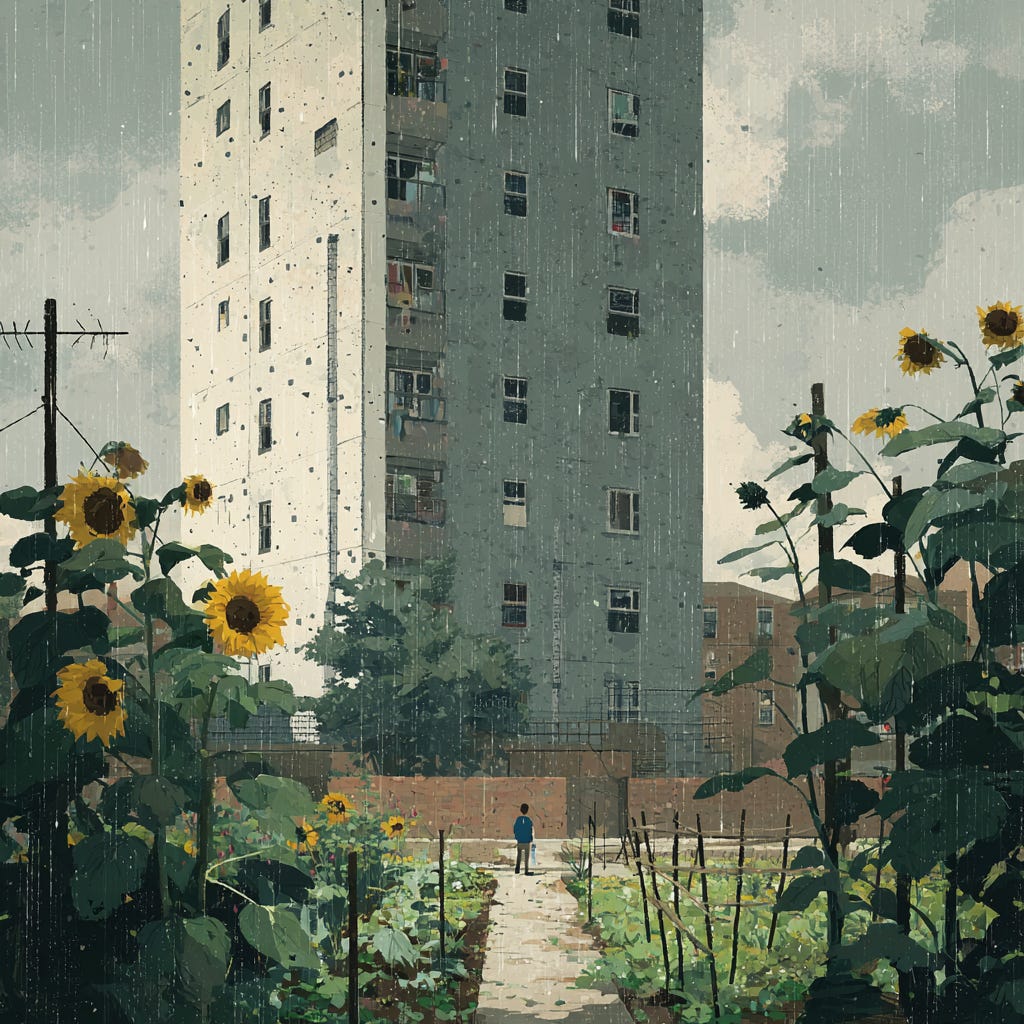
She lives in a tower block. As she walks through the courtyard the wind is howling around the building, as though the building itself is alive and groaning under its own weight. She steps through puddles of rain in the concrete and water soaks through her trainers.
She decides not to take the lift, but walking up the stairwell her steps echo and there is the distinct smell of sour milk. She knows more about this community than anyone else. She knows all the elderly in their residencies, their names and something about their life stories; she knows about the lads who sell gear out of the estate – the police stay away which is just how they like it.
There is a Vietnamese girl about her age, who lives in the same block – she wants to say hello but the Vietnamese girl seems very nervous. She knows the homeless people who sleep in the streets when they cannot get into a hostel – she occasionally takes out sandwiches and coffee, and has helped them find emergency accommodation before.
And she looks out for Julie, the woman living in the flat above, who has learning difficulties, and like Jean, is only barely able to look after herself. And although they barely communicate with one another, to each of them Grace has tried to communicate subtly that she’s there, that their lives are intertwined in some way.
Her flat is on the third floor. She enters into a mostly empty lounge, with windows that look out onto the estate. She picks up her post, and we notice that the letters are addressed to a Grace Wilson. She walks through into a little bedroom with a single bed and a chest of drawers.
She takes off her trainers and her socks, and puts on a fresh pair that are thick and warm. Then she makes herself a coffee, and cupping it in both hands, drinks it in silence, leaning against the work surface. It’s here that we notice for the first time – thin white scars, all the way up both her forearms: there could be hundreds of them.
After finishing her coffee, Grace rinses her mug in the sink and walks through into the lounge. She lays a mat out in the centre of the room, and on top of this she places a cushion. Then she sits cross-legged on the mat, facing her windows that look out into the estate. She closes her eyes and her breathing becomes slower and deeper. She whispers something that we can’t make out. A feeling of peace streams out like music, through the room, out through the tower block and across the tragic landscape.
Grace was a foster child who spent her early childhood being shuffled about from family to family, and whose destiny was really in the hands of her case workers. But between the ages of twelve and seventeen, she managed to settle into a middle-class household not far from here, with two foster parents and another younger boy whom they had also taken on.
They were decent enough people, her foster parents, but her foster father could be a timid and insecure man: he did not get on well with his colleagues at work, and in fact became a bit of a joke to them. Because of his frustrations at work he’d play out these insecurities at home – although he was not once violent, he’d impose silly house rules and bring to book anyone who did not follow them, including lecturing his wife in front of the children.
And both father and mother had nothing but criticism for the two children, whom they did not understand. Grace, probably craving attention and love, was a hypochondriac as a teenager – she’d always have a cold, or feel sick, or have headaches – and each of these she’d report to her foster mother who dealt with them practically, and if she ever sensed the origin of all these complaints, she did not let on.
When her foster mother saw all the scars from where she’d been cutting herself, she didn’t say anything, she just cried, more out of self-pity – “how could she do this to me?” – than out of compassion for Grace. Grace was an average performer at school, who didn’t feel the motivation to go into higher education.
She has thought it strange that her foster parents must have decided at some point that taking on troubled children was something they wanted to do, and yet she never felt much warmth from them – they never felt like a family. Perhaps this was in some ways her fault too; perhaps a part of her always craved to know who her real family were. Other foster families had managed to come together and feel like a real family, although these were in the minority.
Grace remembers being seventeen, and realising with some clarity that nobody gave a damn about her, and if she wanted to survive, she’d only be able to depend on herself. And so she survives. Nowadays when she goes to work she always wears long sleeves. Sometimes she doesn’t show up for work, but her coordinators understand her situation and are sympathetic. Besides, if she lost her job she’d be sorely missed by the elderly ladies.
She does not have much to do with her foster parents anymore, but occasionally returns to make sure her little brother is ok – he’s still living there whilst he finishes college and has no idea what he’s going to do after that.
When she comes out of her meditation, she notices the sound of scratching in her flat. She opens her eyes and without moving, looks across into her kitchen. There is a grey mouse in there, looking for food. She’s got used to sharing the flat with him; has often noticed him running along the skirting board when she’s in bed at night. She’s not frightened of him, and doesn’t feel the need to get rid of him – ‘he’s only surviving, just like the rest of us’.
She gets up and stretches, the mouse quickly runs away.
That night Grace dreamed of endless sheets on washing lines, flapping in the wind. And she was walking through all these, down cobbled streets. She walked into a mill that she thought had been abandoned long ago, and yet inside the machine were going and people were hunched over them. Cotton was threaded through great looms, wheels grinded together and a trap spin and shut, spin and shut, like the great snapping jaws of crocodiles or sharks.
The people at the machines looked like ghosts, their expressions were as one, nobody talking, hands always busy, and some of these were missing fingers. One young woman was missing a whole hand, leaving just a stump – it had been crushed by the machines.
And stood over these men and women were wolves, soul devourers, standing on their hind legs some six feet tall, as though they were people, for they were not always wolves. Somebody challenged her and she turned and ran.
She found herself amongst terraced streets where small children were playing in the gutters. There was rubbish piled up between the houses. A wolf came around the corner, again on its hind legs, and the children fled into invisible hiding places. But for some reason Grace remained, and shouted “I know you! I know who you are!”
The wolf, seeing that Grace was not afraid, fell down again on four legs and fled afraid. And Grace was standing by the door of one of the terraced houses, it was painted red. She pushed the door and it opened.
In one room, huddled together on wooden floorboards, was a man and his wife, and their children. They feared Grace as though she was one of the wolves, but she smiled and sat down next to one of the little girls. She took out a brush and began combing the knots out of the hair of one of the children.
The mother became anxious and tried to get Grace’s attention, but Grace just ignored her. The mother became anxious still and grabbed hold of Grace’s arm, but she continued brushing the little girl’s hair. And then there was this blood curdling scream and the wolves flooded in through the front door, barking and snarling.
Grace awoke in a cold sweat, her heart pounding.
In one of the upstairs flats, next door to Julie, live an Indian family – a father, a mother, and their two daughters. Sameer and Radhika had emigrated to this country when they were very young, lured by the prospect of finding a job and earning more than they could ever expect to back home.
Sameer had come from a family that was greatly respected amongst their peers. He married Radhika, the most beautiful daughter of another family with a similar standing in their community, and all the village saw a prosperous future for them both.
When they announced their decision to move to England, their families were sad to see them leave but they knew it was a good decision – in England they would earn enough money to be able to send back home – the family would be the stronger for it.
And so the young couple saved for a one-way ticket to England, arriving with barely any money to convert to British pounds. Sameer took whatever work was offered to him, and as it turned out, his first job was cleaning school buildings after hours.
He worked hard at this job, and developed his English skills, and in time he managed to take another job with the council, and in this way he managed to work his way up into well-paid employment. Radhika took a few part-time jobs, but she was soon pregnant with their first daughter, and so decided to stay at home to be the dutiful wife.
It seemed in some ways ironic to Radhika that whilst in her village back home she had been the most beautiful daughter of an important family, whereas in England she lived in a block of flats amongst people who seemed to have been shunned by society. They were making money, but she had not expected life in England to have been so drab and dispiriting.
This morning, Sameer had long gone to work, and Radhika leaves the flat to visit a friend of hers in another part of the town. As Radhika is searching amongst her keys for the one that will unlock her car, a gang of young lads come out of the tower.
They talk and laugh wildly amongst themselves and this makes Radhika nervous. She is afraid of these lads because they always have something to say. As the boys approach they are not talking directly about her, but the intention is very much to make her feel intimidated.
It is like the woman is not real to them, just some legitimate figure of fun. As Radhika climbs into the car, one of the boys walks into her wing mirror as though by accident and breaks it clean off. This gives another an idea, and he starts pulling off her windscreen wipers, raising their excitement even more.
Radhika tries to drive away, but the boys stand in her path, she revs her engine, shunting the car forward, but they will not move – they just find it really funny. Everyone in the neighbourhood is now aware that something is going on outside, but nobody dares to do anything about it.
Grace goes to her window to see what is happening and sees Radhika struggling in the car below. Instinctively, she goes straight out of her front door, leaving it swinging behind her.
Julie, the lady with learning difficulties, was set up in the flat by her own group of case workers, who assessed her needs and determined that she would be able to live independently. Julie can do most things for herself including cooking her meals and washing her clothes, and when Julie concentrates very hard on the job at hand, she manages to do most things very well, but if she gets distracted by something then things can go wrong.
On this day Julie empties some soup from a pouch into a pan and sets the gas hob going. But in the other room her favourite television show is starting up – a game show. She drops the pouch and walks hastily into the other room to sit down on the couch in front of the television.
The game show host calls out his favourite catchphrase and the audience, including Julie sat in her front room, respond as one. But in the kitchen the soup is getting hotter and starting to bubble. More dangerously the pouch itself is starting to catch fire. A thin trail of smoke rises silently and wickedly into her kitchen, and pieces of the smouldering soup pouch begin to break off carrying flame with them.
A kitchen towel, draped over the handle of the oven, catches aflame too. And it’s then, that Julie, sat in the other room, can smell the burning. She gets up instantly and runs into the kitchen where she can see flames rising from the oven and the hob. She screams and does not know what to do. We see her frantically searching her kitchen for something, anything that might put out the flames.
As Grace steps down the stairwell, she feels terrified, and does not know what she is going to do when she gets to the bottom. The next few seconds seem to last a great deal longer, and Grace feels like she’s having an out of body experience, it didn’t seem like those were her feet connecting with the steps, or even that she was the one marching the steps at all.
When she comes out the front door of the tower block she continues walking up to the pavement, about forty yards down the road to Radhika’s car. Grace’s legs turn to jelly and she daren’t walk any further. Instead she shrieks – more out of her own fear than anything – “what the hell do you think you’re doing? How dare you do this!”
The boys seem genuinely shocked, as though finally they realise the magnitude of what they are doing, and step away from the car. With that Radhika speeds off down the street. After a couple of moments the gang’s leader recovers and shouts “what the fuck has it got to do with you, you ugly bitch.” The other boys haven’t quite got over the shock but laugh nervously.
Grace is rooted to the spot, but a man leans out of his window in the tower and shouts at the boys to clear off or he’ll be coming down there himself. With that the boys reluctantly take off. Grace is filled with relief, and stands out there for several minutes, trying to get her head around what has just happened. Why had it taken her to go out and confront the boys before other people, like the man in the flat, would back her up? Would that same man have got involved if she hadn’t gone down there screaming?
The boys didn’t realise how serious their crime was until someone was brave enough to stand up and express their horror. That woman, standing out on the street, with the white scars up her forearms, did something small but something transcendent – it triggered a new awareness in the people around her.
As Grace returns to her flat, Julie comes to her in tears to tell her what has just happened in her own kitchen. Grace has still not got over what happened out in the street but finds her composure and goes back up the stairs with Julie with all the compassion she can find. Once they’ve cleaned up Julie’s kitchen, and both recovered a little from their ordeals, Grace asks Julie if she’d like to come help her in the garden, and Julie says that she would.
Grace goes back to her flat, changes her clothes and walks back up the stairs to Julie’s. She helps Julie into her wellies and her jacket, makes sure their flats are locked up, and they walk together down the stairwell, Grace asking Julie if she’s got enough shopping in, and whether her heating’s working ok.
They step out of the building and round to a vegetable patch that runs along a wooden fence. There are five sunflowers tied by string supports to the fence, and each was planted by a different resident in the block. In an otherwise grey landscape, they are an oasis of colour.
Grace had requested the permission to create a vegetable patch with the local council who agreed, so long as they were not responsible in any way for its upkeep. Now they grow carrots and potatoes, which taste all the better when you grow your own. There are pea plants too, also supported by string against the fence. Grace bursts open a pod and puts a couple of peas in Julie’s hand, whilst she pops one in her own mouth too.
“Taste them: they’re sweet.”
Julie gives her approval.
And together, on their hands and knees, they turn the soil with their trowels – it is surprisingly good soil, and fertile too.
“You’ve got soil on your trousers.”
“Have I? So have you!” and the women laugh together.
Pleased to see her smiling, Grace asks: “Are you happy Julie?”
“Yes. Are you happy?”
“I’m happy to be here with you.”
And as they work the vegetable patch, Grace hums a tune, and Julie joins in, and the music streams out across the courtyard and through the estate, meeting the hearts of all that can hear it.
No posts
Comments
Nothing yet. Say the first thing.
Sign in to join the conversation.