
What would it mean to pick a book off the shelves of the eternal library and realise that the entire book was a chronological account of your own life?
You begin reading the pages and discover descriptions of times before you can remember — of your mother and father as young adults, perhaps even younger than you are now, caring for a baby. And that baby is you, with your peculiar patterns of eating, sleeping, care-seeking.
As you move through the pages, you reach scenes from childhood — details that you start to recognise, memories that come flooding back. Then adolescence. Early adulthood. The pages become more contemporary, describing times that still feel recent. And then, eventually, you reach the page that represents where you currently are.
There are still pages left — a great many, if you’re lucky.
Would you carry on reading?
What would it mean to read all the way to the end?
And then — imagine picking another book off the shelf. This one is a parallel life to your own: someone born on the same day as you, perhaps on another continent, described with the same chronological detail. Look up for a moment at this library, which contains a book for every human life that ever was and ever will be.
How stupendously vast it would be.
Would it help you appreciate that each book contains an equal richness to your own — and that your life, though unique, is a single event within a vast epochal tapestry?
Recurrent Lives and Coloured Threads
Do you believe in reincarnation?
If you do, which parts of you recur — and which belong only to this current life? Perhaps there are elements you believe are essential, and others you consider superfluous. How do you decide?
Maybe your book has a coloured hue that the others don’t. What colour would that be?
If you wandered through different aisles of the library — backward into history, or forward into the future — might you find books sharing the same coloured hue? Could those hues mark the parts of you that have recurred through successive generations?
If you were to pick one of those corresponding books from the shelf — the one with the same hue as your current volume — what themes would you recognise within it? What repeating patterns, obsessions, or callings?
Letters Through Time
At the dramatic end of Back to the Future Part II (1989), the DeLorean is struck by lightning and vanishes, apparently destroying Doc Brown. Moments later, a stunned Marty McFly stands in the rain in 1955 when a Western Union courier arrives with a letter — astonishingly dated 1885. The letter, perfectly preserved for seventy years as per Doc’s instructions, reveals that the lightning bolt sent him back to the Old West. Doc explains that he’s safe, living as a blacksmith, and urges Marty not to attempt a rescue.
If you could entertain the idea of a recurrent you, living in future generations, what might you write in such a letter — a message meant to reach them? Something that might help them remember?
Perhaps we already do this when we write books, poems, songs, or make art — attempts to communicate through time to those who share a certain kinship with us. To those who have ears to hear and eyes to see.
And just as we send messages forward, what has already been received by you from previous generations — communications from kin, passed through the infosphere?
The Tapestry of the Infosphere
Our mental architectures are built from ideas transmitted through generations. Yet we fall into the illusion that our minds are independent — that we think our thoughts into existence.
However, the infosphere is our common inheritance: upheld, developed, and passed on as each generation lives and dies.
The infosphere contains all encoded information transmitted across generations: genetic sequences (DNA), books, maps, films and recordings, music and songs, spoken language and conversations, cultural practices and rituals, scientific data, and digital media — all forming a cumulative, intergenerational repository of information.
Important to this thesis, the infosphere contains templates: idealised images of recipes, gardening techniques, musical manuscripts, and architectural blueprints which are applied again and again, like a cookie-cutter being applied to a sheet of dough. In this sense then the infosphere is equivalent to Plato’s Realm of Forms. The idealised non-local is applied to each new local context in space and time.
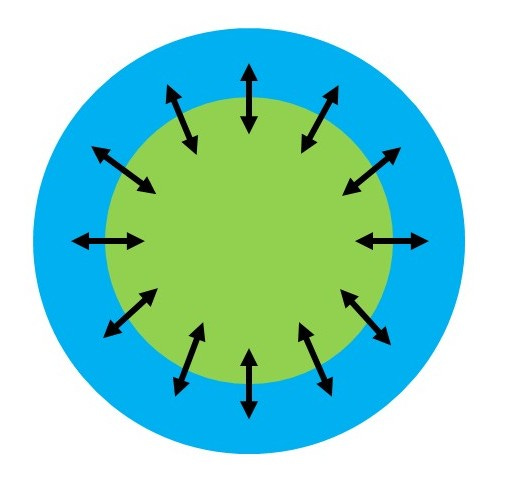
This diagram represents the relationship between the biosphere (including human civilisation), in green, and the infosphere, in blue. The infosphere is the source of non-local information which shapes spatiotemporal incompleteness – the conscious closing of gaps – across local contexts. However the relationship between the biosphere and the infosphere – and therefore the local and the non-local – is reciprocal. The biosphere shapes the infosphere, and the infosphere shapes the biosphere.
Each contributor to this heirloom tapestry — each individual weaver — is mortal, yet the infosphere itself has structural immortality. Within its vast weave, there is an echo of every mortal life.
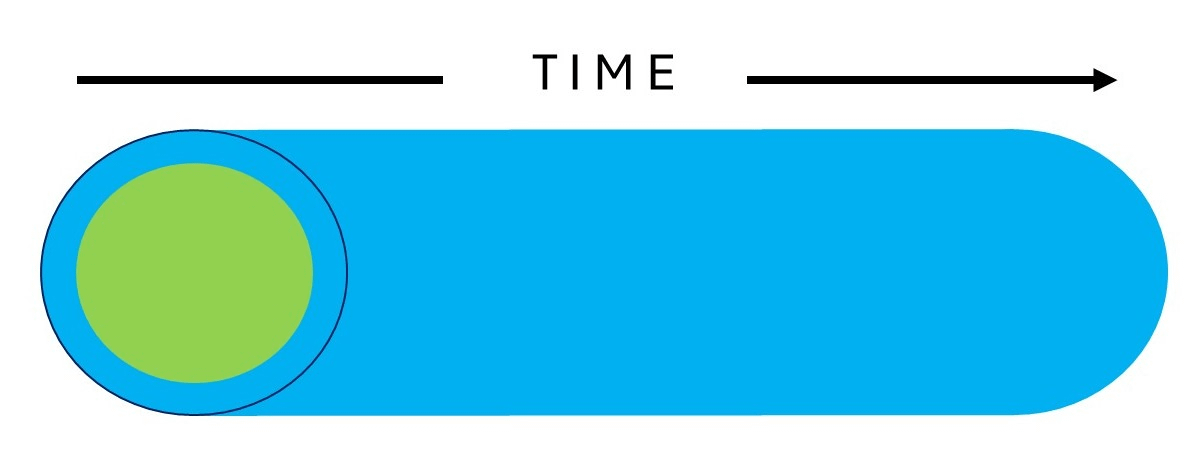
This diagram represents the relationship between the biosphere and the infosphere – the local and the non-local – through history. As mortal lives arise and fall within local contexts, the structurally immortal tapestry continues uninterrupted, received and passed on by each generation.
The infosphere can thus be imagined as a vast world-mind in potential, which gave rise to our limited, mortal minds in motion. Each individual mind is a fraction of the infosphere — the part we are temporarily working on.
An Experiment in Awareness
As an experiment, try jotting down the thought content that’s just been swirling through your mind.
If you trace its origins, you’ll find that every fragment was born outside the self — inherited, witnessed, internalised, or evoked.
Behind the personal moves the transpersonal.
For a moment, you are simply processing the infosphere — working on what has arrived, shaping it, and feeding it back into the world.
Information thus processed is returned upward into the infosphere — completing the reciprocal exchange.
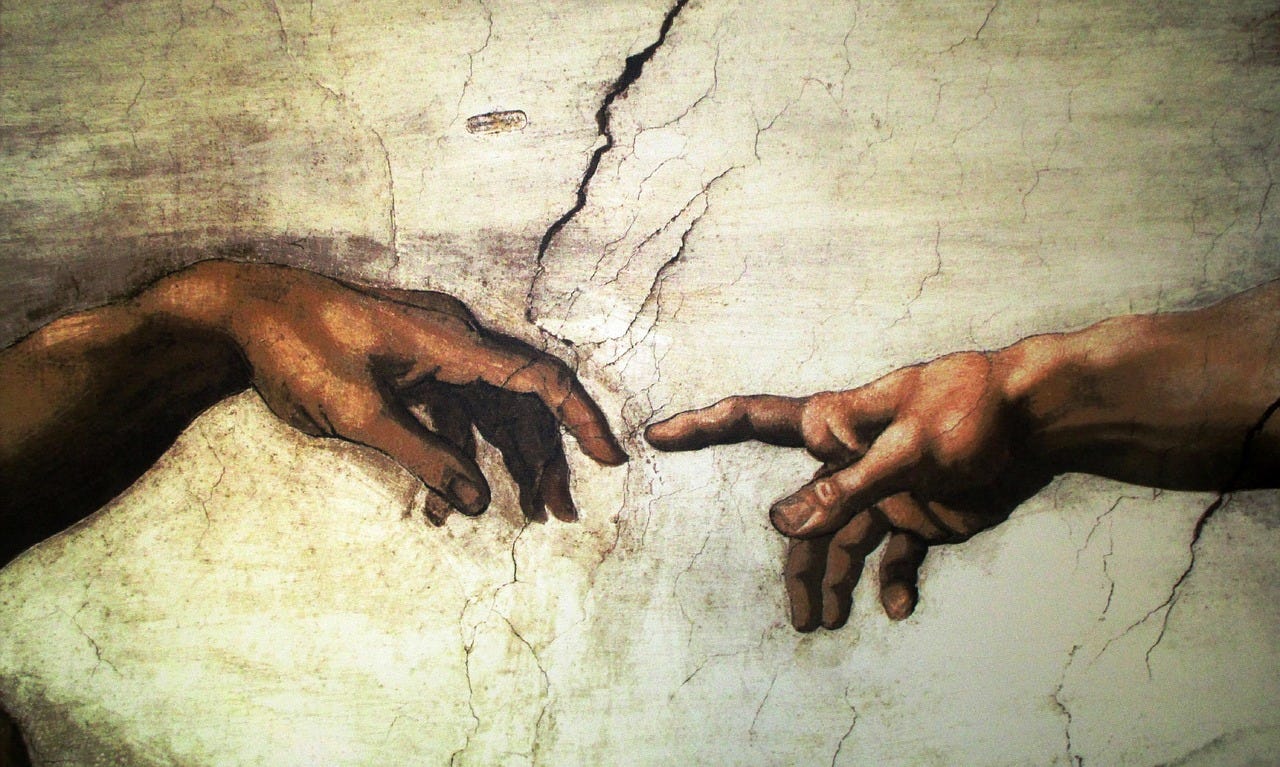
In the sense that it is ‘above’ us, it is our collective Sistine Chapel, making each of us a Michelangelo.
No posts
Comments
Nothing yet. Say the first thing.
Sign in to join the conversation.