
The adage that a politician or business leader might know “the price of everything but the value of nothing” has been on my mind these last two weeks. But it doesn’t quite fit the situation we are in at the University of Exeter as senior managers seek to make more than 150 members of staff redundant. Almost all subjects in humanities and social sciences are expected to lose 20-50% of their academics. Behind these percentages lie many individuals who are at risk, anxious, and in some cases afraid.
Senior managers don’t claim that they know the price of everything but that some things which can be priced provide sufficient evidence to assess the overall value of people and disciplines to the organization. The law allows them to do this provided they “consult” and are fair and non-discriminatory in how they oversee the process. Beyond these legal requirements, managers will repeatedly insist that they recognise how difficult the process is and the anxiety felt by staff, directing us to various online and external counselling resources.
This kind of legalised and therapeutic care for staff wellbeing is quite a feature of the secular age. Perhaps we should appreciate it. Yet despite the evident attempt to treat affected staff humanely, I think most of us are struck by the overall lack of humanity in the process. Anyone who has been through a redundancy process will recognise much of this.
Certain things stand out immediately. Managers reading from scripts in Teams “town hall” online meetings to announce the cuts. The crude 0-3 metrics used to assess staff with unclear scoring criteria. The individualisation of assessments, belying the fact that we work collegially and in groups. The fact that the whole process wholly discounts our system of academic leads advising their peers. All of this adds up to an apparent attempt to engender a Squid Game type competition between staff rather than collegiality and support.
At this point a dose of pragmatism is required. I am not denying the importance of balance sheets, strategic planning, performance management systems, and standardised HR processes. It may also be perfectly reasonable to reduce the size of humanities relative to sciences and medicine in which government is investing. My concern is how this is done and whether this gives due regard to the humanity of persons which I, as a Christian, believe are imago dei – made in the image of God.
The university’s own actions suggest this is not the case. They claim to have used workload model data (SWARM) to identify excess capacity despite having previously stated it was only “indicative” and its many inaccuracies didn’t matter. They repeatedly denied that our “Curriculum for Change” process which required that the number of modules were dramatically reduced, co-taught with a colleague, and made less specialised was not about paving the way for job cuts. They have opted to go for rapid, deep, and damaging cuts to successful departments rather than a longer-term process of shrinking these departments.
Most strikingly, despite healthy application figures in most departments, they appear to be making a bet that student and research council interest in the humanities will shrink – even though many feel that technological change may mean subjects which help us reimagine our humanity will be more valued in the future. It’s a gamble based on dodgy data and questionable assumptions.
But perhaps most indicative is what’s not valued by this process and what cannot possibly be modelled. This hit me when I was advising a colleague who was considering taking voluntary redundancy. This person is one of those excellent colleagues who puts far more work into teaching than can be measured in a workload model and who often steps up to support colleagues. Their decision was largely based on a perception that such collegiality is not really valued anymore and a desire to avoid competition with colleagues.
Despite being saddened by my colleague’s decision, I was encouraged by the fact that colleagues are still thinking about collegiality even if the university is not. The survival-of-the-fittest mentality which the whole process appears to be designed to elicit has not (yet) kicked in.
This is especially clear in the collective organising taking place to oppose the cuts. Extraordinary solidarity is being shown with mercy to the most vulnerable. Dark humour is being shared. Creative approaches to resistance are emerging from a love of human foibles. We are spending more time with each other than we have for some time. There’s nothing like a common enemy to spur collective action.
Of course, it’s not yet clear whether we will be able to reduce or reverse the cuts. But true hope is not found in achieving certain instrumental goals, even if those goals are for the common good.
In the book of Lamentations (3:21-25), it says that true hope is renewed every morning in the steadfast love and never-ending mercy which comes from God. Our hope is nurtured in being loving and merciful to one another. Right now, we are clinging to hope in the face of an uncertain future. But we have help. “The Lord is good to those who wait for him, to the soul that seeks him,” says the writer of Lamentations.
It is not just Christians who believe that while some things need to be priced, we find value in those things which are immeasurable. A great deal of the value of the humanities is found in expressing the inexpressible and accounting for the unaccountable. No redundancy process can properly assess the value of those things.
This is a write-up of a short reflection given at the Mary Harris Memorial Chapel at the University of Exeter on 9 July 2026.
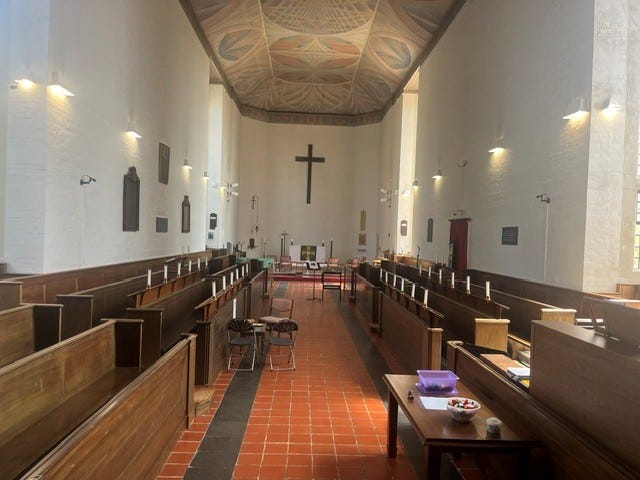
Image: the Mary Harris Memorial Chapel before a prayer service, 9 July 2026
No posts
Comments
Nothing yet. Say the first thing.
Sign in to join the conversation.