
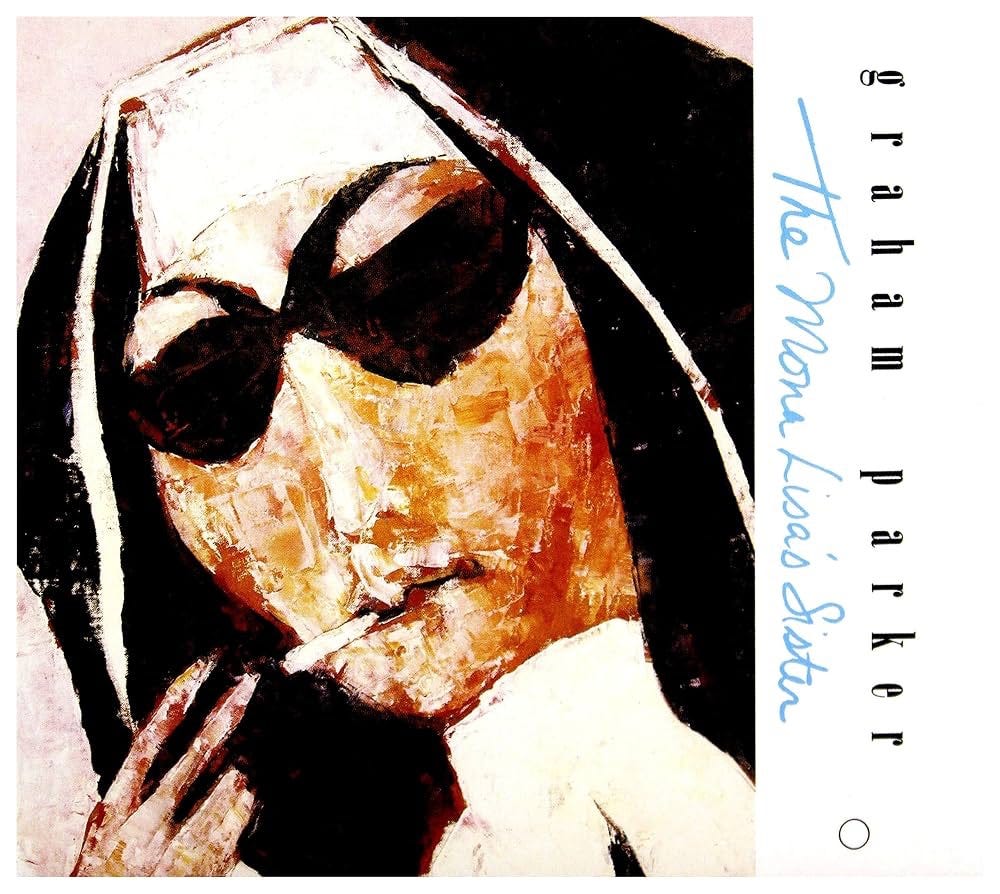
The Mona Lisa’s sister doesn’t smile,
She tried to pose but only for a while.
Leonardo sent her home,
Since then she has lived alone,
With her few belongings and a copy
Of a painting of herself unhappy,
She is going to burn it when she’s ready.—Graham Parker, “Get Started, Start a Fire”
I don’t typically associate music that is important to me with a particular time or place; rather, my relationship to it changes and develops through time, and though I may recall when I first heard it and my initial response to it, I try to listen with fresh ears in the present.
Recently, however, something (I don’t recall what it was specifically) triggered a melody in my head and the lyric “the Mona Lisa’s sister doesn’t smile” from Graham Parker’s 1988 album, The Mona Lisa’s Sister, and suddenly I had to hear this record again. It immediately transported me to a particular time and place with a remarkable vividness. 1988. Raleigh, North Carolina. The CD Superstore. Jennifer and Brad. (No, not that Jennifer and Brad.) Navy blue company polo shirts. Carbon copies of credit card receipts.
By the late 80s, Graham Parker was already a well-established artist, but I had never heard of him before this CD arrived at the store. I had gotten a job at the CD Superstore largely thanks to my promise that I would be able to curate the fairly extensive classical music section. After all, I was bound for Chapel Hill in the fall as a freshman music major. To be honest, this was something of an exaggeration of my expertise; while I certainly knew more about classical music than the other employees, my knowledge was mostly limited to my father’s vinyl collection and its liner notes. Remember, this was decades before streaming or digital downloads, and so collecting music was an expensive prospect.
The CD Superstore at the time was a relatively new kind of business, which is now, almost four decades later, obsolete. It was dedicated entirely to CDs, with no vinyl records or cassette tapes in sight, even though the new format was just beginning to catch up with its analogue predecessors in terms of sales. With that in mind, the store sold CD players as well as the CDs themselves in order to promote interest in the shiny little discs.
There were certainly advantages to the CD over the vinyl record, especially in terms of portability and durability. The classical CD section, however, was an interesting case, because record producers had not yet mastered digital recording techniques, and so many recordings from this era have a glassy, unnatural quality. If you go back now, with the benefit of hindsight (“hindhearing”?), many recordings from the 60s and 70s sound much better.
In the store, however, we played mostly pop and rock, as one would expect, and any of the CDs that we opened up to play in the store, we were allowed to check out and take home after our shifts, with the idea that we would then be better informed in order to make recommendations to customers. We also had a policy that we would open any CD to play in the store at the customer’s request.
After hearing Parker’s new album for the first time in the store, I took it home and dubbed a cassette of it—a cassette that stayed in my car for several years and got played probably hundreds of times before it finally wore out some time in the mid-90s. As a result, this album stayed frozen in time for me, since I never bought a CD copy, nor did I follow Parker’s subsequent career or see him in concert. I had so many other musical interests that I simply never followed that path beyond this single album.
But what an album. When I played it recently, for the first time in decades, it still sounded fresh, a veritable clinic for songwriters, full of great tunes, clever wordsmithing, and hooks for days, and I found that I remembered most of the lyrics, and the tunes were inscribed in my brain. And I found myself in Raleigh in 1988.
In the spring of 1988, I was about to graduate from high school, and I was bound for college at the University of North Carolina, Chapel Hill, about a forty-five-minute drive from home. It was a transitional time, and I needed a job for the summer. Record store jobs were considered plums at the time—a significant step up from the more typical fast-food summer employment available to teenagers—and so I leveraged my classical-music knowledge. My pitch must have been convincing to the two managers, both long-locked ex-hippies turned yuppie wannabes. I can’t remember their names, so we will call them Steve (the short one) and Bob (the tall one).
Steve and Bob considered themselves music experts, though their knowledge didn’t extend far beyond the rock music of about 1968 through 1977, but they clearly considered that this was the only music really worth knowing about. Through Steve and Bob and my fellow employees, most of whom were older than I was, I was granted a first view into adult life struggles beyond the narrow perspective of my own family and circle: the failed relationships, the credit card debt, the battles with drugs and alcohol.
Aaron was in his early thirties, newly married, had a wispy blond mustache, and wore very short shorts along with the standard-issue “CD Superstore” navy polo shirt (which we all had to buy). His wife came into the store a few times, a sweet-faced, pleasantly chubby girl with dark hair and an olive complexion, and clearly younger than her husband. From Aaron I heard a daily narration of his new marriage with all of its glories and agonies. One morning as we opened the store, he complained to me that he hadn’t “gotten any” for three days. I nodded knowingly, though I had no idea what he was talking about—such was my innocence.
Look at them walk, and look at them kiss,
What a picture of domestic bliss,
Laughing and laughing like clockwork toys,
Until they’re broken girls and boys.
Well, one last chance to kiss again,
She looks so good, he looks so sane,
Not forever could they last,
Under the mask of happiness.—Graham Parker, “Under the Mask of Happiness”
It is this sense of disappointment in early adulthood that pervades Parker’s album, with its world-weary cynicism combined with a grudging compassion. When you are young, you can’t wait to be an adult, but then you discover that it’s not all that great. There’s never enough money. You live in a squalid apartment (or, worse, with your parents), and available work is soul-sucking and pays peanuts. Romantic prospects and sex do not live up to the outsized expectations of adolescence. The album’s opening track catalogues much of this suffering of modern life, while the chorus (shifting unexpectedly into a minor key) encourages the listener: “But don’t let it break you down.” There is no promise that it will get better in the future; there is only this admonition. Don’t let it defeat you.
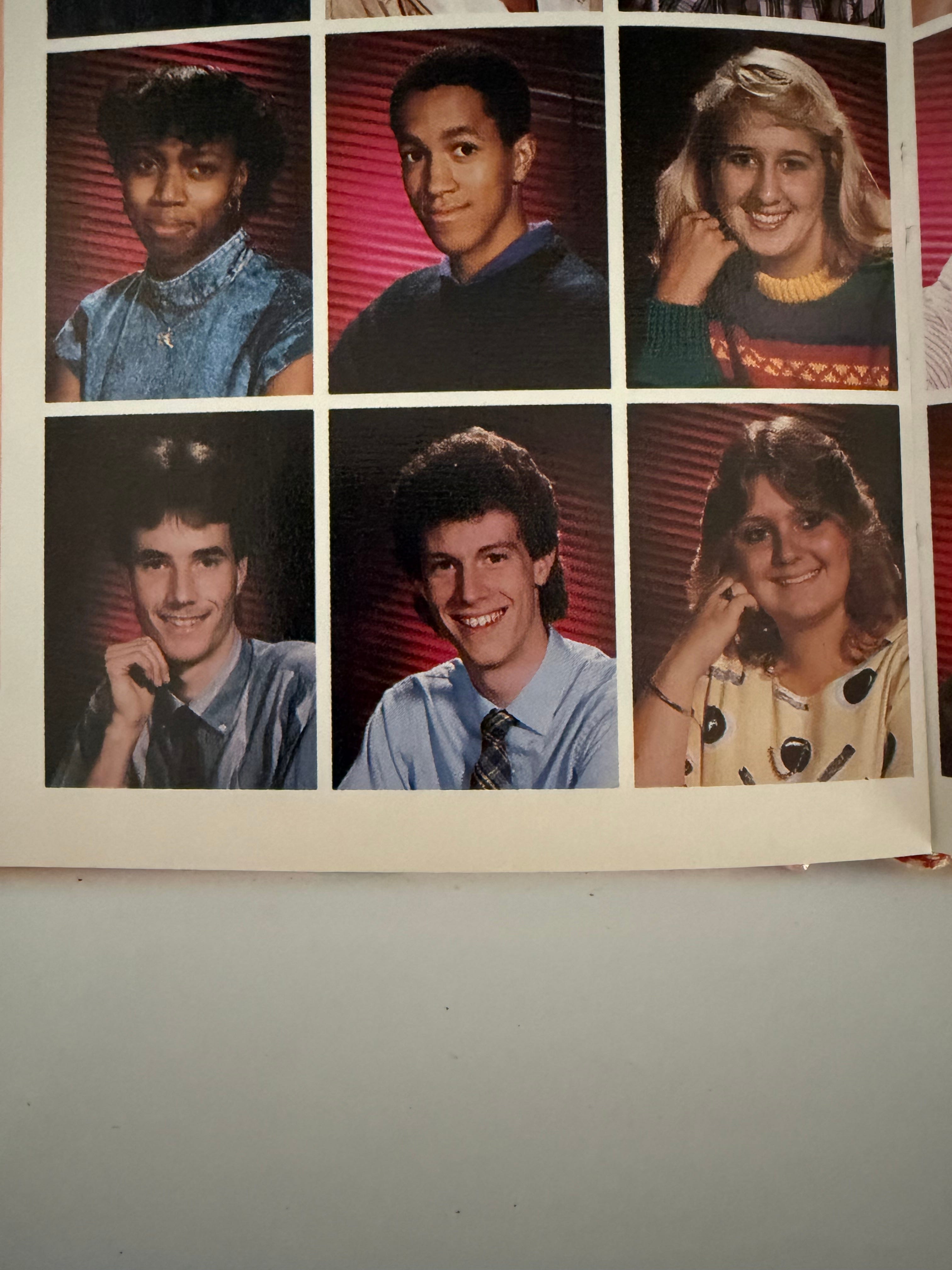
While most of my coworkers were older, there were a couple who were my age. Jennifer was in my graduating class at Enloe High School, and Brad was an odd combination of preppy and metalhead. I got to know Brad pretty well, because our shifts often overlapped. One day, I confided to him that I had a massive crush on our new coworker, Jennifer. He scowled and said: “You’re disgusting.” Jennifer was Black, and apparently Brad thought such feelings were inappropriate for me to entertain, or even unnatural. This was strange to me, because he seemed perfectly friendly when he interacted with Jennifer; virulent racism will hide out in the open I suppose. After that moment, I avoided Brad as much as possible.
Jennifer was gorgeous, with high cheekbones and perfect skin, and her beauty was amplified to me because of her apparent unawareness of it. She seemed to have no sense of vanity whatsoever, wore no makeup and rarely any jewelry aside from her bright pink Swatch on her right wrist (because she was left-handed). We knew each other from school, but our friend groups didn’t overlap much, and so we didn’t really become good friends until the store hired her in May, a few weeks after I had joined the staff. The day that she walked in for her interview, my heart started racing. I had admired her from afar for so long, and the idea of spending hours at a time with her was thrilling and terrifying.
I don’t mean to bother you but I’m in distress,
There’s danger of me losing all of my happiness,
For I love a girl who doesn’t know I exist,
And this you can fix,
So, Cupid, draw back your bow,
And let your arrow go,
Straight to my lover’s heart for me.—Sam Cooke, “Cupid,” covered by Graham Parker in 1988
Despite my initial nervousness, we got to know each other better over the coming months and relaxed into a sort of friendly ease. We even went to a couple of movies together, as friends, and we made cassettes for each other to listen to. One evening as we were closing the store, with no one else there, we played Parker’s album, and we both sang along in full voice with his cover of the great Sam Cooke’s classic, “Cupid.” I clearly remember, though it may seem silly, a desire to preserve the moment in my memory forever and a wish to be able to return to it in the future; it seemed like perfect happiness. Hearing that song again in 2026, I recall the play of the evening light through the store’s windows, the pile of carbon-copy credit card receipts I had sorted on the front desk, and Jennifer’s smile from across the room as she returned misfiled discs to their proper alphabetical homes as she swayed and sang: “Cupid, please hear my cry, / And let your arrow fly, / Straight to my lover’s heart for me.”
Neither of us knew what our lives held in store for us, but for those few minutes, we weren’t worried about that, content as we were in each other’s company.
The dreams and hopes of men are powered by addiction,
And who am I to say that this is an affliction?
When everybody gets suckered in and lives their lives like fiction,
Writing their own stories of success.—Graham Parker, “Success”
It is interesting that in those days of an unwritten future, I was listening to an album full of regret and disillusionment. As I listen to the track “Success” in 2026, it seems to be a prescient vision of Instagram-inspired FOMO and staged lives. And these days, as I read what my friends wrote in my high-school yearbook that spring, I am struck by how optimistic everyone is, even the premature cynics. I found Jennifer’s inscription: “John, it’s gone fast. The year slipped by before I knew it. You’re a great person. After all, I like anyone who loves JT [James Taylor]. Have fun at Carolina next year. For some reason I think you will! Love, Jennifer.” Not profound, but sweet.
I don’t remember saying goodbye, and I never saw her again after that summer. But I thank Graham Parker for reviving the memory.
Thanks for reading, from my fancy internet CD player to yours.
Use the link below if you would like to support my work by buying me a coffee, and I do drink a lot of coffee :)
Comments
Nothing yet. Say the first thing.
Sign in to join the conversation.