
Towards the end of The Two Towers, the reader may be surprised to find a strange and funny conversation between two orcs, Gorbag and Shagrat—surprised because it breaks into this devastating moment in the narrative: Sam believes Frodo to be dead, and he finds himself alone, bearing the Ring, as he finally prepares to enter Mordor.
The two orcs exchange war stories, complain about their jobs, and envision a future when they might live out their orcish dreams. Their idiom is unlike any other in the book. Here is a sample from Gorbag:
The messages go through quicker than anything could fly, as rule. But I don't enquire how it's done. Safest not to. Grr! Those Nazgûl give me the creeps. And they skin the body off you soon as look at you, and leave you all cold in the dark on the other side. But He likes 'em; they're His favourites nowadays, so it's no use grumbling. I tell you, it's no game serving down in the city. (737)
We can't imagine Legolas or Aragorn talking this way—or even the hobbits. This may partly be due to the unthinking cynicism, and also to the use of a relatively modern expression like "the creeps," first attested in this usage by the OED in 1849, from David Copperfield. We can infer just from this brief passage that these orcs fear their superiors and do not understand them, and while they may not be content with their lot, they are too fearful to challenge authority.
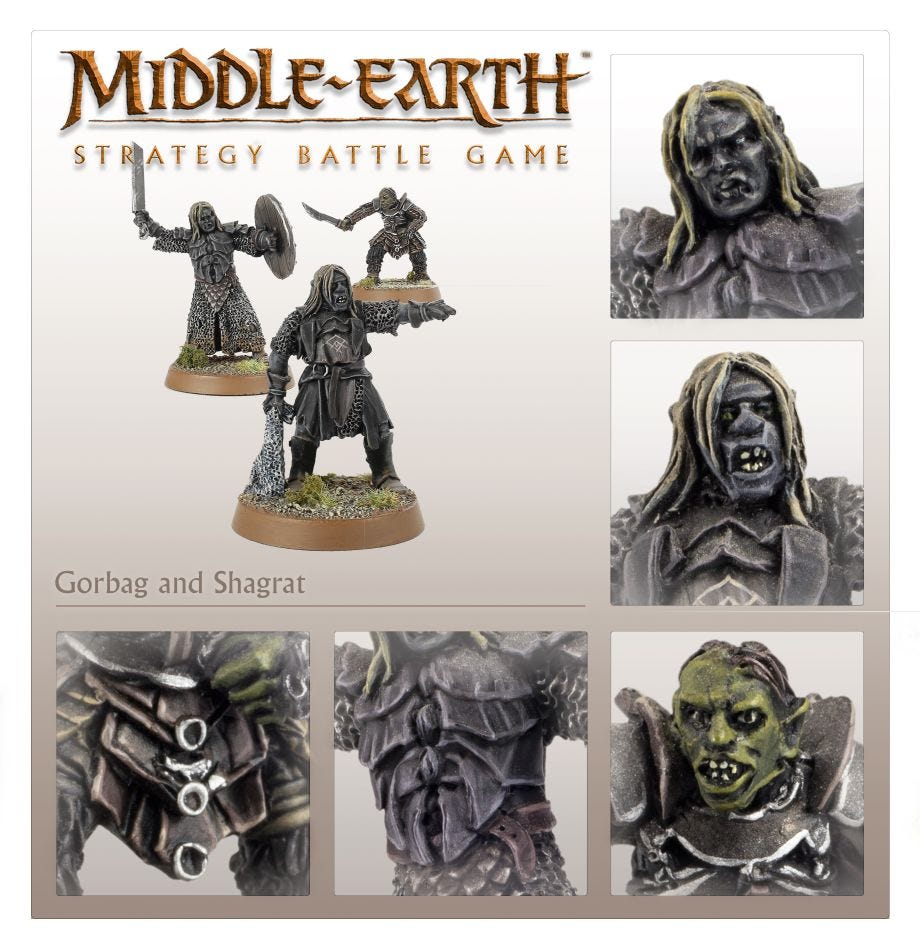
What is also clear, however, is that they are not automata: they have needs, desires, resentments, and even ambitions. Gorbag envisions a future for himself and Shagrat if the war goes well and there is "more room":
"What d'you say? —if we get a chance, you and me'll slip off and set up somewhere on our own with a few trusty lads, somewhere where there's good loot nice and handy, and no big bosses."
"Ah!" said Shagrat. "Like old times." (738)
Orcs nostalgic for the good old days? Orcs who yearn for a more fulfilling future after they can ditch this day job? Orcs who long for freedom? Apparently.
But freedom to do what? Gorbag's wish for handy "loot" suggests a life of petty crime in the context of some sort of orc biker-gang. Compare Sam's vision of freedom at the beginning of Book Six: "The one small garden of a free gardener was all his need and due, not a garden swollen to a realm; his own hands to use, not the hands of others to command" (901).
Orc-style evil in this conversation is revealed as a sort of workaday, ordinary evil: desire without empathy, casual hypocrisy, self-centeredness, finger-pointing, and resentment. For example, Tom Shippey points out that while they accuse elves of abandoning their friends ("regular Elvish trick"), Shagrat recalls with amusement how they left their comrade Ufthak suspended in one of Shelob's webs to await being eaten rather than rescuing him: "he was wide awake and glaring. How we laughed!" (740).
We think of evil on a grand scale in LOTR—satanic and awesome in its sheer power. But when we view it here, on a granular level, it is petty and squalid, and the only difference between Sauron's evil and this "ordinary" evil is one of scope. It is the desire to dominate others; the desire to act as one pleases without consequence—that insidious idea of "freedom" that fails to regard the rights and needs of others—all too common in contemporary political ideology. The very people who sport “Don’t Tread on Me” bumper stickers are the first to cheer when rights are stripped away from others who are not like them. (Simone de Beauvoir in The Ethics of Ambiguity, on the other hand, claimed that real freedom was not possible without recognizing and encouraging the freedom of others.)
Where did Tolkien get the idea for such orc-talk? A perusal of his letters makes it pretty clear: the army. He saw the military as a necessary evil, and despite the presence within it of many good people, he believed that its hierarchical structure was a breeding ground for brutality and mendacity. His correspondence with his son Christopher in 1944 gives this impression. Christopher was stationed in South Africa with the Royal Air Force, and it seems that he had complained of the brutal behavior of his officers and comrades. Tolkien responds to him:
I hope you will have some more leave in genuine Africa, ere too long. Away from the "lesser servants of Mordor." Yes, I think the orcs as real a creation as anything in "realistic" fiction: your vigorous words well describe the tribe; only in real life they are on both sides, of course. For "romance" has grown out of "allegory," and its wars are still derived from the "inner war" of allegory in which good is on one side and various modes of badness on the other. In real (exterior) life men are on both sides: which means a motley alliance of orcs, beasts, demons, plain naturally honest men, and angels. But it does make some difference who are your captains and whether they are orc-like per se! (118)
This association of orcs with modern military organizations becomes apparent when we contrast their language with that of, for example, the Riders of Rohan, who do not use what we would call military language but, rather, antiquated heroic language. The orcs, on the other hand, refer to "orders," which they receive in telegraphic, 20th-century language: "Nazgûl uneasy. Spies feared on stairs. Double vigilance. Patrol to head of stairs" (738).
Compare the language of Théoden, when he proposes his heroic ride out of Helm's Deep to challenge the host of orcs:
When dawn comes, I will bid men sound Helm's horn, and I will ride forth. Will you ride with me then, son of Arathorn? Maybe we shall cleave a road, or make such an end as will be worth a song—if any be left to sing of us hereafter. (539)
It is difficult to imagine Gorbag or Shagrat speaking like this. One idiom or the other is anachronistic, depending on how we imagine the world of Middle-earth. But that is partly the point: a band of heroic knights and horsemen is not a fair match against the ruthless efficiency of a modern military—and Gandalf and others inform us over and over again that their alliance is no match against the power of Sauron. Tolkien has crafted a narrative in which the only way to defeat an evil power is to give up potential power rather than resorting to the necessary evil of industrial militarism.
In the war that his sons were fighting against the Axis powers, on the other hand, "we are attempting to conquer Sauron with the Ring," as he wrote to Christopher in 1944 (113). This was the only option in the middle of the 20th century, which Tolkien understood but lamented. In his created, secondary world, the only option is to destroy the source of power, to undermine the ability to dominate.
Thanks for reading, from my fancy internet telegraph to yours.
Comments
Nothing yet. Say the first thing.
Sign in to join the conversation.