
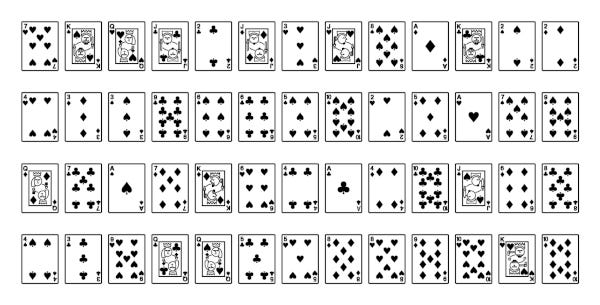
I ran across an article that showed how to store a 128-bit key in the permutations of a deck of 52 cards. I then wrote three blog posts riffing on this idea.
First of all, you can store up to 225 bits of data in the permutations of a deck of cards. This post shows how to do that, converting a huge number to a permutation and vice verse, using Python.
Given a deck size n, you can easily find how many bits of data can be stored in its permutations. But what if you want to go the other way around: given a number of bits, how big does the deck need to be?
I wrote two posts on this question. The first looks at various cryptographic key sizes and how big a deck would need to be. For example, you’d need 58 cards to store a Bitcoin key.
The second looks at an algorithm at the heart of this question. Given a number of bits b, we’re tyring to find the smallest value of n such that n! > 2b. More generally, we’re trying to invert the (log) gamma function. I wrote about how to do this a couple years ago, but the latest point gives some improvements to to previous code.
No posts
Comments
Nothing yet. Say the first thing.
Sign in to join the conversation.