
“What is going on with men?” is a question saturating the cultural conversation. The New York Times Magazine recently ran “The Testosterone Moment Is Here. And Men May Never Look the Same,” tracking the surge in men seeking hormonal fixes to regain stamina, feel better about themselves, and, for some, to maximize a manosphere-flavored masculinity. On his New York Times podcast, Ezra Klein interviewed Helen Lewis, Atlantic staff writer and author of Difficult Women: A History of Feminism in 11 Fights and The Genius Myth: A Curious History of a Dangerous Idea, about the new antifeminist backlash she calls “the single most important force holding together the American right,” men yearning for a world that predates what modern life, in their view, threatens to take from them.
I’ve never felt that our culture threatens my masculinity, certainly not through the people most often cast as aggressors: women, trans people, queer people, anyone filed under “woke.” Maybe that’s because I’m gay and, in the minds of people who think this way, part of the problem. Or maybe—and I’m going with this one—it’s because the claim simply isn’t true. Either way, I used to greet the whole “masculinity is under attack” argument with a big eye roll. I was too busy worrying about the violence that form of masculinity wishes to visit on the many people I love and on me, and at times has. But lately, in part because of some exceptional television, I’ve come to believe the eye-roll response isn’t particularly helpful. It may be dismissive of something real and complex underneath all the chest-beating.
That’s not to say I’m immediately sympathetic. But I’m curious. What’s behind the bluster? I’m a feminist, and the women in my personal and professional life, from mother figures to teachers to writers, have been my guides. I find the manosphere’s misogyny repellent. But yes, something is eating at men. The statistics on boys struggling in school and the male suicide rate—which, according to the National Institute of Mental Health, far exceeds that of women—are concerning data that can’t be eye-rolled away. How, then, do we move past steroid-pumped grievance to get at the real problem, which more and more seems to be loneliness?
I’ve dealt with my share of loneliness, so I understand it. Most gay men do. It was loneliness that pushed me toward my imagination and, eventually, toward writing. I would not have survived without that imagination. But not everyone has the ability or privilege to turn struggle into something positive. And I suspect many women and other marginalized people, hemmed in by patriarchal systems, have known that kind of loneliness too. Isolation may be one of patriarchy’s central functions: keep people separated, and you can control them.
Could that logic apply to men as well? Especially those without power: young men, underprivileged men, emotionally vulnerable men. I’ve come to think patriarchy isn’t about men versus women. It’s about a handful of powerful men against everyone else, including other men. The trick is to link hands across those divisions.
So I’ve stopped rolling my eyes. Well, usually. I’ve begun wanting to listen: Damn it, let’s figure this out together. Maybe that’s naive, but I don’t know what else to do, because if we don’t do anything, the consequences will be dire.
Part of that listening is reading, and I’ve done plenty of it. But articles and interviews have limits. They inform; they don’t always build empathy. Storytelling does something different. If you’re willing to explore this territory (I’m still very much in exploratory mode), three recent, very well-written limited series are worth your time.
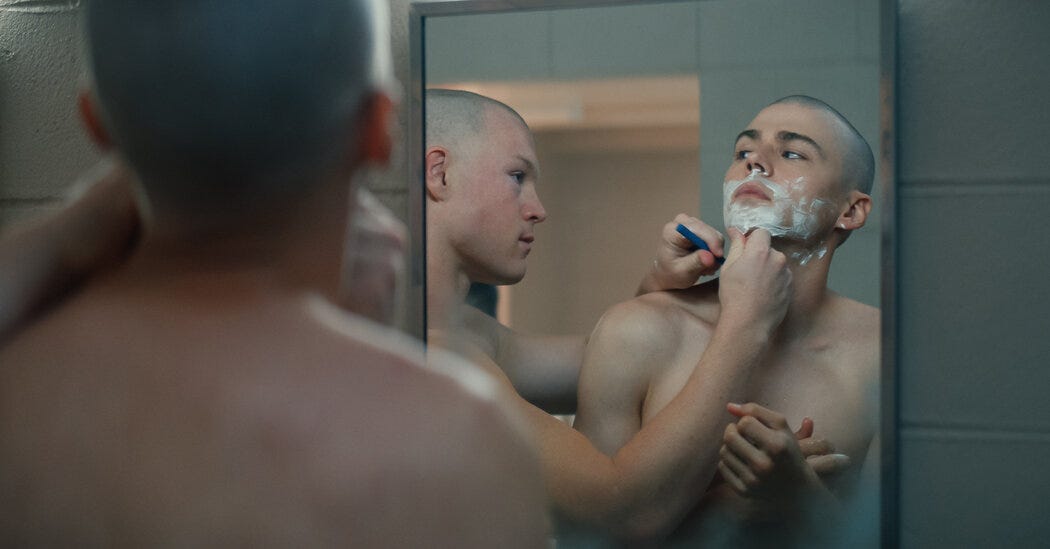
The first is Boots (Netflix), which was canceled after one season, and never should have been. Based on Greg Cope White’s memoir The Pink Marine, the series followed Cameron Cope (Miles Heizer), a closeted gay teen who enlists in the Marine Corps in the early 1990s, shortly before Don’t Ask, Don’t Tell, when being openly gay in the military was barred. The Pentagon slammed it as “woke garbage,” at which point it soared up the Netflix charts. What’s remarkable about the show is that, while often funny, it doesn’t treat Cameron’s choice to join the military as a joke. It takes the other men seriously too, refusing to prescribe a single model of masculinity, exploring the full range of male relationships and, especially, vulnerability. Imagine that: an emotionally vulnerable Marine. No wonder Pete Hegseth’s Pentagon had a fit. I loved this show and keep thinking about it. Maybe the universe will find a way to bring us another season.
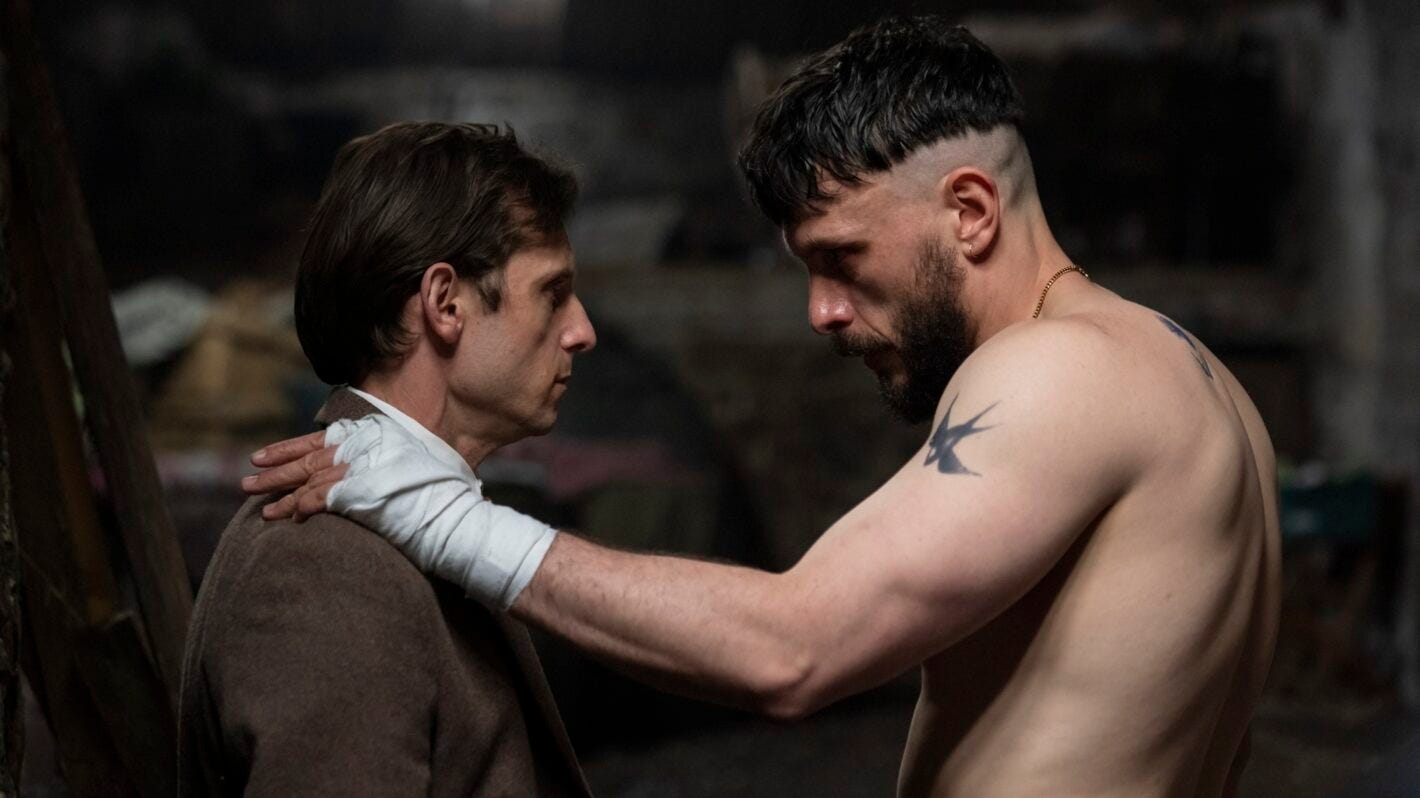
The second is Half Man (HBO/BBC), created and written by Richard Gadd, who broke through with Baby Reindeer, and starring Gadd as Ruben Pallister alongside Jamie Bell as Niall Kennedy, stepbrothers of a sort whose reunion at Niall’s wedding detonates nearly forty years of their deeply entangled relationship. The bond is sexually charged, tender, and violent by turns, but what makes the show so uncomfortable is its central psychological trap: each man lies to the other about his vulnerabilities while depending, to the point of obsession, on the illusion the other projects back. They don’t just need each other; they need the version of themselves they see reflected in each other’s eyes. When that reflection cracks, and it does, first by small fissures then violently, neither man has anything left to stand on. It’s a study in what happens when you believe in someone else more than you believe in yourself, and when that belief is built not on truth but on mutual fiction. It’s not unlike the relationship so many young men have with the manosphere: they look to influencers to understand themselves and their feelings, while those influencers need their audience to exist and keep making money. Everyone is feeding off an illusion. It’s a parasocial nightmare. So it’s no surprise the show is harrowing and not for everyone. Tearing apart illusions maintained for decades is a visceral affair, and the show doesn’t flinch—mutual self-destruction is its foregone conclusion.

The third is DTF St. Louis (HBO), written and directed by Steven Conrad, which follows a love triangle between three middle-aged adults whose suburban malaise ends with one of them dead. Jason Bateman plays Clark Forrest, David Harbour plays Floyd Smernitch, and Linda Cardellini plays Carol Love-Smernitch. The striking thing about the central relationship, between Clark and Floyd, is that the real romance isn’t between Clark and Floyd’s wife; it’s between the two men. Not sex. Something harder to describe: a mutual, platonic love for which neither man has adequate language.
During a police interrogation, Clark tells the detectives that Floyd was “wonderful,” that he would never hurt him, and that he loved him. When asked to explain, Clark says, “Like you love something. You know, like the sun when you’re cold. Like water when you really need water.” Detective Homer asks, “I don’t understand. Like sex?” Clark responds, “No. Or, um, like … I loved Floyd.”
These two men are trying to define a love they don’t have clear language for, built on mutual respect and tenderness, outside the framework that either of them was given. Of the three shows, this feels the most radical, because there’s a purity to it: Clark loves Floyd because he loves his goodness. There’s almost something spiritual about it, without the show quite going there. Despite its dark humor and strange warmth, the show was a gut punch, and it gave me a relationship I don’t think I’d ever seen on screen before. It deserves awards for both writing and acting.
Of the three, DTF St. Louis did the most to help me understand the intense loneliness that can live inside straight men, and to root for characters trying to break through, even when nothing in our still-patriarchal culture wants them to. Such tenderness in our soul-crushing world, the show suggests, can only end in tragedy.
I hope that’s not true. But we’ll have to keep finding ways to tell stories about a kind of tenderness between men if any of us hopes to escape the crush of the systems that profit from keeping us apart.
If you’ve seen any of these series, I’d love to hear your thoughts. There’s so much to unpack … and I’m still thinking about them.

Comments
Nothing yet. Say the first thing.
Sign in to join the conversation.