
Millions of people wake up every morning feeling exhausted.
Not simply tired.
Exhausted.
The kind of exhaustion that lingers after a full night’s sleep. The kind that follows them through the workday, impacts relationships, diminishes performance, and slowly erodes quality of life.
For many, the response is predictable.
Drink more coffee.
Push harder.
Exercise more.
Get more sleep.
Manage stress.
Try another supplement.
And when those strategies fail, the conclusion often becomes deeply personal:
“Maybe I’m just lazy.”
“Maybe I’m getting older.”
“Maybe I need more discipline.”
But what if exhaustion isn’t a motivation problem at all?
What if it is one of the earliest biological signals that something deeper is happening beneath the surface?

One of the greatest limitations of modern healthcare is that it often focuses on disease rather than dysfunction.
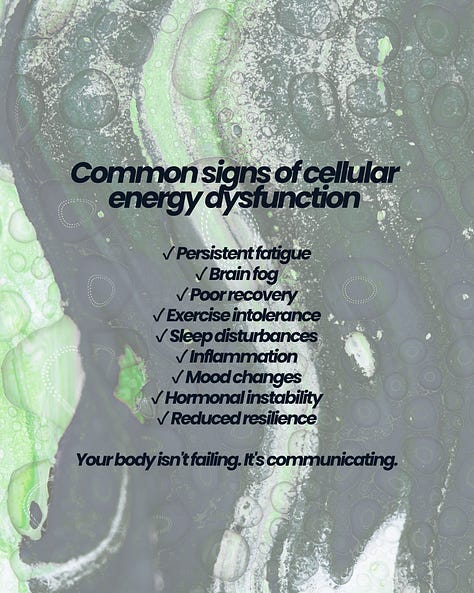
A patient may spend months—or years—experiencing fatigue, brain fog, poor recovery, sleep disruption, inflammation, mood changes, hormonal instability, or declining performance while routine laboratory tests remain “normal.”
The absence of a diagnosis is often interpreted as the absence of a problem.
But biology does not work that way.
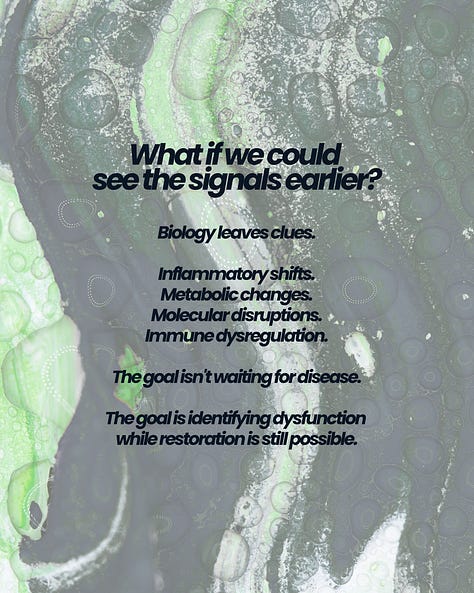
Long before disease is identified, biological systems begin to change.
Inflammation begins to rise.
Mitochondrial efficiency declines.
Immune signaling becomes dysregulated.
Metabolic flexibility decreases.
Hormonal communication becomes disrupted.
Cellular resilience weakens.
These changes may not immediately trigger a diagnostic label, but they frequently produce symptoms.
Fatigue is often one of the first.
Most people think of energy as a feeling.
In reality, energy is biology.
Every heartbeat.
Every thought.
Every muscle contraction.
Every cellular repair process.
All depend upon the continuous production and regulation of energy within the body.
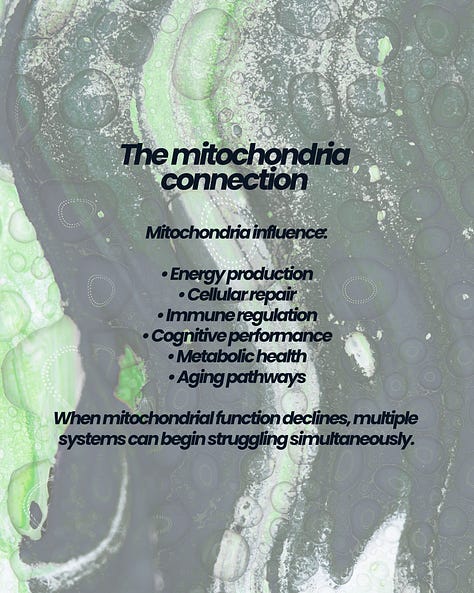
At the center of this process are mitochondria—the microscopic structures responsible for producing the energy that powers human life.
When mitochondrial function becomes impaired, the effects can ripple throughout nearly every system of the body.
The result may include:
Chronic fatigue
Brain fog
Exercise intolerance
Poor recovery
Hormonal disruption
Increased inflammation
Reduced resilience to stress
Cognitive decline
Metabolic dysfunction
The body is not failing.
It is communicating.
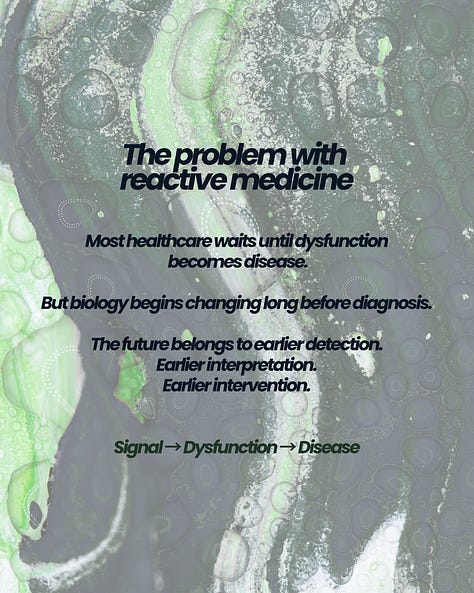
Healthcare has historically been designed around identifying established disease.
The model is largely reactive.
A problem becomes severe enough.
A diagnosis is assigned.
Treatment begins.
While this approach has produced tremendous advances in medicine, it often overlooks the biological transitions that occur before disease becomes obvious.
By the time a condition is diagnosed, dysfunction may have been developing for years.
This creates a critical gap.
Patients know something is wrong.
Their biology is sending signals.
Yet the healthcare system frequently lacks the tools—or the framework—to interpret those signals early.
As a result, countless individuals continue searching for answers while their symptoms are dismissed as stress, aging, burnout, anxiety, or lifestyle issues.
The future of medicine will not belong solely to diagnosing disease.
It will belong to understanding biology in motion.
Human health is dynamic.
Cells communicate continuously.
Immune systems adapt.
Metabolism shifts.
Inflammatory responses fluctuate.
Mitochondria respond to environmental and physiological stressors.
The next generation of healthcare must be capable of interpreting these changes before irreversible dysfunction occurs.
This is where biological intelligence becomes essential.
Instead of asking:
“What disease does this patient have?”
The better question may become:
“What biological patterns are emerging?”
And more importantly:
“What do those patterns tell us about future health outcomes?”
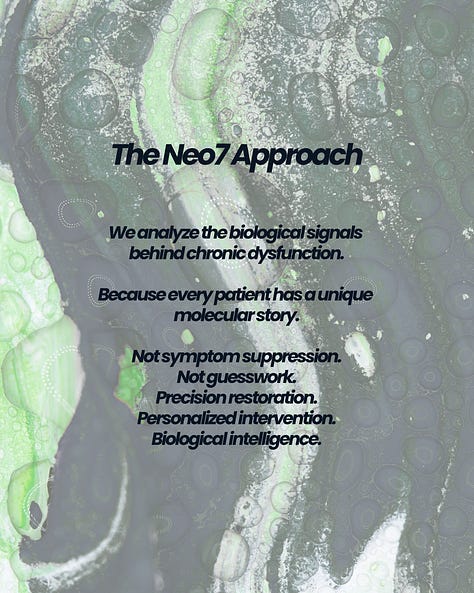
At Neo7 Bioscience, we believe healthcare is entering a new era.
An era focused on signal detection rather than symptom management.
An era focused on understanding biological patterns before systems fully break down.
An era where precision medicine becomes truly personal.
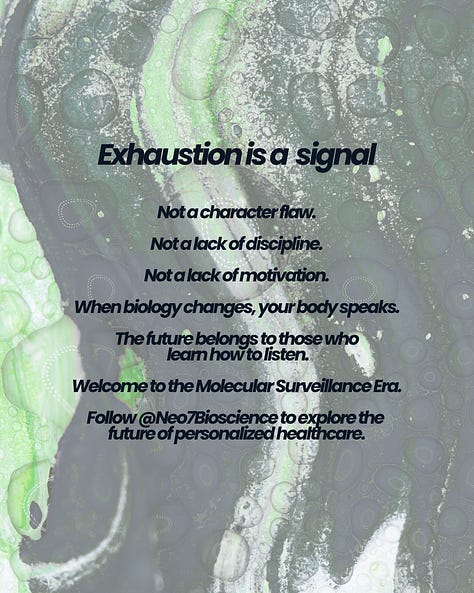
We call this the Molecular Surveillance Era.
A framework built around continuous interpretation of biological signals, molecular adaptation, cellular function, and individualized restoration strategies.
Because every patient is biologically unique.
Every individual has a different molecular story.
And every intervention should be informed by that reality.
The future of medicine is not reactive.
It is adaptive.
It is personalized.
It is intelligent.
And it begins long before disease appears.
When fatigue appears, the goal should not simply be masking symptoms.
The goal should be understanding why the signal exists in the first place.
Because exhaustion is often more than tiredness.
It can be a message.
A warning.
A clue.
A biological signal asking for attention.
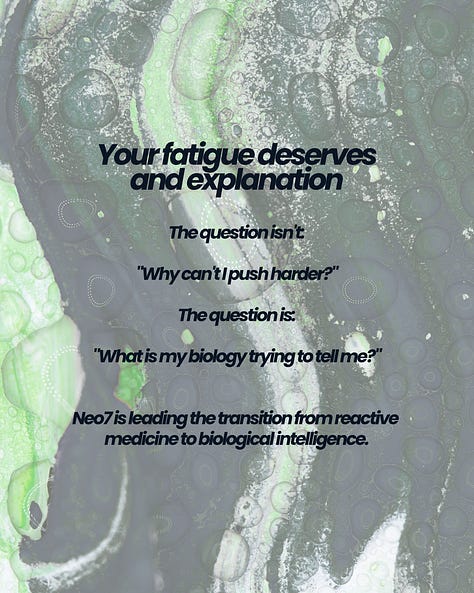
The question isn’t:
“Why can’t I push harder?”
The question is:
“What is my biology trying to tell me?”
The future of medicine will belong to those who learn how to listen.
And at Neo7 Bioscience, that future is already taking shape.
More information:
Follow Neo7Bioscience across social media for real-time insights into precision molecular medicine, transcriptomics, biological restoration, and the future of personalized healthcare.
This is more than content.
It’s the evolution of medicine in real time.
Stay connected for:
• Research breakdowns
• Educational reels & visual explainers
• Emerging molecular insights
• Precision restoration strategies
• Thought leadership from Dr. Catanzaro and collaborators
• Updates shaping the next era of healthcare
The future of medicine is becoming dynamic, individualized, and biologically intelligent.
Follow along as the shift unfolds.
Facebook: Neo7Bioscience
Instagram: @neo7bioscience
LinkedIn: Neo7 Bioscience
Comments
Nothing yet. Say the first thing.
Sign in to join the conversation.