
Author: John A. Catanzaro; CEO Neo7Bioscience
In collaboration with Dr. Peter A. McCullough, Nicolas Hulscher, and the McCullough Foundation
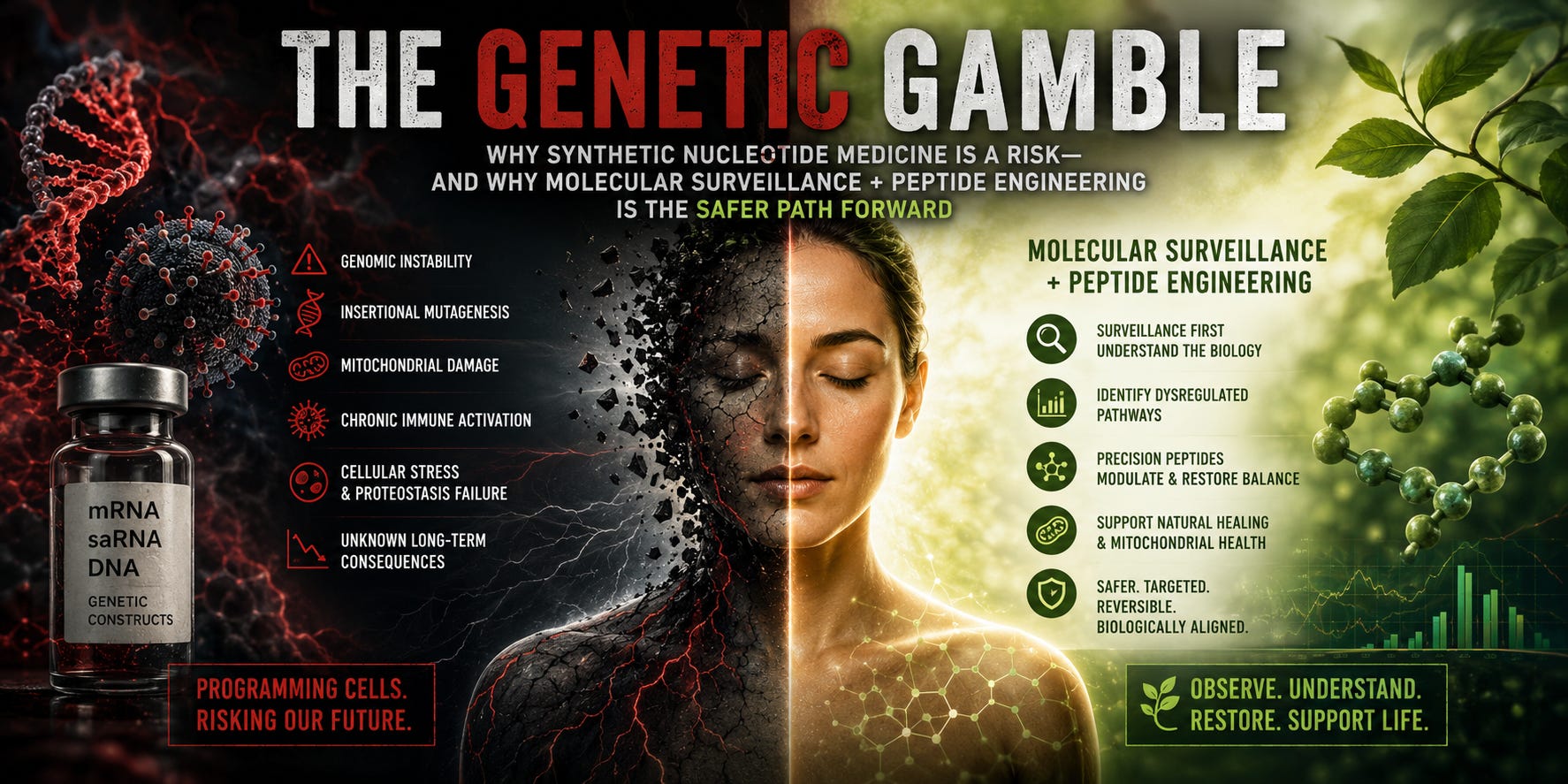
The next generation of medicine is being sold as “precision healthcare” — personalized mRNA vaccines, self-amplifying RNA (saRNA), DNA therapeutics, programmable lipid nanoparticles, and AI-designed nucleotide constructs.
But beneath the marketing language lies a serious biological warning:
Human cells were never designed to coexist with persistent synthetic genetic instructions delivered systemically at scale.
The expansion of personalized nucleotide-based therapeutics may represent one of the most dangerous biological experiments ever attempted if long-term genomic, mitochondrial, transcriptomic, and immunologic consequences are not fully understood before deployment.
Traditional drugs typically interact with proteins or receptors temporarily, but they often lack true biological precision and regulatory balance. Rather than restoring coordinated cellular function, many simply suppress or force pathways unnaturally, which can lead to serious long-term side effects, compensatory dysfunction, and adverse reactions across multiple organ systems throughout the body.
mRNA, saRNA, and DNA plasmid systems are fundamentally different because they introduce synthetic nucleotide instructions into living cells, effectively turning the body into a manufacturing platform. Much more complicated effects will be observed with these molecular manipulators.
These systems may:
Hijack ribosomes
Alter transcriptional balance
Disrupt RNA regulation
Overload mitochondria
Trigger chronic immune activation
Produce aberrant proteins
Create long-term cellular stress
The risk escalates further when the systems become:
so called; “Personalized”
Repeated
Self-amplifying
AI-generated
Combined with immune stimulation technologies
The term “personalized vaccine” creates the illusion of precision and safety.
In reality, this type of so-called “personalization” may actually increase biological unpredictability because every individual possesses the critical functional systems below — yet none of these essential molecular, mitochondrial, immunologic, or regulatory networks are being comprehensively interrogated or precisely mapped before synthetic genetic material is introduced:
Unique HLA architecture
Unique mitochondrial vulnerabilities
Unique immune tolerances
Unique cancer suppression pathways
Unique transcriptomic signatures
Introducing synthetic nucleotide constructs into this environment creates a highly unstable systems-biology dysregulation and functional compromise.
Self-amplifying RNA (saRNA) may represent one of the greatest risks in modern biotechnology.
Unlike conventional mRNA, saRNA contains replication machinery designed to amplify RNA production inside cells.
This may create:
Persistent intracellular RNA burden
Chronic protein production
Oxidative stress
Ribosomal overload
Endoplasmic reticulum stress
Proteostasis disruption
Fibrotic signaling
Cellular senescence
The body is no longer simply receiving instructions. It will become a sustained RNA bioreactor.
DNA therapeutics introduce another level of concern because DNA exists closer to the nucleus and genomic architecture itself.
Potential risks include:
Insertional mutagenesis
Chromosomal instability
Aberrant recombination
Epigenetic disruption
Persistent transcriptional interference
Even rare genomic events become biologically significant when billions of cells are exposed across large populations.
Once genomic stability is compromised, downstream consequences may include:
Cancer initiation
Immune dysfunction
Stem cell corruption
Accelerated aging
Tissue degeneration
Healthy protein signaling pathways can become disrupted, causing cells to produce abnormal and destructive proteins that damage tissues and impair normal function
One of the most overlooked dangers of nucleotide therapeutics is mitochondrial disruption.
Mitochondria regulate:
Cellular energy
Apoptosis
Immune signaling
Redox balance
Repair systems
Stem cell integrity
Synthetic RNA overload may theoretically:
Increase reactive oxygen species
Damage mitochondrial ribosomes
Impair ATP production
Trigger inflammasome activation
Drive chronic inflammatory states
Persistent mitochondrial injury may manifest as:
Neurological dysfunction
Cardiac injury
Autoimmune disease
Fibrosis
Chronic fatigue
Endothelial damage
Multi-system failures
There is a sharp difference between synthetic nucleotide programming and true molecular surveillance-based medicine.
A safer precision model focuses on:
Observing dysregulated biology
Mapping aberrant pathways
Monitoring transcriptomic instability
Identifying dysfunctional signaling
Supporting biological correction without genetic rewriting
This is where personalized molecular surveillance and peptide engineering differ fundamentally from mRNA, saRNA, and DNA platforms.
Instead of forcing cells to manufacture synthetic proteins through genetic instructions, precision peptide engineering works downstream at the signaling level.
The goal is not cellular hijacking.
The goal is biological stabilization.
Properly engineered peptide systems:
Do not replicate
Do not self-amplify
Do not integrate into the genome
Do not rewrite nuclear DNA
Do not rely on prolonged intracellular genetic persistence
Do not turn cells into synthetic protein factories
Instead, they are designed to:
Modulate signaling pathways
Restore regulatory balance
Support repair mechanisms
Improve mitochondrial resilience
Reduce inflammatory dysregulation
Assist immune coordination
When guided by advanced molecular surveillance, this creates a fundamentally different framework:
Observe first
Map instability second
Engineer targeted signaling support third
Not:
Inject synthetic code and hope the system adapts later
AI-designed genetic therapeutics are increasingly optimized for:
Higher expression
Greater persistence
Stronger immune stimulation
Increased translational efficiency
But optimization for expression does not equal biological harmony.
The genome, transcriptome, mitochondria, immune system, and proteome operate through extraordinarily complex adaptive networks that modern computational models still do not fully understand.
Know the Biology
Know the Pathways
Align the Adaptation
Mimic the Natural Rhythm
The Missing Long-Term Data
There is still no:
Multi-generational safety data
Lifelong carcinogenicity surveillance
Long-term mitochondrial monitoring
Comprehensive transcriptomic safety mapping
True genomic instability surveillance
Yet deployment continues accelerating.
Synthetic nucleotide therapeutics may hold limited value in highly controlled settings for severe disease.
But large-scale deployment of personalized mRNA, saRNA, DNA constructs, and programmable genetic systems without exhaustive long-term evaluation risks destabilizing the very biological architecture that sustains human life.
There is a profound difference between:
Supporting biology
andReprogramming biology
That distinction may determine the future of medicine — and the future stability of human health itself.
Comments
Nothing yet. Say the first thing.
Sign in to join the conversation.