
Finally, some of the oversight of Baptists connections to Puritanism is likely due to resistance to Calvinism. For example, probably the pre-eminent purveyor of the narrative that Baptists are descended from Anabaptists, William Estep, was also anti-Calvinist. Estep predicted if “the Calvinizing of Southern Baptists continues unabated, we are in danger of becoming ‘a perfect dunghill,’ to borrow a phrase from Andrew Fuller,” ironically citing the early 19th century Particular Baptist.
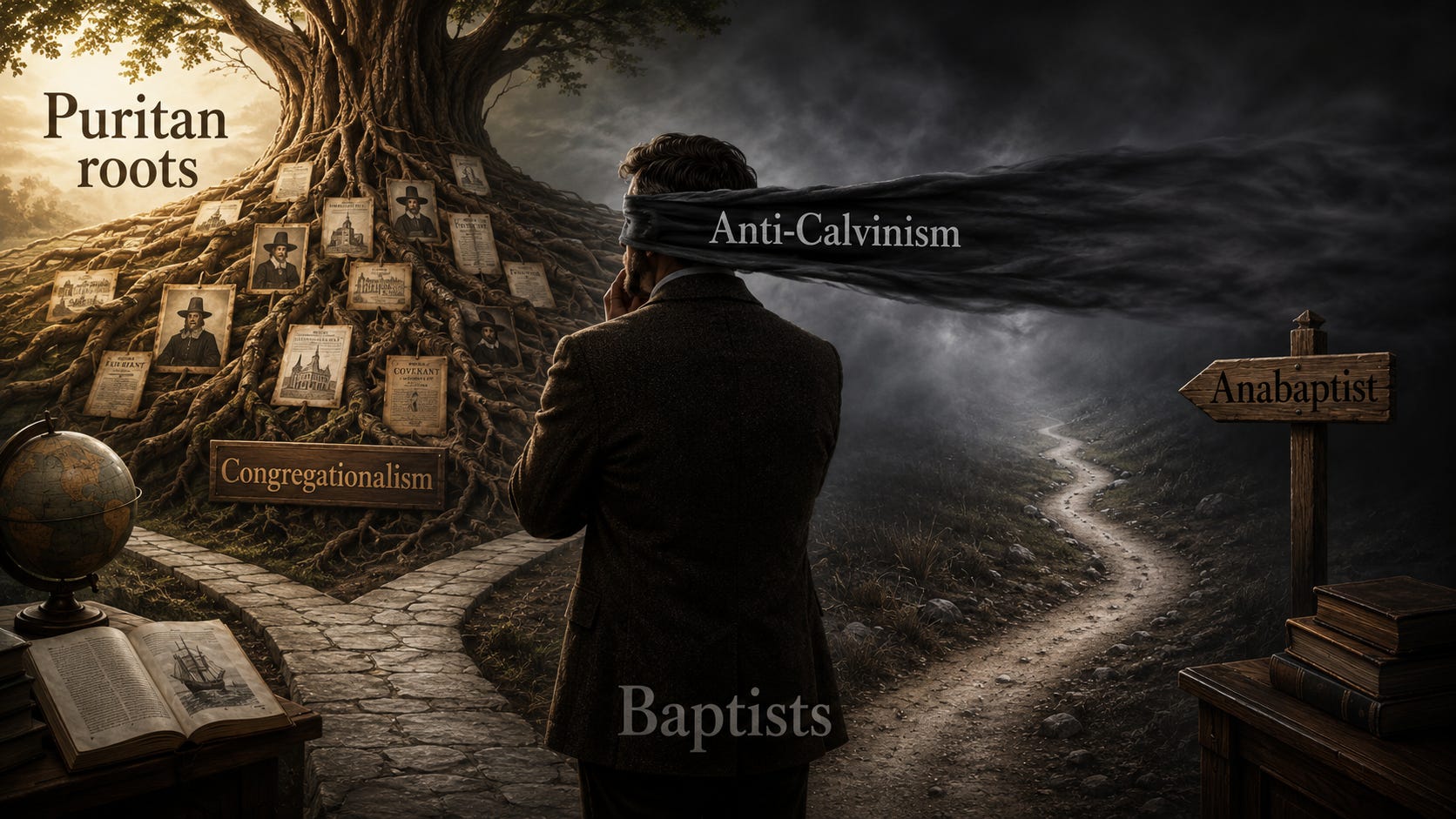
He also claimed that “logically, Calvinism is anti-missionary,” despite the fact that as a church historian he would have to be aware that William Carey, “the father of modern missions,” was a Calvinist. He served as a professor of church history at Southwestern Baptist Theological Seminary for forty years, writing numerous works on Baptist and Anabaptist history. The question is whether his opinion of Calvinism caused him to him to gravitate toward the slight connection of Anabaptists with Baptists and repulse him from the abundance of documentation showing Baptists relationship with Congregationalism. Or is it just a coincidence? That he was both anti-Calvinist and championed the Anabaptist origins narrative is probably not just correlation but causation.
Certainly, historians are free to reject or even despise Calvinism personally. However, they are not free to allow that animus to color their historiography, to move them to classify the Baptists as belonging to a tradition Baptists really do not belong to simply to avoid identifying them with a tradition they, personally, disdain.
Nor was Estep alone. Nelson L. Price, former president of the SBC Pastors’ Conference, wrote that limited atonement and irresistible grace are “daggers in the heart of evangelism,” and then added, “Calvinism makes automatons of people.” Frank S. Page, president of the Southern Baptist Convention from 2006 to 2008, approved Estep’s charge that Calvinism was “a system of religion without biblical support.” The same impulse appeared in the 2012 “Traditional Statement,” formally titled “A Statement of the Traditional Southern Baptist Understanding of God’s Plan of Salvation,” a document drafted principally by Eric Hankins and signed by numerous Southern Baptist leaders to define a supposedly “Traditional” Southern Baptist soteriology against “New Calvinism,” aimed at “making Calvinism the central Southern Baptist position.” The signees of the statement were claiming that their (essentially Arminian) doctrines were “Traditional” and that Calvinism was the foreign invader.
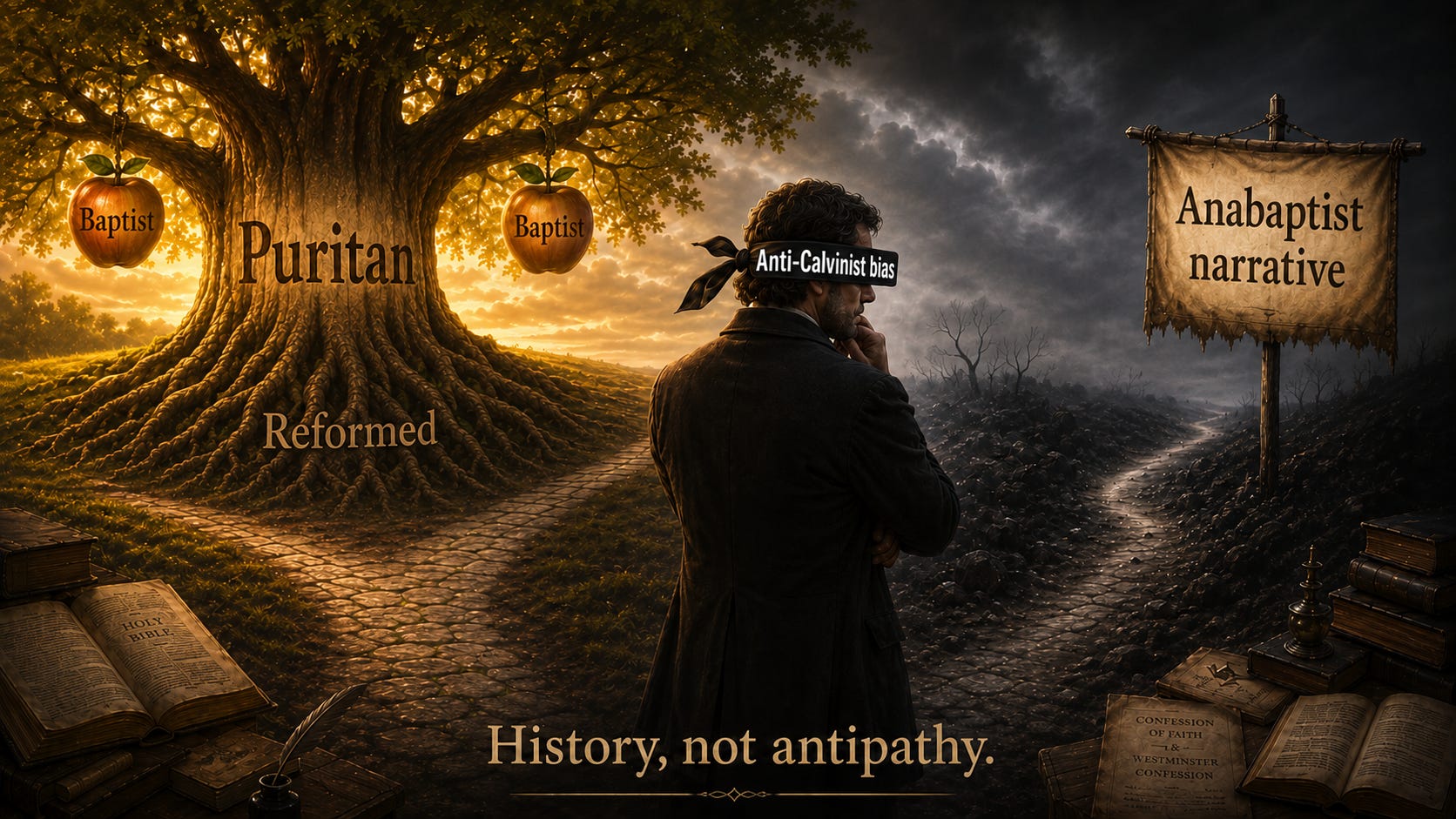
The pattern is revealing. When Calvinism is framed as anti-evangelistic, mechanistic, divisive, or merely “man-made,” the Reformed and Puritan roots of Baptist identity become not a heritage to be recovered, but an alien doctrine to be refuted.
For some Baptist historians, the Anabaptist-origin narrative offered a way to detach Baptist identity from the Reformed and Puritan world. The point is not that anti-Calvinists cannot write Baptist history. They can. The point is that theological antipathies must not be allowed to determine historical genealogy.
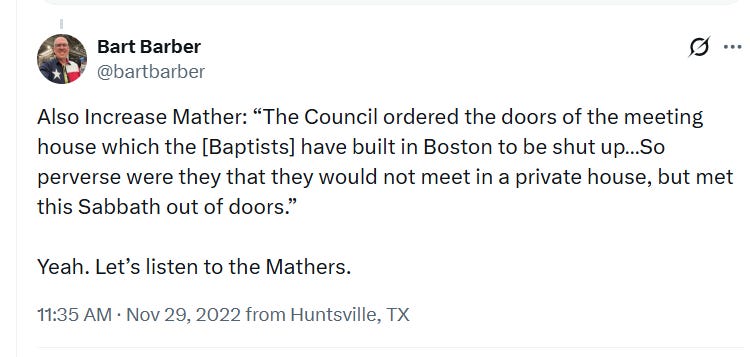
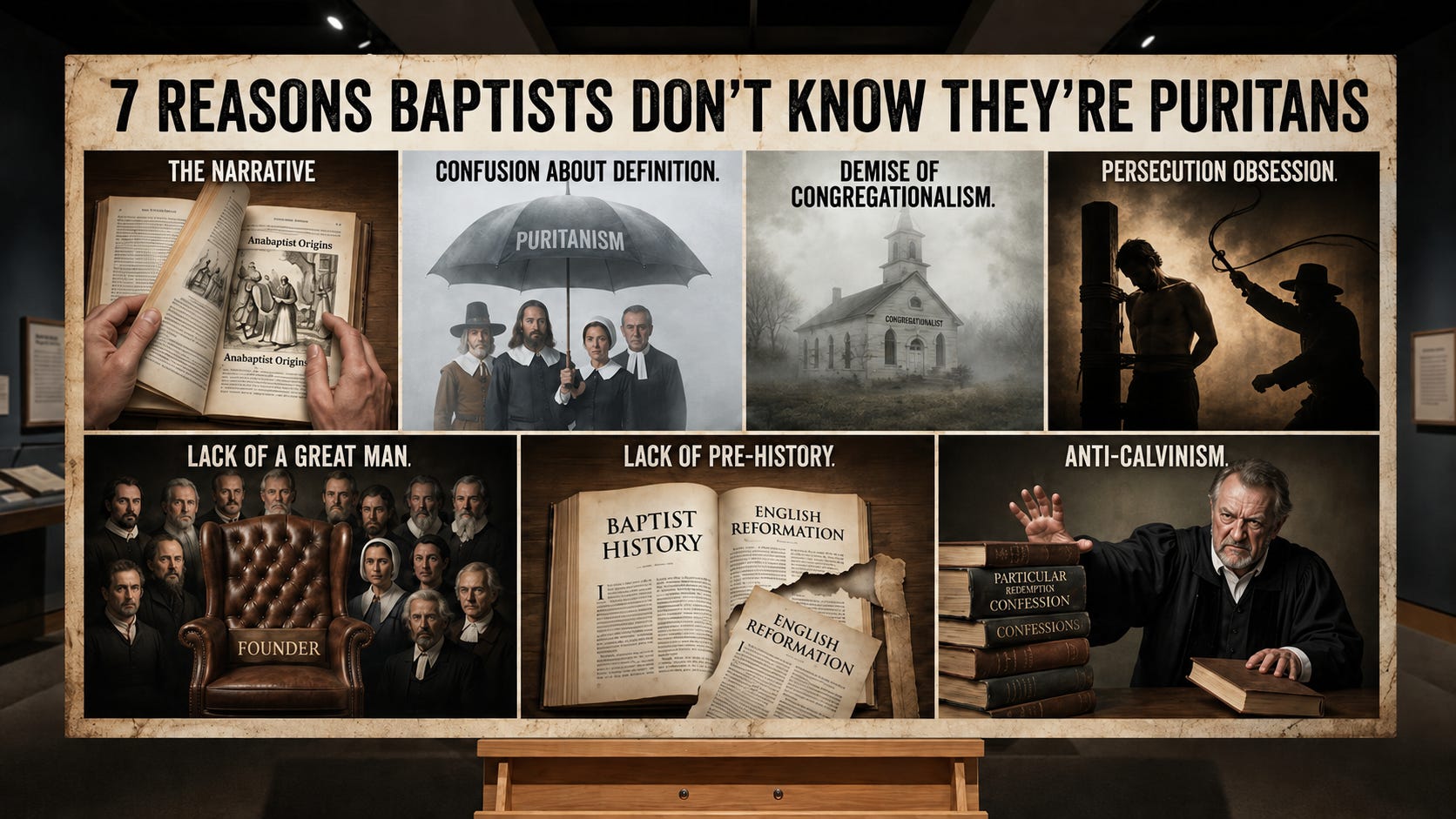
With Puritanism misunderstood, Baptist origins dominated by the Anabaptist or spontaneous Biblicist narrative, the persecution obsession and no Congregationalists or “Great Man” reminding us of our true origins, new Baptist theological students are unlikely to look to the Puritans for their spiritual birthright. Like Bart Barber, they’ll push them to the side.
These distortions, perhaps even more than the anti-intellectualism in some strands of Baptist life, are responsible for the Baptist sense of rootlessness, of being ahistorical, of the myths either that Baptists transcended church history from the days of the Apostles or that they appeared on the scene detached, uncaused in history, “de novo.” These distortions leave some Baptists starved for historical roots.
Because Baptists do not understand their identity as Puritans, we have the phenomena of Baptist academics calling for “theological retrieval” while celebrating the liturgical calendar, apparently unaware that their own tradition rejected that calendar. Original Baptists (or their Congregational progenitors) rejected the liturgical calendar not because they were intellectually benighted hicks who had never heard of it and suspicious of everything different but because they were Cambridge educated, exposed to high church liturgy, Latin and Greek reading scholars who came to the considered conclusion that it undermined the gospel. They may have been wrong but they were not ignorant.
The conclusion of finding that Baptists are Puritans is that when a Baptist wants to retrieve his or her theology or tradition, he or she needs to make a deep dive into Puritanism. What Increase Mather declared about his own Puritans, so also can we Baptists say about ourselves, “We are the children of the good old non-conformists.”[69] It is in our Puritan heritage that we find that we are not anti-intellectual, other-worldly, disconnected; we find why we are congregational, promote a learned ministry but are not chained to it; why we are evangelistic and missions-minded.
In Puritanism we find why we believe salvation is by grace but God works through means; why we celebrate the priesthood of all believers but are not anti-clerical; why we believe in autonomous churches but most of us still associate; why we hold to regenerate church membership and, even, why the immediate impetus for the founding of the Southern Baptist Convention (1845) to protect slave-holding was a tragic failure of Southern Baptists to nurture the seeds Puritans had planted and which bloomed in abolitionism; why “traditional Southern Baptist soteriology” is articulated by William Perkins, William Ames, John Owen, Jonathan Edwards, and George Whitefield; and we find many more of the reasons we are as we are. We find, in many instances, what we have strayed from and we find, in the Puritans, spiritual fathers eager to guide us back home.
This article was published in Founders’ Journal (Fall 2025). See that article for the footnotes.

John B. Carpenter, Ph.D., is pastor of Covenant Reformed Baptist Church, in Danville, VA. and the author of Seven Pillars of a Biblical Church (Wipf and Stock, 2022).
No posts
Comments
Nothing yet. Say the first thing.
Sign in to join the conversation.