
Yesterday I had a slightly viral tweet discussing a weird phenomenon that I’ve been noticing more and more:

John Aziz@aziz0nomics
The term "progressive" should belong to people who actually believe in technological and material progress, not to people who believe in regressive ideas like segregation, racial quotas, and Soviet-style-socialism.
2:28 PM · Aug 12, 2026 · 29.8K Views
44 Replies · 350 Reposts · 2.41K Likes
See, I definitely am progressive. I believe in human, social, material and technological progress.
Progress is the reason that I am sitting in front of a laptop, typing, wearing clothes. As opposed to being out on the savannah, sweaty, naked (or in a leopardskin loincloth, or whatever) and being chased by hyenas.
My food is refrigerated, and the shops nearby have well-stocked shelves. I can talk to billions of humans all around the world through the internet. If I want to visit someone overseas, I can fly there on an aeroplane.
This is all good. Everyone should be able to enjoy the fruits of modernity. That’s what progress is all about.
I am a progressive because I believe in solving problems. If there is something annoying me or causing me or someone else harm the question is: how do I mitigate or resolve this?
That’s why I’m skeptical of war. That’s why I believe in technological progress. That’s why I believe in evidence-based science and evidence-based medicine. That’s why I believe in economic opportunity, and capitalism.
Yes, for the vast majority of people it’s better to live in an electoral democracy than in a tribal autocratic theocracy. Yes, it’s better to drive a car on a well-maintained road than hop through a fetid swamp filled with alligators. Yes, it’s better to develop fertilisers to increase crop yields than it is to suffer from famine. Yes, it’s better to resolve political and international conflicts than to die in endless, futile wars.
Yet today—and certainly in the context of American politics—I get a sense as if the label “progressive” has been taken over by people who don’t really know what it means to be a progressive, who don’t support technological progress, and who believe that social and economic progress mean adopting communism or Soviet-style socialism.
John Aziz@aziz0nomics
You: "I'm a progressive." Me: "what does that mean to you?" You: "it means I'm against data centres, tech companies, cars, air conditioning, artificial intelligence, robots..." Me: *backs away slowly*
11:47 AM · Aug 13, 2026 · 2.5K Views
10 Replies · 13 Reposts · 133 Likes
No doubt, this movement came out of the milieu around Bernie Sanders and the disastrous 2016 Democratic primary.

It seems to have started with something that I am basically quite amenable to: the expectation that everybody should have access to healthcare if they need it.
To me, that’s a completely reasonable idea. Many functions in healthcare are effective monopolies. If you have a serious wound or infectious disease, you’re not going to be in a suitable position to shop around for the best deal on treatment. Nor are you even in a position to shop for health insurance.
So the idea that healthcare should function as public infrastructure is quite reasonable, in my view.
America is quite unique among Westernised developed nations in that it doesn’t have universal healthcare. There have been attempts over the years—such as Obamacare and the individual mandate, and such as the state-level provisions in some states like Massachusetts and Hawaii—to provide universal or at least broader coverage, but from my perspective it seems pretty wild that America has thus far been unable to develop a universal healthcare system or at least a universal healthcare option.
Yes, America is a huge country, and implementing universal healthcare is complex in a political system such as America, where the 9th and 10th Amendments delegate all powers not specifically enumerated to the federal government as belonging to the states and the people. I get it. It’s trickier than in the UK or France.
Anyway, the “progressive” movement that arose in Sanders’ wake (and sort of mixed with European style green and leftist politics) has had wide-reaching impacts on American political culture.
There are certainly elements of it that are genuinely progressive, such as the call for universal healthcare, and acceptance of LGBTQ people.
But there are also elements of it that don’t seem very progressive at all. For example there is a strong Malthusian streak of believing that human environmental impacts are cataclysmic, and therefore modern technology and population growth are cast as suspect.
This, in my view, has contributed to the anti-air conditioning discourse—and more broadly, the degrowth movement—that has emerged in recent years. This has become particularly prevalent in parts of Europe which—ironically—thanks to climate change are now suffering from much more brutal summer heat than in previous decades, which is a trend that I have written about over the summer.
I saw a piece earlier on this from my fellow Quillette contributor, Maarten Boudry who hit on some really important observations:
in a number of respects, the political opposition between Right and Left has been almost flipped on its head. Many self-proclaimed progressives seem to have turned sour on core tenets of the Enlightenment, and even on the whole idea of progress. Defenders of degrowth and post-growth argue that economic growth is a harmful fetish, that we have become too prosperous, and that industrial modernity is exploitative and ruining our planet. Even more moderate leftists claim that globalised capitalism is an oppressive system that keeps widening the gap between rich and poor (in fact, we have seen a spectacular decline in poverty and inequality). Free speech, once a progressive cause, has been discredited by critical race theorists as nothing more than a cynical ploy of the powerful to dominate the weak. And the Enlightenment project itself? That was always just a fig leaf for cultural supremacy and colonialism.
Boudry also develops another thread, suggesting that some conservatives have actually become progressive:
Meanwhile, many political conservatives have gradually warmed to many core values of the Enlightenment (after having fiercely opposed them for generations). There’s a long list of progressive ideas that were once seen as radical but have become so mainstream that virtually every political conservative has come to accept them: universal suffrage, interracial marriage, gender equality, separation of church and state, gay rights, free speech and the right to blasphemy. Even during Trump’s first term, Republicans kept slowly but surely shifting leftward on issues of race and sexuality.
Many conservatives now proudly champion the moral and technological progress our societies have made over the past century. Sometimes their support remains reluctant and lukewarm, but in other cases, such as gay rights, conservatives have completely come around to radical notions they once abhorred.
Obviously, I do think that there are still plenty of genuine progressives and genuine conservatives.
But at the same time, there does seem to be a weird blurring of the lines.
There are people who call themselves “progressive” who hope for the overthrow of industrial capitalism, or even the victory of jihadist-Mediaevalist theocracy.
That particular element seems to have entered the left via the so-called “pro-Palestinian” movement.
As a Palestinian myself, I’ve seen for many years the phenomenon of people who champion themselves as pro-Palestinian, and yet are willing to force Palestinians to sacrifice themselves in very great numbers for the cause of jihad, or anti-Zionism.
Indeed, this has been the attitude of groups like Hamas, whose one-time leader Yahya Sinwar promised that Hamas would fight against Israel until “the last child” in Gaza.
So seeing neo-Malthusian degrowther “progressivism” taking root is hardly a surprise for me, after witnessing over so many years how people’s stated alignment doesn’t necessarily match up with their actual alignment.
I have a suspicion that the problem (or at least a part of the problem) is that oftentimes people don’t actually understand the ideologies that they claim to believe in. They often adopted these postures as a form of virtue signalling, or a way of getting along with and fitting in with their friends.
What’s the socially acceptable political position?
This affects both supposedly left-wing and supposedly right-wing people. Possibly it might even apply to centrists in some cases.
In any case, I think that there is a serious case for a “classical progressive” movement, championing human progress, technological progress, being solution-oriented, and being pro-development.
Human progress has done wonderful things for humans.
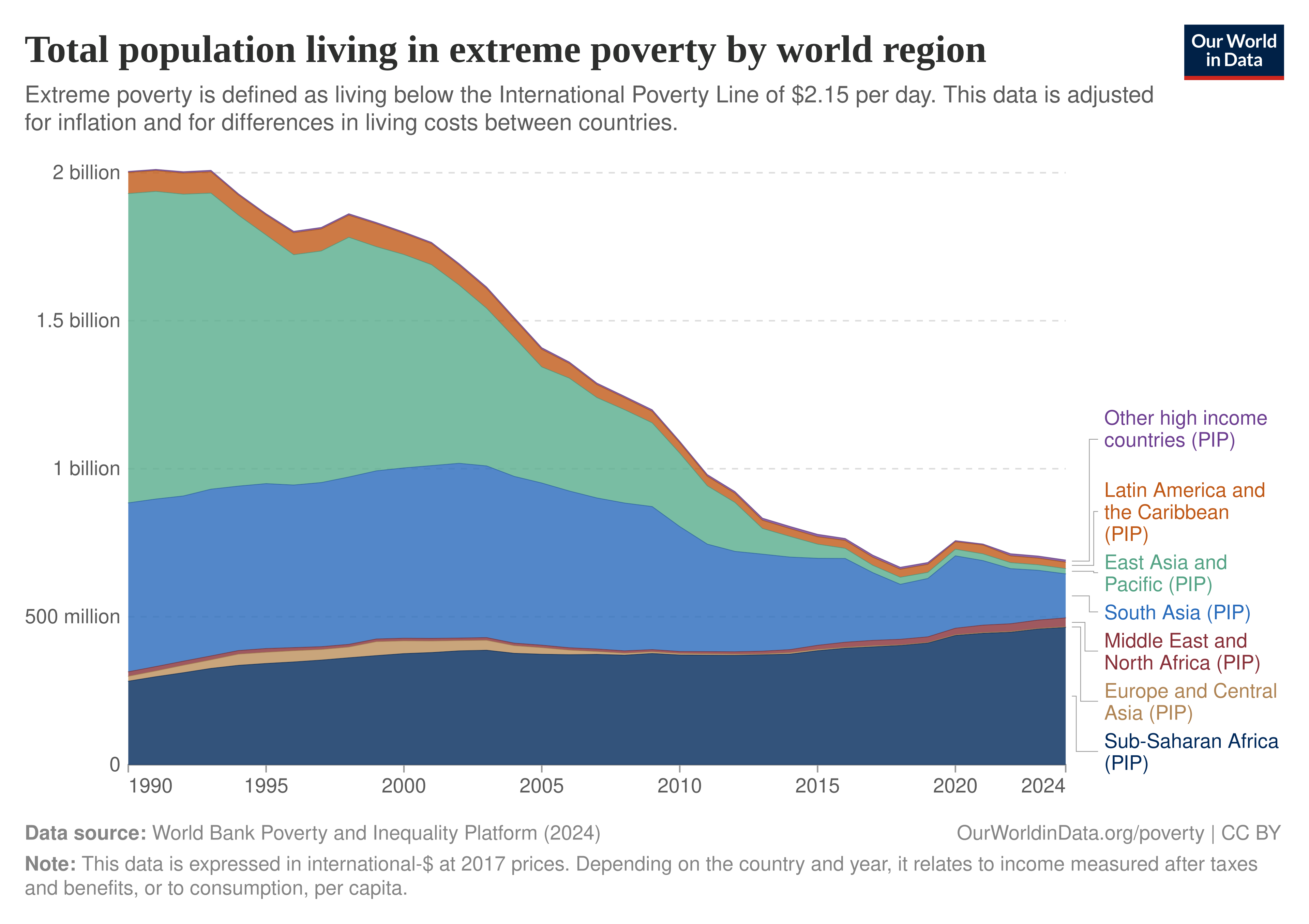
But there’s a huge need for very much more of it.
And I don’t think it’s enough to simply hope for progress to come from technology companies and developers of technology. There’s a need for people to actively champion progress, and to combat neo-Luddism, degrowtherism, Malthusianism, third worldism, neo-decolonialism, and other regressive ideologies.
No posts
Comments
Nothing yet. Say the first thing.
Sign in to join the conversation.