
Lately I’ve been pondering the indeterminate line between poignant and cringe. What moves one person to misty-eyed sympathy moves another to groans, making the line a maddeningly subjective one. For instance, I’ve seen both the following images posted, without a smidge of irony, to social media:

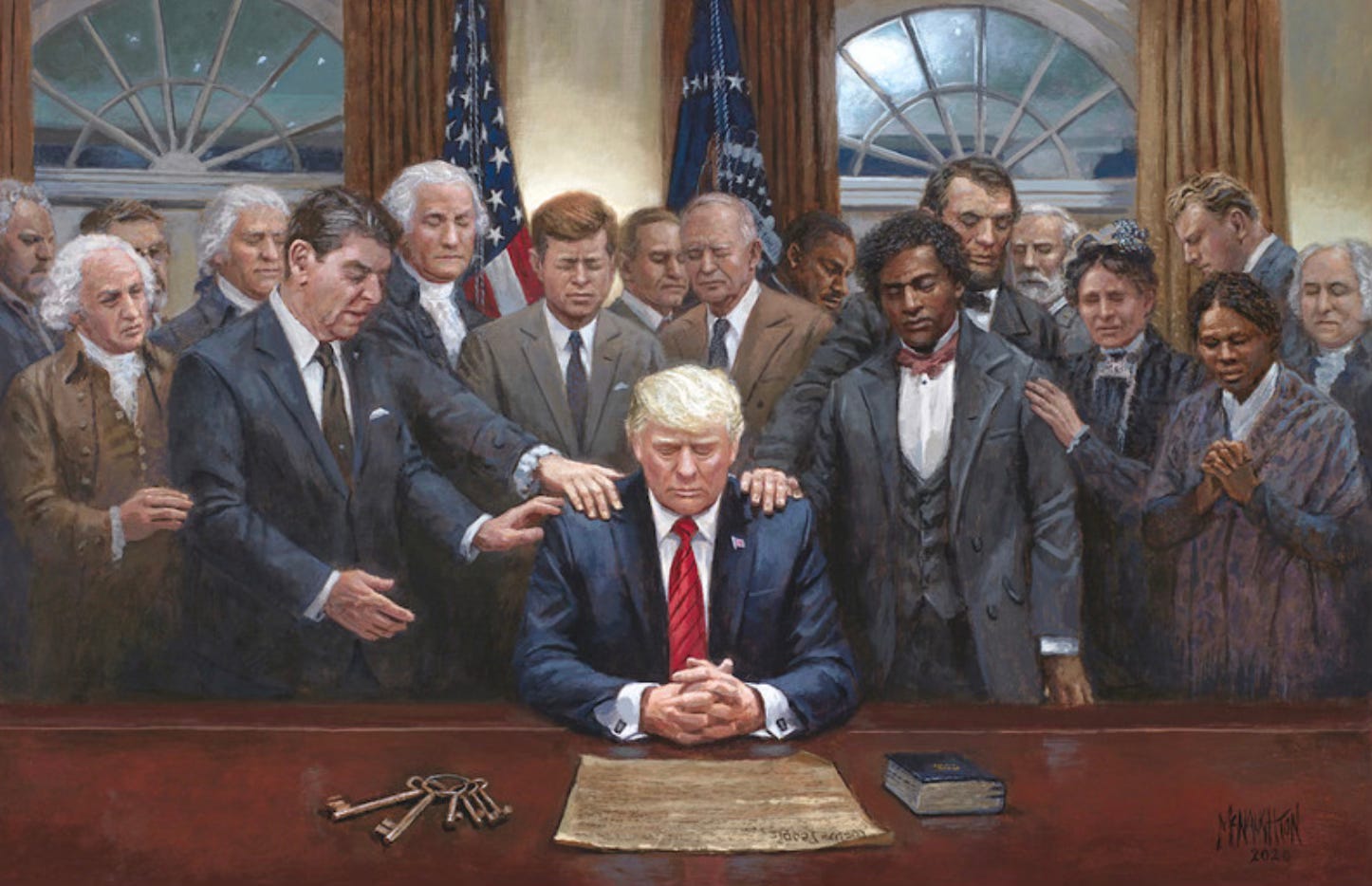
To my mind, both of these images are cringeworthy, your basic Grade AA American cheese. Yet they obviously struck a genuine emotional chord to achieve such visibility, much in the same way popular engravings commemorating the deifications of Presidents Washington and Lincoln once struck a genuine emotional chord with the American public:
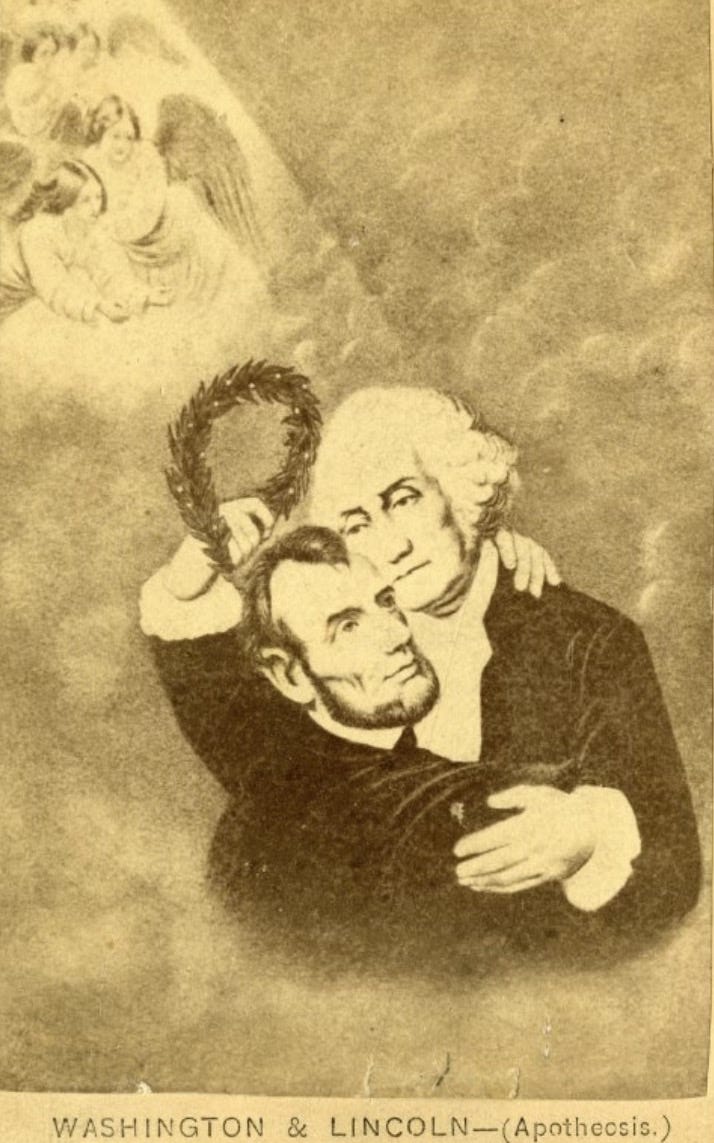
It seems the idea of past generations of politicians bestowing their blessings upon the present one still resonates. So why are the modern images so cringe? Is it the ridiculousness of our current crop of politicians as compared to a Washington or Lincoln? Or does the passage of a century or more make the Apotheosis of Washington & Lincoln seem touchingly naive and folksy?
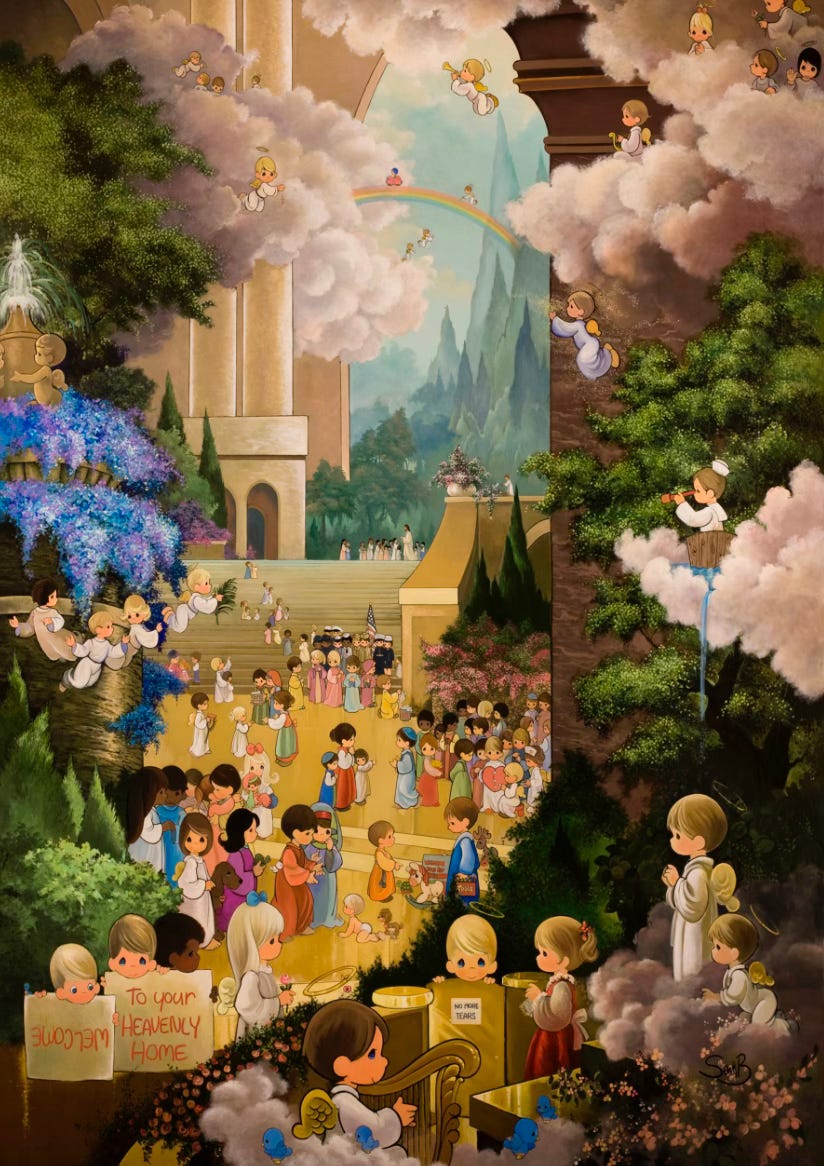
Perhaps it’s hardest to suss out the difference between poignant and cringe when it comes to devotional art (for purposes of this post, I’ll keep it to visual art). I think most would agree that the Precious Moments Chapel in Carthage, Missouri is fairly cringe-inducing. (My apologies if you’re a fan. To each his own.) In fact, I’d argue the mass-produced, commercial nature of those bulb-headed, teardrop-eyed Precious Moments tykes qualifies them as not only cringe, but kitsch.
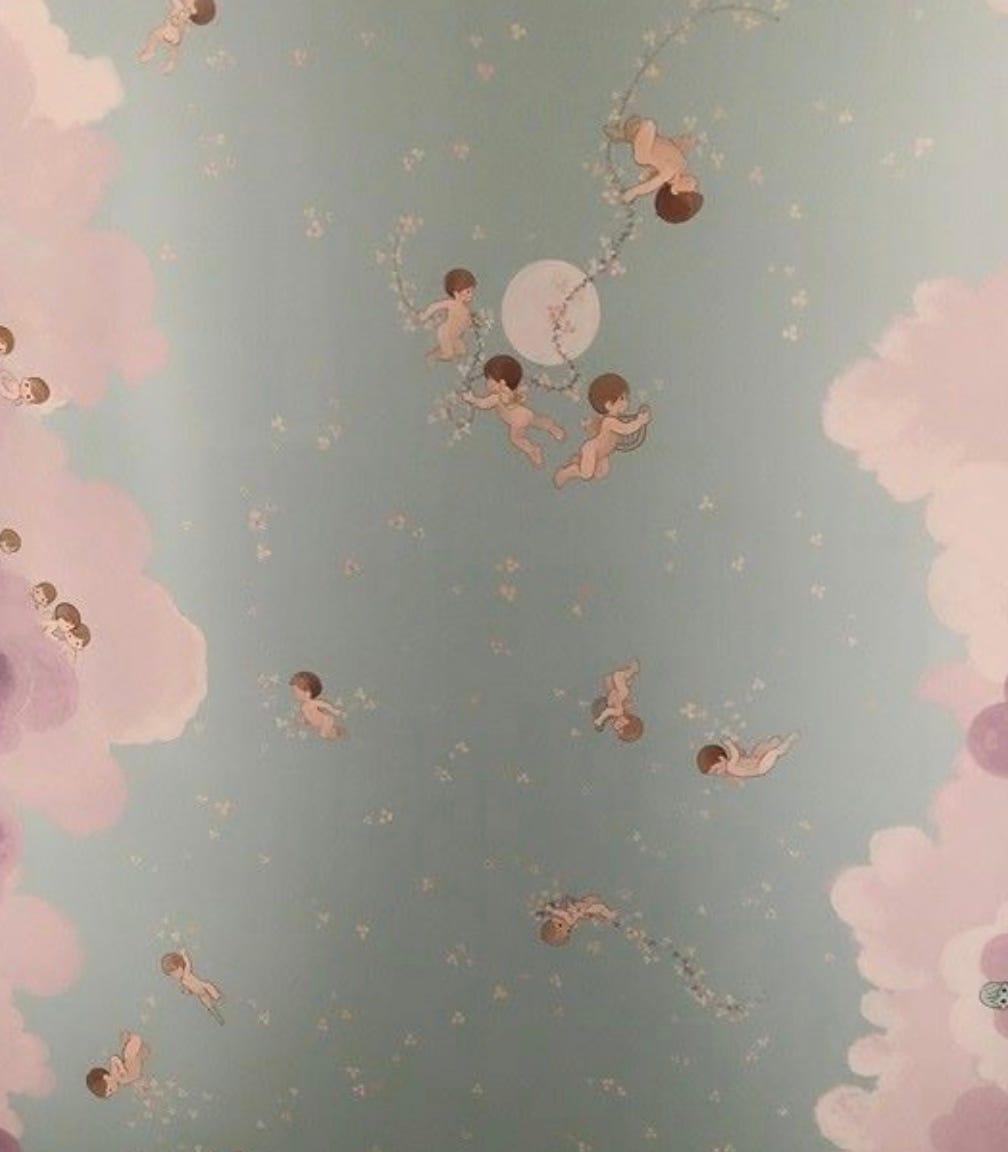
The ceiling of the Precious Moments Chapel features cavorting cherubs, recreating a Baroque fresco like this one, painted by Peter Paul Rubens:
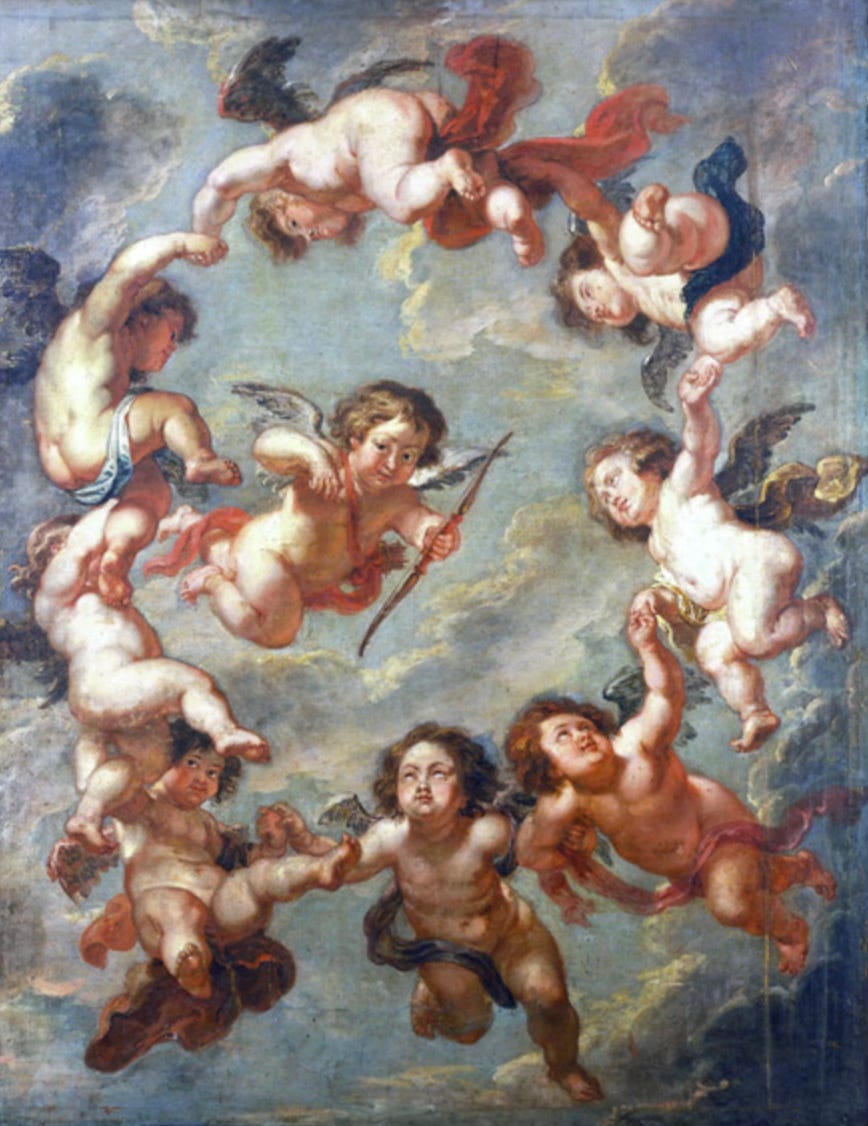
Yet an artist and critic such as Hilary White might argue that the Rubens fresco, for all its technical mastery, is also cringe: an over-sentimentalization and paganization of Biblical angels into cutesy-poo putti, a work created more to inspire awe at Rubens’ trompe l’oiel skills than spiritual awe at God’s heaven.
So what’s a truly devout artist to do? When does art glorify God and evoke mystery, and when does it become — well, a bit too much?
In considering that question, let us examine the English painter William Holman Hunt and his rendering of what one viewer described as “a peculiar goat.”
William Holman Hunt — along with Dante Gabriel Rosetti and John Everett Millais, his fellow art students at the Royal Academy of Art — was a founding member of the Pre-Raphaelite Brotherhood. The group rejected the Royal Academy’s emphasis on Classicism, the late-Renaissance movement that drew upon the balanced compositions, stock poses, and dignified emotion of Greek and Roman art. No other artist embodied Classic ideals quite like Raphael . . .
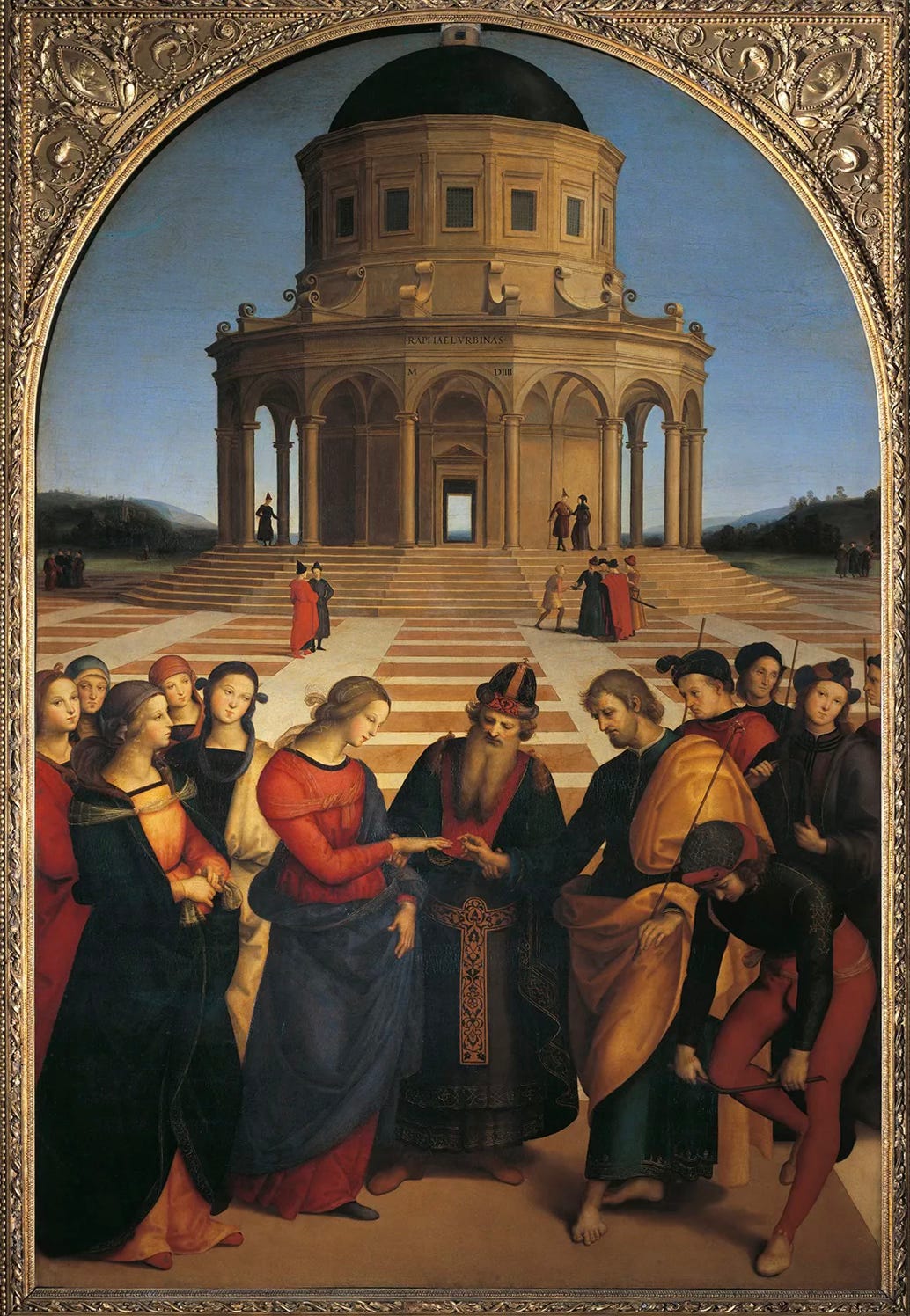
. . . which is why Hunt and his brethren reacted against him. Believing Classic aesthetics had grown stale, they championed art that was executed masterfully, yet full of earnest feeling, fresh symbolism, and accurate detail. As such, one of the Pre-Raphaelite tenets was “to sympathize with what is direct and serious and heartfelt in previous art, to the exclusion of what is conventional and self-parading and learned by rote.”
Hunt’s work certainly lived up to that ideal. Like Raphael, he painted Christian themes with great sensitivity. But whereas a Classicist would have restricted himself to the standard subjects — say, Madonna and Child, or Jesus on the Cross — Hunt’s subjects were innovative for the time. His The Light of the World portrays Christ standing before a door with his hand raised to knock, illustrating the promise of Revelation 3:20: “Behold, I stand at the door, and knock: if any man hear my voice, and open the door, I will come in to him, and will sup with him, and he with me.”
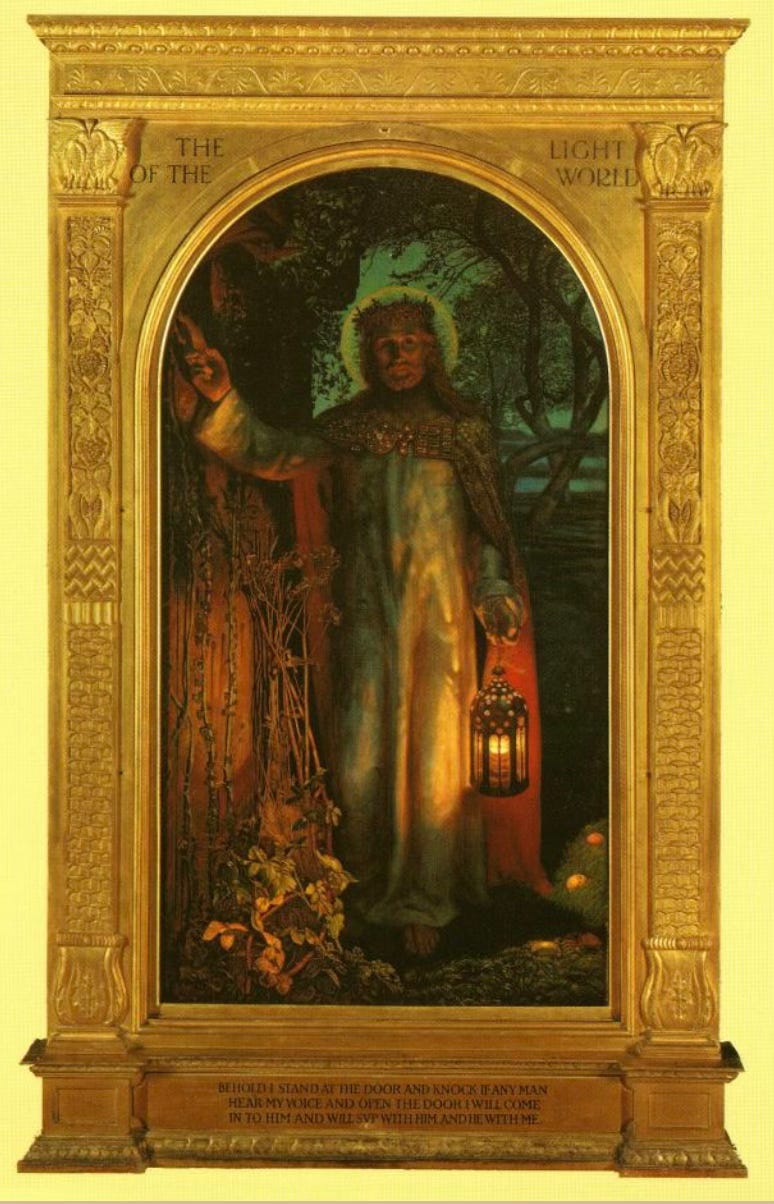
As blogger Maria Christina notes:
The verse is an unusual subject in Christian art. For centuries, many painters preferred to focus on more dynamic Biblical subjects. In my opinion this is because artists and their patrons naturally gravitated toward better-known Biblical stories that would be easily recognized and understood by [often illiterate] viewers (such as the Annunciation, the Crucifixion, and the Nativity).
What’s more, Hunt really pushed boundaries by exhibiting The Light of the World in 1854 alongside a companion piece (and arguably his most famous work), The Awakening of Conscience.
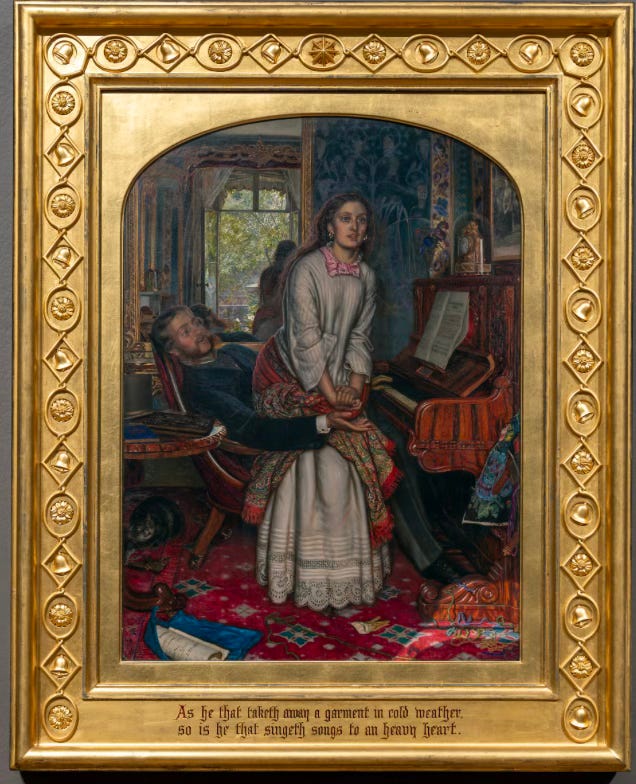
The Awakening shocked Victorian viewers with its depiction of a kept woman rising from her lover’s lap, an epiphany dawning upon her face. Viewed alone, the woman of The Awakening seems to abruptly realize her morally compromised status as mistress to a married man. But viewed with (and directly to the left of) The Light of the World, the source of her epiphany is obvious. Christ is knocking on the long-forgotten door of her conscience, which has no outer handle; it is now up to her (and by extension, us) to open the door and let Him in.
After the success of The Light of the World, in 1854 Hunt traveled to Jerusalem to paint additional Christian works. Most painters would have been content to crank out another Madonna from the comfort of their European studios, but Hunt bucked convention, striving to depict less-common Biblical subjects using the actual people and landscapes of the Holy Land for inspiration.
And here’s where things got kooky.
Hunt’s initial plan was to paint The Finding of the Savior in the Temple, illustrating a twelve-year-old Christ astounding the rabbis of Jerusalem. Hunt wanted to use local Jews as models. The problem? The locals had religious objections to having their portrait painted, especially for a picture that seemed likely destined to end up in a church and turned into an object of worship.
So Hunt fell back on Plan B, or, if you prefer, Plan Baaa!: He would instead paint the scapegoat of Leviticus 16, the one expelled by the Jews into the wilderness to expiate their sins. He would bridge the ritual sacrifice of the scapegoat for the Israelites with the sacrifice of Christ for the world. And he would capture the utter desolation of that sacrifice by painting on location, in the bleak and inhospitable salt flats of the Dead Sea — specifically, at “Usdum,” a place believed to have been Sodom.
The endeavor had its trials. According to his autobiographical account in The Contemporary Review of 1887, Hunt set off for Usdum by mule, accompanied by Arab guides and muleteers with whom he could only crudely communicate. The goat he brought as his model was “provokingly blatant.” Also provoking was Nicola Beyrouti, Hunt’s Arab servant, who feared being robbed by local marauders. Nicola’s fear was entirely reasonable, as it turned out, but Hunt was having none of it. I’ll give you Hunt’s own version of the story, which seems just a teensy bit self-aggrandizing:
[Nicola] was in full tears like a great baby, and he ducked his head as though to avoid some real attack. He was a well-grown man, five years older than myself, and to see him behaving thus made me angry.
“What is the matter with you, O madman?” I said. “There are robbers,” was his reply. “Where?” “All about us; do shoot, I pray, ya Khowagha” — bobbing down to the saddle all the while. “I am not such a fool,” was my reply. “Here, I will ride behind you, and keep you safe from danger.”
I had already taken up my place of rearguard when I was struck with stones in two or three places at once, and my horse swerved from a blow . . . The trees enshrouded men who were following up and pelting us. I held up my gun against the sky, cocked the two triggers, and shouted out, “Now I am ready to kill the first man who shows his head!” Our enemies held their hands . . .
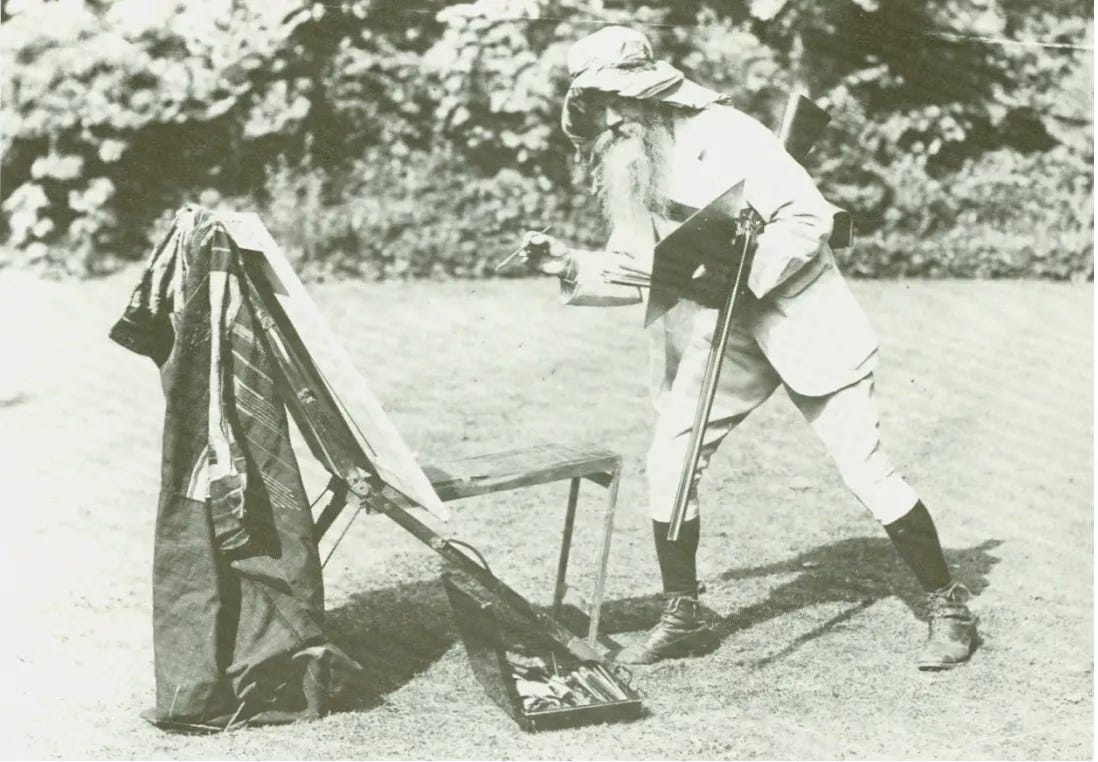
After this totally-not-exaggerated incident, Hunt and his party set up camp approximately two miles from Hunt’s painting site. This meant he had to trek two miles twice daily, lugging canvas, supplies, and (presumably) goat with him. After nine days of work, he fell ill; short on food and without medicine, he opted for a glass of arak, which caused him to sleep “so soundly that the goat came in and overturned everything for food without waking me.”
Hunt recovered and continued painting until bad weather forced him to head back to Jerusalem. Sadly, though, there was baaaaaad news on his return: The goat died. “Provoking” though he was, the goat was also “rare” and “expensive” to replace because he was white — unusual for the Levant. Still, a replacement was secured and Goat II posed in Hunt’s studio, “surrounded by rocks, mud, and crusty salt” brought back from Usdum.
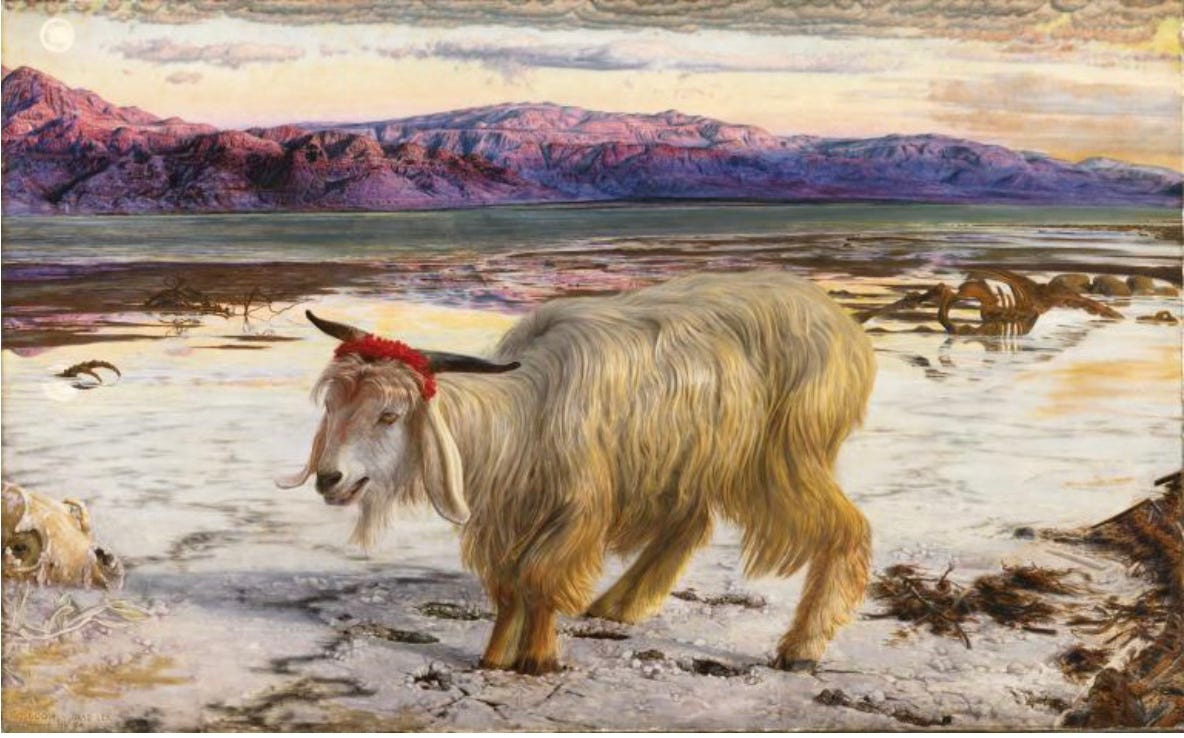
Ultimately, Hunt didn’t complete The Scapegoat until 1856, working from his London studio. He then submitted the painting for exhibition at the Royal Academy.
The viewer reaction was divisive, to say the least.
Then as now, The Scapegoat is one of those works that inspire lovers and haters. Unfortunately for Hunt, his initial audience was mostly in the “hate” camp. Why was that?
As art critic Waldemar Janusczczak has noted, The Scapegoat is undeniably a “creepy” painting. The mountains of Edom are rendered in an otherworldly purple against a yellowing sky. The rising moon, combined with the skeletal remains strewn across the salt flats, emphasize the goat’s demise is at hand.
And as for the goat? Let’s face it, he’s deeply weird. On the one hand, he’s hyper-realistic, each and every strand of his coat visible. On the other hand, he’s not realistic at all, his eyes and mouth contorted in an expression of agony that’s not very goat-like. (I speak from personal bias here. I grew up around goats and can attest that they’re not exactly emotive animals.)
The critic and champion of the Pre-Raphaelite movement, John Ruskin, was underwhelmed, stating that Hunt’s placement of the goat dead-center in the canvas made it look like a merchant’s sign. (But for what kind of business, I wonder? Maybe a pub; The Thirsty Goat sounds like a good watering hole.) Hunt’s art dealer, Ernst Gambart, was understandably disappointed to be presented with a painting that had little chance of selling: "I wanted a nice religious picture and he painted me a great goat."
And the reviewer for The Athenaeum magazine was peeved by Hunt’s portrayal of the goat as a “type of Savior,” despite the explicit reference to Leviticus that Hunt carved into the painting’s frame. Indeed, the reviewer scoffed at Hunt for assigning so much spiritual significance to an animal so undignified, as commonplace as “the sheep that furnished our yesterday’s dinner.”
At bottom, this was the crux of the negative critical response to The Scapegoat: As a stand-in for Christ, a goat is just . . . well . . . goofy, because goats are fundamentally goofy animals. They have goofy sideways pupils, goofy beards, and their bleating is not only goofy but annoying. Or, as the scholar Albert Boime more elegantly puts it: “The hapless animal, in addition to its load of transgressions, had to carry the meaning of the picture. . . . Hunt’s quadruped demanded from the beholder the scrutiny accorded in its time to ambitious history painting.”
If there’s any crude sorting mechanism to separate the genuinely moving from the genuinely cringe, then this has to be it: Cringe forces the ordinary, the unserious, the goofy, to carry a symbolic and emotional load far beyond its capacity. Ergo, The Scapegoat is cringe because it overburdens a “hapless quadruped” with more meaning than its spindly legs can rightly bear.
The goat isn’t to my liking, and, like Ruskin, I think the painting would have been stronger if Hunt hadn’t placed the animal front-and-center. A better choice would have been to depict the goat turned away from the viewer and at a distance, feebly walking towards his fate. The truth is, there was no need for Hunt to try to convey the despair of being cast out and made to suffer in isolation on the goat’s face. The utter barrenness and coldness of Hunt’s landscape conveys that despair in spades. Or, in the words of Janusczczak (who is decidedly not a fan of Hunt):
. . . the colours of the land throb with psychedelic urgency, and the Bambi cortex of the brain takes an almighty emotional hammering. With no people in the picture to worry about, Hunt is free to convey the charged, dark, miserable meanings he is after with the landscape alone . . .
Janusczczak finds the goat’s agonized expression powerful, hammering home the painting’s message: “[The scapegoat is] there because of you. The sins it carries are yours.” Then again, he viewed The Scapegoat first-hand as part of a museum exhibition, whereas I’ve only seen it on the internet. Perhaps digital screen copies flatten the emotional experience of seeing real art in its intended setting.
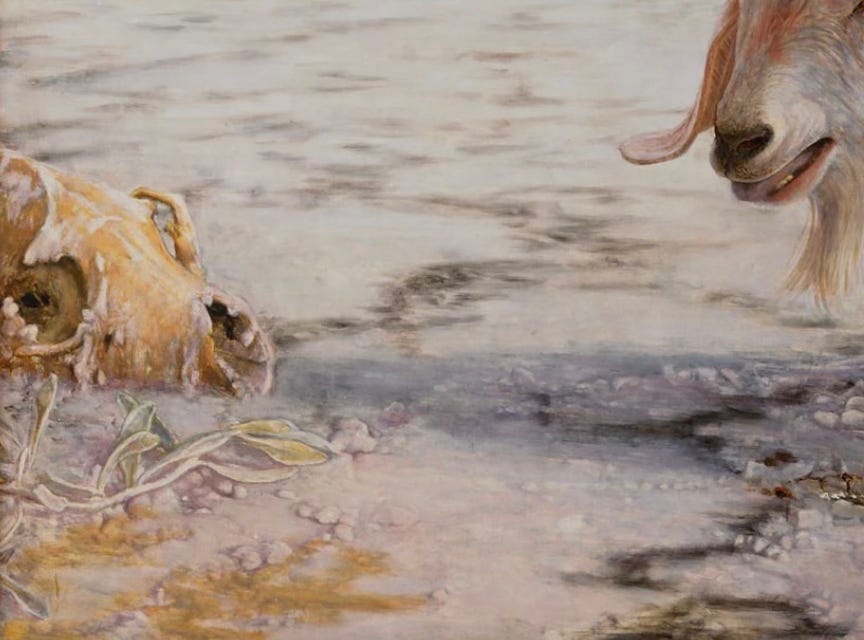
Although I have my doubts. Hunt painted a second version of The Scapegoat, and if anything, I think the second goat appears less goat-ish and more goofy than original:
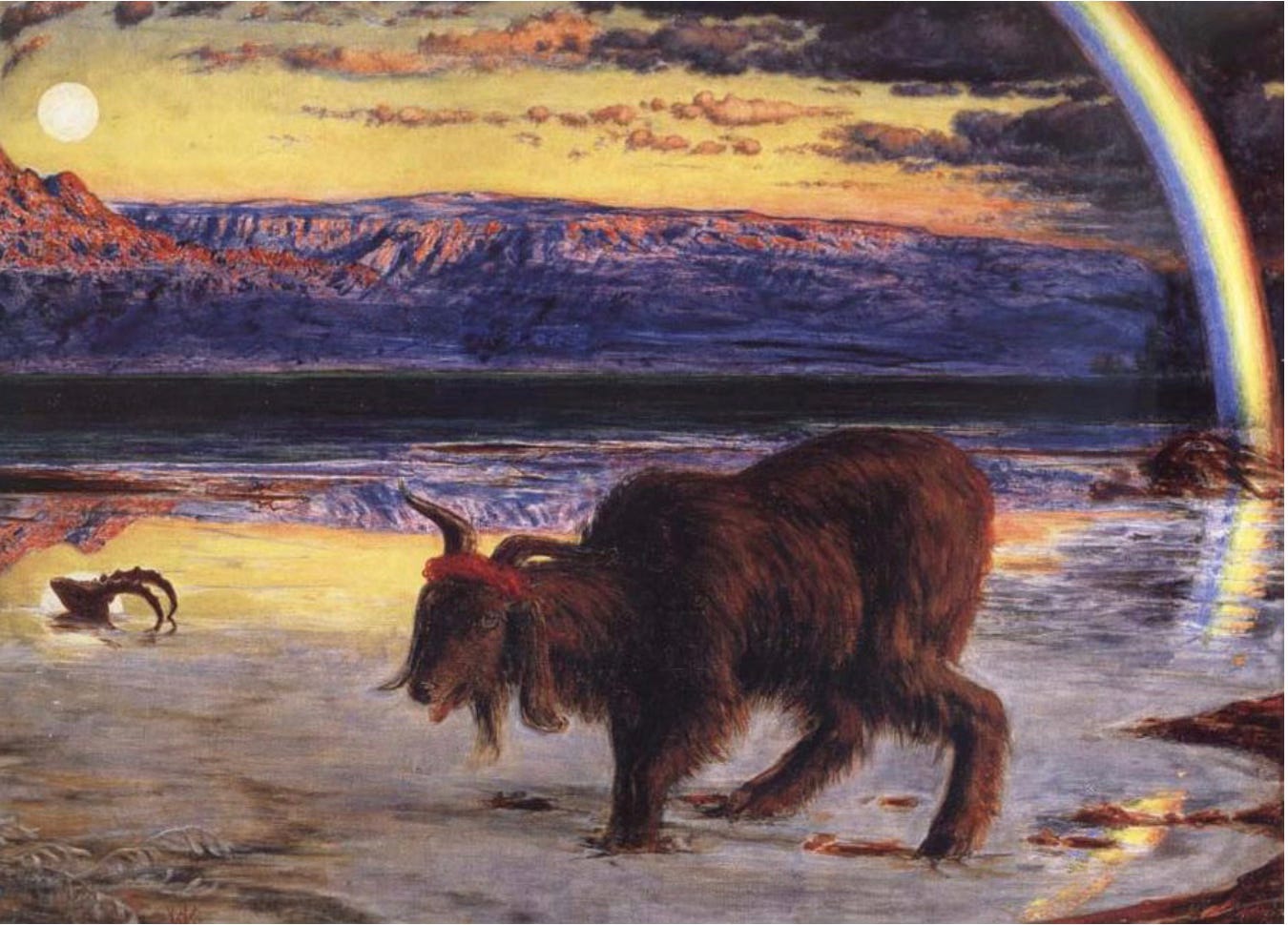
Again, I would classify this as cringe. As devotional art, it fails.
But as the cover of a 1970s sci-fi novel about a distant planet where one rebel slave-goat is exiled to the desert, then plots the revolution that will ultimately overthrow his evil goat overlords?
It’s absolute genius.
No posts
Comments
Nothing yet. Say the first thing.
Sign in to join the conversation.