
A cable signed by Secretary of State Marco Rubio and obtained by the Guardian last month instructed every American embassy and consulate on earth to launch coordinated campaigns against foreign “anti-American propaganda”: recruiting local influencers, working alongside military psychological operations units, and specifically endorsing Elon Musk’s X platform as an “innovative” vehicle for the effort. The directive, issued as the US is at active war with Iran and as Russian and Chinese influence operations continue to target American allies, represents a meaningful escalation in the institutional machinery of narrative management.
It is worth reading carefully -- not primarily as a story about this administration’s politics, on, but because it offers valuable insight into the very practice of propaganda.
The First Principle: Laundering the Source
The directive instructs embassies to recruit “local influencers, academics and community leaders abroad to carry counter-propaganda messaging.” The goal is not persuasion through transparent argument; it is the manufacturing of apparent grassroots consensus. The message must appear to originate from within a community, even when it was authored elsewhere.
This is the oldest trick in the propagandist’s repertoire, and it is not uniquely American. The Guardian notes that the same technique was documented in a 2024 operation attributed to the Kremlin, dubbed the “African Initiative.” The State Department’s Global Engagement Center, before it was defunded by the Trump administration, had exposed that very operation. Now the US directive formalizes the same method for its own purposes. What was called “influence operation” when the adversary did it becomes “public diplomacy” when we do it. The label changes while the mechanism is identical.
This is the first general rule of modern propaganda: launder the source. Power is more effective where it remains hidden.
The Second Principle: The Crowdsource Alibi
The directive endorses X’s Community Notes feature as a tool for “countering anti-American propaganda operations without compromising free speech or privacy.” Community Notes, for those unfamiliar, allows users to collaboratively annotate posts with contextual corrections. It presents itself as decentralized, crowd-driven, anti-authoritarian -- the opposite of state messaging.
This is the second principle: use the aesthetics of free discussion to deliver directed messaging. Propaganda in the 20th century arrived in uniform, through state-controlled broadcasting, from identifiable institutional mouths. Modern propaganda wears the costume of participation. The crowd speaks; the crowd happens to say what is useful. The distinction between authentic crowd behavior and coordinated inauthentic behavior is exactly what makes the latter so effective: it looks like the former.
Whether Community Notes functions this way in practice is a separate empirical question. The point is that its appeal to the directive’s authors is precisely its appearance of spontaneity. A state department endorsement of a megaphone would be embarrassing. An endorsement of a “crowdsourced” correction mechanism is something else entirely.
The Third Principle: Frame Everything as Defense
The cable’s language is worth attending to closely. The US is not launching a propaganda campaign, it is “countering” foreign propaganda. It is not spreading narratives, it is “exposing adversary behavior” and “telling America’s story.” Every action is reactive, protective, corrective. The adversary acts, America responds.
This is not unique to the current administration or to the United States. Every state information operation in history has described itself as a response to someone else’s information operation. The framing of defense is itself a rhetorical move -- it preemptively delegitimizes criticism (”we’re only doing what they do”) and locates the moral weight of the conflict entirely in the other side’s actions.
The trouble is that both sides are usually making the same claim simultaneously. Russian state media characterizes its operations as defensive responses to Western propaganda. Chinese state communications frame Belt and Road information efforts as corrections to Western misrepresentation. The symmetry is not coincidental.

The Fourth Principle: The Infrastructure Is the Message
Perhaps the most significant aspect of the directive is its institutional architecture. The GEC, which previously coordinated State Department and Pentagon information efforts, has been defunded. Its dissolution means that the responsibility for counter-messaging now falls on individual embassies and consulates, many already under-resourced, now formally integrated with Military Information Support Operations -- the rebranded psychological operations unit.
The blurring of civilian and military information functions is not incidental; it is the story. Caroline Orr Bueno, writing in Weaponized Spaces, argues that this represents a shift from counter-disinformation toward something closer to cognitive warfare. Cognitive warfare seeks not to refute disinformation but to operate within a space in which populations’ beliefs are formed, shaped, and interpreted.
This is the fourth principle, and perhaps the most profound one: the aim of information operations is not to defeat the other side’s arguments. Rather, it is to decide what arguments are even possible.

The Precedent Problem
Take note of what is and isn’t new here. The United States has run influence operations continuously since at least World War II — Voice of America, Radio Free Europe, the Congress for Cultural Freedom (covertly CIA-funded), USIA, and the GEC all represent iterations of the same basic project. Recruiting local voices, funding foreign-language media, shaping the narrative environment abroad: none of this is without precedent.
What is new is the combination of several things happening simultaneously. First, the administration disbanded the previously established anti-disinformation structure -- eliminating the GEC, breaking down the FBI’s foreign influence task force, and closing the Counter Foreign Information Manipulation center. The timing of this action suggests more of a dismantling process preceding deployment of a replacement model rather than evolution of an existing approach. Then there is the consolidation of civilian embassy message operations with the Psychological Operations unit, which creates new connections where previous firewalls existed. And finally, the use of a platform run by someone who served in the Obama administration, which has been sanctioned by the EU for deceptive tactics, as a state tool to combat disinformation: this is unprecedented in American public diplomacy.
But the deepest break is epistemological rather than institutional. Previous American propaganda operations, however cynical in execution, operated within a framework that nominally distinguished US public diplomacy from adversary information warfare. That distinction, however hypocritical in practice, did real work. It allowed America to convincingly criticize Russian and Chinese information warfare efforts, support independent media abroad, and position itself as something more than mere propagandist. The exposure of the Congress for Cultural Freedom in the 1960s was embarrassing exactly because it ran counter to those principles.
This directive abandons that pretense formally and in writing. That is what makes it different from its predecessors.
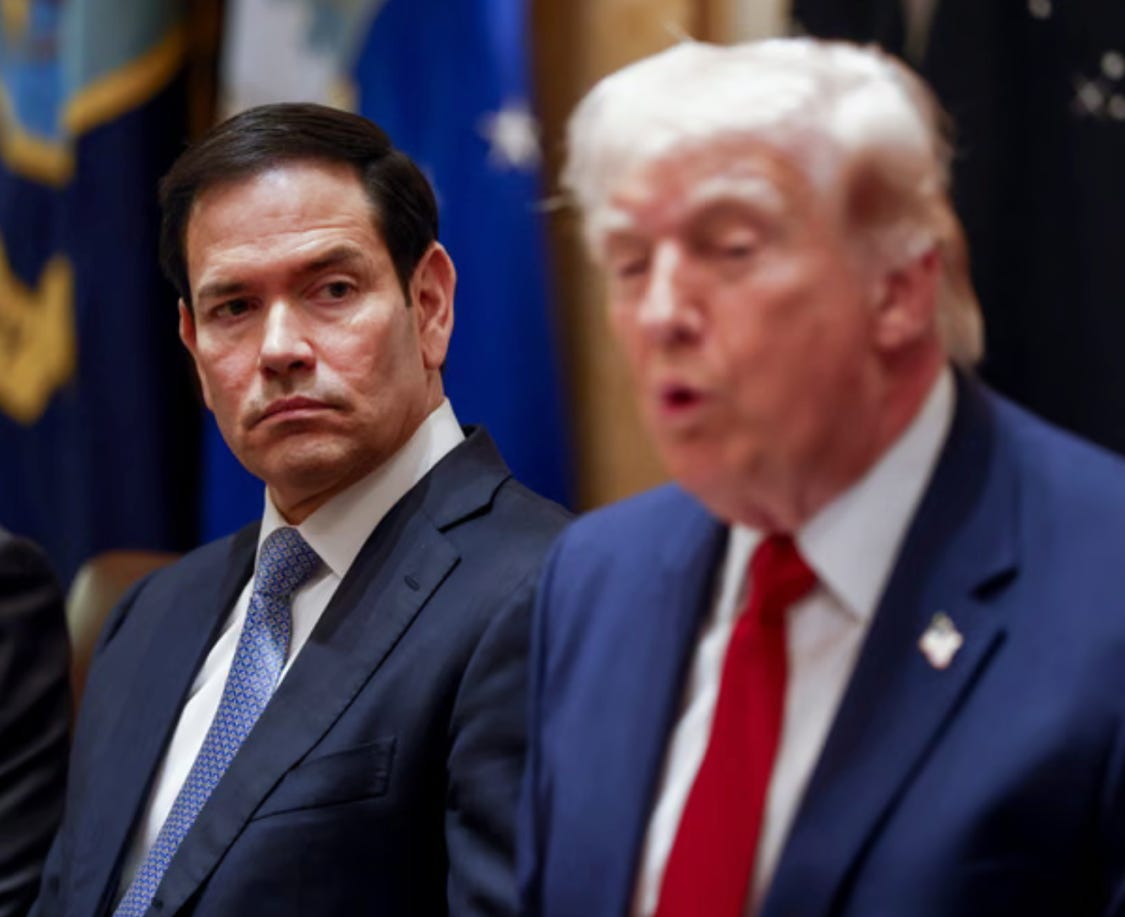
Marco Rubio, the secretary of state, with Trump at the White House earlier this month.
What the Mirror Reveals
There is a genuine problem at the center of this story. Russian, Chinese, and Iranian influence operations are real, sophisticated, and documented. The United States has legitimate interests in not ceding the global information environment to adversaries who use it to destabilize democratic institutions, including its own. None of that is in dispute.
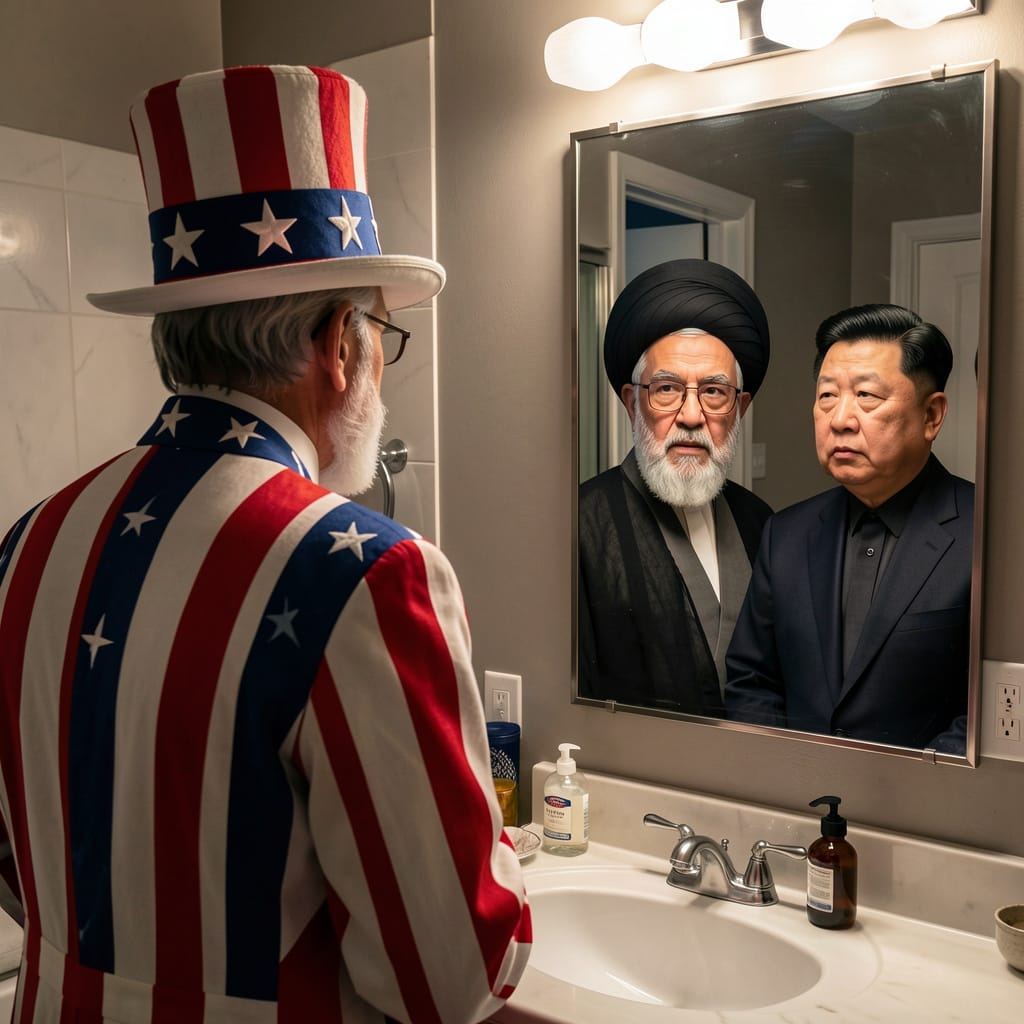
But the directive does something the US will find difficult to undo. It creates an institutional framework, which mirrors perfectly the strategy used by Russia, China, and Iran for many years to achieve their goals in the sphere of propaganda. Recruiting locals. Covert coordination. Crowdsourcing. Defensive framing. Integrating civilian and military messaging.
The mirror image problem in propaganda is not a paradox; it is a warning. Not about hypocrisy. hypocrisy is cheap and universal -- but about epistemology. When both parties employ similar strategies and tactics, there is no way out except recognizing the source and reacting according to whether you trust this source or not. That is exactly what propaganda tries to prevent.
No posts
Comments
Nothing yet. Say the first thing.
Sign in to join the conversation.