
Part 2 (of 7) – Through 3,000 BCE
This timeline of some four millennia starts with the beginning history of rice (now the most consumed food by caloric intake globally), offers just a teaser for the grape and wine record, runs through beer, wheats, peaches, peanuts, garlic, citrus, chocolate, sweet potato, and carrots, and ends with an explosion of agricultural firsts. Plus, an interesting teaser to “chewing gum.”
.
“Speciation” — Plants, just as all living organisms, have evolved over millions of years. This happened in one of two ways or in both ways.
The first, called simply “speciation,” is when populations of the same species become isolated from each other and acquire independent traits, mutations, and adaptations until they can no longer interbreed to produce fertile offspring. This is the familiar, and somewhat simplified, strategy of evolution.
The second, “hybrid speciation,” begins when interbreeding between two different species creates a group of individuals with a new, distinct genetic coding, yet with the potential to further interbreed. The next and most critical step is isolation from the parent plants to prevent regressive interbreeding with those parents. This is where the nomadic hominids came in. They carried the seeds of the hybrid plants far from where the parent plants exist. Then they culled each of the new generations of the plant, selecting those plants that adapted best to their new environments and those plants that suited the needs of the humans who planted them. Over time, the new plant became stable, that is, Unlike ordinary speciation, which could take millions of years, hybrid speciation might get it all done within a millennia (gross simplification to illustrate a point).
It can happen much faster. Sometimes a hybrid can inherit multiple sets of chromosomes from both parent species (it’s called allopolyploidy, a say-it-fast-three-times kind of word). In such cases, it pretty much creates a potential new species right away because that new plant cannot breed again with either of the parent species. This, too, is a human-induced “evolution” due to two plants being planted in a place where they do not naturally overlap, or one plant being planted close to another species of the same genus that evolved in another direction many millions of years ago. Or, more radically, being planted next to a plant that evolved in isolation into another genus. Both happen commonly in plants today, albeit the two-genus crossing is not so common.
In botanical nomenclature, a hybrid species is also called a nothospecies (“notho” meaning hybrid in this new word, although “notho” is from the Greek for bastard).
You’ll find the word “cultigen” smattered throughout these chapters. It refers to all the plants that humans have altered or selected in some way. That includes conventional plant breeding and any form of genetic modification. If the cultigen has a commercial name, it’s usually the nothospecies name. Human-made plants, essentially.
This is not to be confused with the term “cultivar,” which is a selected and almost always commercially named cultivated variety of a plant species or a hybrid of two species; it is recognized as a formal category in the International Code of Nomenclature for Cultivated Plants. Cultivars are one of three categories of plants within the term cultigen; the other two categories being “Group” and “Grex.” I’ve opened that door and I just might close it. Later.
The abbreviation “ca.,” as used in the historical context here, represents “approximately equal to” or, simply, “about.”
.
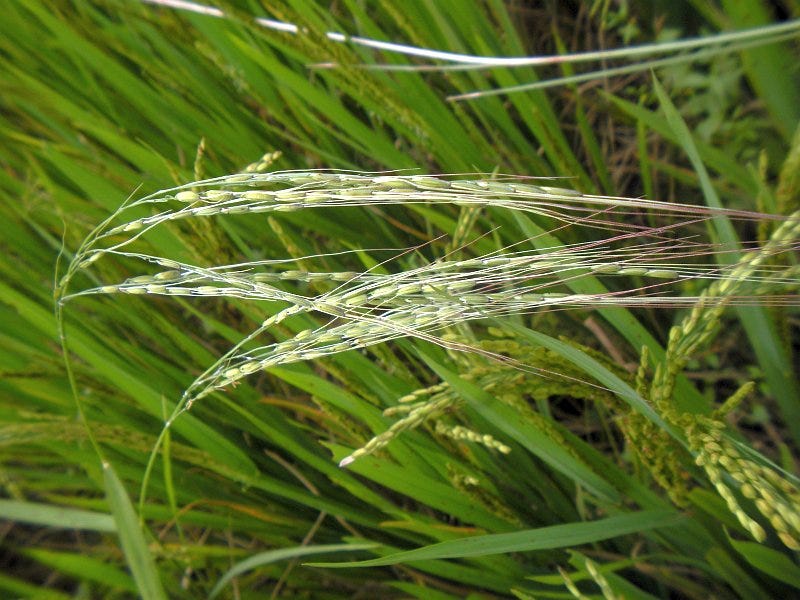
ca.7,000 – 4,000 BCE — Brown-beard rice (Oryza rufipogon) grown somewhere in the Yangtze River valleys of China begins its way toward becoming fully domesticated modern rice. The following history includes some hypotheses (not mine, of course).
There was an intermediate stage, maybe two, starting with the non-wild version of O. rufipogon that has also been called Oryza nivara. Oryza nivara (the next stage?) is an annual plant that has been considered:
a synonym of O. rufipogon (a perennial plant), and
an ecotype — the more cultivated and evolved/adapted form of O. rufipogon, having the distinctive expression of a useful, annual growth cycle.
It’s this annual growth cycle of the latter that would characterize the future ancestry of the yet-to-come common domestic rice: Oryza sativa. This new species/form was already being grown (“cultivated” but not “domesticated” or at least not the definitive signs of domestication) well before the first signs of farming villages in the Yangtze River valleys.
Two villages in China, Bashidang and Pengtoushan, would begin actual rice farming in 4,000 BCE.
This Oryza sativa from China would take on the variety name of Oryza sativa var. japonica or O. s. var. sinica. This natural variety is the sticky, short-grained type familiar to Asian populations and those who like good Asian food.
6,400 (probably) but 7,250 (maybe) – 1,500 BCE — Rice. New findings at the Lahuradewa archaeological site in Sant Kabir Nagar district, Uttar Pradesh, India. Still in discussion: did the dated/tested samples come from wild stands (of Brown-beard rice [Oryza rufipogon]), cultivated stands (of Wild Indian Rice [sometimes recorded as Oryza nivara]), or stands (of a domesticated Oryza sativa)?
5,440 – 4,530 BCE — Rices (Oryza rufipogon and, maybe, O. nivara) were cultivated within the Vindhyan Ranges along the Ganges River Valley (earliest) and the Belan River in northern India at sites such as Chopani-Mando and Mahagara.
3,500 BCE – 2,000 BCE —Migrations of the Austronesian Dapenkeng culture into Taiwan, introducing rice culture.
Sometime between 3,500 and 1,200 BCE — Domesticated rice would be introduced to Korea and Japan.
ca. 3,000 BCE — Rice found in the Mekong River basin, Vietnam.
ca. 2,500 - 2,000 BCE — Asian rice (Oryza sativa var. japonica) arrived in India and Oryza sativa var. indica rice arose when japonica hybridized with the wild Oryza nivara (if there is such a thing) or an undomesticated “proto-indica” species akin to O rufipogon. This is considered “full domestication.” T
Indica is another modern version of rice via further hybridization and speciation. It is the non-sticky, long-grained rice variety. Its strains/cultivars are mainly lowland rices grown on very wet lands throughout tropical Asia.
A short list of modern-day rice selections within each variety:
Japonica types:
Arborio, Carnaroli (risotto rices)
Black rice
Calrose (medium-grain)
Koshihikari (Japanese short-grain)
Mochi rice or sweet rice (a glutinous form)
Sushi rice (labeled)
Indica types:
Basmati
Jasmine (Thai hom mali)
Long-grain white
Thai sticky (a glutinous form)
2,000 to 1,500 BCE — Austronesian settlers from Taiwan moved south to colonize Luzon in the Philippines, then westwards to Borneo, the Malay Peninsula and Sumatra, and then southwards to Sulawesi and Java.
2,000 – 1,500 BCE — Many of the Tai peoples (an ethnolinguistic group) likely originated in southwestern China, possibly in the Yangtze River Valley, as well as in northern Laos, and/or Vietnam with later settlements in northeastern India. They migrated in waves into Southeast Asia beginning ca. 2,500 BCE.
>1,500 BCE — The first evidence of domesticated rice (possibly both var. japonica and var. indica) in Thailand is from the coastal site of Khok Phanom Di (Chonburi Province, Central Thailand, on the eastern margin of the Bangkok Plain, in the lower Bang Pakong River basin; not far from what is now Bangkok).
.
As I was writing this chapter that covers 7,000 BCE to 3,000 BCE, I had originally included the origins of grapes and wine — or wine and grapes, a chicken-or-egg thing. But this one entry in the chapter became so big unto itself, even in its abbreviated version, that I decided to post it separately very soon after this post.
.
Comments
Nothing yet. Say the first thing.
Sign in to join the conversation.