

A sauna at a Finnish summer cottage. Author photo.
I don’t remember a client ever telling me their taxes were too low in my four decades of tax practice. Quite the opposite, in fact, and often emphatically.
That may not be entirely a reflection of my professional competence. Gallup has for years polled on whether respondents’ own taxes - not those in general - were too high, too low, or about right. Respondents consistently report that their own taxes are too high.
In fact, “too low” polls below the Lizardman’s Constant - the four percent of poll respondents who opine that the world is secretly run by shape-shifting reptile people. It’s not clear what the overlap of these two groups might be.
The Lizardman hypothesis may seem outlandish, but not that much more so than believing current, or even higher, federal spending is sustainable at current tax levels - and not just on the rich. Without cuts in spending - and that means Social Security and Medicare, whether you like it or not - bond markets could force tax increases that will make us long for the low-tax days of the 2020s.
What would that look like? The tax system of my favorite European country, Finland (though not my favorite European tax system), may give us a glimpse of our tax future.
Let’s start with taxes on wage and salary income. We will look at it in terms of the “tax wedge,” a fancy way of describing the difference between what it costs to employ someone and the amount the employee gets to keep after taxes and mandatory social contributions1 (mostly what we would call payroll taxes in the U.S.) paid by the employer and employee.
This chart uses figures from the OECD report “Taxing Wages 2026.” The OECD report estimates tax wedges using tax and labor rules in effect in 2026. The chart applies the OECD average worker tax wedge percentage for a hypothetical single employee in Finland and the U.S. to a total employer cost of $80,000.
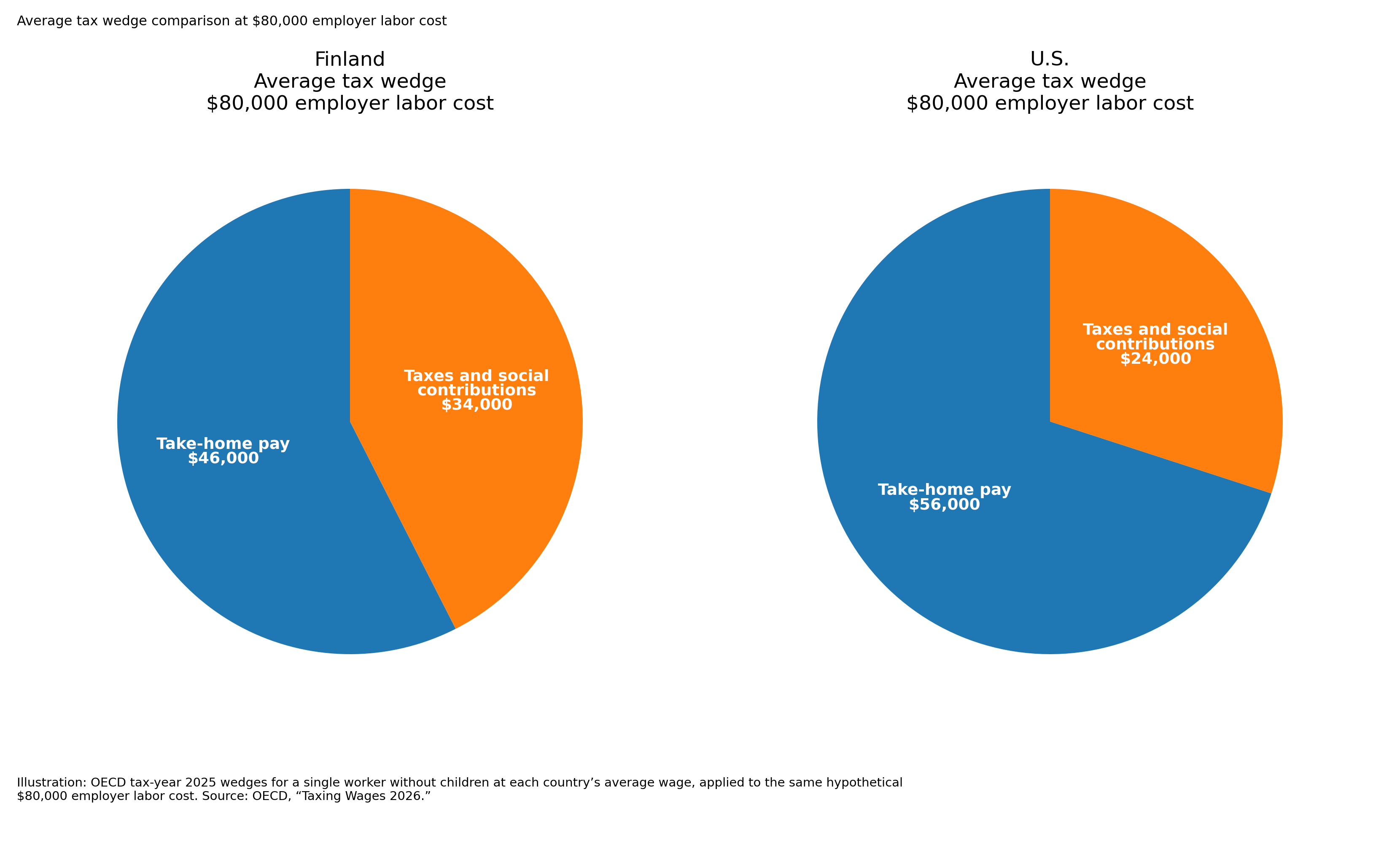
The OECD estimates the tax wedge for a single Finnish worker earning the average gross wage to be 42.5 percent, meaning the employee would take home about 57.5 percent of the employer’s cost of employing her. The comparable U.S. worker would pocket 70 percent of the employer cost. The difference is due to taxes and mandatory employer and employee social contributions.
The chart applies an average wedge. The marginal wedge - the amount of each additional dollar of labor cost attributable to taxes and mandatory social contributions - is higher. If the Finnish worker gets a $1,000 raise2, she would pocket $436 of the employer cost, while the American would take home $592.
Of course, income is only part of the equation. You earn income so you can spend, save, or donate it. Let’s say our worker wants to buy a new Mazda CX-5. While the models sold in Finland and the U.S. are not identical, they are close enough for a rough comparison.
In this case, the base model, before taxes, costs about $29,741 in Finland and $29,990 in Illinois. Let’s compare the taxes that our heroine will pay to take home the vehicle:
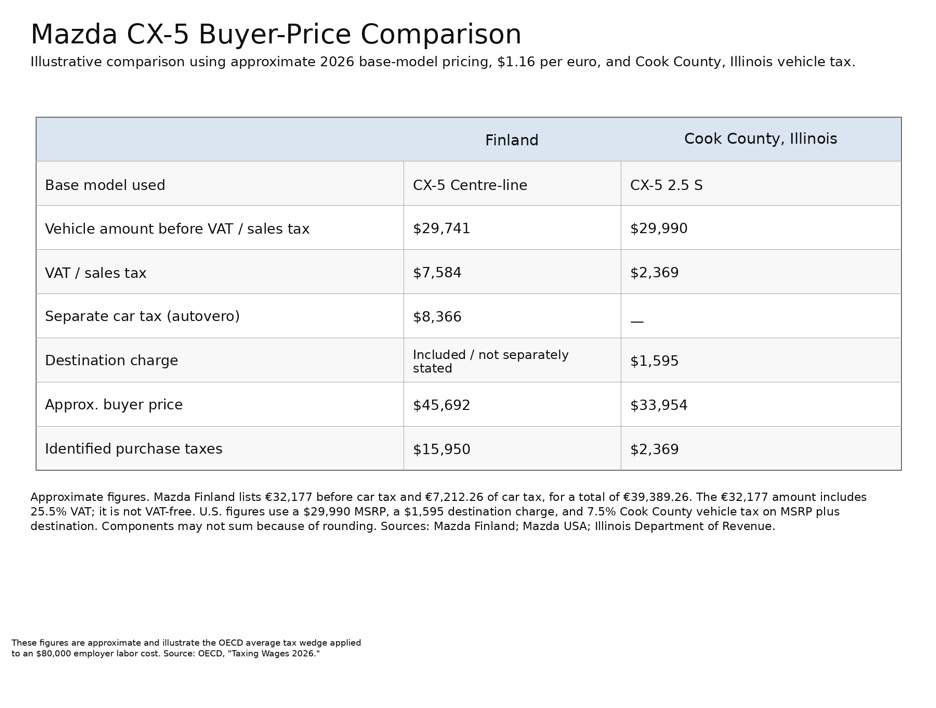
So our worker takes home less, but is out of pocket over $13,000 more in taxes for the base model car - or more likely, buys a cheaper car.
Let’s say our worker has a sympathetic father who wants to give her $20,000 to help buy the car. The U.S. Dad would be required to file a Form 709 to report the gift (and perhaps wouldn’t bother), but would be about $15 million short of the amount of lifetime gifts that would trigger U.S. gift tax.
In contrast, our Finnish heroine would pay $1,020 in gift tax: €100 once gifts reach €7,500, plus further gift taxes on a graduated schedule starting at 8 percent of the amount over €7,500.3 Finland has no U.S.-style lifetime exemption.
In addition to all of this, Finns pay a three percent tax on real estate purchases, a 1.5 percent tax on apartment purchases4, and much higher inheritance levies than in the U.S. The combined exemption for the 40 percent estate and gift taxes in the U.S. is $15 million; the Finnish inheritance tax is imposed on each heir’s inheritance starting at €30,000.
For this, Finns get a reasonably well-functioning welfare state, with generous health benefits, heavily subsidized (but rationed by test scores and other selective measures) higher education, good internal rail and public transport, and low homelessness - while supporting a big and expanding defense budget.
Yet even with these high taxes, Finland still struggles with substantial and growing budget deficits - though smaller than U.S. deficits as a percentage of GDP.
By contrast, the U.S. is likely to require big tax increases just to pay for the welfare system we have, skewed to comfortable Boomers. It’s not clear that taxes at any level could finance Finnish levels of competent public and welfare services here.
If and when the U.S. faces a Treasury market crisis, it of course wouldn’t just adopt the Finnish tax system. The lesson from Finland is that you need high taxes on the middle class to finance broad middle-class benefits. The rich in Finland pay taxes at high rates, but there is no illusion that they can pay for everything.
Finland taxes the rich at rates comparable to those in the U.S. The key difference is that in Finland the top rate kicks in at less than one tenth of the income level where it applies in the U.S.
Finns face a 37.5 percent rate on taxable wage income over about $60,400 (2026 rates). When municipal income tax and other taxes are added, this can lead to a 52 percent rate at the top. By contrast, the 37 percent U.S. top rate only applies to taxable incomes over $640,600 for single filers. Federal Medicare or Net Investment Income taxes and state taxes can push top-bracket U.S. taxpayers to marginal rates over 50 percent in high-tax states.
The tax increases in America’s future are likely to be heavily skewed to consumption taxes, like a VAT, but might also include many smaller annoying taxes, like car taxes - perhaps sold as solutions to climate change.
Finns have the highest reported level of happiness year after year. Reasonably competent government services might have something to do with it, along with their saunas and lovely summer cottages. I don’t think it’s the tax system.
Unless the U.S. does something to deal with its spending problems, we can look forward to Finnish-style taxes, but without the competent governance, cottages, or saunas.
The views here are mine alone. They are not to be considered the views of any firm, person, faith tradition, polity, organization, extended family, or other assemblage that I am or have ever been associated with. Nothing here is tax advice to you, dear reader.
Finland revised its income tax rates, employment-income credit, and social insurance contribution rates for 2026. These changes are not reflected in the OECD Taxing Wages 2026 report, which is based on 2025 rules. The OECD tax wedge definition includes “compulsory social security contributions.” These are roughly comparable to U.S. Social Security, Medicare, and unemployment taxes and workers’ compensation premiums. The OECD Finnish wedge, but not the U.S. wedge, includes workers’ compensation premiums.
Technically, the wedge that results if the employee receives a raise resulting in $1,000 increased labor cost.
Finland has a €7,500 gift tax threshold, but it is applied to three years’ worth of gifts on a rolling basis. It is paid by the recipient, while U.S. gift tax is paid by the donor. For example, if a Finn receives a €7,500 gift from Dad in year one, all further gifts from him in years one, two, and three result in gift tax to the recipient.
No posts
Comments
Nothing yet. Say the first thing.
Sign in to join the conversation.