
It was 8 p.m. on a Monday. I was leaving Norrsken East Africa in Kigali, tired, hungry, and honestly a little impatient. I just wanted to get home to Nyarutarama, cook something quick, and catch the World Cup. You know that specific kind of rush where your body is moving but your mind is already three steps ahead of you? That was me, that night, walking out into the cold Kigali air with one thing on my mind: home.
I flagged down a Spiro rider parked just outside. “Bro, take me Nyarutarama,” I said, already half in my head, already gone.
“Okay, come,” he said.
We didn’t discuss the price. He knew the route, I knew the route, and neither of us thought that small detail mattered. Not that night. Not with what was coming.
I had no idea I was about to spend the next ten minutes only half listening to a man tell me the heaviest thing in his life, while I nodded along to the wind like it was nothing.
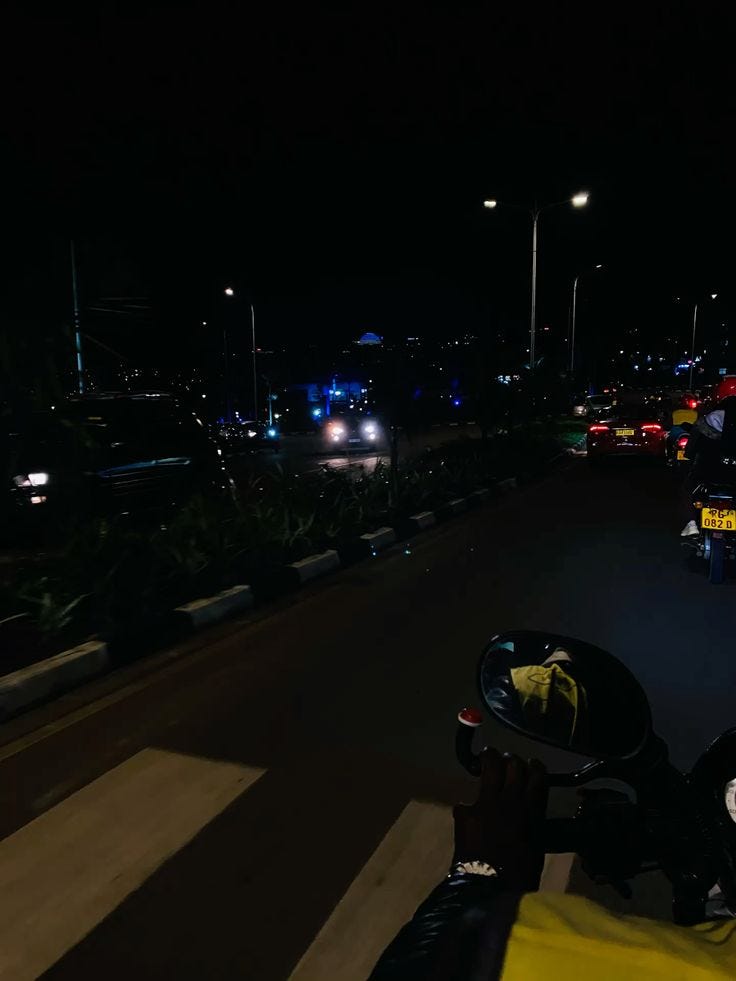
As we pulled off, he asked me the question every motorcyclist in Kigali eventually asks a Norrsken regular. “What do you even do in that place? So many people going in, going out. Foreigners, Rwandans, all day, every day.”
“I’m a marketing manager,” I told him. “It’s a workspace, not a hotel.”
He laughed, and for a moment it felt like any other ride. Wind in my face, city lights blurring past, a stranger’s voice behind me filling the silence the way it always does on a moto at night.
Then, somewhere between Kacyiru and Kibagabaga, something in his voice shifted. He started telling me something longer. Something slower. Something that carried weight, even through the noise. I could feel it change, but between the engine, the wind, and my own head still stuck on rice and football, I was not really hearing him. I was catching pieces, and filling the gaps the way we all do on a bike at night, with the safest, emptiest words we have.
Here in Rwanda, we have all done it. You are on the back of a bike, the wind is loud, the engine is louder, and the man in front of you is telling you something real. But you cannot hear him properly, so you answer anyway, because staying silent feels rude. You just keep the conversation moving with the safest words you know.
So I said “nibisazi bro” when I should have leaned in and asked him to repeat himself. I said “ewww, ntabwo byoroshye” like I understood the weight of what he had just told me, when really I had only caught half the sentence. I said “cyaza bro” the way you say it when you are agreeing with something without knowing what you are agreeing to. I said “reka se” like I was comforting him, when I had no idea yet what needed comforting. I even said “nyumvira kwel” to a story I was not actually hearing.
He kept talking. I kept nodding. I even laughed at one point, at something I still cannot remember, because I was not actually listening. I was present in body, riding on top of someone’s pain, and completely absent everywhere it counted.
Then we reached Mukabuga, close to Nyarutarama, and I heard something that cut straight through everything else.
He was crying.
I sat up straighter. “Bro, what’s going on?”
He did not answer right away. When we finally pulled up outside my gate, he turned around and said the one sentence that has not left me since.
“Bro, don’t you listen to me?”
I did not have a good answer, because the honest one was no. Not really. Not the way he deserved, not after trusting me with something that big while I was busy being somewhere else in my own head. So I told him the truth. “Bro, I did not catch it properly while we were riding. I am sorry. Tell me again. Tell me the whole thing, please.”
And this time, engine off, wind gone, nothing left to hide behind, I listened.
He has a wife and a young son. His son, still small, still innocent to all of this, was diagnosed with cancer in his little toe. The last one. A part of the body so small you would never imagine it could carry something this heavy.
The one small mercy, he said, is that they caught it early, while it was still contained. But early does not mean affordable. The surgery costs around 1.5 million Rwandan francs, and they have no insurance to soften any of it. None.
He told me he has been turning the numbers over in his head every few minutes, for days, maybe weeks. He thought about selling his Spiro bike, the same one that was carrying me home in that exact moment, but then what comes after that? No bike means no income. No income means no way to pay for anything, surgery included. He would be selling the only tool he has to solve a problem this size.
His wife is pregnant. She cannot work right now. There is no second income waiting underneath them if things fall apart. He told me, almost apologetically, that he is not someone who begs, that he works day and night for every single franc he earns. But his son is still in that hospital bed, and pride does not pay medical bills.
He said all of this parked outside my gate, in the dark, with his engine finally off and his voice finally being heard.
I have replayed that ride more times than I can count. How many times has this happened to any of us? How many people have handed us the realest, heaviest thing in their life while we were busy saying “ee bro,” half laughing at nothing, waiting for our stop to arrive?
I do not have a fortune to give him. But I have this, a few thousand people willing to read what I write, and that has to count for something.
If his story moved you the way it moved me, and you want to help him get his son through this surgery, do not look for his number here. Text me instead. I will make sure it reaches him, every franc, every word of support, all of it.
Because sometimes the person carrying you home is the one who actually needs to be carried.
If you read this far, share it. Not for the traffic. For the little toe, for the surgery, for the ten minutes he spent trying to tell someone, and the ten minutes I almost spent not listening.
No posts
Comments
Nothing yet. Say the first thing.
Sign in to join the conversation.