
When I first moved to a village in the Argentinian Andes, the landscape was a mystery to me. I was there for six months, living in with an Indigenous mountain community, where my wife was doing her PhD dissertation field work. The land was rich with new textures and colors, vibrant with species unfamiliar to me. Only a few days into it, I walked with one of the locals, from my perspective threading blindly through the rugged highlands.
My guide walked confidently ahead.
“How do you know where to go?” I asked.
He pointed to the ground.
“I’m following the path,” he replied. “See?”
But I did not see. Not that day.
Months later, the same path was visible to me. The signs had been there all along: subtle shifts in texture, tone, slope, rock, soil, and vegetation. I simply had not yet learned how to see them.
There are patterns in all landscapes.
In our world, we are drowning in information but starving for pattern literacy. Much of what we need to see is already present, but we have to learn how to see it. That raises an uncomfortable question: why don’t we? After all, we grew up here. This is our landscape.
One answer is that the landscape is changing faster than we can easily adapt. Another is that our attention has become unstable at the very moment the world requires greater discernment. Climate disruption, social media, politics, AI, teaching, health, and public life all require a more disciplined way of seeing: one that can recognize real signals without being captured by noise.
And much of the noise is not accidental. Some of it is purposeful. It is meant to keep us lost.
When I peruse the news, I do not usually read it as a sequence of isolated stories. I look for patterns. In the Andean highlands, there were signs along the ground that I eventually learned to tune into. Here, in America, I try to do the same.
That is easier said than done.
Pattern reading can be insight, but it can also become anxiety, projection, or algorithmic capture. The mind is naturally drawn toward connection, but not every connection is meaningful. In a world saturated with spectacle, propaganda, fear, outrage, and emotional fragments, the task is not simply to see patterns. It is to learn which patterns are real.
As people often say, everything is connected. But to navigate the land, we must learn how to differentiate between signal and noise.
Noise is the endless churn: outrage, spectacle, partisan bait, isolated anecdotes, fear loops, and emotional fragments.
Signal is the deeper structure: climate showing up inside insurance, migration, public health, food prices, infrastructure, political instability, and daily experience.
The mature task is not to connect everything to everything. It is to learn which connections matter.
That is the difference between getting lost and finding the path.
Climate is no longer just a distant and detached “climate story.” It is personal now. It appears as heat, smoke, flooding, insurance retreat, crop stress, infrastructure failure, water conflict, migration, disease risk, and economic strain. Because it is everywhere, it can become strangely invisible.
The signal is not absent. It is distributed.
It is so ubiquitous, in fact, that it has become background, and that makes it hidden for most. And that loss is reinforced by systems under stress and efforts to create confusion and incoherence.
For decades, an army of deniers backed by fossil money have engendered mistrust in the institutions of knowledge that actually know what is happening. Their argument has been that science is flawed and scientists are corrupt. And this pattern can also be found in the real of health care, education and so on… Destroying trust is always how fascism arises, it has to make room for itself by first eradicating people’s confidence in civic institutions.
How do I know?
That is what I we look for… the patterns have the most meaning and efficacy. I look to history and compare with the present. I read, explore, open my mind to many points of view, and most important I question my own preset judgements. I recognize that I too have been colonized in mind and spirit.
Don't Believe Everything You Think — Joseph Nguyen
It is not only about trust in science, though the science is critical. It is also about perception itself. How does climate rate among a host of other concerns? Why does climate denial endure? Why do people recognize the heat, the smoke, the floods, the storms, the cost of insurance, the strain on agriculture, and yet often resist the larger pattern tying them together?
To understand that, I have learned to look more broadly. Who benefits from confusion? Who has a stake in delay? What emotional needs does denial satisfy? What cultural stories make some people more willing to reject evidence than to reconsider their worldview?
Climate disruption is a physical reality, but climate denial is also a social pattern. It has stakeholders. It has emotional currency. It has political utility.
If we want to follow the path of understanding, we have to see the recurring patterns, within and without.
Social media trains us to react before we interpret. The feed breaks reality into fragments, then rewards speed, certainty, and emotional intensity. This makes pattern reading both necessary and dangerous. The more complex the world becomes, the more we need discernment.
And it is also frightening. Perhaps too frightening for many people. The science tells us that climate disruption will continue shaping the decades ahead, and if one pays attention, it is clear that the consequences are already serious. Denial can become a retreat to emotional safety and the denier industry has generously set that easy path for us.
But the emotional hazard does not need to come from seeing patterns. The danger is that we lose the discipline to test them, to place them in proper perspective, to ask what is well established, what is likely, what is uncertain, and what is merely suggestive.
If one looks only at climate projections and compares them to what has already occurred, it can be terrifying. But fear, left alone, is not clarity. It narrows the mind. It collapses imagination. It turns the trail ahead into a blur.
Frank Herbert’s Dune gives us the famous line: “Fear is the mind-killer.” That is true enough, but the deeper lesson is not that fear should be denied. Fear has information in it. The task is to let fear pass through perception without letting it seize control of perception.
We need to teach each other that we still have agency and power. It may be latent. It may be constrained. It may not guarantee success. But it is there.
And that means we do have a chance to fight back.
Teaching is not merely delivering content. It is helping students notice relationships: where, why, scale, cause, consequence, feedback, power, culture, environment. As a geographer, I can say that my discipline is especially well suited to this because geography asks students to see the world relationally.
A few years back, I started teaching a course for new college students aimed at creating better habits of mind for success in school and in life. It focused on metacognition: the idea that students need to learn not only what they think, but how they are thinking.
We all do.
When you look for patterns in the noise, when you peruse the web or legacy media, one of the first things to ask is how your own heart and mind are responding to the landscape.
Are you feeling lost?
Are you in despair?
Are you angry?
Does something you see engender hope, or perhaps even joy?
Ask yourself why.
That act of self-observation matters. It helps you locate yourself in the landscape. It helps you tell the difference between perception and reaction. It helps you find a better path forward through the noise.
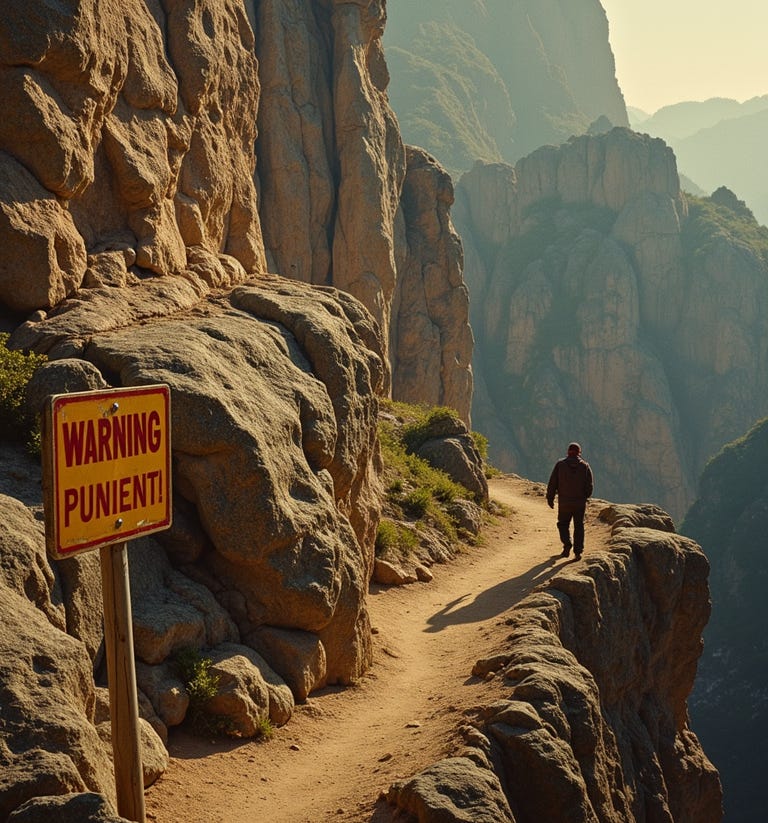
It is like learning where to step on a cliffside trail. Once you begin to see the path, the tension lessens. The world is still dangerous, but it is no longer only chaos. Your eyes adjust. Your body steadies. The fear subsides enough for discernment to return.
That is the internal battle we all face.
The body-mind system teaches humility. Attention can amplify distress; practice can sometimes soften it. Causes are not always linear. Systems have thresholds. Healing often requires tuning into the whole ecology, not only fixing one part.
This is not just metaphor. Anyone who has dealt with a persistent health condition knows that the body is not a machine with one broken part. It is an ecology. Sleep, stress, sound, food, fear, inflammation, attention, memory, hope, and exhaustion all interact. Some patterns are obvious. Others only become visible over time.
In the journey toward a better way, a road of understanding, what we learn is that the path is not only out there. It is inside as well.
To navigate our world today is not simply a matter of finding a better road. It is about taking better steps, cultivating keener eyes, building situational awareness, and developing internal freedom.
That is true agency.
AI can help organize patterns, but it cannot replace judgment. It can synthesize, compare, draft, challenge, and help track recurring themes. But the human role remains essential: values, discernment, lived stakes, ethical direction, and final judgment.
AI becomes useful not when it thinks for us, but when it helps us think more deliberately.
At its best, AI can become a collaborative thinking environment. It can help us slow down, test claims, organize fragments, identify recurring themes, and turn scattered insight into clearer language. But it is not magic, and it is not wisdom by itself. It responds to the quality of the relationship we build with it.
The more we know ourselves, the more useful it can become. The more clearly we understand our own questions, fears, hopes, values, and blind spots, the better we can use AI in service of our own agency rather than surrendering agency to it.
That distinction matters.
The goal is not to outsource perception. The goal is to refine it.
In an age of noise, wisdom depends on disciplined perception directed both outward and inward. We need to slow down enough to deliberate.
We need to ask:
What is the signal and what is noise?
What am I projecting onto reality and what is the truth of the bio-physical world?
What is well established and what is only suggestive?
What does this pattern ask of me and how am I responding to it?
Pattern reading, when well formed, can appear almost magical. But it is not prophecy. It is a practice of attention. It asks us to notice relationships without surrendering to panic, to hold complexity without becoming paralyzed, and to translate what we see into clearer thought, better teaching, more honest writing, and wiser action.
What we are building is perceptual resilience: the capacity to move through a fragmented world without becoming fragmented ourselves.
And if enough of us learn to do that, the landscape begins to change. The noise loses some of its power. The paths become more visible. The structures that depend on our confusion become less stable.
We may not know exactly where the trail leads.
But we can learn how to see well enough to take the next step. And that’s how confidence builds and clarity returns.
No posts
Comments
Nothing yet. Say the first thing.
Sign in to join the conversation.