
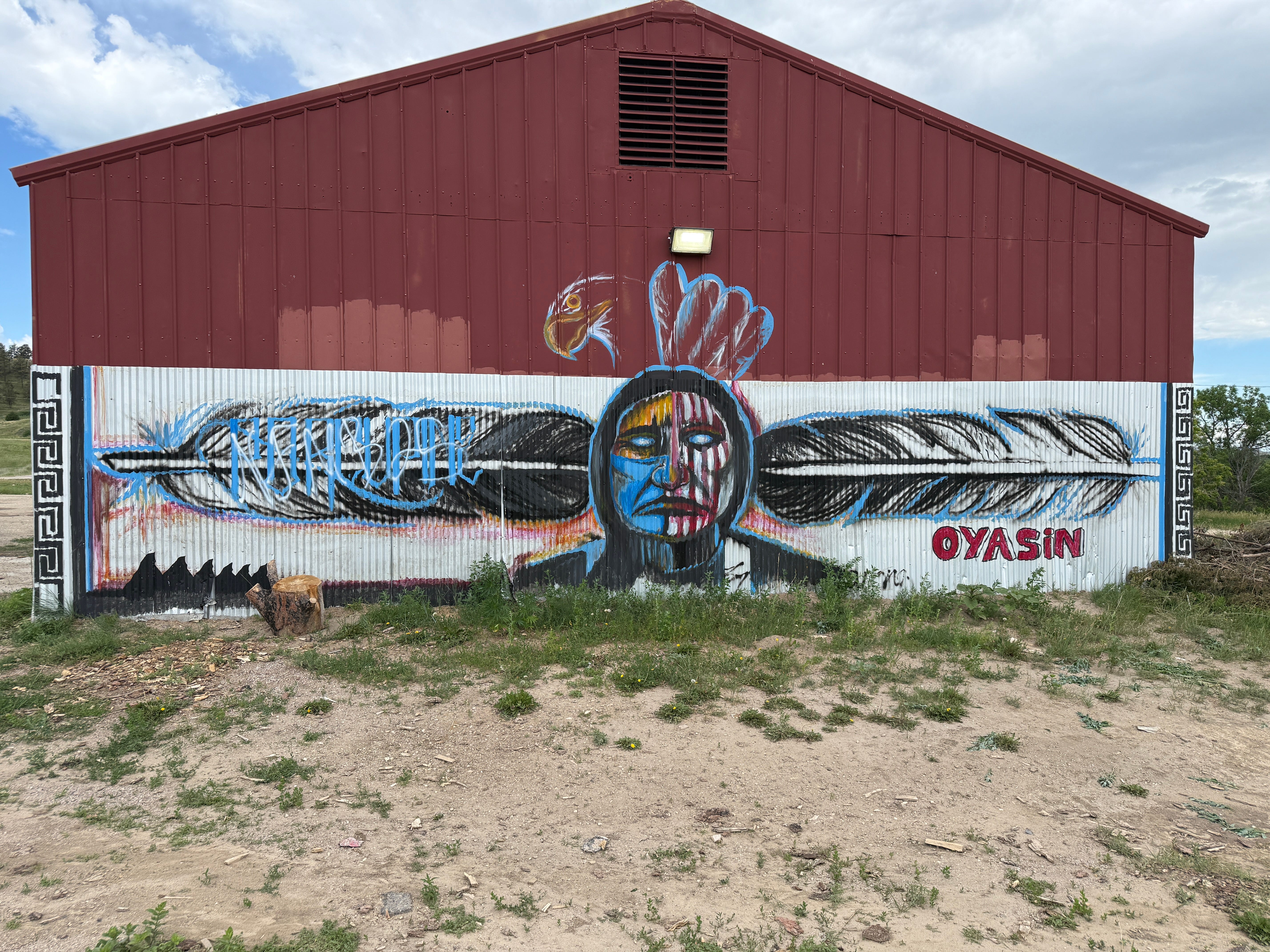
I had occasion to visit South Dakota a couple of weeks ago. Amongst other motivations I was accompanying a pal who is old friends with a woman named Charlotte Black Elk. Charlotte lives in a modest house down a rutted dirt road in a small valley abutting a swath of undeveloped land on the Oglala Lakota reservation.
My wife and I spent a few hours with her, and then a couple of days in the surrounding area. As it turned out, our trip ended near Mount Rushmore, about 80 miles north in the Black Hills. These two poles of American identity spoke volumes.
These two histories, the genocidal legacy of American Indians and the European conquest of the west were very much with me amongst the web of emotions on July 4th.
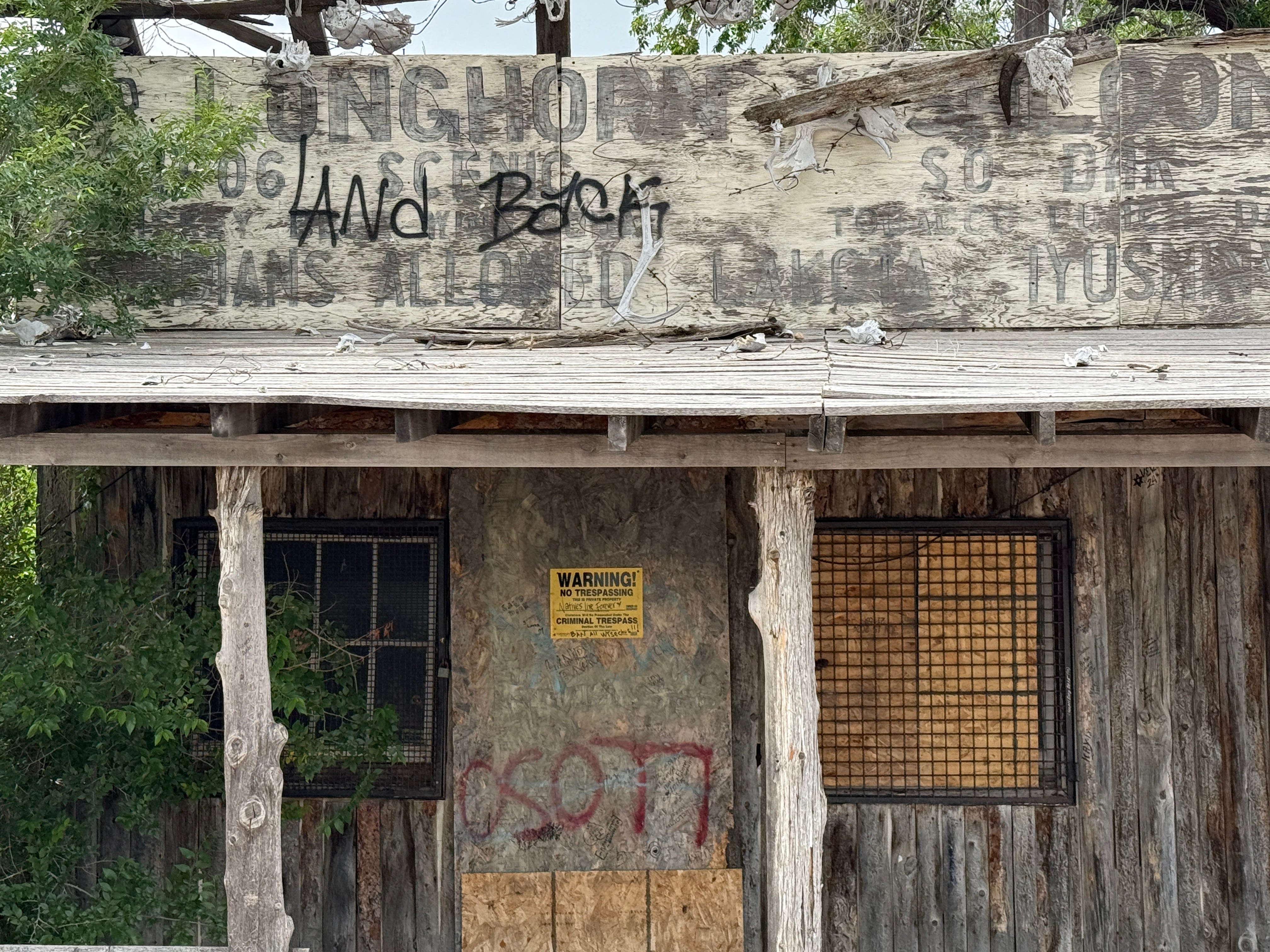
Charlotte is the great granddaughter of the Lakota holy man, Black Elk, who became known in the 1930’s when a book entitled “Black Elk Speaks” was authored by the anthropologist, John Neihardt. The book told of a vision Black Elk had whose theme, to oversimplify, was “the interconnectedness of all life and the preservation of the Lakota traditions in the face of cultural genocide.” Charlotte, now in her mid 70s, is a truth talking, salty elder, an incredibly smart and educated person with two PHD’s who doesn’t suffer fools. She’s a bulwark in her community.
Charlotte and her family still keenly feel the wounds of being robbed of their ancient homeland, the Black Hills, and thrust onto the scrubland down south at the edge of Nebraska. In plain language they’re still incredibly pissed off. Anger, bitterness, resignation, pride, humor, and irony play a fine balance if one wades into their history. It shows itself physically on the reservation. Pine Ridge and other towns are some of the poorest places per capita in the United States. And you feel it—the desperation, the hopelessness, But also the strength.
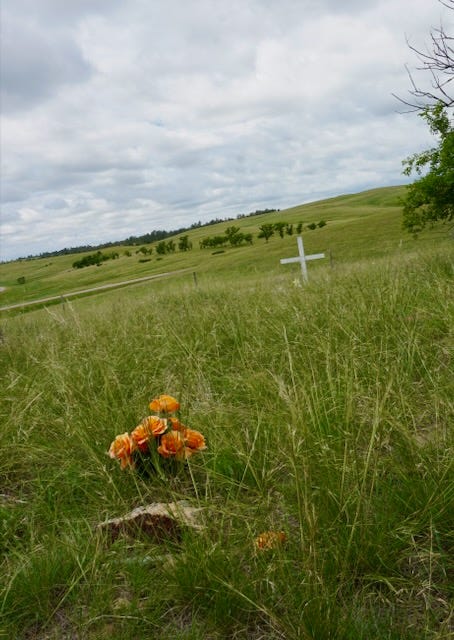
Perhaps the most difficult of our destinations was Wounded Knee, a tiny town on the way to Pine Ridge where the infamous massacre of unarmed Lakota women and children took place by the US cavalry in 1878. Close to 300 dead.
Most of the people reading this are likely acquainted with the indigenous peoples’ history. However, outside the liberal enclaves that I inhabit many people still have a fundamentally skewed vision. I’ll give you an example.
We spent one night at Fort Robinson in Western Nebraska. Fort Robinson played a critical role in the Indian wars of the 19th century. It was there that the greatest Lakota warrior, Crazy Horse, was jailed and then assassinated. In subsequent years, it was used as a military garrison for the Lakota and others, a site to jail POW’s, and it is now preserved as a 22,000 acre park, some of whose structures remain remarkably intact. It’s physically quite lovely.
It was a gut-wrenching place. Ghosts hover like low hanging clouds. You feel the blood of history in the literature, the exhibits, the very ground that you walk on. I wasn’t aware of its history when we showed up, but when I started reading the flyers they handed out, I wanted to barf. They speak of the Wounded Knee massacre as if it was a fair battle between two opposing sides. They perpetrate the fraud that the Indians were just as much at fault for their extermination as the white man. We had a nice conversation with the lady behind the desk about that, she was glad I brought it up. “My husband is Native,” she said, “we feel just like you do, but I can’t say anything or I’ll be fired.”
Breakfast time: overweight people off a tourist bus stuffing their faces with criminally bad fried food, flag-waving, believing the rhetoric.
Earlier in our visit, we stumbled upon a peace and prayer ceremony out near the sacred site, Bear Butte, where Black Elk stood. All were welcome, there were a handful of other white people, and a number of spiritual leaders from indigenous groups around the world. It was extremely powerful. I’ll save some of what I witnessed for another post. The speeches and prayers were not just for the state of the world, the preservation of spiritual traditions, and the healing of the earth. Some of them centered around the terrible violence that the Lakota perpetrate upon each other. Nothing is black and white in the human race.
There’s sex trafficking, domestic violence, and a lot of substance abuse on the reservations. Suicides, overdoses are more common than most other places. It’s not my place here to analyze how this all came about or what to do about it. But it breaks my heart to see what we do to each other.
I’m not trying to make generalizations here. I really don’t know anything about Indian people, how could I? Each nation is different, and each person on them singular. I’m just reporting what I saw in a brief glimpse.
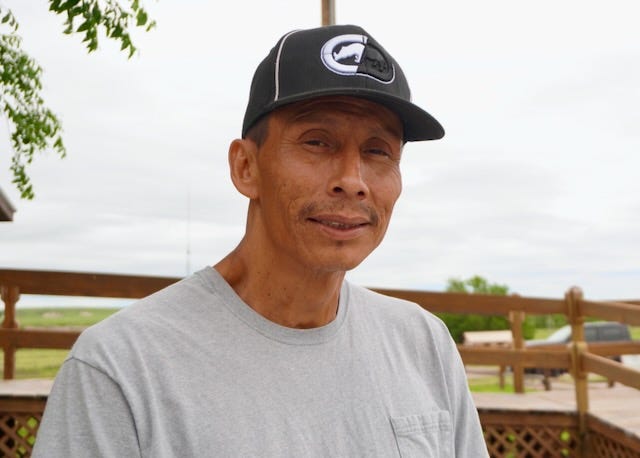
We stopped at a roadside stand to buy some jewelry. Here was a thin, frail, cane carrying Lakota man selling his goods. Somehow he got talking to us, telling us his story, and it was a beautiful, heartrending tale of years of alcoholism and recovery. One of the many excruciating details was how he’d wake up in the morning after an enormous bender and go outside with his cane and poke all the empty bottles lying on the ground from last night and see if anything was left in them. If there was even a drop of watered -down liquor, he’d throw it down. In a classic “hitting bottom” ending, he finally fell onto his hands and knees one dawn, begging God to help him, stumbled over to his mother’s house and threw himself into her arms and begged her to take him wherever he needed to go to recover. He began to cry when he told us his story, told us about his wife who had stage four cancer, and all the while there’s this light beaming from his face, his eyes were soft, his voice, gentle, a big- hearted guy so close to death, and so full of life. I was so grateful for this brief connection, grateful to him for being real with us. He said, “No one’s too far gone to climb back up again.”He also said. “We gotta stop blaming white people for all our problems, and heal ourselves.”
There are an incredible number of people in this country who desperately need help— and not getting it. Many of them, including these, are virtually invisible to the powers that be. What are we going to do about it? WE. Not me, not you, WE. Because if you believe in the rhetoric spread about this July 4, you understand that we’re all in this together, that we all belong, that when one falls we all do.
Plenty of divisions may be more imagined than real. On the plane ride out I spotted a fellow in front of me boarding the plane with a “1776” t-shirt on. “He must be one of those crazy- ass Oath Keepers or something,” I thought to myself. Big muscles, an imposing demeanor. Well, wouldn’t you know it, we sat next to this guy on the plane and had a great conversation about all the things we had in common. So much for my judgments!
Meanwhile, somehow, our journey ended up a few miles from Mount Rushmore. We found a cheap motel there the last night. This little town called Keystone is basically a pitstop for anybody visiting the four Stone Faces. A lot of Harley Davidson’s, a lot of American flags, shirts made of red white and blue, double-armed tatoos, ominous beards, ball caps, a feeling of claustrophobia, as if of the very rock formations surrounding the valley road were choking off the whole story of our native land. It was so entirely different than where we’d been.
What is it about Mount Rushmore that makes some consider it a holy site? It’s a stone face carved on rock stolen from the Lakota people. Why does Jefferson’s bewigged mug in a mountain bring meaning to anyone? It’s not exactly the Liberty Bell. I wish that these tourists would at least consider the crime to the Lakota tribes. How do you celebrate our country by defacing somebody’s sacred land?
One of the many ironies on the Indian reservations is that for many their favorite president was Nixon. Many of them are registered Republicans. Why? Because Nixon was the only president to ever actually give back Indian land. Do you think Joe Biden did that?
In fact, Indian people can be extremely patriotic, they’re often the first to volunteer to fight in a foreign war.
As for the hog riding, red, white, and blue wearing tourists staying in my hotel. I will admit, sometimes they scare the shit out of me. I imagine saying the wrong thing around them and getting a hammer to the head. But see there I go with the judgments again. if you were in trouble, they might be the first ones to show up and bail you out. If there was a war with any actual meaning in this country, they’d be on the front lines. It doesn’t mean they wouldn’t still throw around the “n-word” like a frisbee, though.
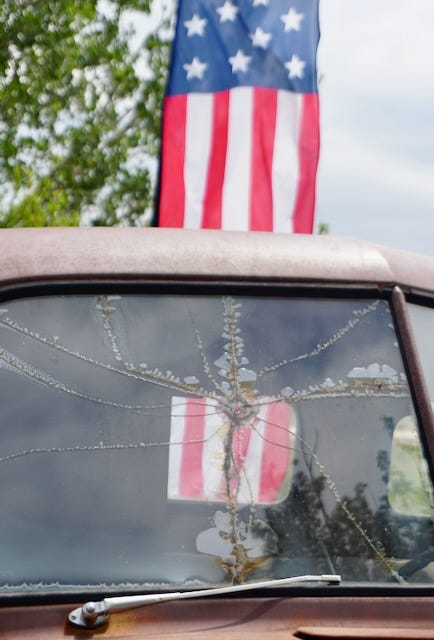
I read recently that there is a so-called masculinity movement. Pete Hegseth type of stuff. Empathy is now considered a lethal weakness. The whole point of being a man is to dominate and win.
Are you fucking kidding me? The moment you consider empathy a flaw you’ve signed the death warrant of the human race.
Still…STILL
Like I said there’s no black-and-white, just an infinite web of wanderers attached to impermanent flesh.
I played a July 4 show in Woodstock, New York, July 4. My goal was to assemble a set of music so diverse, so mixed with tragedy and celebration, that I could speak to these feelings, simply with the music. We mixed Thelonious Monk with Tom Waits, Al Green with Johnny Cash, Tejano rhythms with funk. We sang songs about immigrants, about fireworks, about the devastation of a Vietnam vet, a Civil War song, Jim Pepper’s “Witchi Tai To,” we played my dark-hued version of America the Beautiful. Rarely have I been so proud to lead a band.
Because it’s the music that tells the tale of this land. You can write your speeches, build out novels, make a documentary, or write a poem. You can go to Mt. Rushmore or Wounded Knee. They’ve all got their place. But to me, the rainbow of music in America truly embodies the unalienable truths of life, liberty, and the pursuit of happiness. Music has always been the soundtrack to revolution, joy, and profound grief. I can shimmy down a 4/4 beat and there’s Billy Higgins swinging behind his drum kit, there’s Jim Pepper screaming into his tenor saxophone, I can hear the Plains Indians tribes wailing a sundance song, I can hear the growl of Johnny Cash’s baritone, dance to the trance of an Afro Cuban drum, boogie to Neil Young, nod to reggae, do a two -step to a country shuffle. All in one set!
It’s all there. The music is the soul of the country, the envy of the world.
I’m not much for New Year’s resolutions. But how about a post July 4 resolution?
How about I aspire to greet the uninvited guest with open arms? To set aside rivalry and undo suspicion. To set aside envy, greed, pointless ambition. To set aside desire of success and fear of failure, to set aside the mirage of red and blue. To always lean toward peace, towards empathy.
The bottom line of my trip to South Dakota was that anybody I actually stopped and talked to were wonderful people. All these ideas in our heads, some of them habituated from listening to big mouth podcasters, screaming at the world with dark agendas, the 24 hour news, the 24 hour rage cycle—they mostly fall away when you actually TALK to people. The great preponderance of people are good. They mean well. They wish you happiness. They will lend a helping hand.
May all beings prosper, may all beings be blessed.
.
No posts
Comments
Nothing yet. Say the first thing.
Sign in to join the conversation.