
The most revealing comparison between Donald Trump and Adolf Hitler may not begin with the two leaders themselves. It may begin with the men standing just behind them.
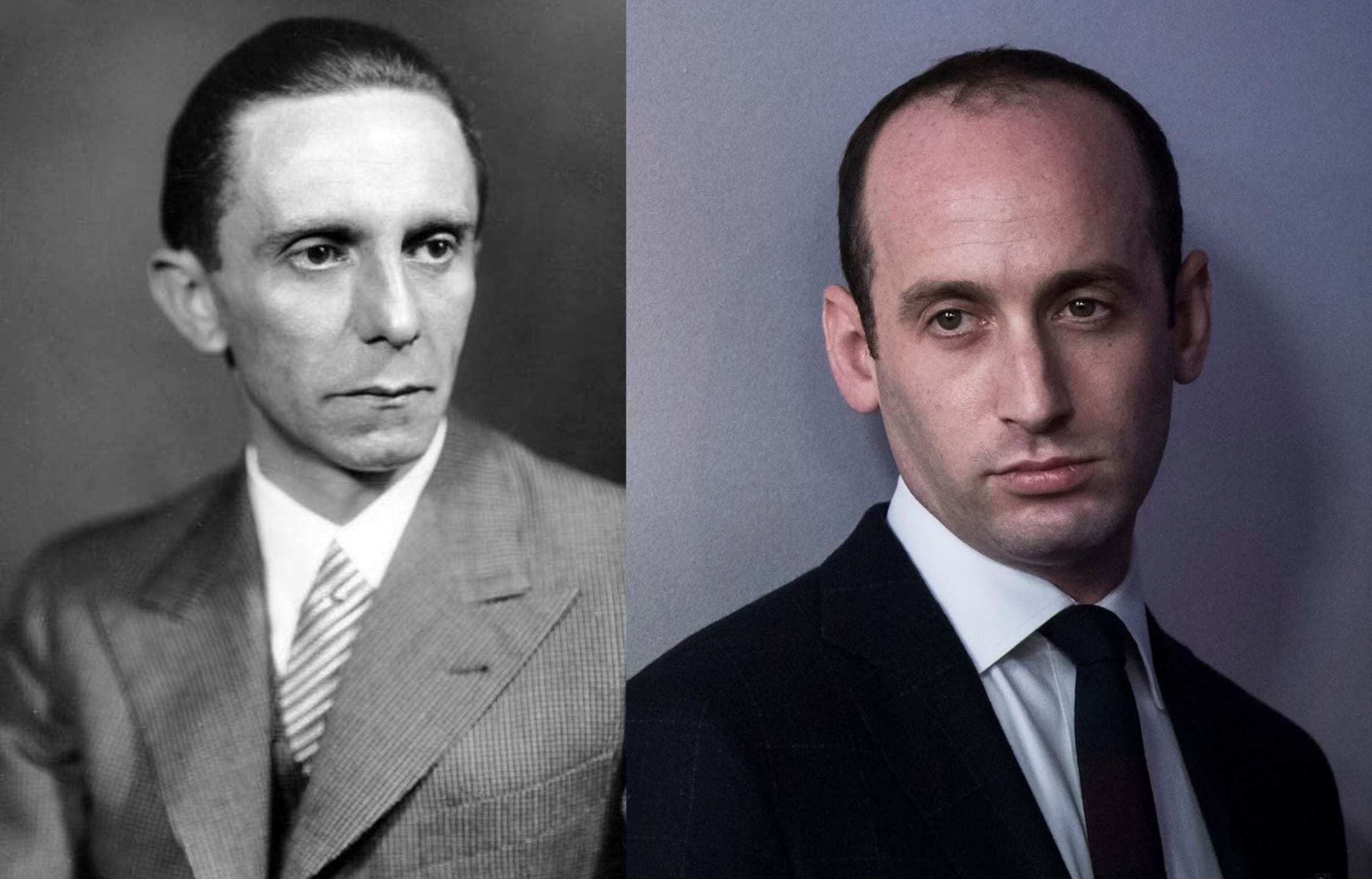
Joseph Goebbels Stephen Miller
Joseph Goebbels did not create Hitler’s hatreds.
Stephen Miller did not create Donald Trump’s hostility toward immigrants, political opponents or the institutions that restrain presidential power.
It’s important to note that Goebbels served a totalitarian dictator, controlled a national propaganda ministry and followed Hitler into death, while Miller serves an elected American president within a constitutional system that still retains courts, elections, opposition parties and an independent press.
The charismatic leader supplies the audience and authority. The devoted adviser supplies consistency, justification and execution. The leader says what he feels. The adviser explains why it must become policy.
The danger lies not in claiming that history is repeating exactly, but in recognizing a recurring relationship between a grievance-driven leader and an ideologically committed subordinate who gives those grievances language, structure and governmental force.
Both relationships can be understood as a form of political symbiosis:
The leader supplies the charisma, mass following and authority. The adviser supplies ideological consistency, language, policy detail and relentless implementation.
But there is an important difference:
Goebbels virtually worshipped Hitler.
Miller appears to understand, serve and reinforce Trump—without publicly displaying the same quasi-religious personal devotion.
Joseph Goebbels did not begin as merely Hitler’s hired communications specialist. He gradually constructed Hitler in his own mind as a historic redeemer, father figure and almost providential personality.
After meeting Hitler and hearing him speak on racial and political questions, Goebbels described him in his diary as a genius and an instrument of destiny. Hitler became the central figure in Goebbels’s private writings and emotional life. The diaries are considered an important—although necessarily self-serving—source for understanding the relationship.
Goebbels possessed abilities Hitler badly needed:
disciplined message development;
emotional and theatrical mass communication;
control of press, radio, film and culture;
simplification of complex events into enemies, betrayals and slogans;
the constant elevation of Hitler above ordinary politics.
After Hitler came to power in 1933, Goebbels headed the Ministry of Public Enlightenment and Propaganda, which coordinated ideological messaging and exercised extensive control over German media and culture.
Goebbels did not merely publicize Hitler’s opinions. He helped create the Hitler myth: Hitler as the singular embodiment of Germany, the interpreter of the people’s will and the only person capable of saving the nation.
status and national importance;
an outlet for his intellectual and theatrical ambitions;
a political family and personal identity;
permission to turn prejudice into state power;
proximity to the person he regarded as history’s chosen leader.
The relationship was not always equal or affectionate. Hitler could be distant and manipulative, and Goebbels occasionally fell from favor. Goebbels’s emotional dependence on Hitler appears to have been much greater than Hitler’s dependence on Goebbels.
Nevertheless, Goebbels remained among Hitler’s most devoted followers. He stayed in Berlin during the final collapse, brought his wife and children into the Führerbunker and rejected survival in a Germany without Hitler. Goebbels and his wife killed their six children and then killed themselves on May 1, 1945, one day after Hitler’s suicide.
That ending demonstrates that the relationship had passed far beyond ordinary political loyalty. For Goebbels, Hitler had become the organizing principle of reality itself.
Stephen Miller’s relationship with Donald Trump is less intimate and less emotionally documented. There is no Miller diary revealing private worship comparable to Goebbels’s writings.
What is clearly documented is Miller’s unusual durability.
Miller joined Trump’s first presidential campaign early, remained a senior adviser throughout the first administration, continued promoting Trump’s agenda during the Biden years and returned in 2025 with greater authority. He currently serves as White House deputy chief of staff for policy and has exercised extensive influence over immigration and homeland-security policy.
Miller supplies several things Trump values:
Absolute public loyalty.
Unlike numerous former Trump advisers, Miller has not written a critical memoir, publicly repudiated Trump or attempted to build an independent reputation by exposing private conversations.
Ideological continuity.
Trump’s rhetoric can be spontaneous, contradictory and reactive. Miller converts broad impulses—border closure, deportation, national decline, internal enemies—into sustained messages, executive proposals and bureaucratic instructions.
Language.
Miller has helped write some of Trump’s hardest-edged speeches and has acted as a forceful public defender of the administration’s policies. AP describes him as one of Trump’s longest-serving aides and a central figure in immigration policy and speechwriting.
Institutional memory.
Miller learned during the first term which agencies, officials, courts and procedures could delay the president’s objectives. His influence in the second administration reflects both his proximity to Trump and his practical knowledge of how to overcome resistance. Reuters attributes Miller’s unusual authority partly to his lengthy and close relationship with Trump.
No threat to Trump’s primacy.
Miller can be highly visible, but he generally presents himself as the defender and interpreter of Trump’s program—not as a competing political star. One analysis of his longevity emphasized that he remained in Trump’s shadow, understood Trump’s grievances and demonstrated unwavering loyalty.
Trump gives Miller something equally important:
presidential authority for ideas Miller held before joining Trump;
access to the machinery of the federal government;
a mass political audience;
protection from opponents inside the administration;
the opportunity to transform ideological conviction into enforceable policy.
This may be the deepest parallel with Goebbels.
Neither adviser appears to have invented his leader’s central prejudices or political instincts. Instead, each adviser recognized those instincts, systematized them and helped convert them into a governing program.
Goebbels did not manufacture Hitler’s antisemitism or authoritarianism. Miller did not invent Trump’s hostility toward illegal immigration or his language of national decline.
Each adviser took the leader’s existing impulses and made them:
more coherent;
more repeatable;
more administratively useful;
more emotionally powerful.
Both leaders valued followers who reinforced their worldview.
The relationship is therefore not the traditional model in which a counselor offers independent advice. It is closer to:
“You express what I instinctively believe, and I give you the power to make it real.”
Goebbels’s propaganda divided society into the authentic German nation and allegedly contaminating or conspiratorial enemies.
Trump and Miller frequently use a different but structurally comparable framework: the authentic American people versus illegal immigrants, criminals, radicals, bureaucrats, hostile media and political enemies.
The comparison should concern the rhetorical structure, not an assertion that the targets, policies or historical consequences are already equivalent.
Hitler could be erratic, repetitive and improvisational. Goebbels translated the Nazi worldview into disciplined propaganda.
Trump is similarly improvisational. Miller often gives Trumpism a more consistent ideological vocabulary—civilizational conflict, invasion, sovereignty, national survival and internal subversion.
The leader’s confidence strengthens because a sophisticated subordinate repeatedly confirms that his instincts are historically necessary.
The adviser’s influence grows because the leader rewards the person who most forcefully validates him.
That can create a closed loop:
grievance → ideological justification → policy escalation → public conflict → renewed grievance.
Plainly Stated.
Goebbels commanded a centralized propaganda ministry in a one-party state that destroyed the independent press, imprisoned opponents and participated in a regime of aggressive war and genocide.
Miller operates within the United States constitutional system, where courts, elections, Congress, states, journalists and civil society continue to exercise independent power.
Goebbels’s diaries reveal fascination, emotional dependency and near-messianic reverence.
The publicly available evidence concerning Miller supports descriptions such as loyalist, ideological partner, policy architect and interpreter. It does not establish the same intimate psychological worship.
Goebbels controlled a national propaganda apparatus.
Miller is primarily a policy strategist, speechwriter, ideological spokesman and coordinator of executive action. He does not formally control American newspapers, television networks, publishing, theater and film as Goebbels’s ministry controlled German cultural communication.
Invoking Goebbels and Hitler risks implying that every harsh immigration policy is a preliminary stage of the Holocaust. However, there is a disturbing similarity between Hitler’s Gestapo and Trump’s ICE.
1. Fear as an instrument of policy
Both institutions can make an entire population feel that ordinary life is unsafe. People may fear going to work, attending court, answering the door, taking children to school, or reporting a crime.
That atmosphere matters even when relatively few people are arrested. The Gestapo was not numerically large enough to watch every German; it depended heavily on denunciations and the public’s belief that it could appear anywhere.
ICE also invites tips from the public, conducts targeted operations, and benefits from uncertainty over who may be stopped or arrested. The mechanisms are not identical, but the social effect—fear extending far beyond those actually detained—can be compared.
2. Administrative machinery replacing individualized justice
The Gestapo used “protective custody,” a bureaucratic term that concealed arbitrary imprisonment.
ICE uses administrative warrants, detention classifications, expedited-removal procedures, and removal orders. These are legal categories, not Gestapo powers—but they can permit enormous government coercion without the protections associated with a criminal trial.
An ICE administrative warrant is issued within the executive branch. It is not the same thing as a search or arrest warrant approved by an independent judge.
ICE itself states that it does not always require a judicial warrant to make immigration arrests.
3. The visual language of secret policing
Masked officers, plain clothes, unmarked vehicles, sudden street arrests, and uncertainty about officers’ identities create an unmistakable secret-police appearance.
That does not make the agents Gestapo. Masks may have genuine officer-safety purposes, and ICE is not institutionally secret. But anonymity reduces immediate accountability and makes it harder for witnesses to distinguish legitimate federal agents from impersonators.
The imagery is politically significant because it communicates:
We can identify you, but you may not be able to identify us.
4. A population defined as a threat
The Gestapo protected the Nazi regime from people categorized as racial, political, or social enemies. Their conduct was often secondary; identity itself could make them suspect.
ICE is legally directed at immigration status, not ethnicity or political belief. Nevertheless, the language surrounding contemporary enforcement—“invasion,” “enemy within,” “infestation,” and collective criminality—can blur the distinction between an individual’s legal status and an entire ethnic or national population.
That is where Stephen Miller’s rhetoric becomes relevant. When a government describes millions of people collectively as an existential danger, enforcement officers cease to appear merely regulatory. They become defenders of the nation against a supposedly contaminating population.
5. Arrest first, legal review later
Recent courts have found or alleged that ICE agents made warrantless arrests without adequately establishing the statutorily required likelihood of escape. In one Colorado case, a federal judge found that ICE had violated a court order governing warrantless arrests and required additional training and documentation.
That does not prove ICE has escaped judicial control. In fact, the ruling proves courts still possess power. But repeated noncompliance can become an important warning sign: an enforcement body is most dangerous when it begins treating legal restraints as inconveniences rather than commands.
It is impossible to turn away from the fact that today, innocent people are being detained, shot, and killed by ICE, by the United States Executive Branch, led by Trump, with Miller as a primary policy advisor.
But “not yet the Gestapo” cannot become our only standard for acceptable law enforcement. Masked officers, administrative warrants, warrantless arrests, unmarked vehicles, collective suspicion, inaccessible detention and official defiance of court orders are precisely the kinds of practices a constitutional democracy should examine before—not after—they harden into something worse.
The Gestapo comparison should not be used as a verdict. It should be used as a warning. History does not tell us that ICE and the Gestapo are equivalent. It tells us which institutional guardrails must never be surrendered.
No posts
Comments
Nothing yet. Say the first thing.
Sign in to join the conversation.