
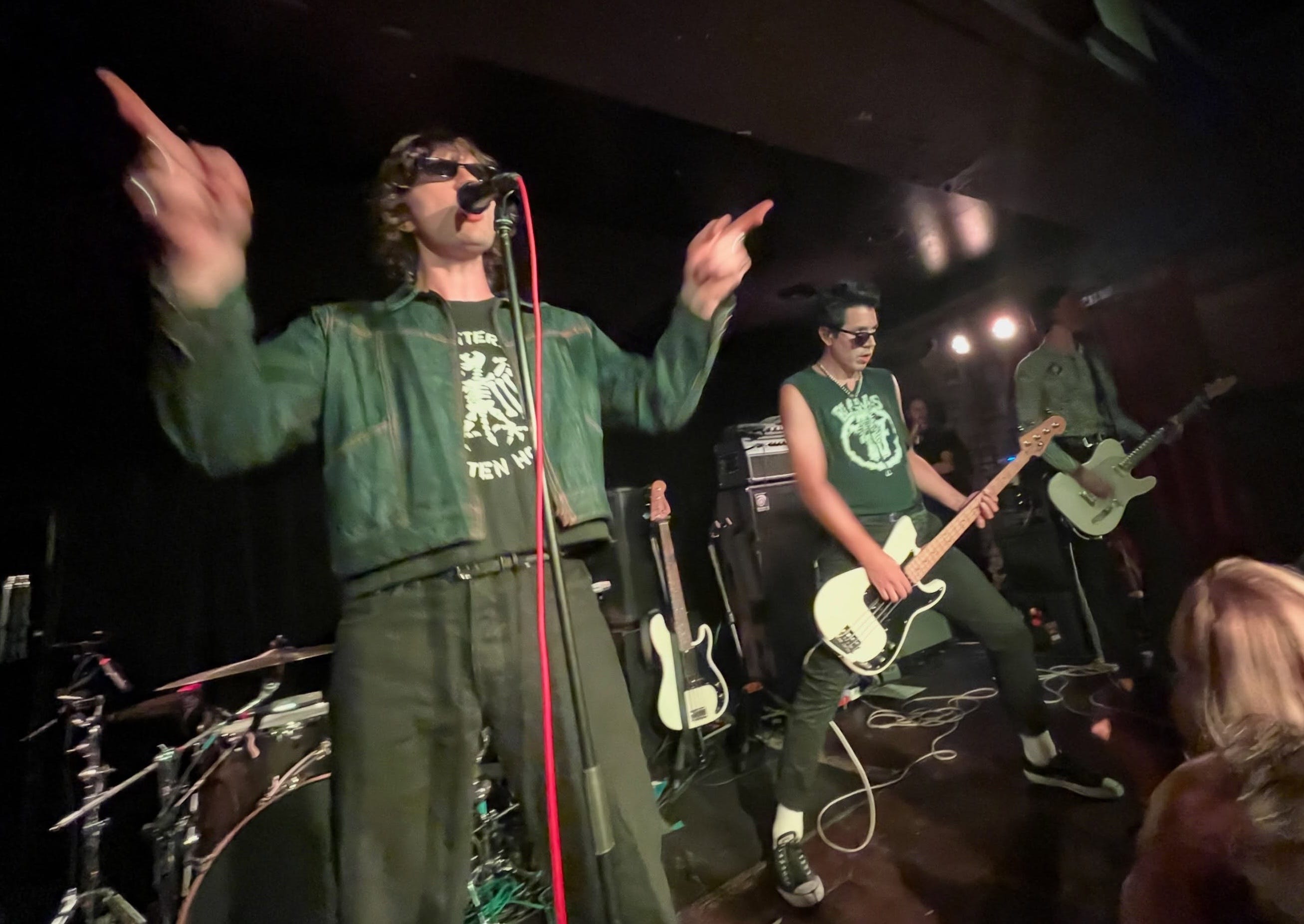
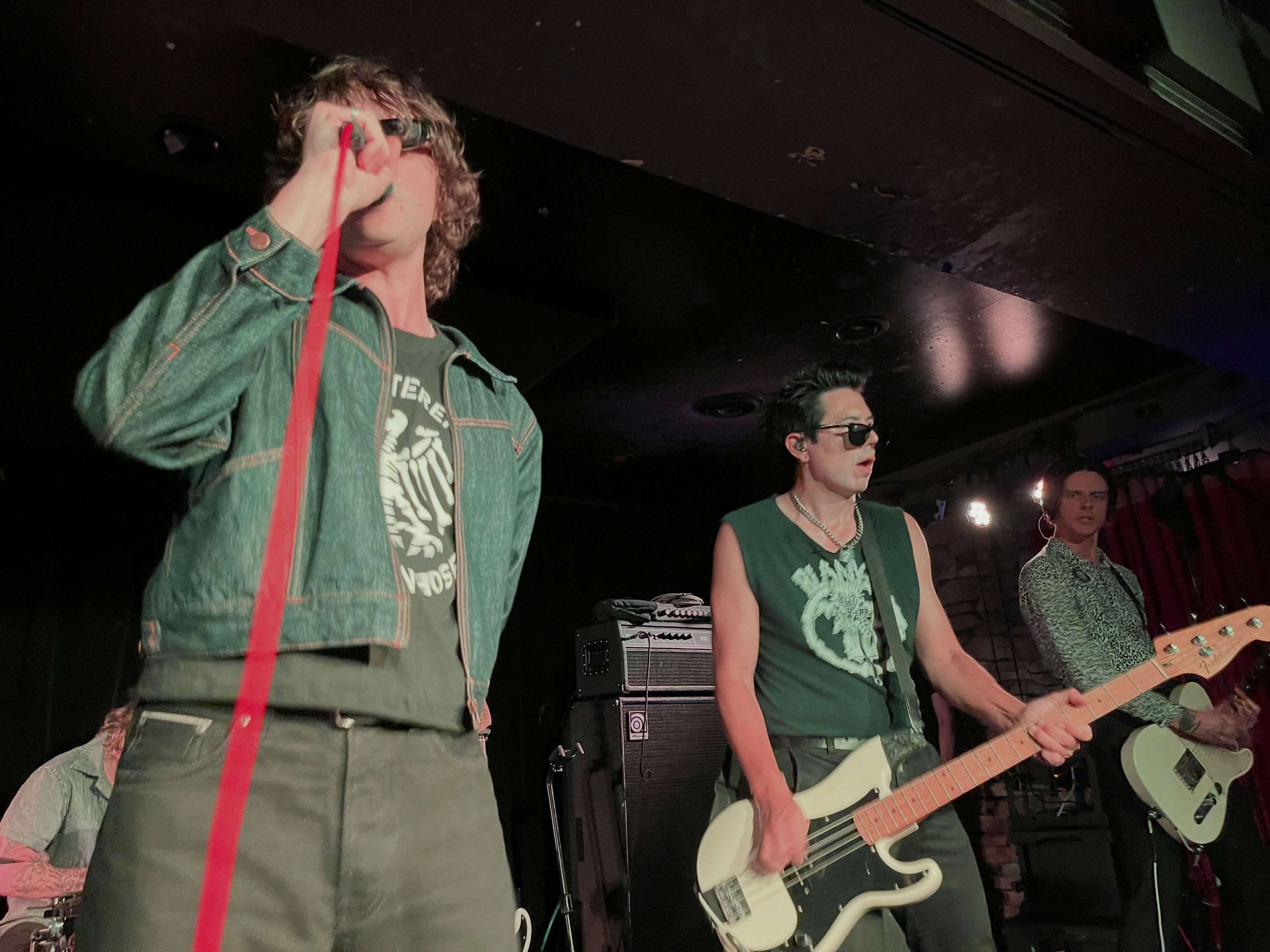
DOWN AT THE ROCK AND ROLL CLUB—“This is what we love to do, play in small places like this!” Bad Nerves’ frontman Bobby Nerves crowed at Chicago’s sold-out Cobra Lounge, standing beneath a low ceiling while inches from the crowd. Bad Nerves was in town for Lollapalooza; the night before they played Grant Park in front of thousands, they granted around 300 people the chance to get up close and personal. I’ve seen Bad Nerves three times in the last three years, and to my great fortune the venues have gotten smaller each time. (The Slyvee in Madison, Wisconsin, and Thalia Hall and the Cobra Lounge in Chicago.) This is hardly an indication of Bad Nerves’ declining appeal; the band’s only gaining steam, popularity, and coverage. But I was happy all the same for the nearness, which allowed me to stand one or two deep from the tiny sage at Cobra Lounge as the band fired salvos over the top of our heads.
Since forming in Essex, England in the mid-2010’s, Bad Nerves have released a handful of singles and two studio albums, their self-titled debut in 2020 and Still Nervous in 2024; a third album is on the way. Their current lineup is Nerves hollering out front, Will Phillipson and Jimmy Gern on guitars, Jon Poulten on bass, and Samuel Thompson on drums. (Original guitarist George Bell left the band in March, citing the rigors of touring; Gern is replacing him for this current run of North American and European shows.) They are an absurdly tight and well-rehearsed band, the result of a sonic camaraderie forged down the years and their messianic devotion to three-chord, anthemic blasts of galloping, riffing rock and roll. And that stuff’s gotta be played tight to achieve the proper velocity and liftoff. Nearly every Bad Nerves song sounds as if it’s begun somewhere in the middle, already sweaty and amped up.
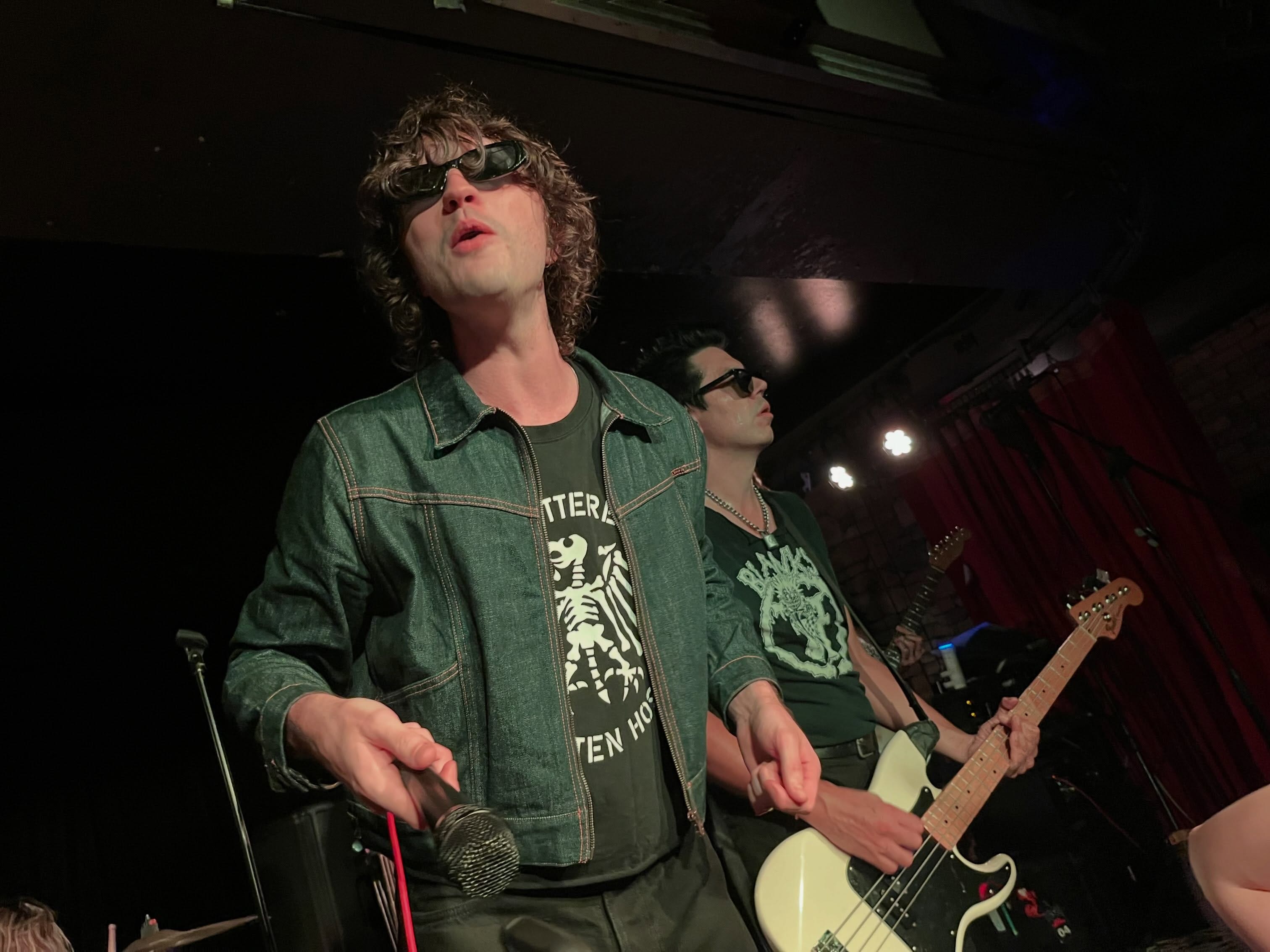
With their twin-guitar flash, wire-tight rhythm section, and aggressive, hook-filled songs, Bad Nerves bear more than a passing resemblance to the Hives, those Lords of Swedish rock and roll. Close your eyes when both bands play, and you can hear the overlap. (Though, Nerves lacks Hives frontman Howlin’ Pelle Almqvist’s mock arrogance. “Who’s heard our new single?” he barked at Cobra Lounge. “Who likes our new single? Who wants to hear our new single?” Cheers all around. Almqvist would’ve issued those questions in the form of demands.) “I don’t like to listen to guitar bands and the guitars are so quiet, you know?” Nerves remarked in Goldmine in May. “You tend to get these big, pounding drums, and this really in-your-face vocal a lot. You know, I like the sound of the bass and the guitars battling the vocals and the drums, with the vocals and the drums kind of losing a little bit, to be honest.” He added, “With this band, we’re still keeping it real, which is nice. I prefer listening to us playing the songs live. You can hear us fucking up, but in a nice way, like a nice human way.”
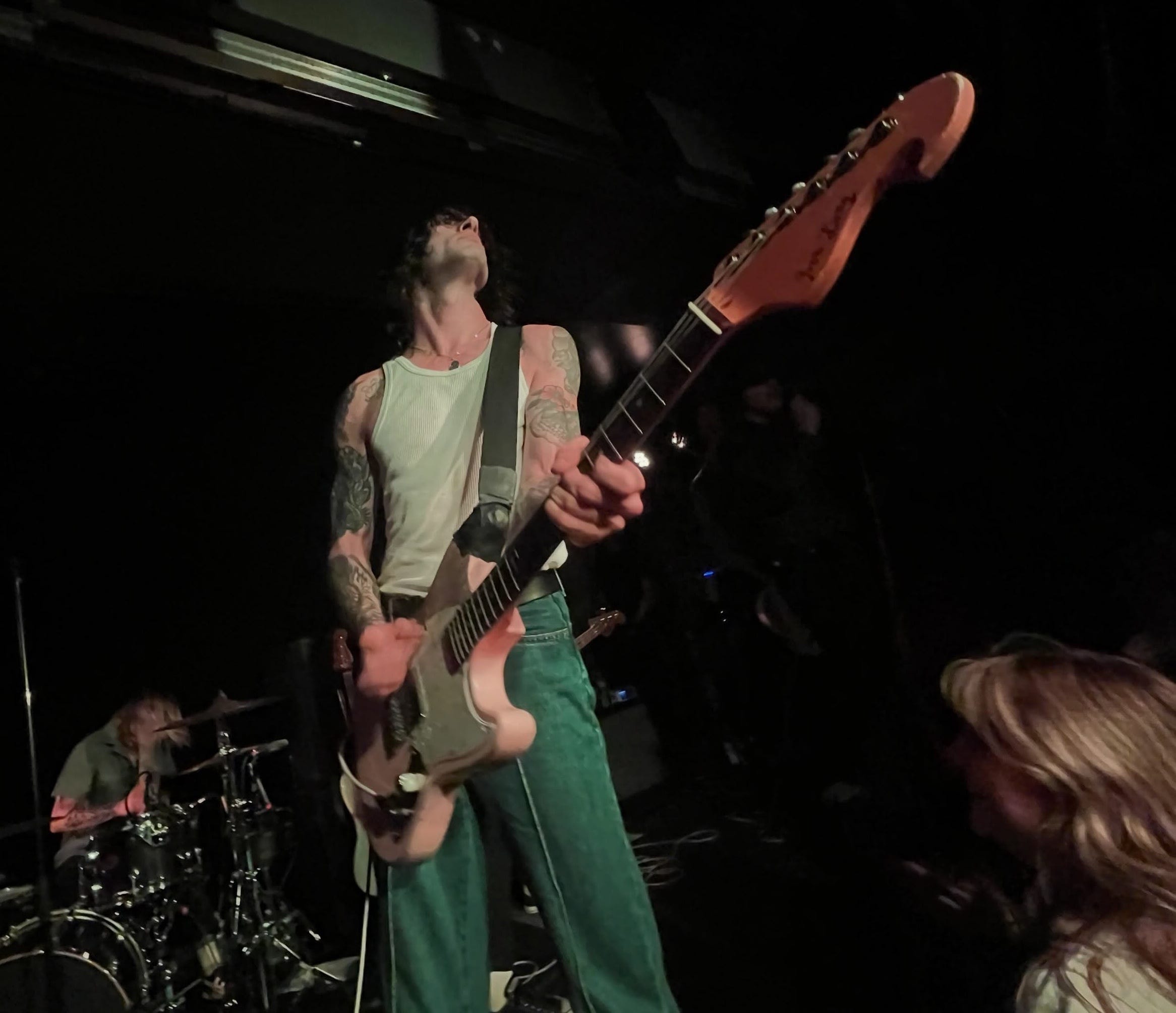
After hitting the stage as the Ramones’ “Do You Remember Rock ‘n’ Roll Radio?” blasted over the PA, Bad Nerves played a fairly even selection of songs from both records, the opening triumvirate of “Baby Drummer,” “Don’t Stop,” and “Palace” setting the relentless pace. The handsome Phillipson looks like a cross between Johnny Thunders and Joe Perry (who always looked great with a guitar), and between firing off searing leads and knotty riffs he regularly spins onstage and salutes the ceiling his the neck of his guitar; Poulten is equally animated, though nearly serious looking in his attempts at maintaining the bottom end through tortuous changes; Thompson is nothing short of an overwound metronome, occasionally adding to his long-haired, athletic panache by banging an old school cowbell. They played two new songs, “Network” and “Loner,” each released as a single in the past year, each raw and raucous, full-throated roars of disaffection suggesting that the new album might take on darker shadings.
Bad Nerves are obsessed with making connections. While many of their songs deal with the vagaries of shitty national politics, low economic ceilings, and shallow culture, the through line is the need to want and to get, but it’s always, it seems, a push and pull. The longing in lines like “I don’t know you now / I don’t know you at all (“Bored of Babies”), “You can’t be mine, you can’t be mine / Can I be yours? Maybe I can” (“Can’t Be Mine”), and “Do ya, do ya, do ya wanna be my antidote?” (“Antidote”) turns into taunts and dares with “Hey you, you got the nerve? / You better move your body if you’ve got the nerve at all / I don’t think you’ve got the nerve” (“You’ve Got the Nerve”), and is met, finally, with grins and gratitude in celebratory moments like “I want you around / ‘Cause we live and we die but to the same sound” (“New Shapes”), “I’m yours and you’re mine” (“Dreaming”), and “But it’s alright, everything is okay / ‘Cause I got you and you’ve got me” (“Don’t Stop”). It’s all a loud, perpetual motion machine of wanting and getting.
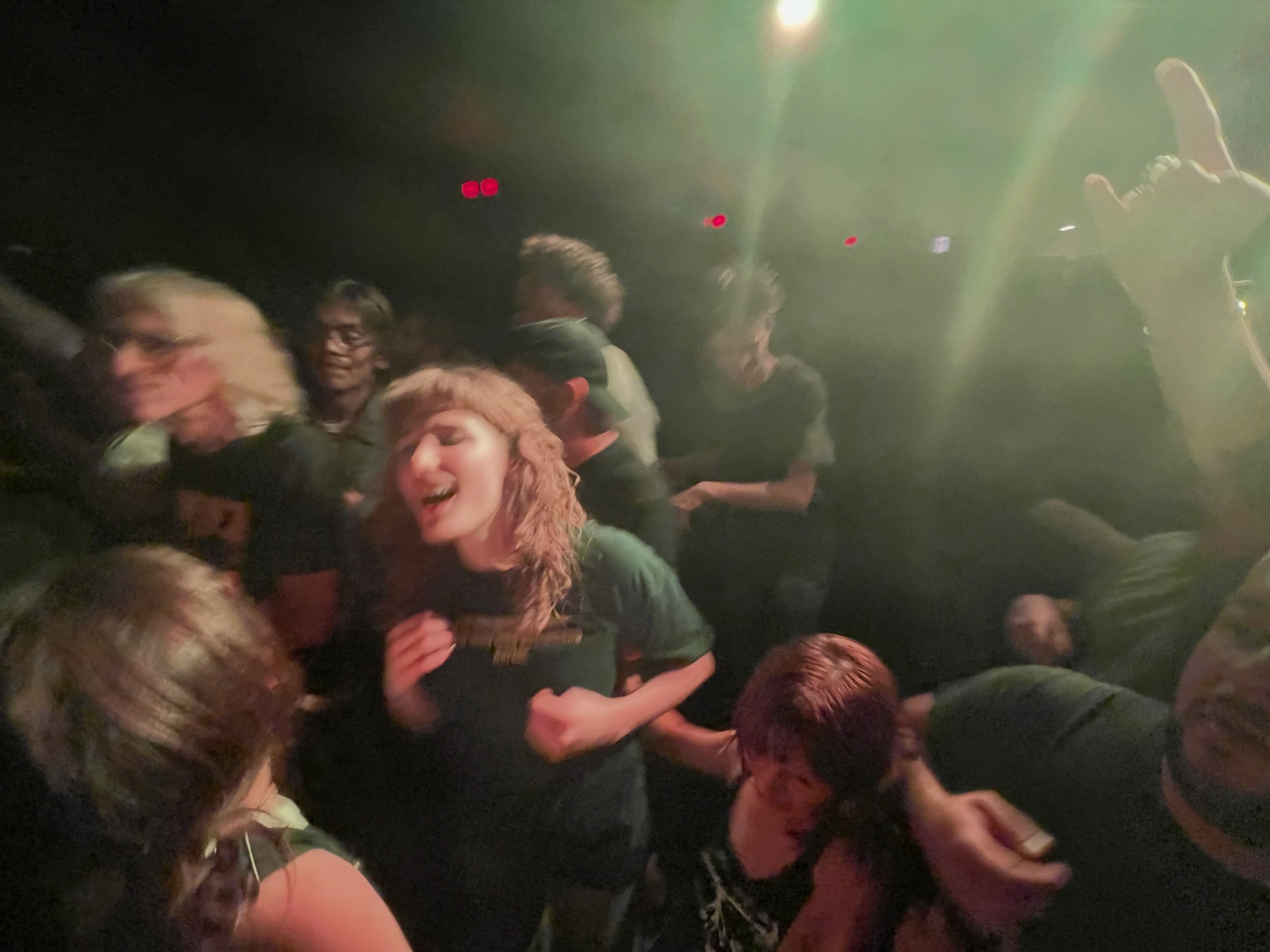
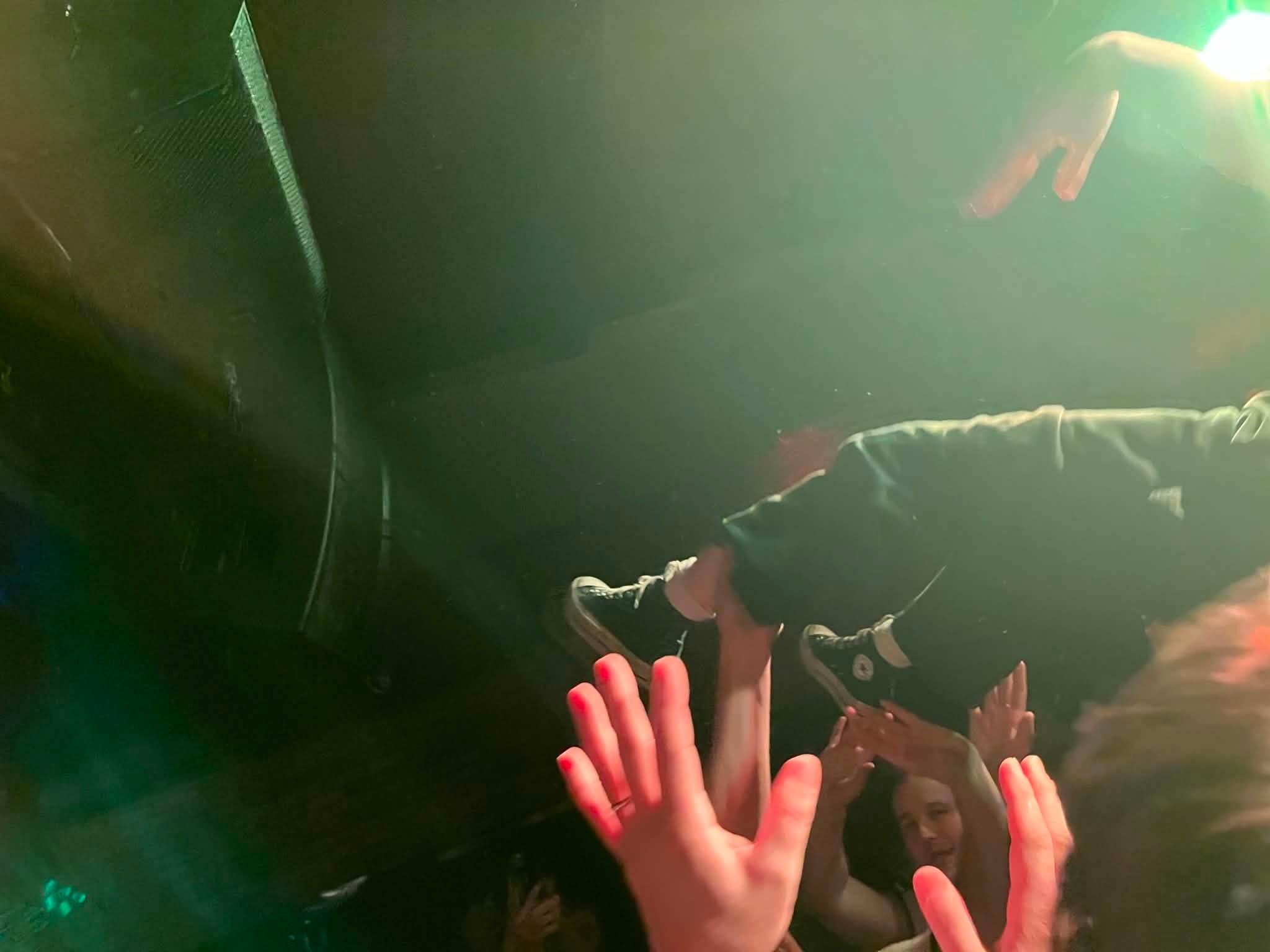
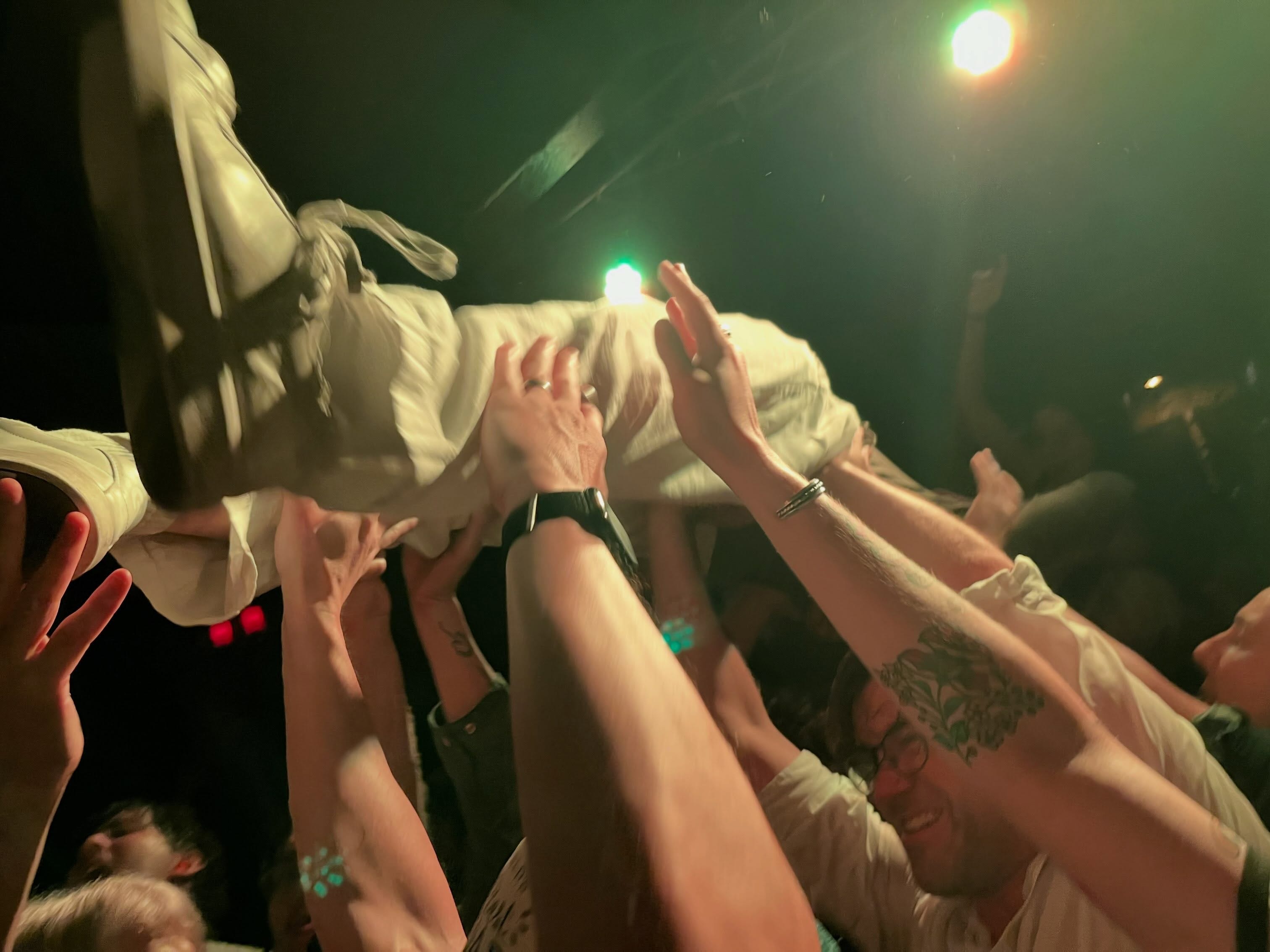
Nerves wore dark shades all night, but that didn’t prevent him from searching the audience for connection, running the stage back and forth, prowling with a half grin as if goaded by the songs themselves. During the final third of the show, the stage divers and crowd surfers began their grinning, good natured assault on the audience. I lost track of how many guys and girls I aided in vaulting over, or barely clearing, my head, vanishing in the din behind me echoing the din in front.
After the show, I thought back to a passage that I’d read not too long ago in Dave Marsh’s Before I Get Old: The Story of the Who, first published in 1983. Nearly a decade into the Punk Era, and moments after the Who had wrapped up their farewell tour—first of many, as it turned out—Marsh takes the long view, describing, and lamenting, the widening divide between Rock Bands and The Audience that beginning in the early 1970s, a gap that a handful of bands strove valiantly to close, originating with anonymous garage bands, the proto-punk MC5 and the Stooges, and raucous pub rock, and cresting with punk by the end of the decade. Describing a rainy Forest Hills show in Queens, New York on the successful Who’s Next 1971 tour, Marsh hones in on the issue:
The crowd inside was content to sit and soak as long as the Who played, a pattern that was maintained throughout, not just on this tour but for the rest of the decade as well. So the Who toured in continuing comfort, and their audience (like all rock audiences in this time) became increasingly irrelevant, except as a means of footing the bills. The bonds between band and fan were severed now; in a world without true connections, only shallow symbols remained. The moment to replace them had passed. The tour closed in Chicago with Townshend demolishing two guitars at once, battering the ruins of one with another until both shattered into tiny splinters. They had played to more than 700, 000 fans.
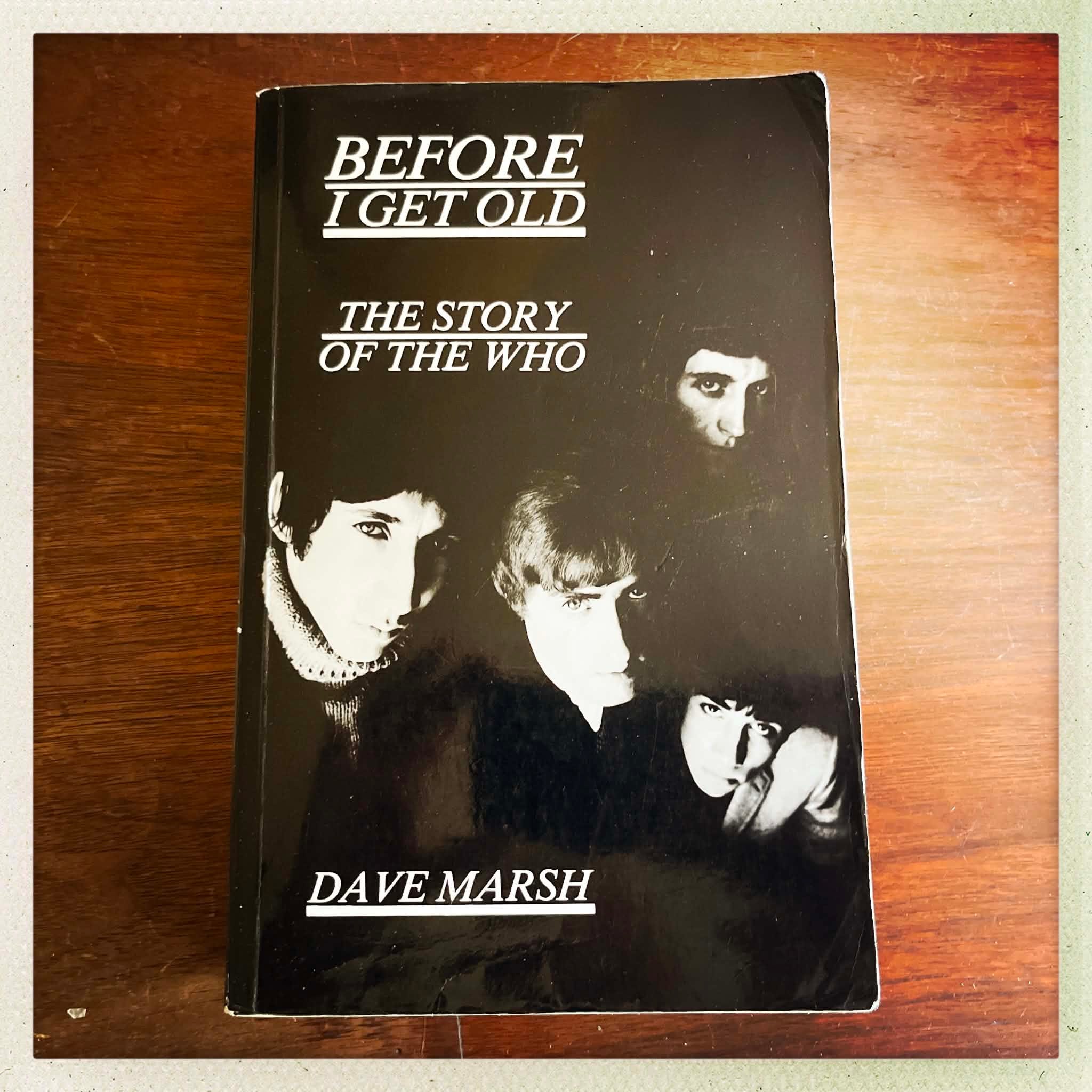
A bit later, Marsh chronicles the vexed tour that the Who endured to support Quadrophenia, shows that were beset with technical difficulties, particularly corrosive (and sometimes violent) bickering among band members, and Daltrey’s curious decision to pedantically explain the context and meaning of the songs before the band would play them. The alienated crowd seemed further away than ever from the stage. “As even Roger Daltrey could see, this situation couldn’t last forever,” Marsh writes.
“If they want to bust that frustration bubble, they’ve got to show their feelings,” Daltrey said. “One day they’re all going to get so bored, they’re gonna go out and smash windows. Then we’ll have a whole new rock era.”
Cue: Punk Rock.
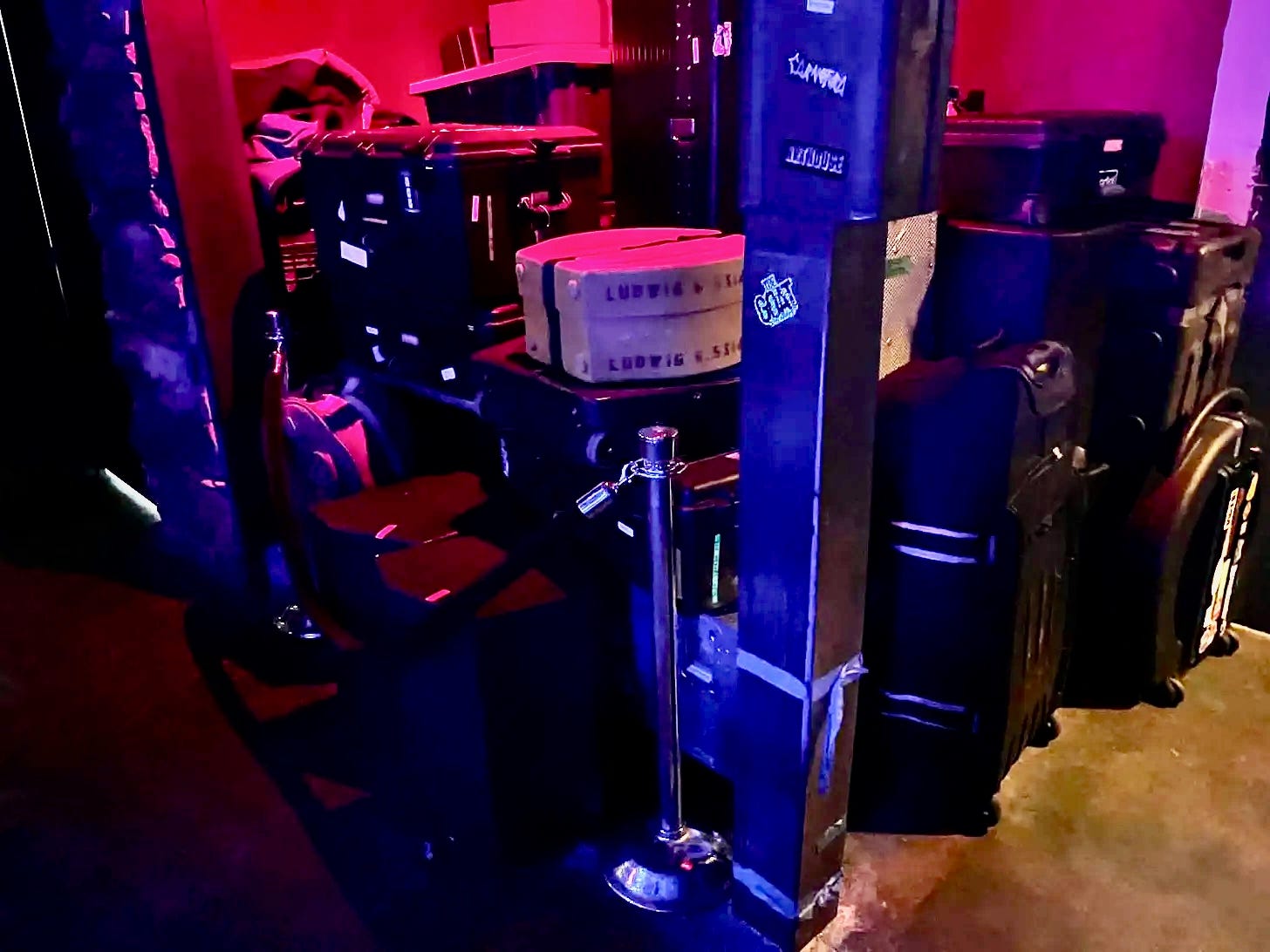
The dark, tiny, black-and-red Cobra Lounge is the ideal joint where the wall between band and fans can come crashing down. I love venues where the bands’ gear cases are piled in a small hill and stuffed into a corner of the room feet away from the stage.
“I think the Ramones live record It's Alive was the biggest influence on our live shows,” Nerves remarked a few years back to Emma Schoors at Unclear. “Fast and to the point. No big speeches.” Indeed, Nerves spoke very little at the Cobra Lounge, and when he did, it left a mark. Before the band launched into the roiling, electrifying “USA” from Still Nervous, Nerves announced that he’d written the song before he or the band had ever visited the United States. With its evocative, declarative, very spare lyrics—
The United Sates of America
Two million prisoners
Rock and roll is bad for their business, Rock and roll is back from the dead
—and anthemic title chorus, the song is hitting quite sharply these days, and there’s a palpable thrill in hearing, and being in the middle of, a sold-out crowd hoarsely gang-singing the lyrics as the country devolves more and more each day, the sight of crowd surfers leaping into the fray an absurdly liberating image. “I get the feeling people in America are more into our brand of garage punk than folks here in England,” Nerves observed. “No idea why that is, but yeah, I definitely think with a bit of luck it could pop off over [in the U.S.].”
Who knows if that will happen in our complex, ever diversifying music culture. In the meantime, a new Bad Nerves album is on the horizon; so is more testifying to the redemptive, liberating power of rock and roll. In “Baby Drummer,” Nerves sings, “I listen for God on my radio,” but in “Radio Punk,” he laments, “Radio, I gotta plug in my radio / Yeah, you used to be mine / But now you never play the punk I like.” Armed with Nerve’s manic and righteous howling, high energy guitars, and a thundering rhythm section, Bad Nerves are on a mission to rewrite those algorithms.
You might also dig:
Some mutts can't be muzzled
·
Jun 17
DOWN AT THE ROCK AND ROLL CLUB—I’ve seen Melbourne, Australia’s mighty Amyl and the Sniffers several times in the past few years. They’ve become as dependable a great night out as the Ramones were decades ago.
We’ll sing to people and show
·
April 15, 2025
DOWN AT THE ROCK AND ROLL CLUB—Looking at the Linda Lindas onstage, you’d be forgiven for guessing that they’d formed two weeks ago, they’re so energetic. and they look—well, they are—so young.
Goodtimes are killing Dion Lunadon
·
July 10, 2024
DOWN AT THE ROCK AND ROLL CLUB—As I wrote here last October, the D4 are among the bands I regret never seeing live. I love their two albums immoderately, and they had a reputation as a killer live band. When the D4 split up in 2006, guitarist and singer
Photos of Bad Nerves at the Cobra Lounge, Chicago, July 29, 2026 ©Joe Bonomo
Thanks for reading No Such Thing As Was! This post is public so feel free to share it.
Comments
Nothing yet. Say the first thing.
Sign in to join the conversation.