
David Foster Wallace opened a Kenyon commencement speech in 2005 with a parable. Two young fish are swimming along. They meet an older fish going the other way. He nods at them and says, morning boys, how’s the water? The young fish swim on. And then, after a while, one turns to the other and asks, what the hell is water?
It’s a neat joke. And it also illustrates the fundamental challenge that every strategist, consultant, editor, founder, creative director and senior anyone spends the entirety of their working life grappling with. They will spend whole careers trying to point out the water. They will be ignored, humoured, briskly defenestrated, chastised, and ridiculed for doing this. They will write many strategy decks that say, very astutely, the water is the problem, and then the deck will be archived. They will be paid handsomely to keep noticing the water, even though practically no one will ever do anything about it.
David Foster Wallace used the fish parable to make a point about being a conscious adult, about choosing what to attend to. A poignant message, and highly appropriate to a commencement speech. But this piece of writing that you are reading right now is not intended for graduating liberal arts students, it is intended for all the aforementioned ‘strategist, consultant, editor, founder, creative director and senior anyone’.
Contrary to popular belief, the reason it is so hard to point out the water isn’t that the fish is unobservant, or stupid, or asleep at the wheel. The fish is simply doing exactly what fish do. The water is the problem because the water is the medium through which the fish receives every other piece of information that it has ever received. It can’t assess your claims about the water without using the water to do it.
And this is the source of practically all the trickiness in what we do.
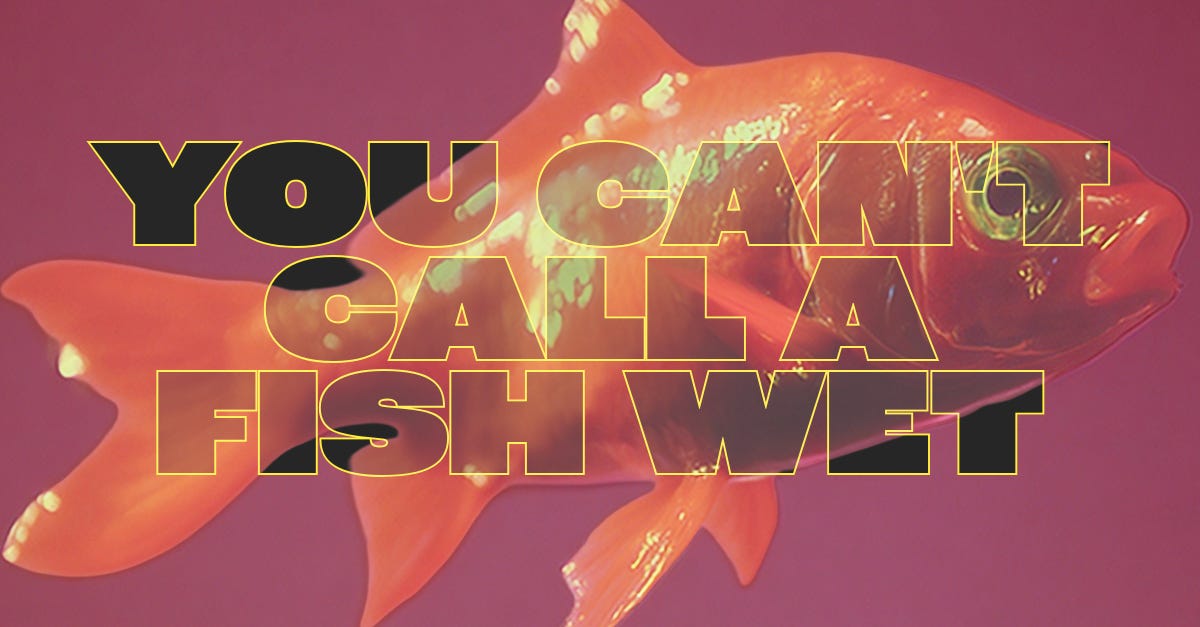
Professionally, most of us run on an idea that human beings update on evidence. You show someone data. You show them some consumer interviews. You show them some facts. You show them some studies. And eventually they go “ah, yes, of course”, and adjust to a more sensible course of action.
So much of the implicit infrastructure of modern work is built upon this facetious foundation. Most performance reviews, most strategy decks, an absolutely staggering quantity of management consulting deliverables. Even down to the conversations taking place in a given meeting. It all rests on a patently ludicrous notion that people, when presented with evidence, will update their thinking.
Clearly. That is not how it works.
The things that hold work back are almost never the things people are debating. The problem is rarely what has been written in the brief. The problem is the shape of the brief, the people working on the brief, the amount of time given to answer the brief, the simple fact that a hand off is in itself destructive. Similarly the problem is usually not the testing methodology. The problem is the assumption that testing can improve something that doesn’t exist yet. Again, the problem is usually not the latest piece of work that came out wrong. The problem is the processes that decide what right means before work even starts.
The arguments that are happening, about quality, or risk, or scope, or speed, are downstream of an argument that nobody is addressing, because nobody can quite see it. Because it’s the water.
And if you decide to name the water as the source of the wetness, you are no longer just another fish pointing at something in the room. You are now the fish with the temerity to call into question the entire lens through which every other thing in the room has been judged. You are asking the other fish to evaluate your claim about the wetness of the water using a sensory apparatus that has been calibrated entirely by water.
So of course this goes badly.
The fish is not being unreasonable out of spite. The fish is doing exactly what every theory of cognition since 1957 says it ought to do.
There is cognitive dissonance: if the water is wrong, then I have spent fifteen years being wet, expensively, wasting years of my life, and I would quite like that not to be the case, thank you.
There is system justification, the Jost-and-Banaji finding that we rationalise the systems we live in as fair and necessary precisely in proportion to how stuck inside them we are.
There is our old pal Goodharting: by the metrics that currently exist, which are themselves part of the water, things look fine, the metrics are up, the deck got signed off, so what exactly is your problem?
There is the IKEA effect: I helped build this water and so it is, structurally and emotionally, my water. And just who do you think you are to criticise it?
And then there is the big one, status. The senior fish became senior fish through their mastery of swimming through water. The proposition that the water is the source of the wetness problem is a coup against the people who currently run the aquarium. They can read the political subtext instinctively.
This, by the way, is where consultants produce a slide with a headline that says something like Driving Cultural Change. You will note that everyone in the room likes this slide, and then absolutely nothing happens. The slide is too soggy.
There is a way out of the water though, and maybe you already guessed what it is. It is a hook. And doesn’t that make for a delightful metaphor?
Take the painful hook for example. A failure so catastrophic that even the exalted excel dashboard can no longer lie about it. Kodak invented digital photography in 1975 and were still convincing themselves they were a film business in 2012, by which point the hook was Chapter 11 and the fish in question was on a marble slab in a sushi restaurant. Awareness, in this mode, is a near-death experience, and a really quite alarming number of organisations only work out which business they were in once they have already left it.
The painful hook is, of course, of absolutely no use to you. You cannot deploy bankruptcy on a Tuesday morning. But it does teach us the most important thing about hooks generally, which is that they do not ask the fish to sit back and rationally consider the evidence.
This is what a hook is. A hook is a thing that grabs you and abruptly yanks you, viscerally, into a position from which you can finally see the thing you couldn’t see before. It is something that happens to you, not something you agree to consider. It bypasses your cognitive defences because it does not bother to engage with them. It does not gently knock at the door of consciousness with a rat-a-tat-tat.
A rational argument can’t do that. A rational argument works, implicitly, by asking the listener to consent to it. Here is the evidence. Will you please consider it and adjust your view? The listener controls the evaluation. The listener decides what is admissible. And the listener, being a fish whose existence is bounded by water, will evaluate your evidence using the very water you are critiquing, in service of the very identity you are threatening, with the very metrics that are part of the wetness problem you are trying to solve. So, your argument loses before you have finished writing it.
You will notice, by the way, that every framework anybody is ever taught for building a strategic narrative skips over all of this almost entirely. The Pyramid Principle, Minto’s primordial ooze of strategic storytelling, takes the form of SCQA’s, with logical evidence stacked underneath in MECE pyramids of supporting argument. It is a thing of beautiful rational architecture. It contains, by intentional design, nothing that grabs anybody by the gills. It is a way to structure ideas that is itself made of water.
Narrative training is overwhelmingly about what comes after the hook.
This is the wrong way around. The hook is not the flourish. The hook is the fixture in the apparatus of your strategic thinking that allows every single other part of the puzzle to make any sort of impact.
And then, because our undersea kingdom enjoys a good joke, the moment you do manage to build a hook into your work, the people around you will put a lot of effort into trying to remove it.
This is because most people are aquatic. And even the smartest people are merely amphibious. The very talented are toads, penguins, mudskippers, and very, very rarely majestic cormorants and frigatebirds and sea herons. We have all spent the majority of our careers in our own pool of water, and that water is usually very similar to the water you were trying to point at, and the hook that grabs and yanks does not look like the sort of thing they have been trained to recognise. The hook looks weird. Maybe it looks unprofessional. Often it looks a lot like the slide our soggy old boss would have made us take out of a presentation. Our instinct, honed by a decade in the pond, is to remove the water threatening hook. Most ideas that fail were not killed by senior client fishes. They get unceremoniously murdered in the internal review meeting three days earlier, because the hook looked like the kind of thing that might pull us out of our own little aquarium.
Our job then, is not just to design a really great hook. It is also to protect the hook from our own water-refined instincts to make thinking feel suitably wet. A hook will always feel slightly wrong, if it doesn’t then it’s probably not much of a hook.
No posts
Comments
Nothing yet. Say the first thing.
Sign in to join the conversation.