
“Whatchu want today?”
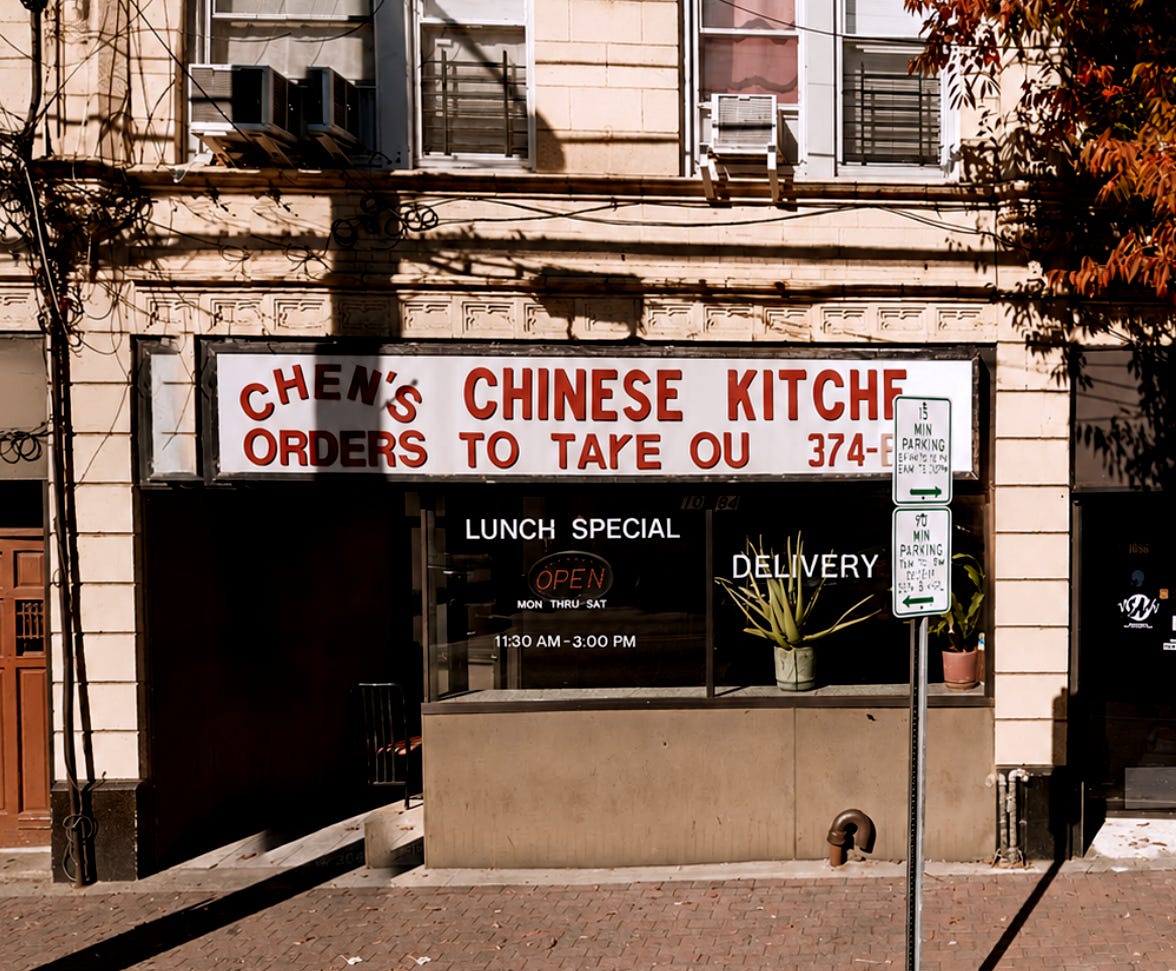
Mrs. Chen said it the same way every time. Chen’s Chinese Kitchen in Woodmere, Long Island: bare walls, two tables nobody used, a phone that never stopped ringing, and a counter so fast you could walk in hungry and walk out eating before the door closed behind you.
The Cooper brothers lived a few blocks away. Their parents were rarely home, but they had standing accounts at two of the neighborhood’s most important spots: Chen’s and Friendlier Pizza. They could call, give their name, and thirty minutes later food appeared. It was DoorDash before DoorDash, except there was no app and no driver to track. There was Mrs. Chen, and she already knew your order.
I was paying in quarters from the ashtray of my father’s Oldsmobile, which we affectionately called the Rolls-mobile. The Coopers thought I was lucky because there was always home-cooked food at my house. I thought they were lucky because they could decide what they wanted for dinner and make it show up.
The lunch special at Chen’s ran $1.99 to $2.99 depending on what you ordered. All noodles kept you at the cheap end. General Tso’s was going premium. You got to choose an egg roll or soup, and everything came with fried rice. I walked the mile there and the mile back because a tip was money I did not have.
Rumor had it that David’s older brother once tried to negotiate the General Tso’s lunch special at the $1.99 lo mein price. He tried to shake down Chen’s for a dollar. No Cooper ever willingly paid retail; their father lent money at rates that eventually became a federal matter. Mrs. Chen didn’t like it one bit. She gave him the Chinese takeout death penalty: lifetime ban.
At sixteen, that is worse than prison. Prison still has lunch.
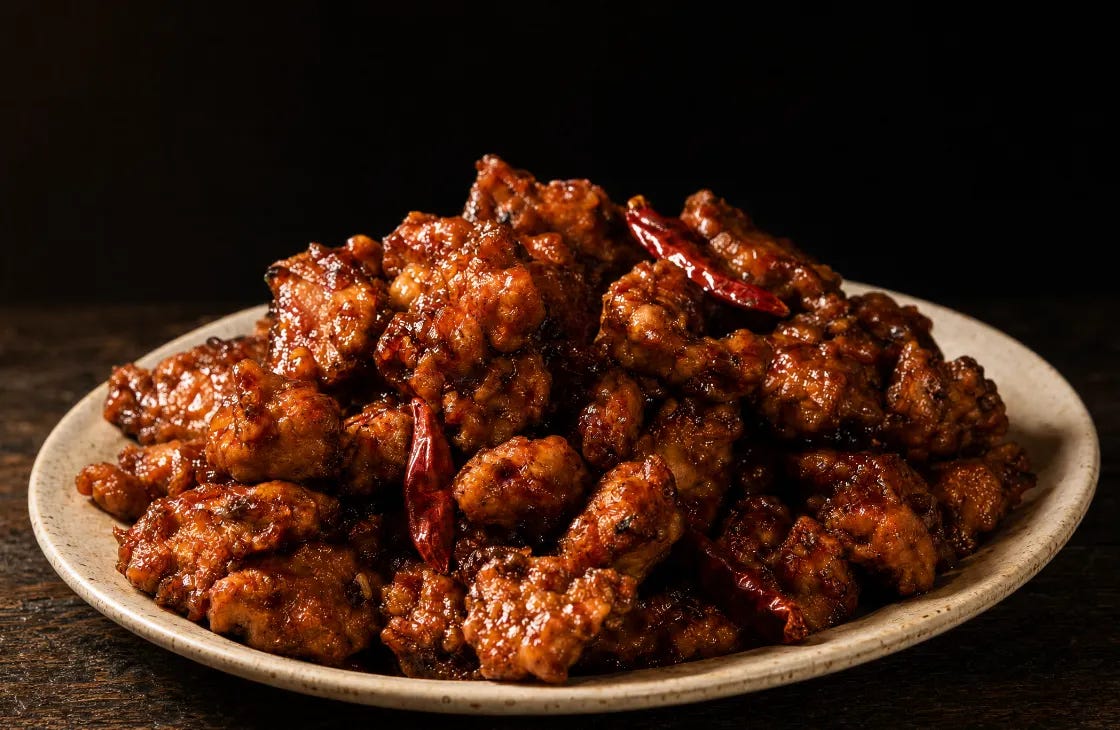
This is what he risked exile for: a crust that shatters before the sauce arrives, sweet first, salty behind it, the chile heat arriving late to check that you meant it. The bag never made it home unopened. You ate the first piece on the walk, too hot, fingers sticky, and by the time you got to the fried rice the sauce had already found it. A single crown of broccoli sat on the side, which nobody ate.
If anyone in the family ever came home with leftover General Tso’s, that container became gold. By morning the crust had collapsed into the sauce, the sauce had gone tacky, and every piece you pulled loose took a little of the next one with it. You did not particularly want General Tso’s at six in the morning, but if you waited until you wanted it, somebody else would have eaten it. You ate it cold from the container. No plate. No microwave. The microwave made noise, and a plate left evidence.
* * *
Here is the part they never put on the menu.
In 1882, America passed the Chinese Exclusion Act, the first federal law to shut the door on one nationality by name. Laborers were barred. Merchants were exempt. If you wanted to stay in this country, you could not be a worker. You had to own something.
In 1915, immigration authorities adopted a rule recognizing a restaurant owner who worked solely as a manager as a merchant. A restaurant could now become a way through the exclusion laws. Your cousin helped you over, gave you a job, showed you the kitchen. You worked until you could buy in as a partner, took your turn managing so you could qualify as a merchant, brought your own family over, and the cycle started again. Between 1910 and 1920, the number of Chinese restaurants in New York City nearly quadrupled. Every one of them was somebody’s turn.
A restaurant that failed was not just a failed business. If the customers stopped coming, somebody’s chance to stay, qualify, or bring family over could disappear with it. When your back is against the wall, you pay attention.
So they figured us out one table at a time: what got ordered, what got left on the plate, what people said they wanted versus what they actually ate. Less bone. More meat. More frying. More sweetness. They kept at it until they had built a cuisine nobody in China would recognize and nobody in America could give up.
* * *
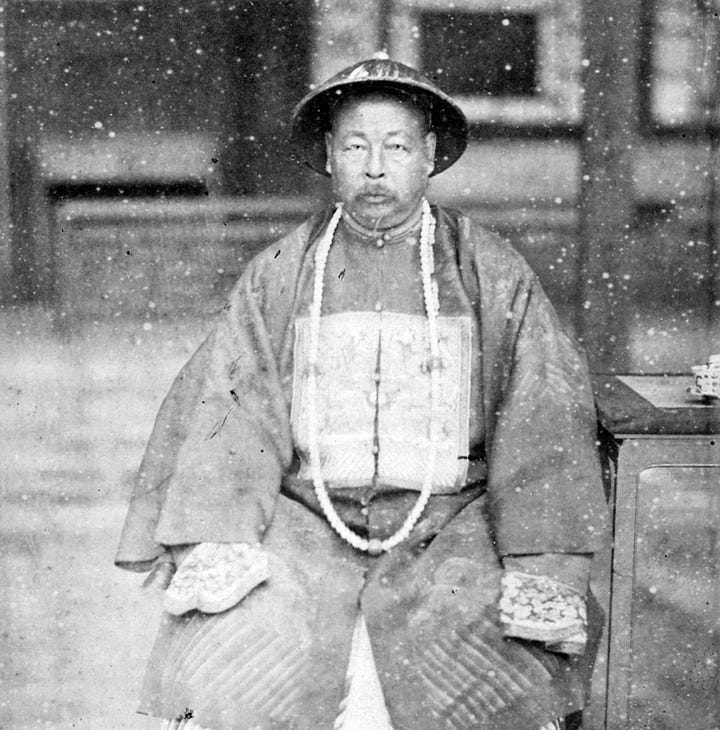
Peng Chang-kuei was born in 1919 in Hunan Province and apprenticed as a teenager under Cao Jinchen, one of the great chefs of his generation, before fleeing to Taiwan in 1949 and becoming the government’s banquet chef. If someone important landed hungry, Peng got the call.
In 1953, during a three-day state banquet for visiting American Admiral Arthur Radford, Peng improvised. He deboned a chicken leg, cut it into pieces, and cooked it at extreme heat with dried chiles and Hunanese spices, then named it after Zuo Zongtang, a famous general from his home province. In America, like Colonel Sanders, the general is known for chicken. In China, he is known for war. The dish was sour, hot, salty, no sugar, a Hunanese chef’s dish for a room full of Americans.
Then it met the American customer.
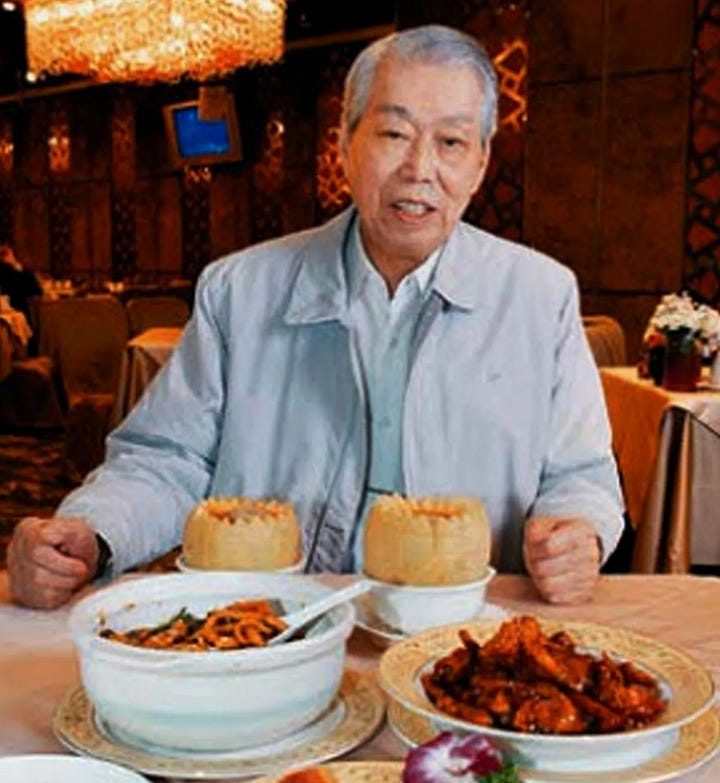
In the early 1970s, New York chef T.T. Wang encountered Peng’s dish and made the changes that mattered: sweeter sauce, battered chicken, fried crisp. Less bone. More meat. More frying. More sweetness. America took a military banquet dish and turned it into fried chicken candy.
When Peng opened his own restaurant in Manhattan in 1973 and served his original, sweeter and crispier versions were already circulating in New York.
Filmmakers working on The Search for General Tso later showed Peng what America had done to his chicken: sweet, battered, glistening, broccoli on the side. He called it “crazy nonsense.” He was right. He was also too late.
Peng died in 2016 in Taipei. His son Chuck kept the family restaurants going, and the original remained on the menu: sour, hot, no sugar, nothing like the version that made the name famous. Almost nobody orders it.
Chuck makes it anyway.
* * *
There was a man in the back at Chen’s, probably the cook. He was there every time I walked in, every time David called, every time the bag came across the counter before you finished asking for it. I never learned his name. It never occurred to me to ask. I called David Cooper this year. He didn’t know either.
Two kids who ate there for years, hundreds of meals between us, and neither of us could name the person who made the food. Mrs. Chen always knew what we wanted. At one of those two tables nobody used, the family’s kids did their homework. When the phone rang or a customer walked in, a pencil went down and one of them worked the counter. Then back to the textbook.
Chen’s is still there. I went back this year. The bare walls are still there. The two tables are still there. The phone still rings. General Tso’s is still on the menu. The lunch special is $9.50 now, the only thing in the room that knows how much time has passed. The Chens don’t run it anymore. Another family does.
At one of the tables, a kid was doing homework. The phone rang. The pencil went down.
I always knew what I wanted. I knew almost nothing else.
Joe Ariel
No posts
Comments
Nothing yet. Say the first thing.
Sign in to join the conversation.