
Welcome back to the Curious About Everything Newsletter! CAE 61 is here, if you missed it. The most popular link from last month was Hana Lee Goldin’s tips for using Google search as a reference desk.
We lost my stepmom in late April. Like me, in her thirties her life was changed by a medical emergency that left her with long-term consequences. During April, I spent all my ‘uptime’ with her, soaking in everything I could, smothering her in hugs, and asking all the things I knew I was running out of time to ask. While I still did read and compile the links I found most interesting, this is a more bare-bones CAE than usual. There is a lot less editorial with each link, and there’s no separate ‘best of’ and ‘the rest’ sections. You can find some fun quick links at the bottom as always, though.
Here is the short tribute I wrote about her and shared on social media. She was an incredible woman. 🤍
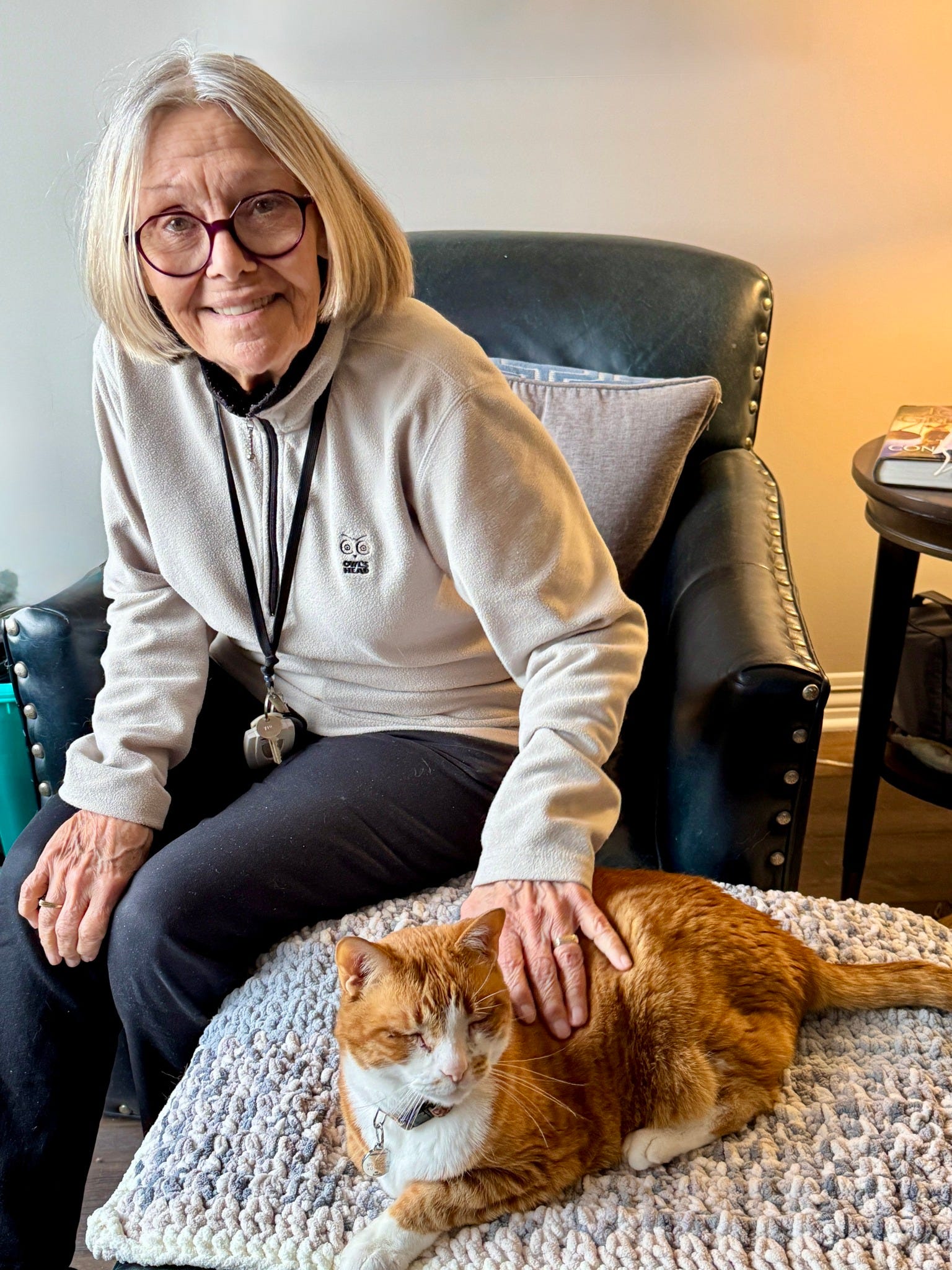
This is a tough post to write, but I wanted to share that Deborah, my wonderful stepmom, passed away this week. She has been in my life from the time I was six and my brother was only two and a half; so many of our formative memories involve her, and the hole she leaves in our lives is enormous.
She had a very tough life medically, something that brought us closer in recent years when my life and mobility also changed dramatically. In the 1980s, she was hospitalized for months and in a coma for over six weeks, which left her with considerable health issues long-term. She rarely mentioned or complained about her complex medical picture, instead living by the adage of looking forward, not backward — something she frequently repeated to my dad, brother, and me.
One of those issues was kidney disease, and as time went on and her kidneys began to fail, she was adamant that she would not want to do dialysis or opt for a transplant should she be eligible. Instead, she wanted to do MAID, medical assistance in dying. Those wishes never faltered, though of course we all hoped her kidneys would hang in a little longer than they did.
She passed quietly and peacefully on Wednesday in her favourite comfy chair, surrounded by the three of us. We each held onto her as she told us she loved us one last time and ebbed away.
Always private and understated, she did not want a funeral, nor a public gathering. Respecting her wishes, we had a quiet graveside burial. As my brother Cale noted when he spoke graveside, she was the cool parent, the person we went to with our embarrassing problems and the one we could joke with about anything.
And she kept her sense of humour until the very end. We had the benefit of time, allowing us to soak up as much as we could with her in the past few weeks. This included a last supper of her choice where she ended the night lifting her arms like she was a zombie, and telling us that she planned to haunt us for eternity.
She knew I’d want to write something longer eventually, and was happy for me to do so. I plan to write at length when I’m able, sharing more about her life and some of the stories our family will never forget.
It was a profound honour to journey with her as she made this choice, and to support her in life and in death. It was also a comfort to see her pass with the dignity she wanted and so deserved.
She is, and will always be, deeply missed. May her memory always be a blessing.
(For those wondering about her beloved cat, Zack, he is now 18 and he too has end-stage kidney disease. As I am not mobile enough to adopt him myself, one of my friends here in Ottawa has adopted him and will give him the best last years of his life that he can have.)
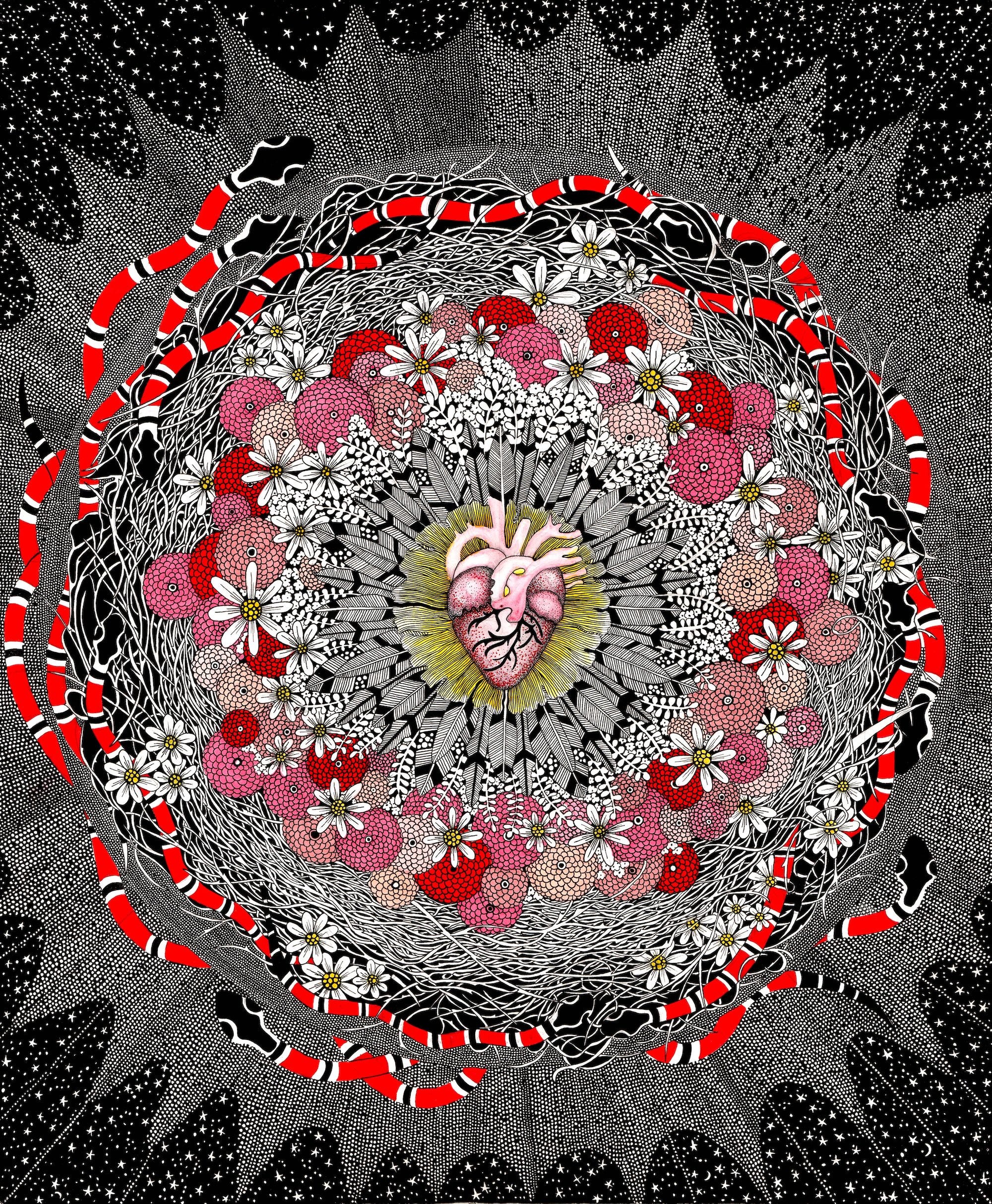
CAE 62’s featured artist is Sandra Shugart, who I initially contacted after I saw her beautiful image below from 2021, entitled “Guard Your Heart”. It seemed fitting to use it here, as Sandra created it in when overwhelmed with grief after losing close members of her family. The heart is drawn on ginkgo leaves for longevity, and wrapped in feathers to soften and protect. Sandra wrote in the caption to her piece that flowers represent memories of love and happiness, and the intertwined branches are life’s many struggles. The snakes are her reminder to guard your heart and not let it be hardened with fear and regret. You can find Sandra on Instagram and on her website.

More than the Latest “It Bird”. If you’re not on the woodcock side of the algorithm, this post gives you the background about a bird you didn’t know you needed in your life. Bird History
The Courage of Vulnerability: Teenage Frida Kahlo’s Moving Letters to Her First Love. This is Maria Popova’s essay about a new book edited by my friend Suzanne, who I got to know when I lived in Oaxaca. The book features the correspondence through the years between a teenage Kahlo and her first love, Alejandro Gómez Arias, including just after the 1925 bus accident that nearly killed her. Popova aptly notes that every love Kahlo lived and every loss she suffered became part of what she had to give to the world through her painting. The Marginalian
Cocaine pollution in rivers and lakes may disrupt behaviour of salmon, study finds. Cocaine is now one of the most detected illicit drugs in aquatic environments worldwide, and a new study looks at how it impacts salmon via a chemical called benzoylecgonine, which is the main thing left over after our bodies break down cocaine. It found that fish exposed to benzoylecgonine swam up to 1.9x farther per week than unexposed fish and dispersed up to 12.3 kilometres farther across the lake. The Guardian
Penguin ‘toxicologists’ find PFAS chemicals in remote Patagonia. A new study shows a non-invasive way that animals can help monitor their environment: via little anklets that measure the water’s pollution levels. Eureka
Artemis II Is Competency Porn and We Are Starving For It. Great read about how many of us were very emotional about Artemis II, and the reasons for that aren’t just the awe and wonder of space but also something we’re fundamentally missing in today’s discourse: competency. Airplane Mode
Deepfake Nudify Schools: Global Crisis. An analysis by WIRED and Indicator found nearly 90 schools and 600 students around the world impacted by AI-generated deepfake nude image, with technology ensuring that the problem shows no signs of going away. I can’t imagine growing up with the standard teenage drama and angst superimposing this foundation of vulnerability, especially for girls. WIRED
Trump’s Humiliation in Orbán Defeat Stunner Is Only Just Beginning. For Viktor Orbán’s epic loss in Hungary to have real meaning in America, Democrats need to firmly proclaim themselves part of the global anti-authoritarian movement and frame domestic politics as part of the international pro-democracy movements. (But, they won’t.) The New Republic
Largest Study of Pregnancy Sickness Uncovers Six New Genetic Links. The study analyzed DNA from more than 10,000 women and identified a total of 10 genes linked to the most severe form of pregnancy sickness, hyperemesis gravidarum, pointing to biological mechanisms behind it and (WE HOPE) potential new treatment pathways. Keck School of Medicine, USC
GLP-1 Drug Improves Liver Health Independent of Weight Loss, Mouse Study Finds. As a follow up to my own post about GLP-1 meds in microdoses, which really helped my symptoms of MCAS and pain, a new mouse study from researchers at Toronto’s Sinai Health have found that semaglutide acts directly on liver cells to improve organ function, and does so independently of weight loss. Genetic Engineering & Biotechnology News
Cognitive Dissonance Helps Explain Why Trump Supporters Remain Loyal, New Research Suggests. When people face information that conflicts with their deeply held beliefs, they tend to reduce their mental discomfort by denying the allegations, focusing on policies over personal behaviour, or claiming that other politicians commit similar acts. PsyPost
I Liked Travel Better in the Early 2000s. Travel in the early 2000s felt more immersive and meaningful because it was less mediated by smartphones and social media, theorizes this piece. It forced people to be present, to rely on spontaneity, and to engage more deeply with their surroundings. The constant connectivity these days leads to a more curated experience that can pull you away from the perspective and e Back By Dinner. Be Back by Dinner (via Travelfish)
Michael J. Fox, Three Co-Workers at 70s TV Show, All Got Parkinson’s. With more and more discussion about Parkinson’s and Alzheimer’s diseases potentially having viral or environmental triggers, I wanted to share a 2002 CBC report that I’d guess many American readers haven’t yet seen: it describes a possible Parkinson’s cluster MJF and three colleagues who worked on the 1970s sitcom Leo and Me. No definitive cause was established, to be clear, but as more scientific curiosity related to viral triggers has emerged in recent years, I thought you’d all find it interesting. CBC
What I Ate as an Unpaid Intern at Noma. Three Michelin starred Noma (via its chef and co-founder René Redzepi) has been in the news these days, for all the wrong reasons: allegations of widespread staff abuse. In this post, Namrata Hegde recounts her 2018 unpaid internship at Noma, where she arrived from India with a budget of roughly 66 kroner ($7.10 USD) a day after rent, survived largely on two staff meals and groceries, and regularly skipped dinner. She argues that that elite culinary institutions like Noma rely on exploitative labor systems, where interns shoulder financial, physical, and emotional costs while the business remains profitable. Yes, it’s a learning opportunity, but it leaves interns feeling replaceable and weaponizes their ambition to justify exploiting them. A Food & Culture Namifesto
Blowing The Whistle On Deepak Chopra, The Epstein Files, Cancel Culture, & Holding My Influencer Peers (& Myself) Accountable. Using Deepak Chopra’s documented ties to Jeffrey Epstein, physician and author Lissa Rankin shares firsthand and secondhand accounts of misconduct, abuse of power, fraud, and ethical failures she witnessed across the wellness and spirituality influencer industry, including popular names like Louise Hay, Joe Dispenza, Byron Katie, and others. She argues that these influencer-gurus have engaged in harmful or unethical behaviour behind the scenes, often concealed by their public personas and loyal followings, and that insiders have remained silent out of fear or complicity. Lissa Rankin, MD
Study: Infrasound likely a key factor in alleged hauntings. A recent study suggests that eerie sensations associated with feeling haunted are often caused by low-frequency infrasound like as vibrations from pipes or ventilation systems, which people can’t consciously hear but which can increase cortisol, stress, and unease. Researchers conclude that these subtle physical effects, combined with expectations about a place being haunted, can lead people to interpret “ordinary discomfort” as paranormal activity rather than a mundane environmental cause. Ars Technica
The Creation of Instant Coffee. I drink Starbucks VIA coffee every morning, because it’s quick and easy and tastes great (unlike most instant coffee, which is pretty terrible). So I was interested in this post, and it turns out that instant coffee wasn’t easy to invent, because preserving flavour compounds required decades of trial and error — mostly error. My beloved VIAs are mentioned too; it turns out we needed modern techniques like microgrinding and freeze-drying to get it tasting better. Works in Progress
Exploring the Far Side of the Moon: A Visual History. Also related to Artemis II and the amazing footage we got from it: this post looks at how the Moon’s far side remained mostly unknown for centuries because of tidal locking (meaning that only one side of the Moon ever faces the Earth). As a result, we got only partial glimpses from Earth until space-age missions finally showed it to us it. Great, image-laden post that goes through the decade from Luna 3’s flyby to NASA’s Lunar Orbiter program and everything in between. Inverting Vision
See also: An Artemis II interactive and visual timeline, here. Use the bar at the top of the page to scroll through photos.
Tristan da Cunha: The Busiest Place You’ve Never Seen. An interactive article with lots of photos and some video all about Tristan da Cunha, a British overseas territory described as “a rugged Scottish highland dropped into the South Atlantic”. It is the world’s most remote inhabited island with only 221 residents. Extreme isolation has led to a deeply communal, self-reliant society with shared labor in livestock monitoring, lobster fishing, food processing and more, dating back to 1817. Everyone pitches in across roles as needed. NPR
The War Against Misinformation Is Over. The Lies Won. Justin Ling on how research suggests that people know images and headlines are false, but share them anyway. As a result, efforts to combat misinformation fail because people don’t actually care; they’re driven by emotion, not logic. The misinformation overload is a structural (social media + human behaviour) problem, not about getting better facts in front of people. Depressing and (in my experience) also true. The Walrus
The AI Writing Witchhunt Is Pointless. “You can’t read a paragraph and reliably, with a human life on the line (because that’s the stakes, when you destroy a writer’s career and a writer’s reputation) tell beyond any reasonable doubt, whether a human or a machine produced it,” writes Joan Westenberg. As a result, the culture of suspicion we live in disproportionately harms writers, especially newer, ESL, or neurodivergent writers. Interesting follow up to last month’s piece on AI and books. Westenberg
A Cancer Treatment That Does More Than Scientists Thought. A single course of CAR-T cell therapy made three (!) simultaneous rare autoimmune diseases into remission in one patient. More than a year later, she remains free of symptoms without any ongoing medication. Very interesting, and promising! The Atlantic (gift link); via Jason Kottke
Winners of the GDT Nature Photographer of the Year Awards. Amazing gallery of photos from both the winner Luca Lorenz and all of the category winners and finalists. GDT (Gesellschaft für Naturfotografie) e.V.
National Butter Tart Day? Canada says, yes please.
Telling time via street view images from New York City. (I appreciate the pigeon too.)
All of the Artemis II Mobile Wallpapers released by NASA during the awe-inspiring mission last month.
FontCrafter: create a font using your own handwriting, for free.
A Korean traveler uses creativity to convey his food preferences. In his case, no coriander. Should I be making versions of my GF t-shirts and totes in other languages?
Birthday colour fun. A creative person in Japan made a tool that generates a unique colour associated with your birth date, along with its name and meaning. (You’ll need Google translate for the meaning!)
Prediction markets don’t reflect reality, they create it: interesting read on ‘outsider trading’ and the scourge of betting markets.
CRISPR-edited wheat could make toasted bread less carcinogenic. (But what about us celiacs? There’s a lot less research on which ones are carcinogenic when toasted/burned.)
University of Calgary sets the world record for the largest gathering of people dressed as dinosaurs with 682 people total.
Your wowza title of the month: A Woman Who Became Pregnant After Having Sex With Identical Twins Was Told It’s Not Possible to Identify the Father of Her Baby
Hello, World: The first image downlinked from the Artemis II crew was of Earth photographed by Commander Reid Wiseman from the Orion spacecraft’s window, with two auroras and zodiacal light visible as Earth eclipses the Sun. Amazing.
Hope you enjoyed these links! See you next month,
-Jodi
Comments
Nothing yet. Say the first thing.
Sign in to join the conversation.