
The Etudes edition is out! My edition of the twelve concert etudes by Agnes Tyrrell just dropped (I feel very hip describing a publication that way). I’m really proud of it.
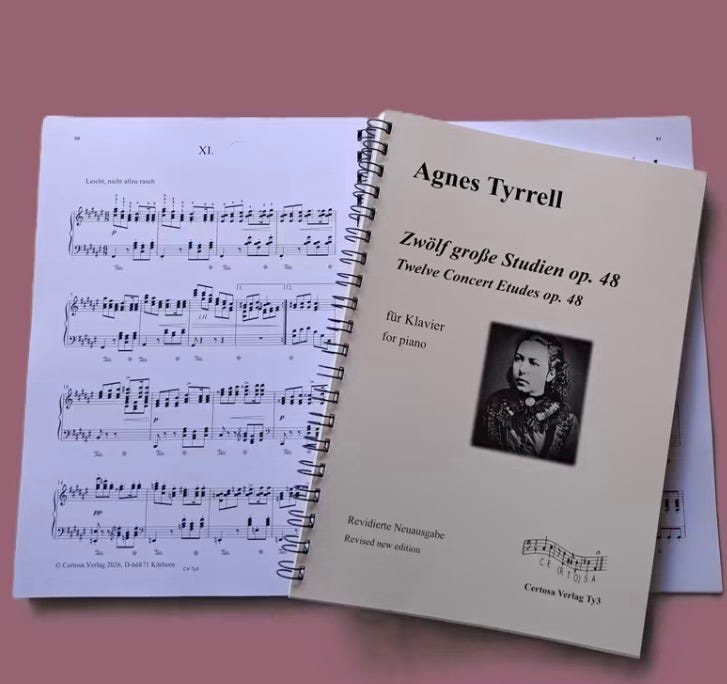
I haven’t seen the actual printed copy yet—the publisher is mailing me some copies from Germany, so it will take a while--but the files look beautiful. It was a big project, with so many (SO, SO MANY) revisions back and forth. And I learned so much. It reminds me of a summer at Chautauqua a million years ago, when I worked as an artist’s model in the painting and drawing studios. At the end of the summer, after being in art classes all summer and hearing art teachers talk about all the student works, I tagged along on the art class trip to a museum. I had been to museums many times before, but for the first time when I looked at the paintings it was easy to imagine them out of the frame, on the easel, with an actual person painting them. I feel that way now when I look at printed scores: I can see that every single placement of every single mark is a choice someone made. They’re out of the frame.
I’ve probably told you this story before, because I keep thinking of it while editing Agnes’s music, but I remember the first time I ever heard a piece on the radio that I was working on in my lessons. I was young, and it was one of the Clementi sonatinas, probably Op. 36 C major, and it was such a shock to realize that what I did practicing the piano was the same thing as MUSIC, that the music that came out of the radio and the record player was played by a person moving their fingers. Having these pieces exist in their printed form feels like that.
It also feels really good to have a finished product after deciding to postpone recording the etudes. That was absolutely the right decision, and every time I think about it I feel happy. And I’m celebrating being done with an editing project by…editing more. Riley, my stalwart collaborator, has typeset lots of Agnes shorter pieces that I’ve been waiting to edit till I was done with the etudes. So it’s been fun in the last couple of weeks to go through some of those, and I’ve finished the ones that were in the queue for me to edit. Riley is at a music festival now, focusing on her own compositions, so she won’t be typesetting Agnes for the next couple of weeks, but I think we can have them on IMSLP by the end of the summer. Certainly, absolutely, I really mean it, by the end of 2026. And I’m also going to edit some of the lieder, for voice and piano, that have been waiting in the queue. So it feels really good to be putting Agnes’s music out in the world.
Here’s more editing coming up: I’m mentoring a fantastic student, Katie, through the Kolbe fellowship program at Gettysburg College this summer to digitize the handwritten score to Agnes’s opera (YOU GUYS THERE’S AN OPERA AND IT’S GOING TO BE REALLY AMAZING. Ahem.) Like Riley, Katie is a brilliant student and a dream collaborator and she’s doing excellent work: she’s already typeset the first act and part of the second act in just a few weeks.I can’t believe how lucky I am (and how lucky Agnes is) to have these incredible young minds working on this music.
In the opera there are hundreds of pages and thousands of measures and I’m so proud of Katie for her great work. I’ve gotten to hear most of the first act and part of the second act, and even with the mediocre midi sounds on the computer the music is compelling and beautiful. The bad news is that I’m not sure it will work as a student production: the vocal parts are demanding, including a lead tenor and lead soprano who both have lots of high B flats, and that’s just not safe for most undergraduate singers. But we’ll see.
What’s the opera about, you ask? It stars Eleanor of Aquitaine, Henry II, their daughter Mathilda, their son Henry, and Bertran de Born, a warrior troubadour. Katie and I haven’t read the libretto yet, but I’ve just hired out the project of transcribing the libretto from the old German cursive, so we should have it in a couple of weeks. Poor Katie is having the experience of working so intimately with this music without knowing what the lyrics are, and I’m so curious to find out how her imaginings compare to the actual text.
But wait, you say, that all sounds great, but weren’t you going to be practicing lots and also starting a podcast about that?
Okay, yes, and, but.
I’m holding off on the podcast till the fall; I’m teaching at Interlochen Arts Camp right now, and I’m going to wait to get it going till I’m back in my regular office. But practicing is going well, though I did hit a couple of snags.
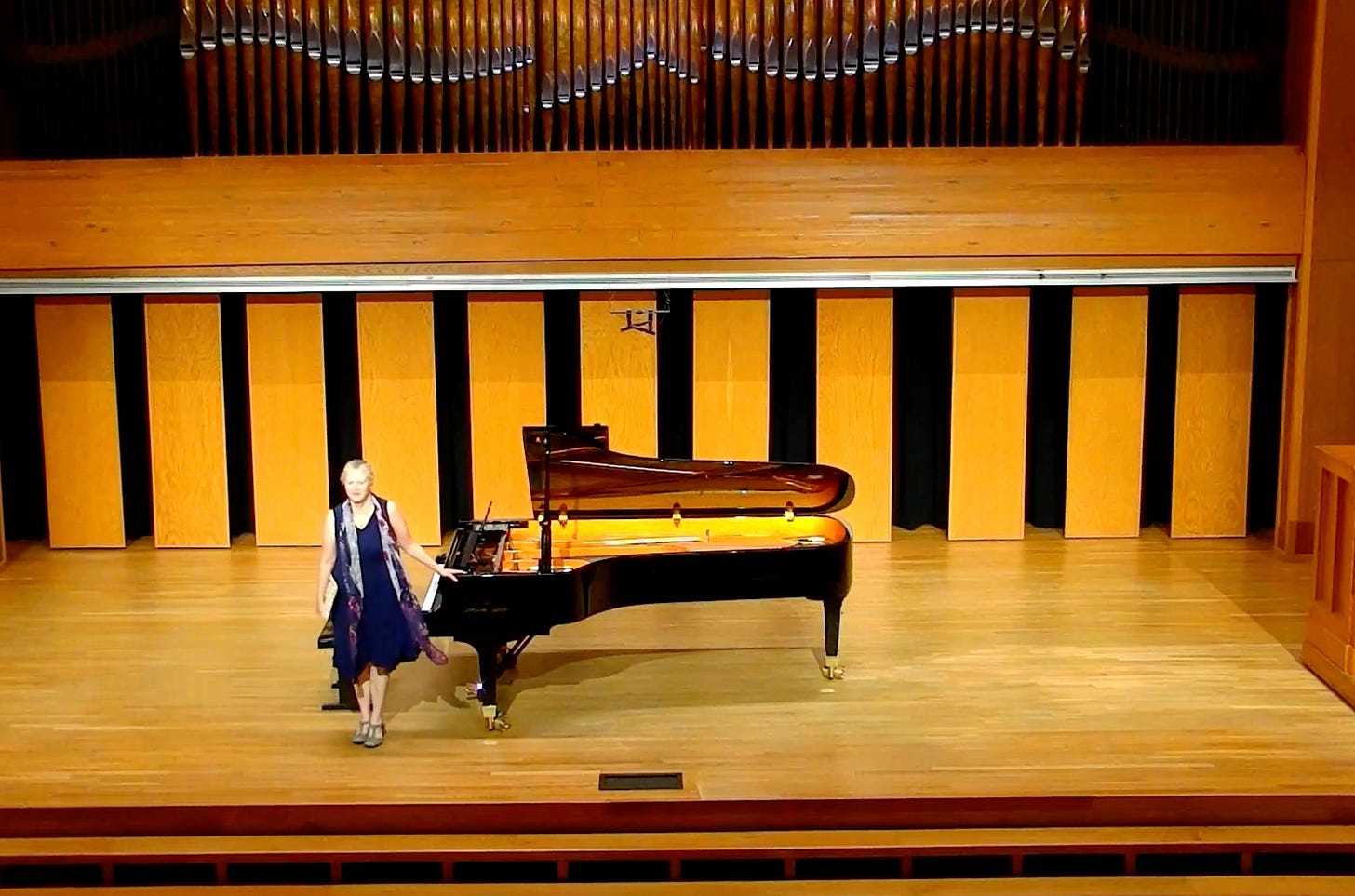
I had a couple of packing and travel days, and then I arrived at Interlochen, where I played three Agnes Idylls on the piano faculty recital…
… and then I promptly succumbed to a terrible cold that knocked me out for about nine days. I have to say it was about the best cold I’ve ever had: cold medication got me through all my teaching, and then I spent every free moment in the hammock, blowing my nose and reading detective novels.

It was delightful.
And of course every time I get sick I think of Agnes, whose health was so terrible. And I do get sick often enough that I’ve developed that pattern: I get a cold and I think of Agnes. I had an allergy test a few weeks ago, with the needles in my arm and back: turns out I’m allergic to dogs, cats, dust, spring, summer, and fall. So I’m taking lots of antihistamines now and I’m going to do a course of allergy shots in the fall. I hope that I won’t have to commune with Agnes by getting sick so much anymore.
Now that I’m over the cold, I’m enjoying practicing slowly. It’s a luxury to be able to take things apart and not have to worry about putting them back together in the near future. In the last year I played lots of concerts of the Etudes & Idylls program, and I loved all of that, but it meant that most weeks I really couldn’t take things apart because I had to make sure everything was together to play for the concert. Now I’m doing things like changing what finger goes on what key in a certain place to make a transition smoother. If I tried to make that change in the few days before the concert, it wouldn’t work: my brain would register that place as a taken-apart, work-in-progress place, and I would have a glitch in the performance. But now I can make changes and build in new habits.
It’s also a luxury to practice from the printed scores of the etudes. Agnes’s handwriting is miraculously clear and readable, but it’s still very much my comfort zone to read music from print, not handwriting. And practicing from a new score is always a nice reset. I don’t have the kind of photographic memory that tells me exactly what every note is, alas, but I do learn where different sections lie on the page (upper left, middle right, etc), and that makes it a really different experience to practice from a new score.
It’s also an incentive to finish editing the other short scores so I can practice from them. And it really does feel like a reset: here’s this music I know well, and a score I know well, but my fingers haven’t quite learned this score yet.
I love being at camp, and I love having practice be such a big part of my day. It really does feel good to practice more. My fingers obey me more, and some sections that are hard really are getting easier. I’m also making sure that my posture and alignment are exactly what I want them to be in every phrase—lots of the details end up being in my neck or my shoulders, not my fingers. It’s a luxury to really get things right.
And it’s a luxury to be at camp. My colleagues and my students here are truly amazing, and I think I’ve really helped some of my students. It’s so fun when you see a student come here, realize what’s possible, then work really hard over the year and come back vastly improved. And I love seeing them grow year to year, literally: one student started working with me as an adorable teeny sixth grader and now towers over me as a ninth grader, and it’s so fun to see him growing into himself. I also had a kid who didn’t take lessons with me and barely spoke in my class (though she was always paying attention and often had a twinkle in her eye) come up and hug me after the final recital, so that felt great too.
And I think I dramatically changed one young pianist’s life in the past couple of weeks. She’s fully blind, walking with a cane, and maybe 12 or 13 years old. She’s a fabulous kid—really bright and good humored, with terrific focus. I knew I’d have a blind student ahead of time, and I assumed her playing would be very musical, because she would have learned most things by ear with braille notation to help. Instead I was shocked by how mechanical her playing was: everything at the same volume with no phrasing at all. It turns out she hasn’t been learning by ear at all (!!!) but has been relying on her mom or her teacher to tell her “then there’s a G, then an A, then a B.” I can’t imagine a more tedious way of learning, and I can’t believe she’s stuck with playing piano to the point where she can play at all. So once I figured that out, we spent lots of time in her lessons doing call and response: “ okay, the first note is going to be middle C, then listen and play back.” Then I would play short phrases and have her imitate the notes and rhythm and articulations. I also had her imitate me playing the opening of her Chopin nocturne in lots of different ways, with variations in speed and dynamics, so she could imitate not just the notes but the way you play them. That was a new idea for her too. I played her Renee Fleming singing Casta Diva to talk about a singing line, and then I had her listen to the opening phrase of her nocturne in lots of different recordings and try to imitate those. All new skills for her! But she got so much better in a short time, and of course she’s going to get really good at playing by ear and learning to phrase by listening. I don’t think I’ve ever had an student improve so dramatically. She played so much more artistically in the final recital, with some beautifully tapered phrases—it was like a different musician. I’m sure that any of my colleagues here would have done exactly the same things with her, but I just happened to be the one who worked with her. So that feels really good, to imagine how much better her musical life will be. Maybe someday she’ll play some music by Agnes and learn it by ear (hmm. I don’t know how to go about making it available in braille…that’s a later question I think).
No posts
Comments
Nothing yet. Say the first thing.
Sign in to join the conversation.