
There’s a particular kind of man who doesn’t say much. Who meets declarations of love with a nod, or an “OK.” Who seems to move through life, through women, through work, even through war, as though none of it quite touches him. You probably know one. You may have loved one.
I’ve recently discovered one.
In a novel called Flesh.
I was sitting in an auditoriaum at the Margaret River Readers and Writers Festival listening to David Szalay in conversation with Claire Nicols from the ABC Book Show. He was talking about Flesh, his 2025 Booker Prize-winning novel, a meditation on class, power, intimacy, migration and masculinity that follows one man from a housing estate in Hungary to the mansions of London’s super-rich.
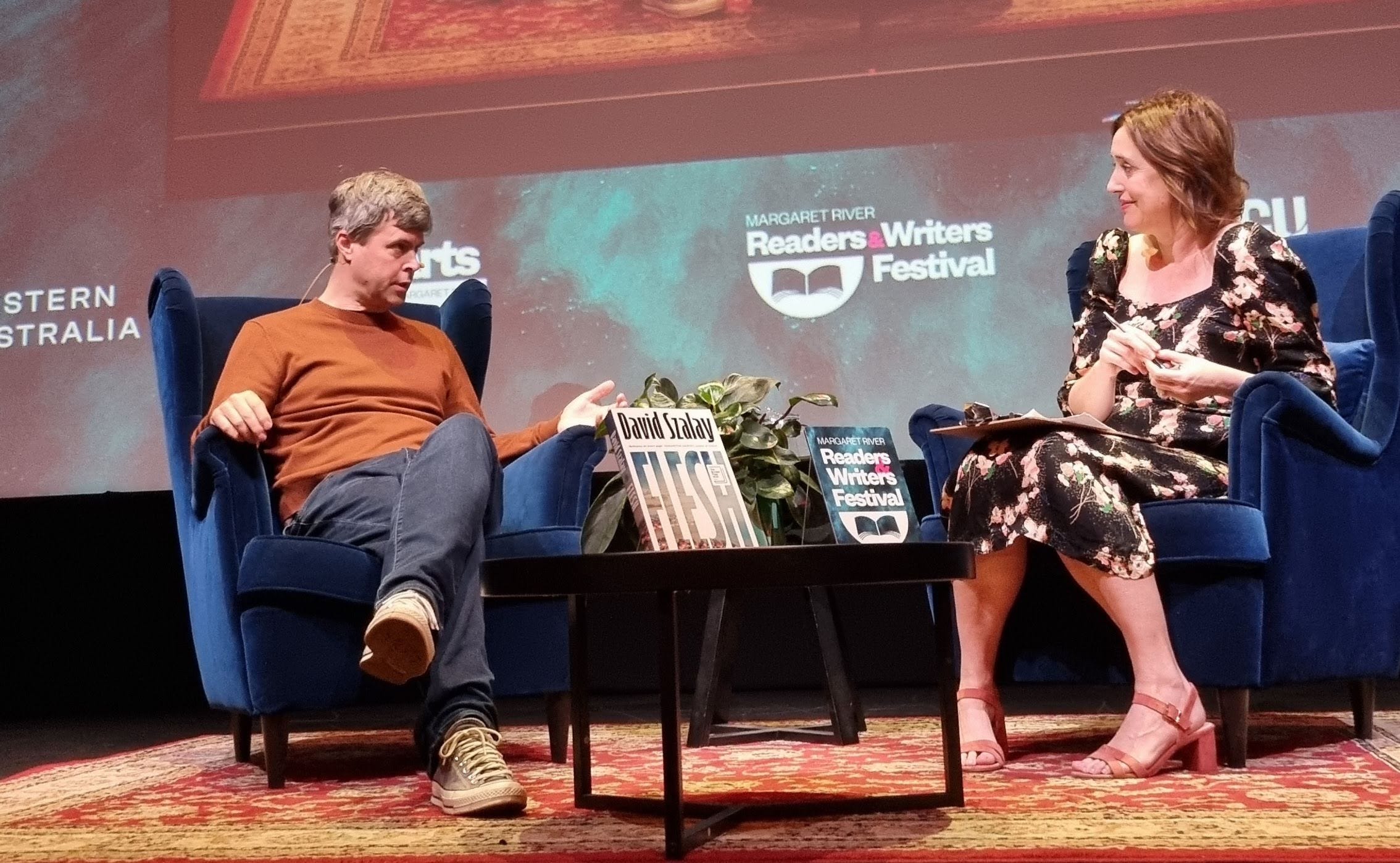
The Booker judges called the novel spare, disciplined, urgent, honest and heartbreaking - and said they had never read anything quite like it.
Meanwhile sitting there, contemplatively, I realised that, in the novel, he was describing some of the men I’ve come across in my life.
István, his protagonist, is taciturn, and magnetic in a way that’s almost impossible to explain, and yet I recognised him immediately. So did most of the woman in that audience, if the hush of attention was anything to go by.
Szalay has written a novel that is, on the surface, about one man’s life. But what I couldn’t stop turning over, long after I left the festival and drove home, was the uncomfortable question it plants in you: what do we actually know about the men closest to us? And have we ever really asked?
By the time I walked out of the Margaret River Heart venue, I had already bought a copy of Flesh for book club.
Here are the notes I made, because this is a novel that rewards a little preparation.
Well, on stage, David was delightfully unassuming and modest. He didn’t expect to win the Booker Prize, he said. He looked a little grave, nervous, ill at ease, was a bit fidgety, and admitted to feeling really uncomfortable at the Booker Awards event. He said with a wry smile that he had avoided fellow nominees as well as the judges, with focussed intent, during the awards evening!
He seemed quite serious, and yet, there was a latent sense of humour hiding within his interview too.
It seems to me that he’s possibly a man more at home socialising with the big ideas and crazy imaginings of his own fertile mind; writing novels and living, what he said is, a quiet life in Vienna.
Yet what a bold, hypnotic, melodramatic, novel he’s written in Flesh.
It’s not quiet at all.
“What’s it about in one sentence,” he was recently asked.
“It’s the story of a man’s life from adolescence to middle age,” he replied.
Okay.
And probably with that description you’re not likely to go and buy the book.
But there’s a lot more to it than just that.
And a helluva lot more “okays” too.
It’s a raw and unapologetic story that explores male adolescent desires. It lays bare in unflinching prose the relationship young men have with their bodies, and the way their identities are affected by their desires.
It explores masculinity, but David said the book was never meant to be about male masculinity, and by the way - he took out every ‘masculinity’ word except for one which he left in as reported speech that related to Istvan ‘as an exemplar of primitive masculinity.’
There are 10 chapters, and each chapter covers only a week or a few months of Istvan’s life, and the gaps in-between cover years. Does David know what happened during the gaps in Istvan’s life. No. We are all allowed to make our own assumptions.
The storytellling is hypnotic, page turning, and it’s intimate from a man’s perspective.
The scenes are starkly populated, the descriptions are unadorned yet feel vivid.
The narrative explores male thinking about strength, ageing, and vulnerability. It explores how traditional physical and violent occupations might have an impact on a man, and then redefines what it means to be a man today.
One of the key ideas asks, does physicality of experience come before anything else? Most of the main plot elements in Flesh are to do with physical experiences, and many of the turning points in Istvan’s life are related to physicality. Very much so.
But what else?
Not at all, the book withholds moral judgement. The first chapter charts and characterises what could be termed an abusive and manipulative relationship, even grooming to an extent, but it doesn’t judge or moralise.
What it does do is show through a series of extreme emotional reactions from shock, desire, shame, the feeling he should not want this but he does, moves on to feel engaged in the situation, and becomes involved in the relationship where the woman never intended to become involved. Istvan totally misunderstands the situation and it’s quite shocking because of the ethical considerations.
It becomes a pattern - the power dynamic is different as the novel goes on, but the wife he marries offers a very concrete money/status/power option. Even in this relationship Istvan is not powerfully attracted in the first moment, but he doesn’t feel shame, and over time the attraction grows.
“He’s been ordered and institutionalised most of his life, in the army and the detention centre, but this book isn’t meant to analyse the psychology,” explained David. However, we’re given time to think about this, and led to unpack our own conclusions about how this may have affected his character.
Istvan’s character hasn’t been spelt out - yet we do get access to his feelings. “We experience him through other characters and we do get to feel sympathy for him. We see him as a child and a parent and we get to see him just as a fellow human being. But I just wanted to write a book about fundamental human experiences and so we do get to feel for him and know him.” David Szalay.
The book creates enormous contrast between wealthy and a very average level of living. But Istvan’s upwardly mobile pathway to wealth is by physicality and sex and relationships.
“The people who have the wealth are not any more deserving than Istvan. It’s all slightly absurd - a crazy lottery to being rich. But there’s no kind of moral intended. He enounters soft prejudice that he’s not meant to be wealthy, and ultimately he does mess it up.” David Szalay.
The book is written with short sentences and very direct style of writing, almost simple - although it’s not simple at all. The 1st chapter was originally intended to be a short story, and the style was detached, pared back to create a stronger emotional impact. The restrained style David thought would maximise the impact of the story.
“Writing the book was fairly instinctive. I started each chapter writing about what interested me. I wanted the book to be full of incident. The way of achieving this was not to write about the melodramatic incidents, but to write about the aftermath they had on Istvan and the characters.”
There’s at least one ‘okay’ in the dialogue on each page, in fact David reckons there are about 500 ‘okays’ altogether. The dialogue is interesting because it’s based very much on how people speak to each other in real life. This he pulls off, miraculously. Does he think it gives the book realism, does it give it emotional impact? David thinks “YES!”
So how did a novel that has limited dialogue, that’s made up of a lot of ‘okays’, that’s about an adolescent boy’s sexual awakenings, and his journey of lucky chance from near poverty in Prague to living amongst billionaires in London, riding the waves of big world events - how did it ever become a Booker winner?
“It felt risky to write the book,” David said. “Because the book doesn’t give the reader much guidance about how to respond to the lead character Istvan.” Indeed, there are only subtle pointers to what he’s really like.
“But risk and the thing about being interesting are closely related when writing a book. Risk tends to mean you’re in a zone where things do get interesting.”
David was born in Hungary. He’s lived in London, Canada and Hungary, and now lives in Vienna. His Mum is Canadian, his Dad is Hungarian, and when he was growing up in London David visited Hungary almost every year from the 1980’s. In 2010 he moved to Hungary for around 10 years but he felt he didn’t fit into Hungary anymore, nor did he speak the language very well.
Not fitting is was one of the first things he thought about when he began writing the book. “I wanted to write about feeling stretched or marooned between 2 countries. This was an important emotional ingredient. Istvan is deliberately divided between two places.”
His novel, Flesh, begins in Hungary, and European history at the time is significant. For instance, Hungary joining the EU affected people’s lives, especially young people. It gives Istvan the opportunity to move to London and change his life. “The big world events happening around the timeline of the novel are a big part of the book, especially how they change people’s lives,” David said.
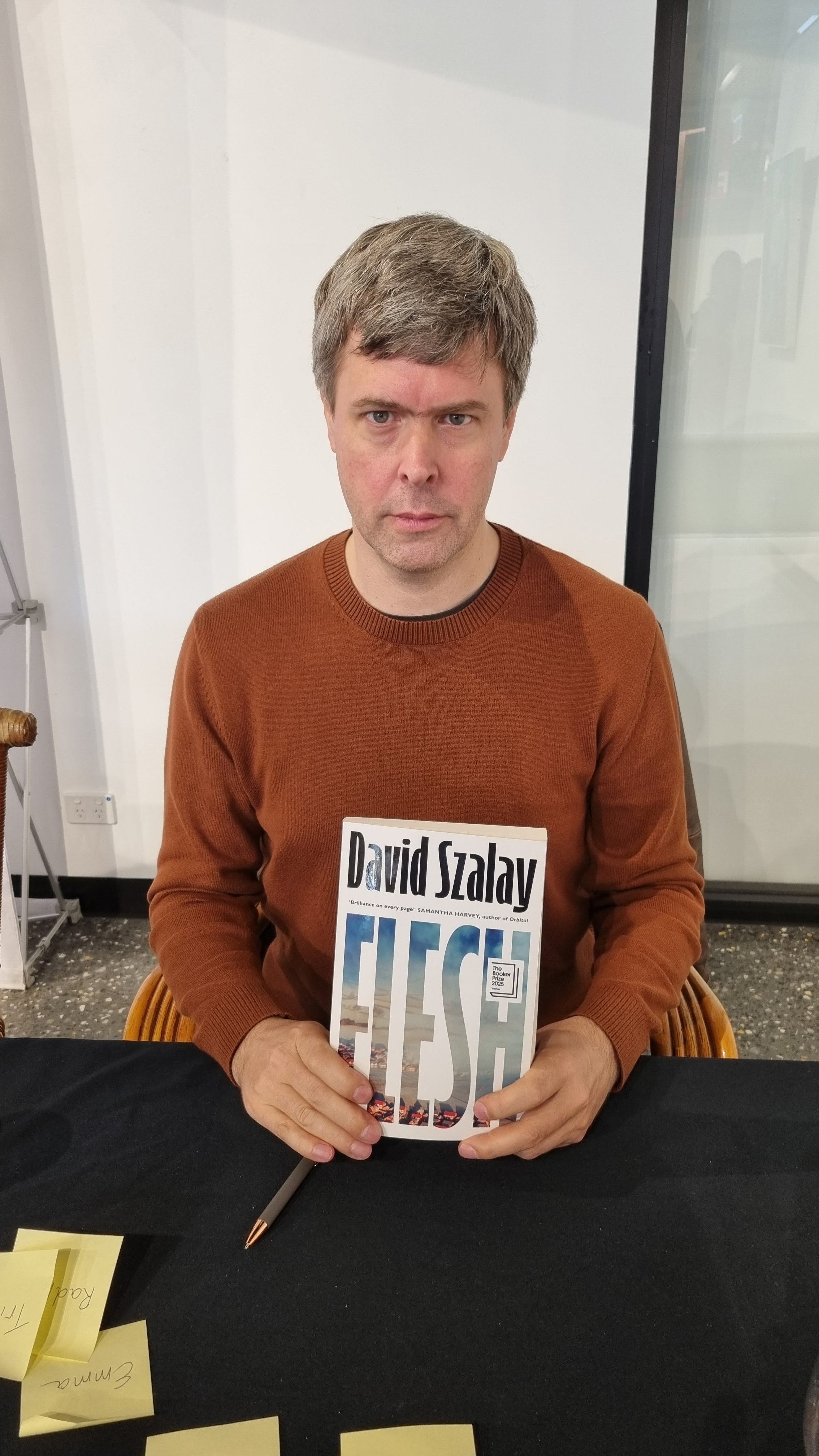
David explained that Flesh was the first working title but he assumed it would have a different title in the en because Flesh seemed a bit tawdry, embarrassing even, and the publisher was of the same opinion. He tried to find an elevated literary title, but couldn’t, and he had feelings of unease thinking that the title would reflect the book, or give it vulgar connotations. On the other hand the word Flesh also has its own parallel existence with a big history of its own in the English language.
In the end he stayed with the title of flesh because “It’s actually a warning about the nature of the book.” The beginning chapter is all about a teenage boy going through huge hormonal changes. In a way it offers insight into the intense, confused, detached and yet completely engrossed way an adolescent can be so so driven by his body.
And you’ll soon realise there’s no evidence in the title that Istvan’s life will be ‘okay’ at all.
Have you read Flesh by David Szalay? What did you think?
What other Booker Prize Winning Novels have you read and enjoyed.
You might also like my post : Why Attend A Readers & Writers Festival?
Until next time,
Jo x
Comments
Nothing yet. Say the first thing.
Sign in to join the conversation.