
Until I started looking beyond South Africa’s famous safari names, Madikwe was barely on my radar. That turned out to be a considerable oversight because it’s malaria-free, quieter than many famous reserves—and remarkably rewarding for mature travellers.
“An elephant in ‘must’ is after only one thing – A woman.” Thabie, our game ranger pulls up under a Tamboti tree and jumps down from the landcruiser. “See here, these droplets – urine. When an ellie’s in ‘must’ he urinates constantly.” We peer down and cringe as he fingers the elephant tracks in the damp red earth.
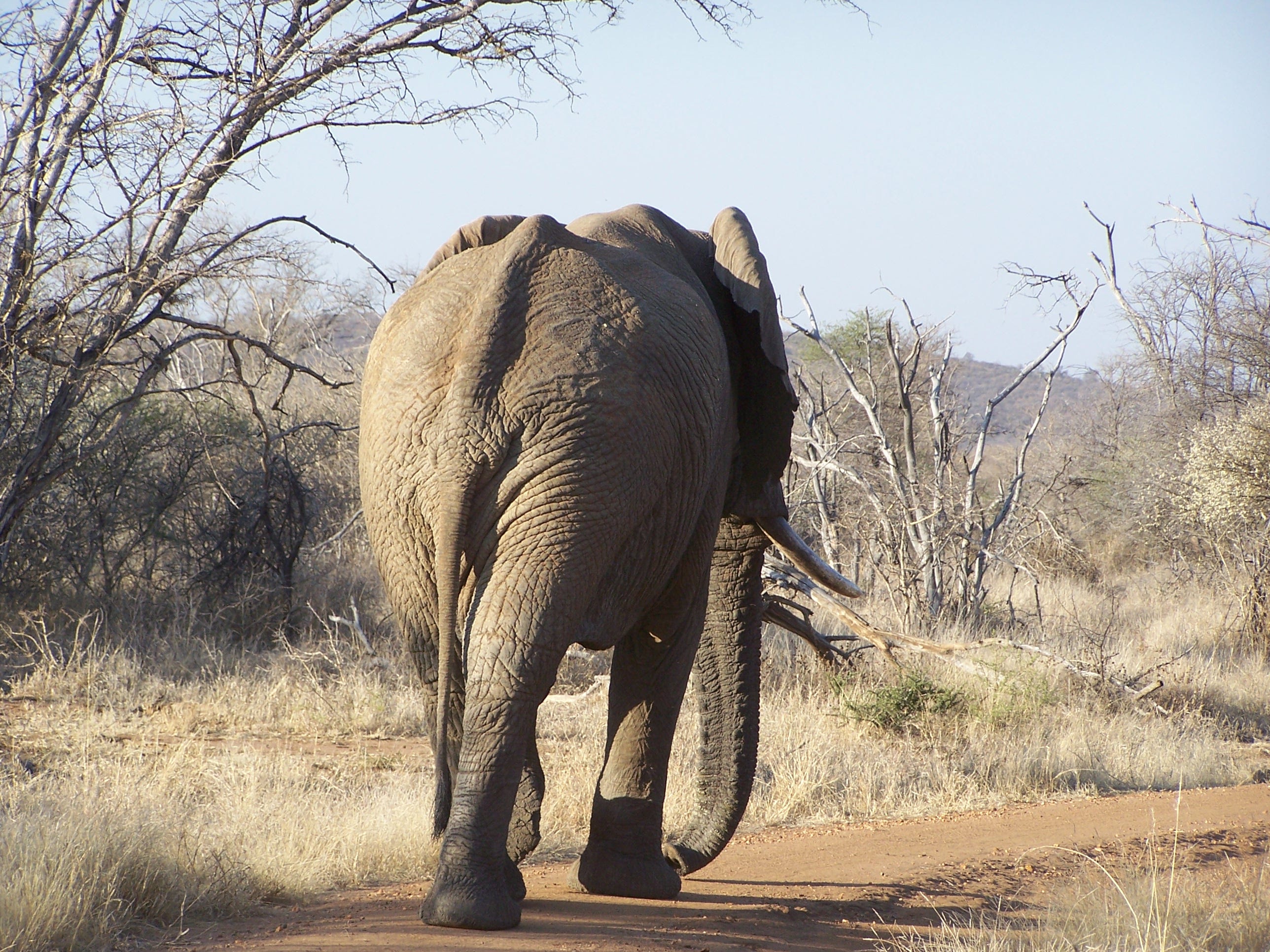
“How old are they?” Someone asks and the air is drawn tight with expectation.
“Probably last night’s.” Thabie says as an eager, collective sigh expands into the 75,000 hectares of South Africa’s largest game reserve, Madikwe, in the North West Province on the border of Botswana, 360kms from Johannesburg.
“When an ellie moves quickly you can see the front pad here,” Thabie points, “closely followed by the other, behind here.” He looks up, brushes the dirt from his hands. “When he walks slowly, the back and front pads are on top of each other. This ellie,” Thabie’s aware of the suspense he’s creating, “He was moving fast.”
Nine of us pull khaki- coloured ponchos tighter around our shoulders and hug hot water bottles to our knees. Madikwe has South Africa’s second largest population of elephants, and having heard tales of the damage a rogue bull might inflict, we are bristling with anticipation on this chilly winter morning.
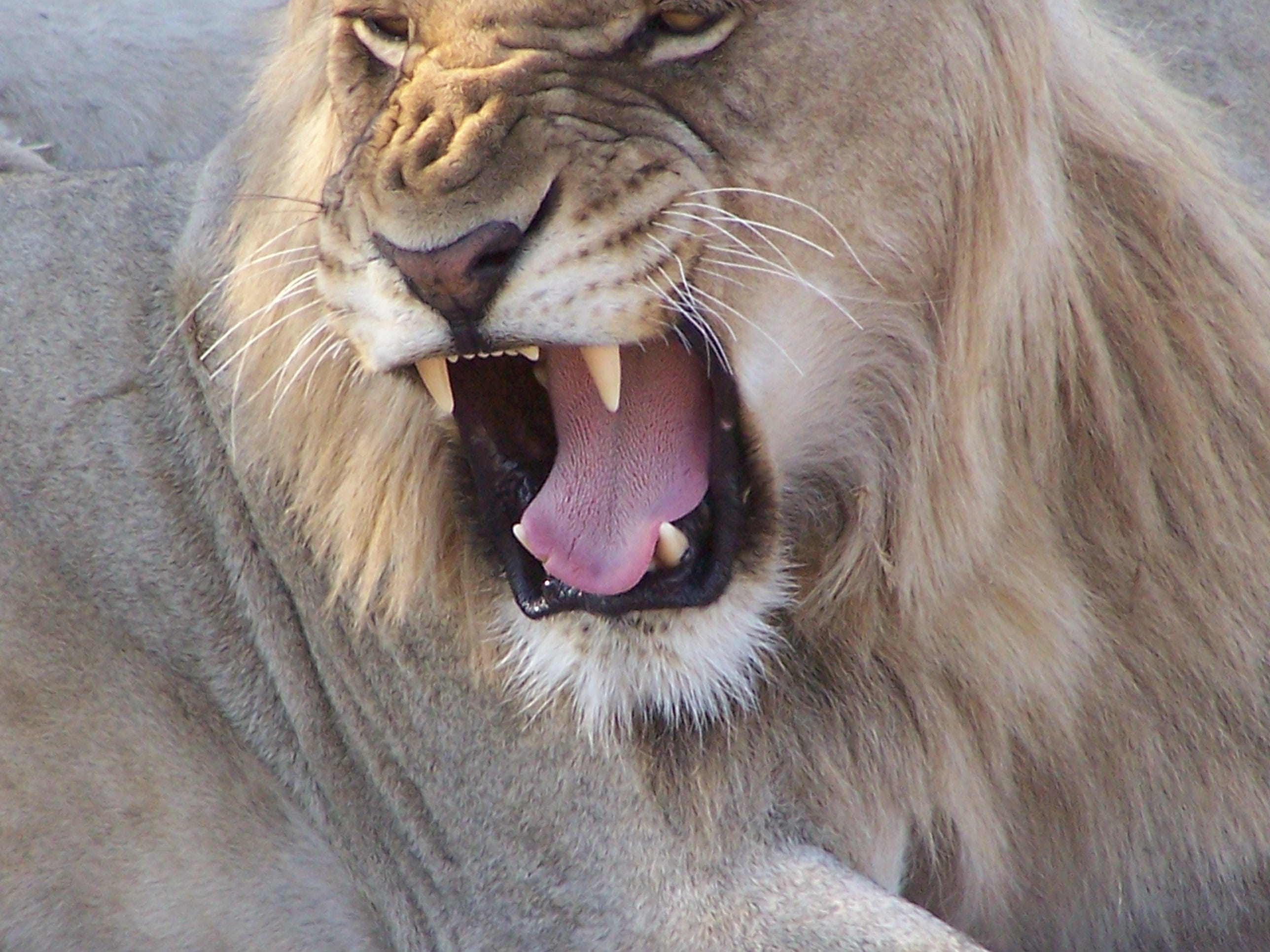
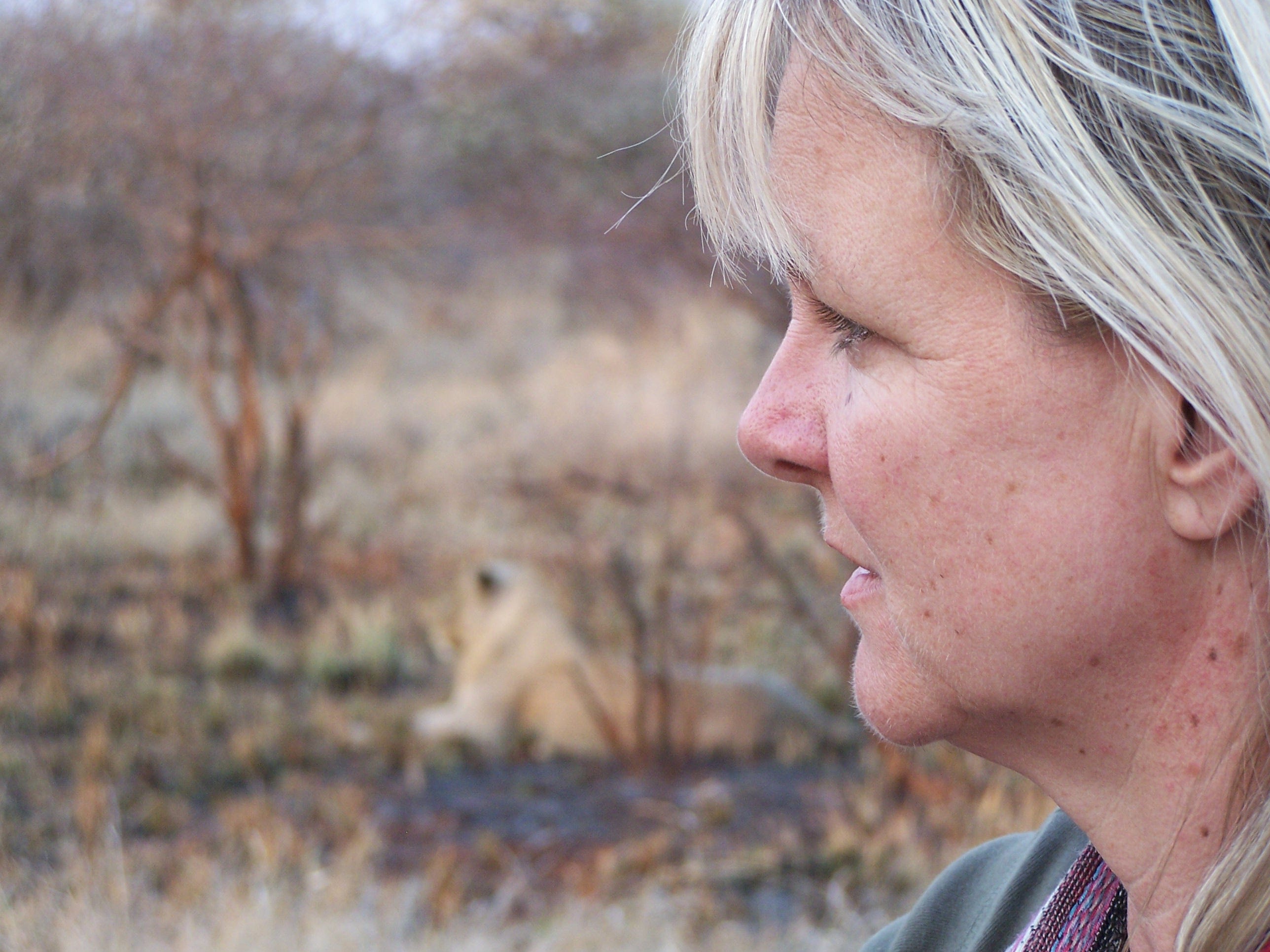
Madikwe might be conservation-minded and malaria-free, but it’s home to the Big 5, and we’re ticking them off rapidly. Leopard by spotlight last night, an angry herd of buffalo this morning, rhino, elephant, and ... there’s a sudden rustle along with a strong, rancid smell emanating from the Black Thorn. “Lion,” hisses Thabie as he gently eases the land cruiser into first gear, just in case. As if on cue a male lion saunters majestically into view, and then a female, to confirm my suspicion that Madikwe really is a modern day Noah’s Ark.
But it hasn’t always been like this. “Not long ago Madikwe was an economically depressed area with nothing but unproductive farmland and alien plants. Back in 1991 a government sponsored programme, called Operation Phoenix, was initiated to re-stock the area with wildlife species that had once occurred here,” Thabie tells us.
He goes on to say that by 1997 more than 8,000 animals had been introduced into Madikwe in, what was then, the largest game translocation exercise in the world . Today, approximately 12,000 animals live in the Reserve including 66 large mammal species, and over 300 recorded bird species.
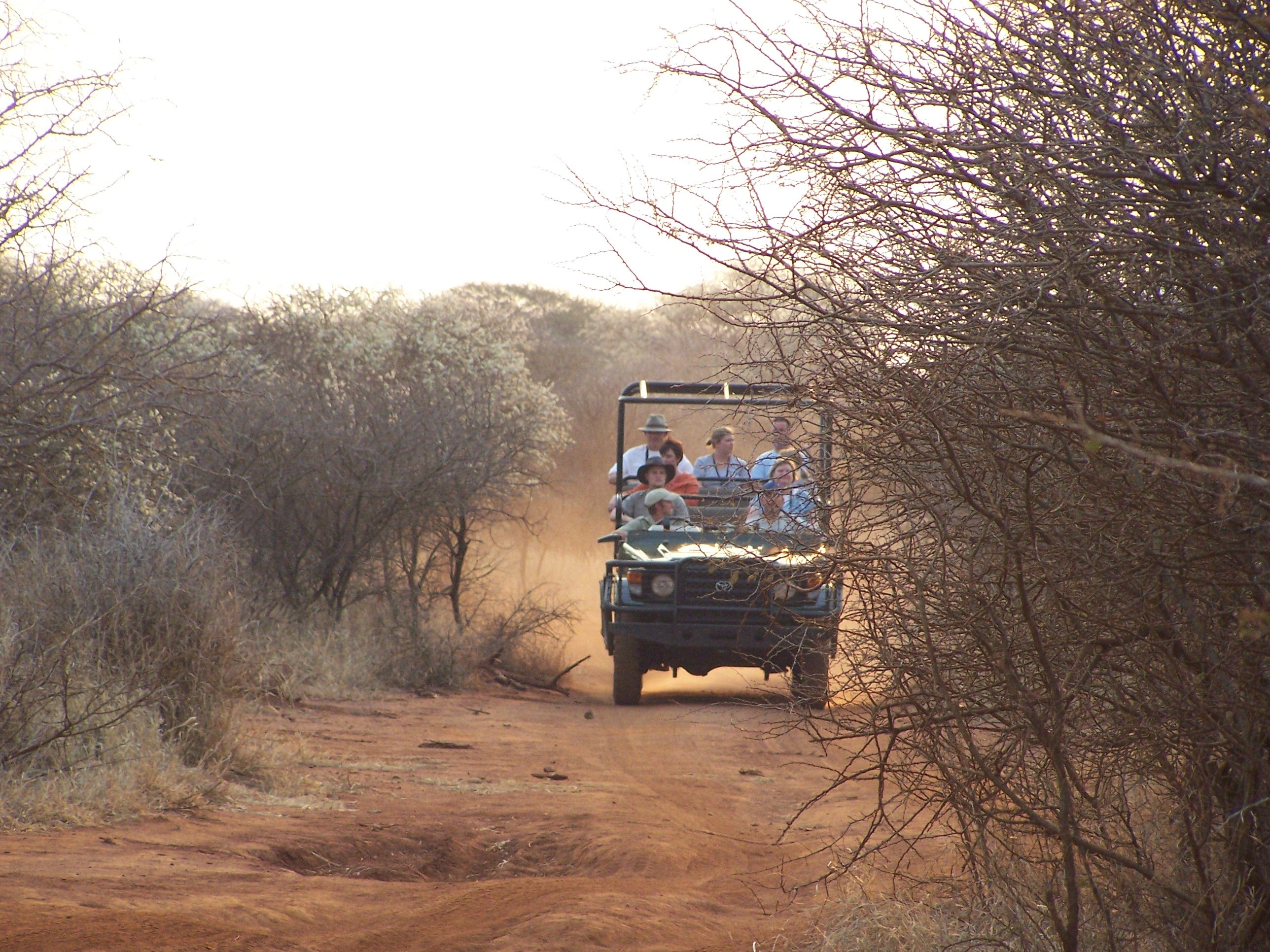
After an afternoon game drive, it’s almost dark when we begin our return journey back to the lodge. Thabie swings the spotlight from side to side as the land cruiser jolts through the bush. We see an African kangaroo (a bush hare, which looks like a cross between a rodent and hare) and a jackal which slinks across the road. Sometimes the honey-sweet aroma of the Black Thorn wafts our way, while the gentle ‘coo-coo’ of a dove hangs in the night air like a lullaby. I am dangerously lulled.
Suddenly there’s a roar so loud it makes my ear-drums rattle. Thabie spins the spotlight faster from side to side and pulls up abruptly. “There,” he says in a stage whisper, and there’s a collective gasp as we see, not 50 metres away, a pride of 7 lions devouring what we think is a wildebeest that isn’t quite dead. The noises the lions make as they feed are spine chilling, deep rumbles and angry outbursts, as mesmerising as they are scary. The dominant male lion with his shaggy mane stands firm and proud above all the others, the cubs foraging where they can, and soon the wildebeest lies quiet with one spindly leg and a small black hoof raised in the air like a flag, the sign of ultimate submission.
We feel humbled by nature as we finally peel away into the night, all silent now and late for our own supper but not in the least bit hungry. The night is pitch black as coal, there is no light pollution except for a myriad of stars twinkling in a canopy that someone remarks is, “of celestial extravagance”.
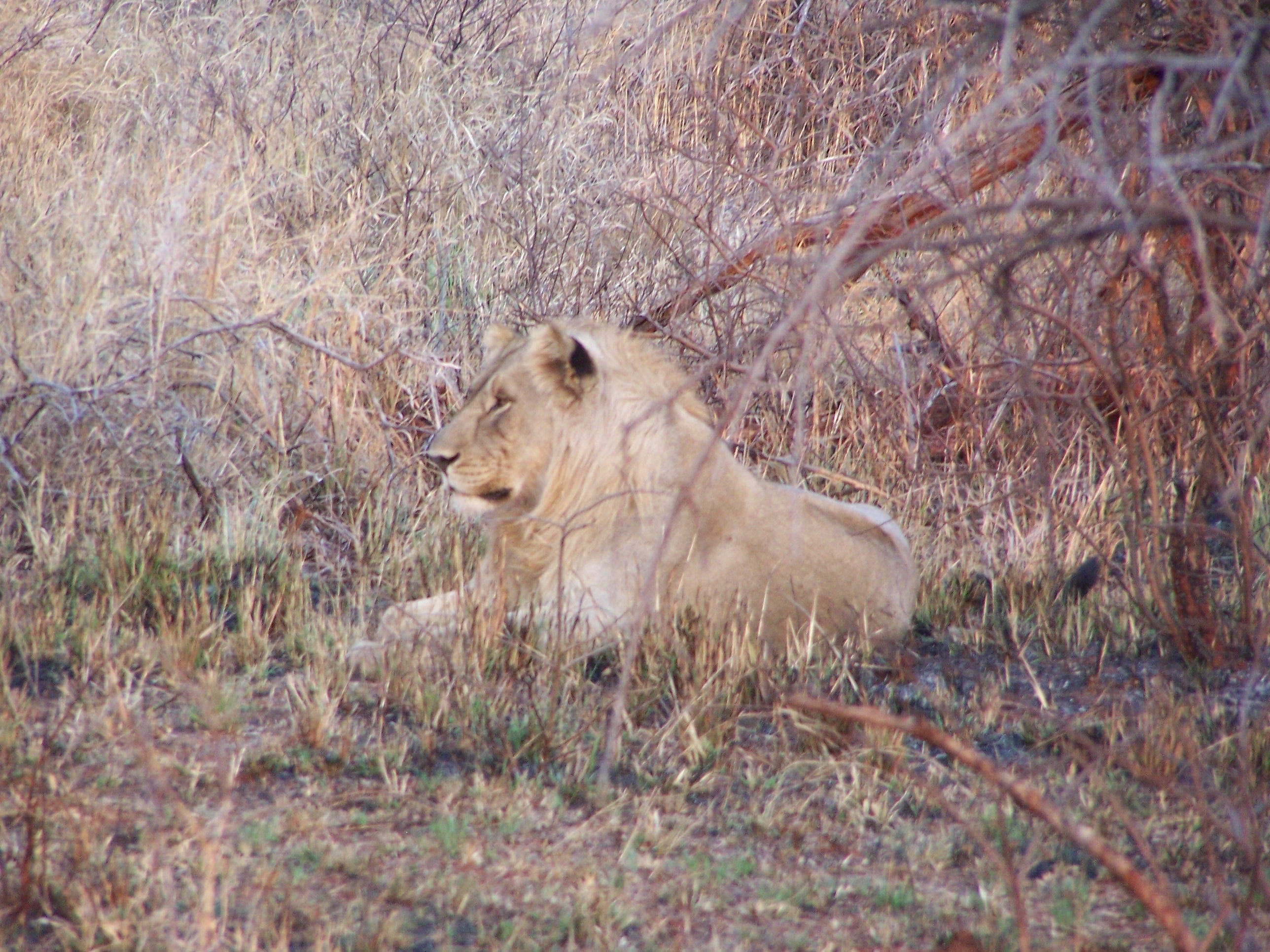
Like a shining star, Madikwe has earned a reputation as one of South Africa’s premier safari destinations. It has a lot going for it and being malaria free is a big draw card, so too are the resident packs of endangered wild dogs, translocated to Madikwe in 1994. The reserve is considered to be one of the best places in the world to spot these impressive, carnivorous, hunting machines which are slightly larger than Australian dingos.
Being a top safari destination is possibly aided by the fact that self-drive visitors are not allowed in the park, which means that apart from traffic heading to and from the various lodges in the reserve, you will only see 4 x 4’s, driven by experienced rangers. In this respect it’s unusual, and unlike other large reserves such as The Kruger in South Africa or Etosha in Namibia.
It’s also of note because it’s one of the few game reserves in the world to be declared as such on the grounds of a feasibility study which showed that wildlife-based tourism was the most appropriate, land use for the area.
Madikwe is an area with a history that dates back to the Stone Age, although these days it’s main notoriety is as a modern-day conservation success story. Not only because farmland has been rehabilitated to a natural environment but also due to the innovative partnership status between the North West Parks Board (The State), the private sector and local communities. The management of Madikwe aims to benefit all three entities and has an underlying philosophy that if wildlife conservation is to succeed in South Africa then local communities must also benefit . In this respect it seems that Madikwe is not just a tourist draw card, it’s like an economic generator for the surrounding region.
Within the park there’s a wide choice of accommodation; various lodges ranging from 5 star eco-experiences some with wellness centres and spas, to family safari lodges with swimming pools, and basic bush cabins without electricity.
One of the luxury lodges, Madikwe River Lodge, in the heart of the Reserve is set amongst acacia bushveld and has 16 thatched chalets set in a riverine forest with private viewing decks overlooking the river. I’m overwhelmed by the welcome; our car is whisked away, baggage mysteriously disappears and reappears in our chalet overlooking the Marico River. As I’m wiping my face with a citronella scented, ice cold flannel a fresh lemonade is thrust into my hand. “Welcome to Madikwe River Lodge,” the receptionist says with a smile the size of Africa itself.
A hippo is wallowing and watching us as we walk to our room and along the way we spot a crimson breasted shrike, tiny blue waxbills and red and yellow hornbills.
Some time later there’s afternoon tea ( fit for a queen), an afternoon game drive, followed by dinner in the Boma where a huge central fire warms us. African song resonates as we tackle a varied buffet dinner including traditional African favourites such as mealie-pap with tomato sauce.
“To awaken quite alone in a strange town is one of the pleasantest sensations in the world,” wrote Freya Starke, but I’d like to tweak that to, “To awaken to the sounds of the African bush in a strange thatched cabin is one of the pleasantest sensations in the world.” It’s 6am, the air seems to be singing. Riotous birdcalls – doves, babblers, louries, waxbills and hornbills – completely fill the airwaves. Again, I’m expectant. What will we see this morning?
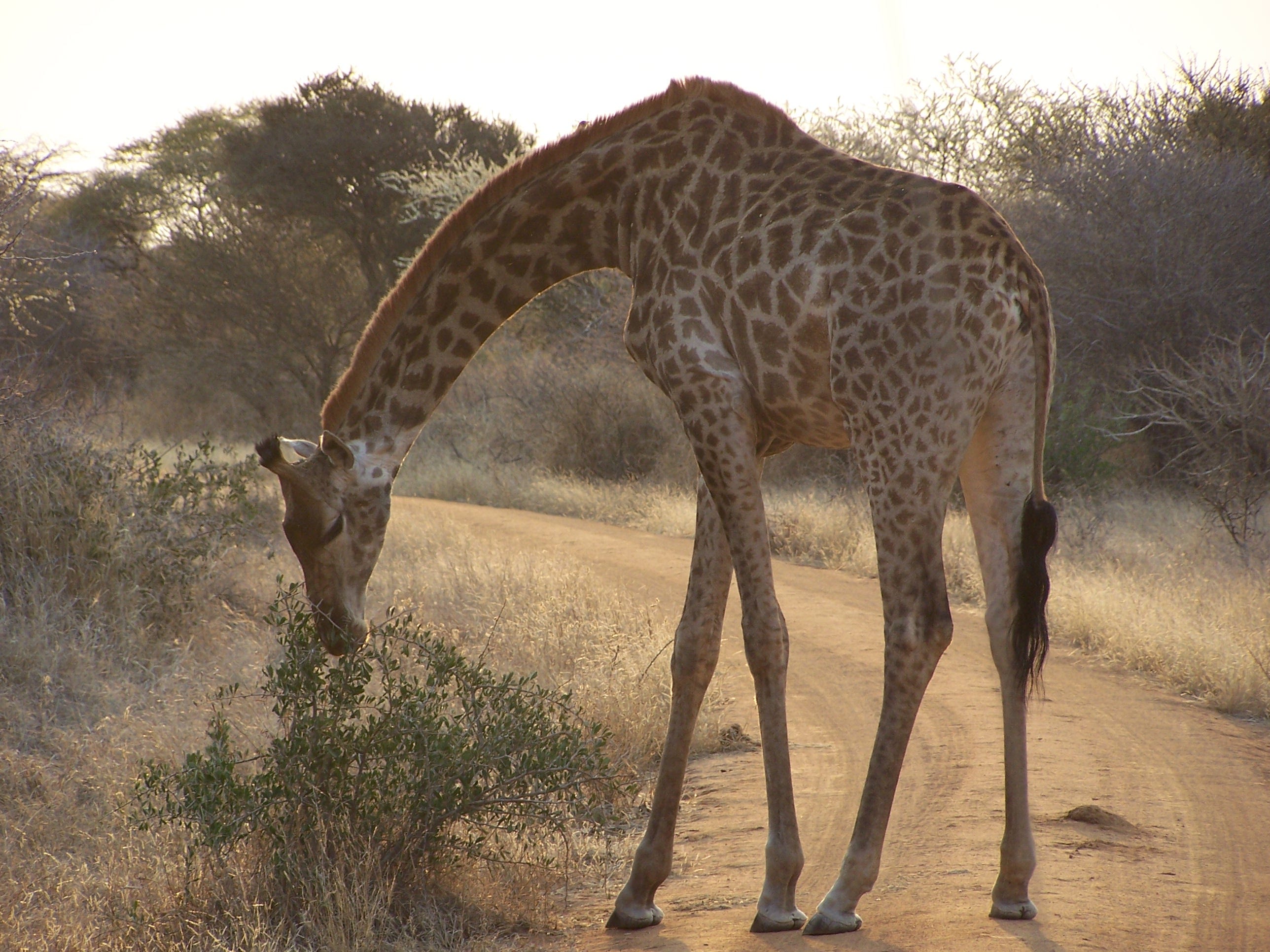
With perfect timing a huge iguana scuttles past as I open the door, and a male bushbuck tentatively picks his way down the bank on the other side of the river to drink. The silvery, milky cream of the Black Thorn trees, from a distance, mimics frost, and accentuates the icy cold of this August morning. After coffee, we are again wrapped up warm, hugging hot water bottles, talking in stage whispers and chugging out with Thabie into the sunrise.
The plains of Madikwe and the faraway hills leading into Botswana stretch down before us as Thabie sets up a small trestle table and produces muffins and biltong. I’m eating dried mango and drinking honey-rooibos tea (the tea favoured by Precious Ramotswe in Alexander McCall Smith’s Ladies Detective Agency series) as the heaviest of all flying birds, a Kori Bustard swoops overhead.
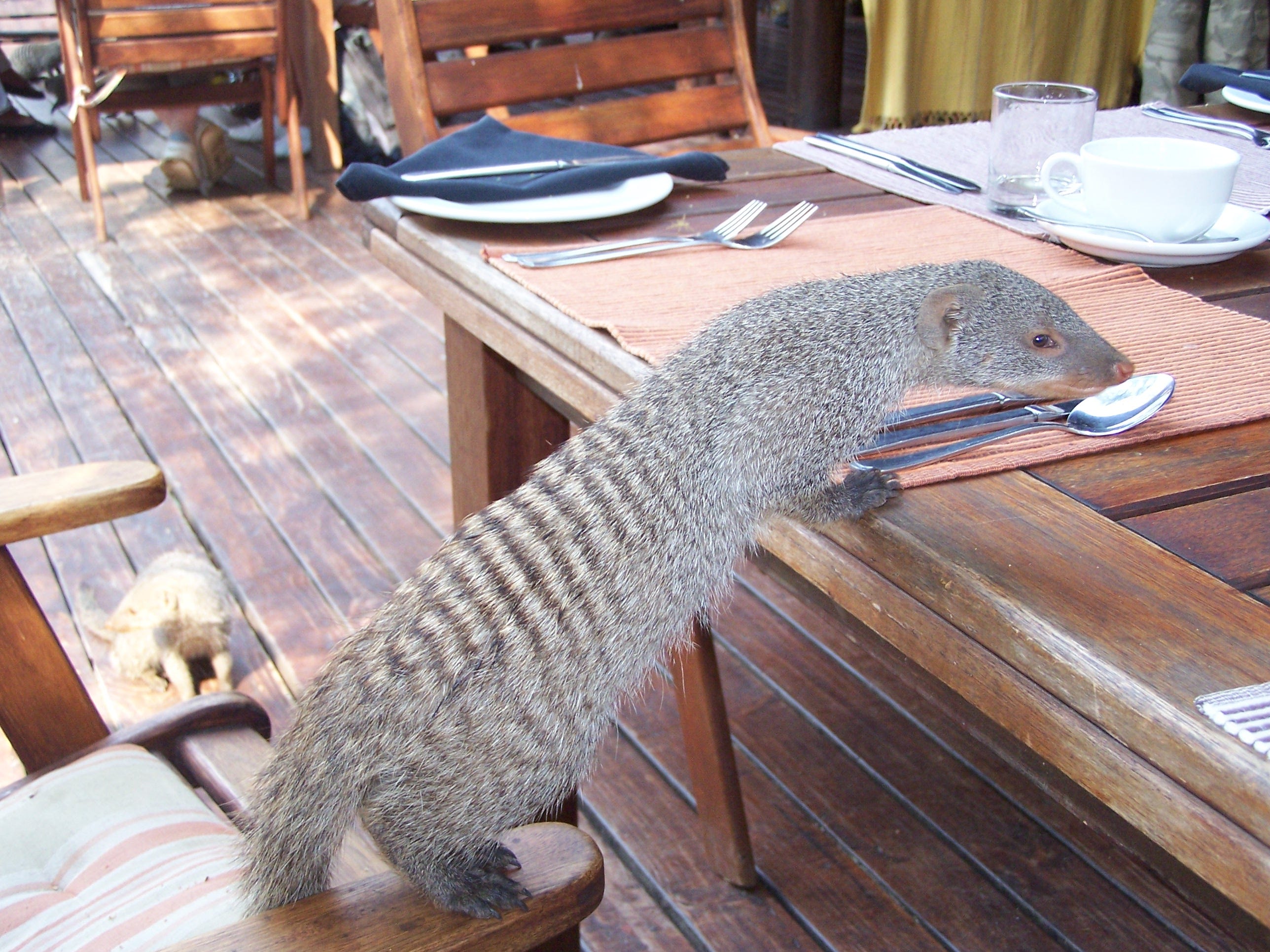
At lunchtime we’re entertained by the antics of about 20 Banded Mongeese, doing acrobatic stunts to access our brunch on the table. We hear the “Gwao-Gwao” of the “Go-Away” birds (Grey Louries) who appear to be voicing their disapproval. Now I’m immersed in ‘Africa time’, and enjoying every moment, though the beat of the adrenalin charged, “What’s next?” is never far away.
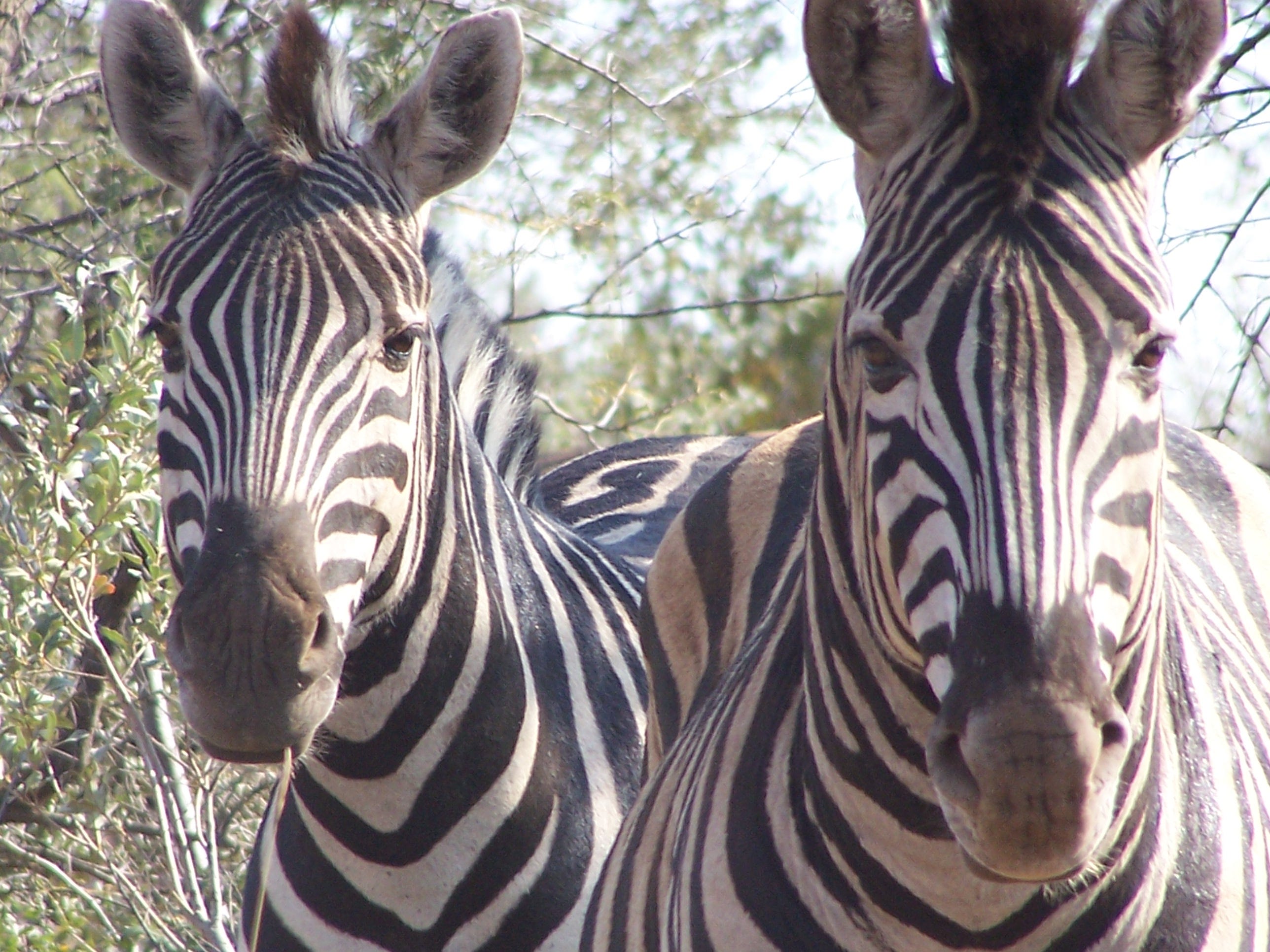
But it’s dangerous to live with expectation, so I chose to embark on the final game drive of the trip with an air of content, and I wasn’t disappointed by the lack of sightings. Nonetheless, the quantum enjoyment of being driven around Madikwe Game Reserve in an open truck, by a knowledgeable game ranger as the sun sets on a dusty African horizon is hard to beat at the best of times.
Quick Facts
Madikwe is a malaria free reserve
Situated in South Africa’s north west province, Madikwe’s vegetation ranges from woodlands and grasslands to large open plains with steep cliffs on the Rant van Tweedepoort, to the riverine habitat of the perennial Marico River. It’s bordered in the south by the Dwarsberg Mountains while a short drive to the north west is Gaborone, the capital of Botswana.
No self-drive, no day visitors, only guests staying at the lodges can enter then park as there are no facilities for independent day trips. Game drives are conducted by qualified guides from the lodges.
One of South Africa’s largest game reserves - 75,000 hectares.
Game includes the Big 5, endangered wild dog, Aardvark and caracal.
Approx 66 large mammal species, 300 resident and migrant bird species
What to take
Walking shoes, camera, binoculars, sunblock, insect repellent, hat, warm clothes in winter, sunglasses.
Would you prefer a quieter reserve such as Madikwe, or the excitement of a larger and better-known safari park?
If you enjoyed travelling to Madikwe with me, please tap the heart below. It helps more readers discover my stories.
Until next time,
Jo x
Comments
Nothing yet. Say the first thing.
Sign in to join the conversation.