
Welcome to Masala Chai Theology with Father Joash P. Thomas: a space to spice up our spiritual journeys with ancient, Empire-resisting, and precolonial Christian ways of understanding God and neighbour - in ways that risk upsetting our Empire-shaped religious palate. This space builds on Fr. Joash’s bestselling book, The Justice of Jesus, which you can buy here for 30% off plus free shipping (US only) or wherever you get your books / audiobooks globally. Paid Subscribers are Fr. Joash’s inner circle of chai conversation partners who generously support his ministry as a priest and public theologian. If you’d like a Paid Subscription to Masala Chai Theology but are unable to afford one in this season, just reach out and we’re happy to arrange one for you.
Welcome back to our Decolonizing The Great Commission series! If you haven’t familiarized yourself with Part 1, Part 2 & Part 3 of this series, do catch up on this before you jump to assumptions / judgements because of anything you read here! There’s a good chance I’ve already addressed your question.
But first, a pastoral / priestly note: Regardless of what brings you here, thank you for journeying and wrestling with me in all of this! There’s been something liberating and deeply jarring about honestly exploring and reframing what historically speaking, the Global Church never called ‘The Great Commission’ before the modern, colonial era - because we’re asking questions that many of us were told to never ask in or of the Church.
Asking these questions as a Christian Priest has been a fascinating experience too. While I’ve made many more friends by exploring these controversial themes (so many of these new friends being folks wanting to re-explore Jesus after realizing that the Empire-shaped version of Christianity many of us were presented with looks nothing like Jesus of Nazareth), I’ve also lost a few friends in religious spaces along the way.
But I’m okay with that. After all, when you publicly question the theological frameworks of high control, Empire-shaped religion, there’s bound to be pushback. And I do this as someone who is super secure in his love for Jesus as a missional priest; one who constantly tells others about the beauty of Jesus in an invitational and hospitable way. Not the Jesus we just would rather crucify for our sin so we can complete a transaction with him; but the risen, alive one resurrecting all of creation today; a task he will fully complete when he returns. And the Jesus who desires to deeply transform everything about us - for our good.
Thankfully for those of us on this seemingly lonely journey, Jesus knows what it’s like to get pushback for asking challenging questions of these Empire-shaped, high control religious frameworks. The truth will set us all free; after it first pisses us off.
Or as St. Paul writes to the Church in Galatia:
“For freedom Christ has set us free. Stand firm, therefore, and do not submit again to a yoke of slavery.” - Galatians 5:1 NRSVUE
A couple of weeks ago, I got to speak and minister the sacraments as a priest at one of the most unique spaces I’ve ever been invited to teach at in America - an annual retreat for a global campus ministry under a global missions organization with American evangelical roots.
These are campus ministers at universities across Europe, Latin America, and Asia wrestling with what it means to be “missionaries” (even though many of them are uncomfortable with that term and would prefer terms like “global / cross-cultural workers” or “campus ministers / chaplains”) in ways that are Jesus-centered, justice-oriented, and decolonial in nature; while still being deeply invitational in radically inclusive and hospitable ways for their contexts - even if the Spirit leads them past the bounds of traditional evangelical imagination.
Ever since the launch of my book (The Justice of Jesus), I’ve been approached by at least half a dozen Christian mission agencies and dozens of global, intercultural workers (missionaries!) who are starting to become aware of how colonialism has shaped their understanding of ‘Christian Mission’.
Even this week, I'll be in the UK ministering as a missional priest by teaching at a conference of 5000 teenagers from across the UK Church (mostly evangelical) and their youth leaders who genuinely want to wrestle with how to decolonize youth ministry from the ways of Empire in ancient, Jesus-centered, justice-oriented ways.
Here’s what gives me so much hope: Instead of entirely throwing away their love for Jesus and his hospitable / invitational ways (ways that go deeper than what the Empire-shaped evangelical church has taught us), all of these folks find themselves wanting to keep wrestling with what a healthier, faithful decolonial missiology looks like.
And they’re doing this by tracking along the work of folks like myself, Bradley Jersak, Kristin Du Mez, Brian Recker, Sarah Bessey, Beth Allison Barr, Zach W. Lambert, Amy Lambert, and other dear friends doing helpful deconstruction and reconstruction work in Christian publishing / digital spaces right now. These “missionaries” are quietly reading our books and Substacks in safe, intimate communities - to confront and reframe so much of what Empire Christianity taught them what Christian Mission should look like.
Many of these folks once went with traditional evangelical missiological frameworks of being “the good guys bringing Jesus” to the missional contexts they were sent to; only to be transformed by the Christ already present in these communities.
In fact, this is fairly typical for so, so many missionaries / global workers / holistic mission practitioners I come across - setting off to the “mission field” with colonial-era white saviorism theological frameworks; only to be deeply transformed by the Christ they encounter, the Christ who has always been present in their missional contexts - just like my St. Thomas Indian Christian ancestors who followed Jesus for 1500 years in ecumenical and interfaith pluralistic ways before western empires showed up with their missionaries to steal our wealth and resources by dividing and conquering our imaginations.
Or like the ancient Celtic Christians we’ve been exploring in the Augustine vs. Celtic Christianity series who considered their ancestors’ Celtic spiritualities to be their Old Testament to the New Testament revelation of Jesus.
As I’ve said earlier in this series (something that triggers every evangelical Empire-shaped instinct in many of us): there are no unreached people groups to the love of God. That is a lie from the pit of colonial theological hell to keep us from seeing Christ in all of creation.
Several of these fellow missional practitioner friends are also part of our Paid Subscriber community at Masala Chai Theology or in my classes at St. Stephen’s University to wrestle with all of this further! These practitioner friends teach me so much and I find it deeply healing to be in relationship with them.
The challenge however often comes with donor relationships. Because while these practitioner friends are being shaped by the Jesus they encounter on the margins of Empire, their donors are often still being shaped by the theologies of Empire through their local church communities in the west (also why almost every single Christian justice practitioner I know feels a bit homeless in the western church).
Every practitioner then faces a moral, spiritual, and financial dilemma:
Do I preach the transformative Gospel of Christ I’ve learned from the margins and risk losing financial support? Or, do I just keep my mouth shut and not risk upsetting the status quo for “the greater good”?
Do I courageously share back stories of my own transformation after encountering Christ in the lands I was convinced were “empty, pagan, and Christless” to invite donors on their Theosis / transformation journeys? Or, do I just keep quietly (and transactionally) collecting my checks so I can keep financially supporting my ministry team and our families?”
One of the reasons why I left a comfortable fundraising leadership role in the Christian international development / holistic mission space a few months ago was to personally put even more monastic distance between myself and Empire - so that I could wrestle more courageously in public with questions like this; building a community of support around this wrestling instead of constantly worrying about which donor / church partner I would possibly alienate because of them being unable to keep up with the transformational work that Christ is constantly doing within me - because of the Jesus I’m constantly encountering on the margins of Empire.
Getting to now invite others into that journey of inner wrestling and transformation through our MA in Transformative Leadership program at St. Stephen’s University (SSU), where I’m teaching a course on Kenotic & Decolonized Leadership this Fall, is an even greater gift!
But forgive my ADHD brain. Back to missionaries of Empire and my original question:
What are missionaries of Empire converting people to?
This is a question that arose for me as I was reading the brilliant Dr. Harvey Kwiyani’s latest book, Decolonizing Mission. This is simply one of those books that you have to read for yourself. And I don’t just say this because I’ve asked Dr. Kwiyani to be on my PhD supervisory committee (alongside my boss and mentor at SSU, Dr. Bradley Jersak given his wealth of expertise in Patristic and Eastern Christianities) for a PhD program I hope to start in January - something they’ve both very generously agreed to!1
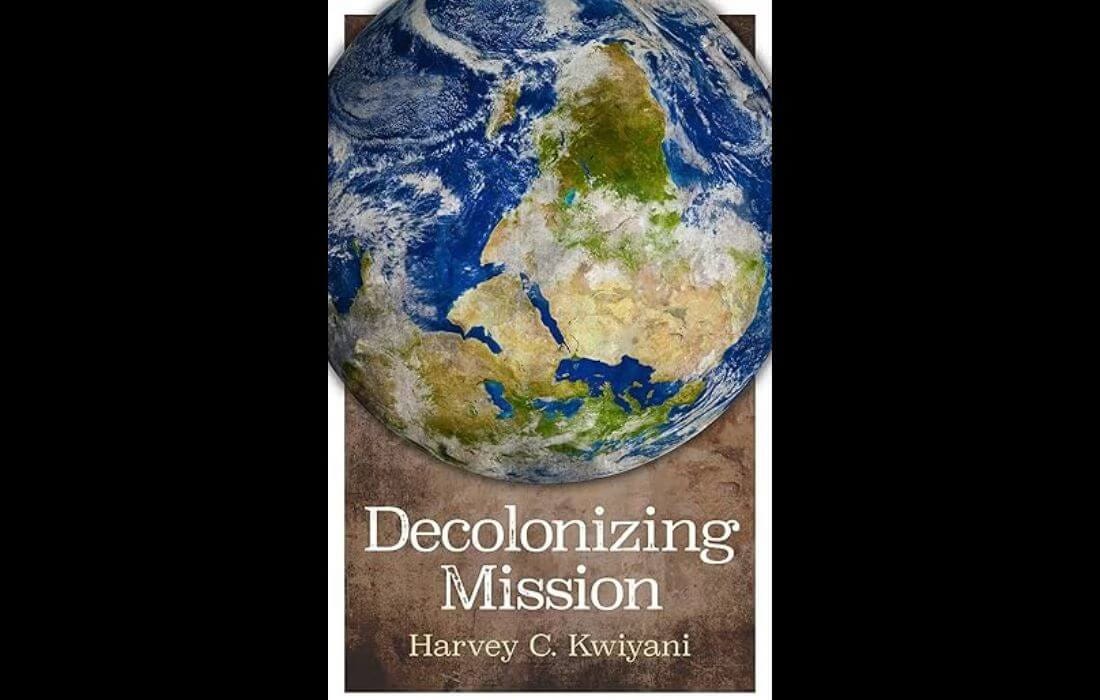
As a Malawi-origin theologian now training the Church of England’s missionaries on decolonial missiology, Dr. Kwiyani focuses the first chapter of this book investigating the legacy of a missionary I was taught to admire in my evangelical childhood - David Livingstone, one of the earliest British missionaries to Africa. Maybe you were too.
If many of us weren’t being distracted by an Empire-shaped narrative of a valiant David Livingstone fighting off a lion, we’d have maybe also been presented with uncomfortable truths of Livingstone’s legacy that Dr. Kwiyani very truthfully and graciously invites us to wrestle with. One example of this that Decolonizing Mission sheds a light on:
Livingstone’s mission estate being converted into a colonial slave plantation (at his request) run by his relatives who created exploitative conditions that even the British Empire thought went too far; a colonial plantation that Dr. Kwiyani’s near ancestors were forced to work at - just because they lived in a neighboring village.
Dr. Kwiyani also digs deep into historical archives to find Livingstone’s own letters to friends with highly problematic (at best) and racist (at worst) quotes like the one below:
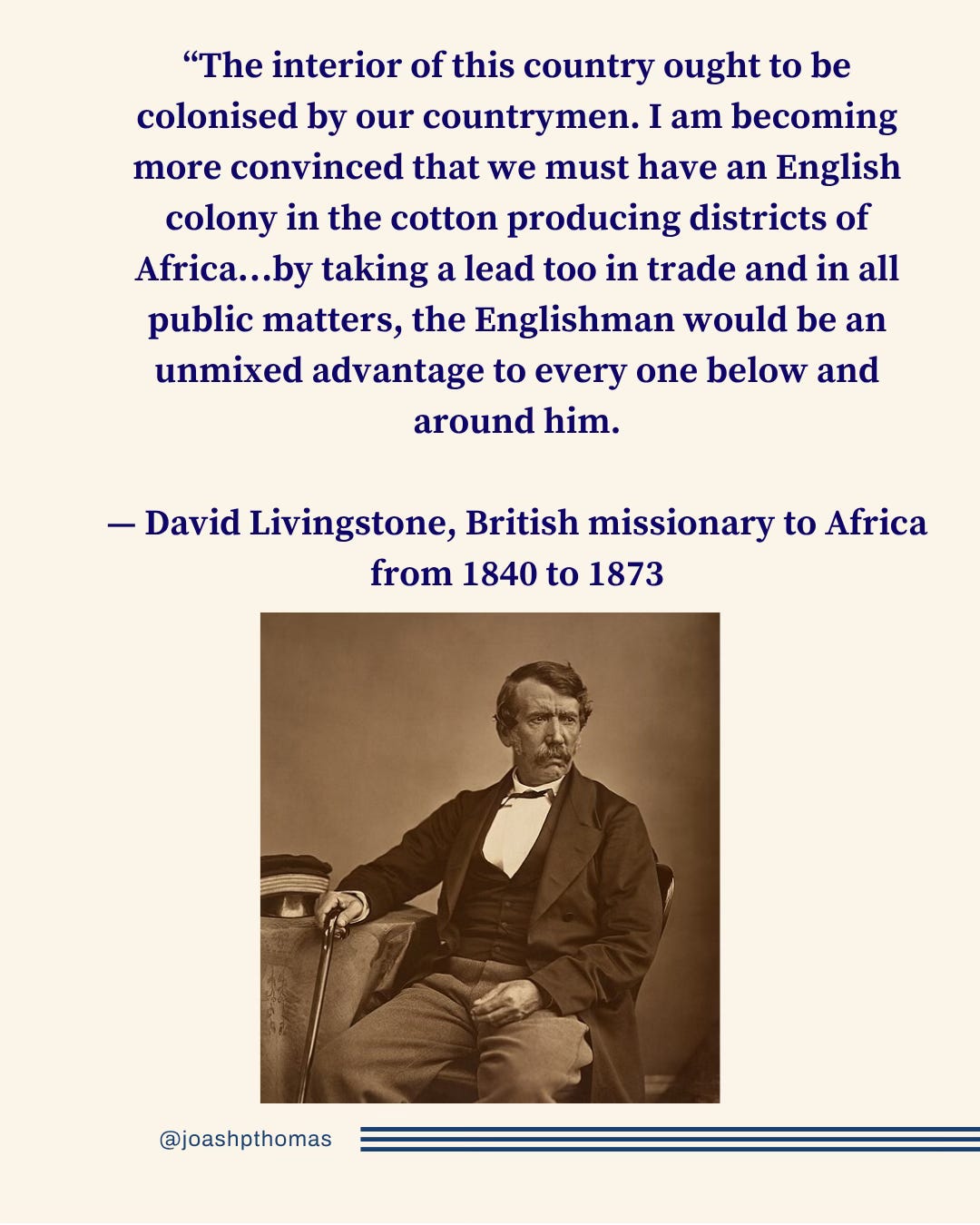
Unlike the missionaries of Empire who showed up to colonize my Indian ancestors hand-in-hand with Portuguese, Dutch & British colonial powers, Decolonizing Mission helps us see another possible model of colonial era missionaries engaging with Empire - one where they explicitly invite colonial empires to establish a settler colonial presence in a part of the world that previously wasn’t on their radar - just like Livingstone did.
This was in fact a calculated move on Livingstone’s part for the growth of his struggling missionary efforts. Or, in Dr. Kwiyani’s words (Pg 31):
There is enough evidence in the stories of the growth of Christianity in Africa that suggests that the Church began to explode during the era of the Scramble for Africa, especially in the 1890’s. We have a record that the Livingstonia Mission (of the Free Church of Scotland) that worked in Malawi from 1875, led by the capable Robert Laws (1851-1934) could only point to 15 converts in 1890. The next year, British rule was extended over northern Malawi. By 1964, when British rule came to an end, 49 new missionaries and 9500 communicants had been added and 900 schools established, having 1600 teachers and 57,000 students. Colonialism made a huge difference to the work of the missionaries.
This is the passage from Decolonizing Mission that sparked my original question:
“What the hell were the missionaries of Empire actually converting people to?”
Here’s where I’ve landed in all my historical research and theological reflection. As is customary around here, I’ll keep these spicier masala thoughts exclusively for my Paid Subscriber community as my inner-most community of chai conversation partners generously funding my research and writing work:
Comments
Nothing yet. Say the first thing.
Sign in to join the conversation.