
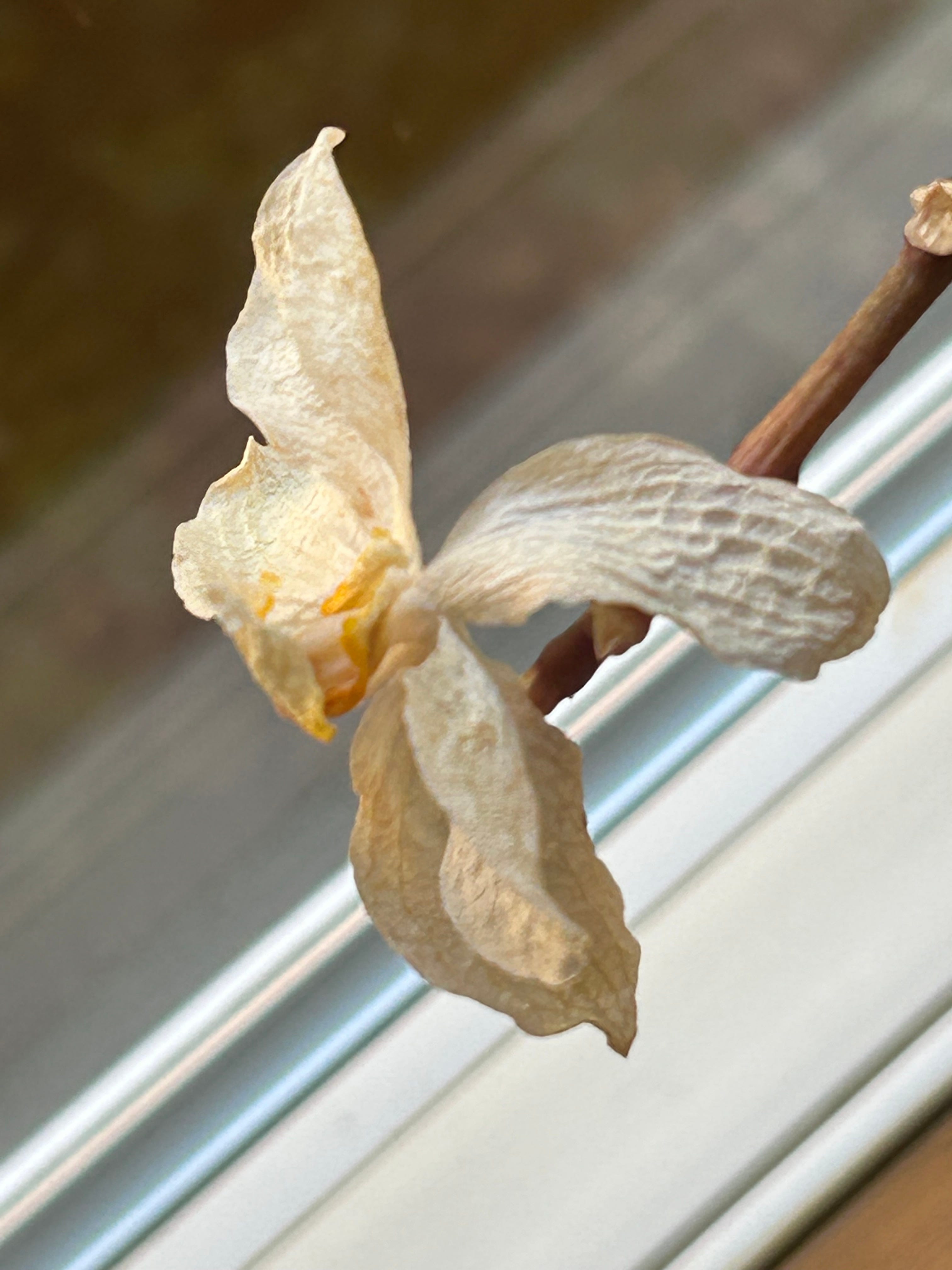
Can we see the beauty in the flower that is withering, in old age and death? Can we see the Holy Reality shining forth even in the places we regard as ugly, disturbing or unwanted? Can we find the gift hidden in the apparent imperfections and even in the most deeply disturbing things? Can we notice the unbound awareness, the unconditional love that is beholding (being and holding) it all? Can we see that our human foibles are no more personal or controllable than the outer weather? Can we see and appreciate the beauty in life just exactly as it is?
Excerpted from Chapter Two: The Immediacy of Presence, Here-Now, in my last book, DEATH: The End of Self-Improvement:
The present moment is a fleeting instant between past and future, gone before we can even perceive it, but Now is timeless and eternal. There is no end to Now. Nothing comes after or before Now. We may think the past is really back there, but actually, when it happened, it happened Now, and Now, it has vanished completely…
Without thought, this moment is without plot or narrative. It has no meaning or purpose. There is no main character, no “me,” at the center of it. There is simply present experiencing—a snowflake landing in a fire. It may all seem quite solid if we don’t look too closely, but if we pay attention, we find reality is actually fluid, ephemeral, effervescent, impossible to grasp or pin down. It keeps changing shape without ever moving away from right here, right now. It is completely obvious, never hidden, and yet strangely elusive if we try to take hold of it. It is at once immovable and constantly in motion, unchanging and yet totally in flux. It is an unbroken whole of infinite diversity. It defies all words and categories.
Now is holographic—it contains the past and the future. Everything happens Now, and yet, a symphony wouldn’t make any sense, it wouldn’t be music, without the context, without a memory of the notes that have come before and an anticipation of what might come next, without the sense of progression and relationship between what came before and what is arising now, and without the expectation of what may come next. The same is true of a novel, a play or a movie. This is precisely what makes it meaningful to us. But at the same time, we can see that each note happens Now, that the future resolution will happen Now, and that the context for the whole unfolding symphony (or story) is Now. Past and future are Now, memory happens Now. “Relationship” is simply a description of this seamless happening that all happens Now. That Now-ness doesn’t deny past and future. It includes them. No concept can ever capture reality, so beware of fixating on one side of any imaginary conceptual divide. Life itself cannot be pinned down or captured by formulations.
When we’re fully alive to the naked reality of the present moment, it turns out to be an astonishing and extraordinary miracle, this luminous awaring presence bursting forth as flowers, leaves, mountains, oceans, chairs, tables, planets, rabbits, giraffes, zebras, people, birds, tornados, planets, stars, random acts of kindness, horrifying acts of cruelty—one seamless and shimmering display, appearing and disappearing in the vastness of Here-Now.
There’s a tremendous beauty and depth to be found in doing just one thing and being fully present with the infinite richness of just drinking a cup of tea, just washing the dishes, just sitting quietly, just being fully present with one activity or one thing. When walking, giving our whole-hearted attention to walking, to the sounds we’re hearing and the sights we’re seeing, feeling the breeze, smelling the smells, feeling the legs moving and the feet touching the ground. Being totally present to this ever-changing, infinite richness where we actually are.
I’m not suggesting this in some rigid, methodical, unbending, self-improvement oriented way. Many years ago when I encountered my Zen teacher Mel Weitsman reading a newspaper while drinking his tea, I questioned him about “doing just one thing,” and with a smile, he replied, “Just doing reading newspaper and drinking tea.” I love to play music while exercising, I sometimes listen to music or public radio while driving, and I often sing while driving, doing the dishes, and in the shower. Years ago, immersed in the meditation culture of mindful attention, I felt like I “should” be mindfully doing “just one thing” at all times, and it was incredibly freeing at some point to break free of that idea, to relax. So mentioning this possibility of “doing just one thing” is not about the right or wrong way to do things. It isn’t a prescription for spiritually correct living, but rather, something to explore.
That’s the voice in our head that orders us around, tells us how poorly we’re doing and how we need to do better. This drill sergeant is nothing more than a bunch of conditioned thoughts, rooted in the illusion of being an autonomous separate self with free will, the “me” who always could and should be doing better. This drill sergeant hears suggestions as commands. It thinks in terms of good and bad, right and wrong, success and failure. It takes everything personally. If I can’t stop smoking, I’m not trying hard enough. If I’m depressed, I should buck up and snap out of it. If I can’t, I’m a weak-willed, lazy failure. If I’ve been meditating and going on retreats for decades, I shouldn’t still be experiencing ____ (fill in the blank). The inner drill sergeant loves to beat us up and berate us. It’s harsh, judgmental and unforgiving.
But the truth is, there is no separate, independent, autonomous self steering our ship. Like a wave in the ocean, we are never separate from the whole ocean. The one who is supposedly in control is a mirage-like illusion. Our words and actions, our moods, the movement of our attention is all an activity of the whole universe. None of it is actually any more personal than the outer weather. Everything is a movement of the totality, a movement in consciousness, and all of it is a kind of play, a waving of the great ocean of being. I often call it the movie of waking life.
Consciousness seems to love movies—all kinds of movies—happy ones, sad ones, comedies, tragedies, love stories, horror stories, thrillers, war stories, romances, the whole range of possibilities. It includes everything! Consciousness is like a multiplex movie theater with infinite movies playing simultaneously. Consciousness easily gets lost in its own creations.
There are all kinds of helpful pointers and suggestions that the universe offers to itself to wake itself up from confusion and suffering. But beware of the inner drill sergeant trying to turn these suggestions into commands for How to Be a Spiritually Correct and Successful Nondual Self. That’s just another movie.
As for the whole sticky issue of free will (and more to the point, who has it?), I’ve written about it quite extensively in my books and in other Substack articles and articles on my website if you’re interested. Zen teacher Steve Hagen said it quite well: “Are you breathing? Or are you being breathed? You need not answer. There is no essential difference.”
I really loved this article by Paul Gerstein, transcribed from a 2016 dharma talk. It talks about how Zen is not a self-improvement project, but rather a matter of being just this moment, exactly as it is, and discovering that nothing is lacking and that the things we imagine are holding us back may in fact be marvelous gifts. Paul is a Zen teacher, retired ER physician, dharma successor of Richard Clarke, and the author of the book Form is Emptiness, an Insider’s Guide to the Heart of Zen Buddhism. You can read the article here:
Or, if you prefer, you can hear Paul read it here:
You can find many more talks, some in audio, some transcribed, some in both formats on Paul’s Substack.
(1) My feelings about the AI Audio version of my articles: Substack includes an audio feature at the top of my posts on the app (not online or in email versions). This audio is a synthetic AI voice “reading” the post. I’m glad it’s available for people who are visually disabled or truly unable to read or look at a screen. But unfortunately, Substack doesn’t make it clear that it is an AI rendering, and having that “Listen” button right there at the very top of an article seems to suggest that it is a perfectly good way to take in my post.
In fact, it distorts and sometimes obliterates the intended meaning in many ways by what words it does and doesn’t emphasize, where it pauses or doesn’t pause, inflection, speed, mispronunciations, etc. As a writer, it’s painful to hear it. One way in which it gets very confusing and misleading is with my use of quotations from other people. I often include a quote without introducing it first, and a reader looking at the text can visually see that it is a quote, but the AI reader simply reads the quote as if it were part of my text, and then says the name of the person being quoted, which I always include below a quote, and then goes on with my text as if what followed might be the words of that person. So it’s very confusing and easily misleading as to who said what.
Maybe one day I’ll have the energy and inclination to figure out how to read and record them myself and to actually do that with each post. But my time and energy is limited, and so far this hasn’t happened and I’m guessing it probably won’t.
(2) I never use AI to write
Substack recently announced a feature that allows readers to scan text published on Substack to see how much of it is estimated to be written by or with AI assistance and how much of it is human only. I’m all for this, but I also have no doubt that this AI tool will sometimes get it wrong, so I want to let you all know that I never use AI to write and can’t imagine that I ever would! So if the new AI tool ever says otherwise, it is mistaken.
Love to all…
No posts
Comments
Nothing yet. Say the first thing.
Sign in to join the conversation.