
This is a post about writing and breaking. And how they are related.
Why do we emphasize, in writing, the value of showing, not telling?
It has to do with the angle, the slant of the narrative and what it disallows.
Telling is direct. ‘I was afraid and couldn’t wait to leave. So I packed my bags and I shut the door behind me, glad to be out of that toxic place.’
Like all explicit information, it is filled with assumptions. It names emotion overtly and supposes a shared sense of what fear is. It is bossy, outright, it closes space. It does not issue invitations to the other. One might go so far as to say, it colonizes emotional territory. Sometimes, of course we need to name a feeling. Especially through the haze of gaslighting, being spoken over, dismissed or ignored.
Names are potent. They adhere to us.
The chastising labels of childhood and bullying phrases thrown around in playgrounds cling to our self-worth. We often need years to dislocate them from our sense of self.
When we’re trying to fix the broken world, we have to find a way to name people’s suffering – an enterprise the feminist movement did a brilliant job with over the past few decades. Until ‘marital rape’ was named, the experience of a woman being forced to have sex with her husband did not exist outside of her own shattered psyche. Finding the right words to fit a particular contortion of anguish is only the beginning. Then we need the language to shield people from further harm.
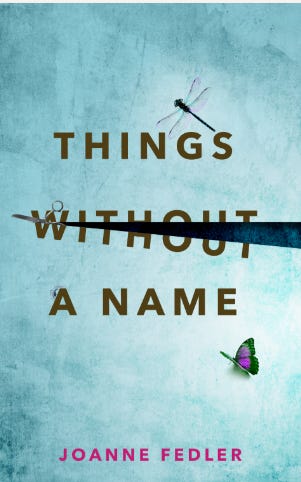
My novel Things Without A Name (2008) is about the power of naming and the way we are defined by all we cannot name. I wanted the title to render the withheld emotion and unexpressed loss through which my protagonist, Faith moves towards the hopeful whispered exclamation at the end‘…There is a name for this, what I’m feeling…. I just know there is a name for this.’
The title also echoes the feminist achievement in naming aspects of women’s experience that had previously been invisible: date rape, sexual harassment, femicide and others. Each chapter of the book is entitled with a simple noun to confirm the way in which language anchors us to meaning and arguably creates meaning. If something has no name, how do we speak of it? Can we even say it exists?
So I’m not dissing naming, or the way it instructs and tells us what something is. It is an excellent identification tool. It is a spell that can render the invisible, visible.
Telling is for scything. It is the laser aiming for X marks the spot.
‘This is abuse,’ is a healthy response and the catalyst for taking action to move on. I am all for this. Especially in circumstances of danger. In advocacy, it is essential, when we are trying to change laws and educate people.
Not so much, in storytelling.
When we write, our main aim is to elicit an emotional response from a reader. The most effective way of doing this is, strangely, not to give instructions to the reader about the emotional territory, but rather to imply it. We do this with sensory information.
‘My heart clattered. The door was right there. Its handle beckoned.’
This is, ‘I was afraid and couldn’t wait to leave,’ without the training wheels. It assumes the reader knows what it feels like to have a clattering heart. That seeing a door handle implies the longing to get out, but also the hesitation. This is ripe with many more possibilities, but not in a hazardous Funes the Memorious way (I refer to the short story by Jorge Luis Borges - in which the narrator has an endless mushrooming of detailed memory ). For who knows what doors mean to a reader? When we ‘show’ in this kind of writing, it is an offering of kinship to another because we’ve all known moments of uncertainty, but it allows someone their own individually hallowed territory of memory.
During the early months of 2025, I was unable to sleep through the night. I would wake between 2 and 3 am and just couldn’t stop thinking about the hostages. Here is a poem I wrote in some of those bleak early hours.
The words sit askew, the grammar and pronouns are unkempt, phrases are unfinished, left hanging, verbs taken hostage.
The form mimics my emotional state:
If I were telling, it might read this way:
‘I feel broken. I think about those young dancers at the Nova Music Festival and how they were all gunned down, their lives over. I don’t understand why Jews have to go through all this pain again – another war? Where God is now? Why have we been abandoned? When will Jewish suffering ever be ‘enough’? What does God want from Jews? We are all so exhausted and broken.’
You might think the telling is clearer than the poem. You are right about that. But in its strangeness and jumbledness, the poem makes you feel something, even if its frustration or that feeling of ‘I don’t understand.’ That is the offering of the poem. You get to feel what I do.
Comments
Nothing yet. Say the first thing.
Sign in to join the conversation.