
Digging in with Joan Fernandez” is a bi-weekly newsletter with ideas for you on shattering limits to reaching your true potential, told through bits from the life of Jo van Gogh (the woman that would not allow Van Gogh to die twice). Please sign up here.
I am in the midst of writing Book #2: a non-fiction book about the twelve marketing strategies I discovered while researching my biographical novel, Saving Vincent: A Novel of Jo van Gogh. Here is Strategy #1 and Strategy #2.
I have a confession to make.
Over the past year, as I’ve transitioned from writing historical fiction to studying real-world innovators for business audiences, my view of Jo van Gogh-Bonger has continuously evolved. And in that evolution, I realized I did her dad an injustice.
In my novel, I used narrative shorthand to make Hendrik Bonger a cardboard villain—a two-dimensional symbol of patriarchal pressure and the stifling 19th-century “cult of domesticity.” Making Hendrik mean served the drama.
His sharp censure reflects the cold trap waiting for Jo when her husband dies and she faces a future suddenly strangled. Patriarchal society works that way.
But as I’ve dug deeper into Jo’s history to extract marketing strategies for modern entrepreneurs, I discovered her background is far more nuanced. To be fair—and more accurate for a non-fiction audience—I’m lifting the fictional trope of the tyrannical father from the actual man. Yes, he was very much a man of his stiff era, but he also gave Jo an example of how to stretch the boundaries of a rigid system from the inside.
Hendrik’s real-world behavior framed what would become Jo’s core competency—and a game-changer for modern innovators: Calculated Defiance. This is the art of mastering the small rules of a system so you gain the ultimate leverage to rewrite the big ones.
In 1891, standard societal logic dictated exactly what a 28-year-old widow should do. Left penniless in a cramped apartment with a one-year-old and hundreds of “worthless, ugly, and unsellable” canvases, Jo was expected to sell what she could for scrap, retreat to a quiet domestic life, and rely on family charity.
Instead, Jo zigged when the world zagged. She took the first steps toward going her own way by ignoring naysayer advice and keeping the huge collection of Van Gogh art. Instead, she took on a socially acceptable occupation for widows—opening a boarding house—and used it as a launchpad for her own independence.
Her father didn’t realize it, but he had planted the seeds for this “zig” decades earlier.
Hendrik Christiaan Bonger was an Amsterdam insurance broker, editor, and publisher. He absolutely accepted the social structures of his era; he and his wife, Hermine, ensured their daughters could handle traditional domestic duties.
But alongside those home management skills, Hendrik introduced a boundary-busting liberal arts mindset. He adhered to the progressive Remonstrant* tradition, championing tolerance, personal reason, and individual conscience over rigid dogma. As a result, he filled the home with literature, theater, and music, regularly holding Sunday concerts with his seven children—including Jo on the piano.
That was just the beginning of expanding Jo’s sense of possibility. Hendrik systematically colored outside the lines of typical female upbringing by treating Jo’s intellect as an asset to be cultivated:
Advanced Education: He sent Jo to a Hogere Burgerschool (HBS)—a higher secondary school—at a time when advanced female education was widely viewed as dangerous to a woman’s “domestic nature.”
Financial Independence: When university proved too costly for a family of seven, he financed her state teaching examinations, allowing her to earn her own living as an English teacher.
Global Exposure: He paid for her travel to London in her mid-twenties to work and conduct research at the British Museum.
By working the cracks of a rigid system, Hendrik gave Jo an “outside-the-domestic-box” perspective that she would later need to survive and thrive in the public sphere. Those small liberties conditioned her to embrace the unfamiliar. He had no idea that this minor rule-bending was sowing the seeds for a future massive upheaval.
Learning Calculated Defiance comes in many forms. If Jo van Gogh-Bonger’s savviness was forged in the vibrant warmth of an intellectual home, legendary film pioneer Mary Pickford’s was fused in the flames of absolute survival.

When Mary’s father died in 1898, leaving her mother, Charlotte, destitute with three infants, seven-year-old Mary took to the stage out of sheer economic desperation. She became the primary breadwinner for her family before she could even read. That trauma of early poverty meant Mary never viewed her art as mere creative expression; to her, art was commerce, survival, and leverage. She vowed as a child that she would achieve absolute financial security by age twenty.
Known globally as “America’s Sweetheart,” Pickford became the most famous woman in the world during the silent film era. But behind the screen, she used the small rules of image to smash the big rules of business.
In the 1910s, Hollywood was an aggressive, male-dominated studio monopoly. Actresses were treated as studio property—paid minor wages while executives made millions off their faces. Pickford’s genius was that she leaned completely into her on-screen persona of a helpless, innocent, Victorian girl with golden ringlets. She played the era’s game of submissive femininity perfectly in public.
Behind closed doors, however, she used that immense social capital as a massive lever. She negotiated her own contracts, demanded absolute creative control, and became the first star to earn $10,000 a week.
While Hendrik Bonger served as an intellectual incubator for Jo, Charlotte Pickford served as ruthless strategic guidance for Mary.
While Mary kept up her pristine, hyper-feminine public image, Charlotte handled the aggressive contract negotiations with Hollywood titans. As Mary later put it: “Mother always talked terms.”
Charlotte taught Mary to ignore the flashy Hollywood lifestyle and reinvest her massive paydays into tangible infrastructure, quietly buying up the literal dirt the city of Los Angeles was being built on.
In 1919, when major studios attempted to cap actors’ salaries, Pickford cofounded United Artists, bypassing the monopolies entirely. It prompted a studio executive’s famous remark, “The inmates have taken over the asylum.”
Different origins, same execution.
Hendrik Bonger gave Jo the tools to navigate the elite art salons of Europe; Charlotte Pickford gave Mary the shield to conquer the cinematic boardroom. Both women used the rules of contemporary respectability to anchor their power, ensuring they held the keys to their own kingdoms.
Beyond the strong role models of their parents, both women transformed the tragic circumstances of their lives. Fueled by a feisty independence and raw courage, they actively seized the reins of their own futures.
Innovators do not need a perfect system to build a massive legacy. They do not wait for the world to change, nor do they blow up the infrastructure around them. They look at a landscape full of closed doors, find the hidden tools already at their disposal, and quietly turn them into crowbars.
They stand defiant against the crushing weight of defeatism, frustration, and doubt to see the way forward. Calculated defiance is what keeps them going.
What rigid, unspoken rules are quietly dictating your life or work right now? More importantly, how can you deploy your own version of calculated defiance to break them?

*Remonstrant tradition is a Protestant movement originating in 17c Netherlands. It emphasized religion must be freely chosen, not forced, and supports freedom, tolerance and personal faith.

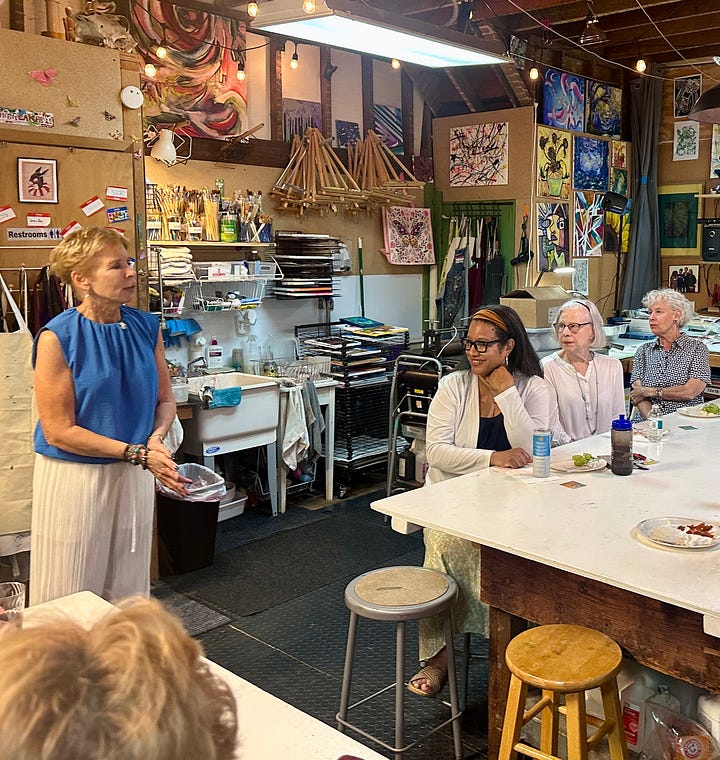

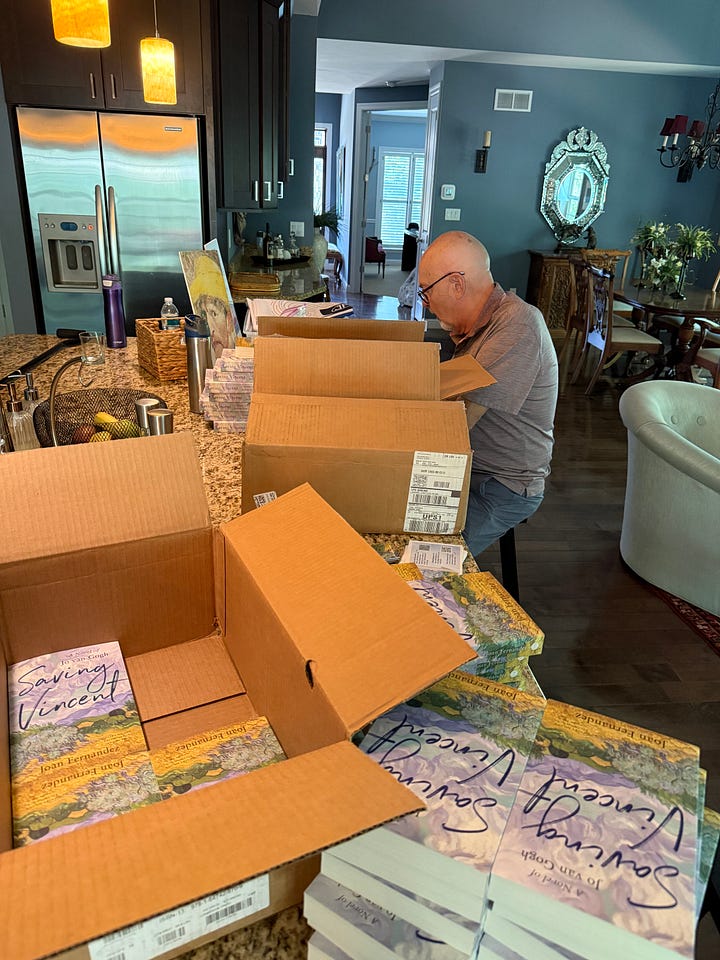
(Captions are left to right)
Lively evening with a Saving Vincent-loving, golf-playing book club in Weldon Springs, MO.
Art lovers meet Jo at Marnie’s Creative Outlet in Webster Groves, MO.
Van Gogh continues to universally inspire! A Starry Night public swimming pool in China.
Book sales prep in our kitchen: My husband adds book marks and review postcards to Saving Vincent books destined for readers’ hands.
Last Week! Publisher’s Summer E-book Sale: June 29 - July 10

Available via ebook retailers’ sites.
Every book on your shelf represents a door that had to be opened, but for many women writers of color, the traditional publishing industry still presents immense barriers to entry. That is why the STEP contest (Toward Equality in Publishing) exists.
Since 2018, this initiative has awarded full, fee-free publishing packages to fifteen amazing female authors of color, turning previously overlooked manuscripts into the powerful books readers need most. Submissions for the 9th annual STEP contest are officially open now through September 10, 2026. If you know a writer of color who may be interested in this opportunity, please share this opportunity with her.

Comments
Nothing yet. Say the first thing.
Sign in to join the conversation.