
We have shared out, like thieves, the amazing treasures of days and nights.
- Jorge Luis Borges
“So what we’re gonna do, is we’re going to write letters to ourselves, and I’m going to send the letters back to you in five years,” Kass said, and she pulled a stack of pearlescent paper and envelopes she’d been hoarding from her bag, and placed it on the table among the Powerpuff Girls stickers, Snoopy washi tape, and rainbow pens. The paper pushed the pens into my chopsticks, which rolled off my napkin. I caught them.
We were in London, at a soup dumpling restaurant, in between dinner and our taro bao desserts, and I had known Kass for at least fourteen years though I hadn’t seen her in what felt like half a lifetime. I knew the other women less well, or not at all, but they all knew Kass, some for much longer than I did. But now I did know them, after only three short days with them, and I also knew we’d never be here again.
Most of them are turning fifty this year, hence the trip, although I am turning forty-nine today. It’s close enough to recognize that by now we likely have more years behind us than we have ahead of us. I’ve always held onto moments because I knew they’d never happen again, and while I wish I had taken more photos I also knew that static images could never recreate the things that were said, the passing smile, the joke, music, an accent, the way it made me feel.
The women glowed and looked at each other and chattered after Kass made her announcement, and then the divvying of the stationery began, which is a very serious thing among women who were once girls, and I watched as the stickers were sifted through and felt that familiar third grade pang in my heart when someone chose a sticker I thought was more valuable than the rest. I leaned back in my chair and looked at my blank paper.
I had completed this exercise before. I’m sure a lot of people have done this. Freshman year of high school my social sciences teacher asked everyone to write a letter to their future self, and make predictions about what might happen in current events as well as their own lives. Four years later he would hand these letters back to us as hardened seniors ready to set off for college, and we’d see if we were right. My sole memory of this event was opening my letter only to reveal firstly how inaccurate I was at predicting anything, and how insignificant my current events were in 1990 compared to what was happening in 1994. It was all a bit of a let down.
As my pen hovered above the shimmery sheet of paper, I struggled with the idea of writing something that could be considered significant, that would have any staying power at all in five years. This was silly, of course, because it really didn’t matter what I wrote since I was the only one going to read it, but I guess the memory of my disappointment in my trivial teenage note lingered distressingly and I felt I had to try harder. The one thing I thought I knew was that whatever issues I was facing this moment probably wouldn’t matter at all in five years, in fact, it was possible I’d be embarrassed I mentioned them to my future self.
I repositioned the pen between my fingers. It felt weird because I rarely wrote anything with a pen anymore. My once lovely, rounded handwriting had degraded to a wobbly, cramped scribble. I glanced up and across the table at someone else’s letter, as if I was cheating on a test, and saw that she was writing about remaining friends with everyone here. I don’t know why I hadn’t thought about that. I suddenly felt this fleeting anxiety that I had been taking everything for granted, and I desperately wanted to write to my future self not to do that, except that’s not the way it works. It’s my present self that has to remember to cherish everything if future self is to have any good results. So I decided to write for my present self. No matter how stupid it might seem in five years, I was going to write down the last five months, the last five days, and the last five minutes.
My cheeks were freezing but I faced the wind, which was really just a pleasant fall breeze for Switzerland at this time of year. It had been sixteen years since I’d been back, and I was cold fragile after spending seven hellacious summers in Texas, but finally Sleeper said, “Ok I think I am going to go inside now,” and I was relieved. I followed him inside the ferry that was cruising down Lake Lucerne, and as he sat down at the table I watched the fairytale Swiss buildings with the wooden shutters pass behind him on the shore.
The last time I saw Sleeper he was partially immobilized with fear in the seat of an electric go-kart in north Austin; it had rained during his entire two day visit to Texas and he had agreed, perhaps with some regret, to do something indoors that scared him. I am a huge proponent of doing things that scare you all the time, but I recognize that not everyone shares my enthusiasm for near constant amygdala activation. He had already managed to survive one race. I leaned into him and said, “In the next race, every time you’re going in a straight line, full throttle, ok?” He cut six seconds off his time. As in life, you don’t always have to go fast in the dangerous parts, but you better be going full speed when the road is clear.
Sleeper and his wife were both already in Zurich when I started working there decades ago. When I left to move back to California two years later, I always thought I’d go back, but I ended up seeing Sleeper several times in the U.S. before I ever returned to Zurich. They have three kids now, who are burgeoning rockstars and inventors and fearlessly articulate in their non-native tongue, and they watched Harry Potter in German and were kind enough to turn on English subtitles for me. When the kids went to bed I talked with Sleeper and later his wife, for hours, gripping my orange pekoe tea mug with the intensity of someone who could fly five-thousand miles to a foreign country to be supremely happy sharing old stories in someone’s living room all night. Perhaps that is friendship.
Sleeper later texted me, when I got home, about the “Likedeelers,” a crew in the 14th century North Sea who worked for the medieval pirate Störtebecker. Their name translates from old, low German to modern English as “same-sharers,” which likely was reference to their practice of equally splitting their loot. We are the Likedeelers, he wrote. What greater treasure have we shared, he suggested, other than time?
“Let me show you something,” Noah said, and he turned on the lights in his living room and they glowed different shades of orange and green and yellow. “I got those lights.”
Over a year ago Noah, his wife Alisa, and I had been lying on my bed staring at the ceiling and listening to Bob Moses while my room lights changed color to the music. Alisa had become enamored of my “sexytime” setup with my ceiling mirror and special Phillips Hue lighting themes and precision crafted playlist and made a point of asking Spotify to play Bob Moses the day I randomly came to visit them in South London.
I was on my way from Zurich to London, and headed to meet a group of women I only half knew in Notting Hill, when I asked if the two of them had time to meet for lunch. Nine hours later I was still at their house, and we sat on the couch while we regaled each other with absurd tales of things we had seen and done since they visited me last year in Texas. Alisa always remembered the characters in my stories, and Noah always the adventures, and some of these stories the two of them had also been a part of with me. It seemed that Alisa remembered my brief lovers better than I did, because she would ask about where I’d left off with various men who were like a time capsule to me, and then I’d have to update her with all the men in between and the current situation, and she would always listen simultaneously captivated while cleaning the kitchen counter or cutting me a piece of cake. They both remembered tubing on the San Marcos river with me early in the season, and how cold it was, which is a funny memory to have of Texas, and Noah asked me about my driving and I said I was still racing and that I was in my rookie year on the track. “You mean you were just starting out when we rode in the red car?” he asked. He was incredulous that I could now be much faster than I was when he rode with me last year, which honestly, made my heart grow two sizes bigger like the Grinch’s, because if you want someone to make you smile in a really authentic, childlike way just ask your friends who don’t know anything about cars.
“Are you ok now? Because you were really sad when we left,” Noah asked.
“I was,” I said, “I was really sad. But I’m better now.”
And it’s not that I wasn’t sad anymore, it’s just that it had morphed into something else, this intangible feeling of a gradual loss, of things slipping through my fingers like so much glitter. But I couldn’t explain it, so I just told them that fish oil was an amazing natural remedy.
I was wrapped up in him in the back gravel parking lot of a Mexican restaurant in a forgotten southern town. My temple was against his chest, and his shirt smelled of asado and brake dust and sweat. The tall grasses in the front yard of the house across the street bent to the ground in the hot Texas wind. In the distance, the thunder of freight cars, far away traffic, and the squall of grackles. A pickup crunched its way into the lot, slowly rolling into a corner. I turned my head to see it out of the corner of my eye, and I could hear his heart beating in my left ear. His grip never changed on my lower back. I felt as if we could stand there forever. I felt as if we were trapped there forever.
I only ever want people I can’t have. No one ever told me that. It just occurred to me one day. And then, many, many days later I thought, maybe I only ever want people I can’t have to ensure I won’t get them. Maybe I was hoping the universe would help to protect me from what I wanted.
I told more than one person that I don’t feel things anymore, that I am broken. “You’re not broken, you’re just smart,” Celeste said to me upon hearing this, “better than falling in love with everyone you meet, like me.”
“I don’t know,” I had responded. But I did know.
Sometimes I forgot that he knew me better than he’d let on, that I’d spent the last two years telling him my hopes and dreams over speakerphone during one or the other person’s long, solitary road trips across the country. I would get passionate about something, and he would conveniently remember all the contradictory things I told him as a friend.
“Do you think it’s dangerous to love people?” he asked me once, long before we held onto each other in secret in that forgotten southern town.
“Yes,” I had said.
“But what is your book about?” Sleeper’s wife asked me with an inflection in the middle of the question rather than at the end. Everyone always asked this, and why shouldn’t they? But I had grown tired of answering it, not because I didn’t love the story, but because I knew the story only existed under a particular set of circumstances.
“If you’re not here then there is no point to this story,” I had texted Saturyne, not even that long ago. She knew this worked both ways, and no more was said about it. Saturyne and I have had many differences, as people might be expected to have over a thirty-eight year career friendship, but we’ve never had any differences about the story. This ease of telling gave it an air of magic, and held it sacred, and neither of us ever questioned it. Perhaps questioning it would break the spell, and maybe that’s what happened. Or maybe it was less mystical and more profound, and that when I questioned Saturyne’s storytelling I was sensing the vulnerability of a character I perceived to be myself in some way, and her outrage was mine, her hurt was mine, and their friendship was actually ours.
I would later try to write about this incident in my substack but it went unpublished. I called it “creative differences,” like when your favorite band breaks up because the singer and the guitarist got into an argument, but to fans it all appeared very trivial on the outside. Like, they couldn’t agree on lyrics, or they were tired of the stupid concert requests for green M&Ms backstage, or someone had an annoying girlfriend, or the cocaine max threshold had been breached. You want to scream, “The fuck is wrong with you? You had this great thing, and you ruined it, for what?”
Part of me, though, thinks it really was just a creative difference and that Saturyne was overreacting, but the other part of me feels like this world is real, and the only way magic can exist is if everyone believes in it, and that means both of us. And if she was overreacting then it was obviously an overreaction to my overreaction, and that it all happened because I was holding the whole thing too close to my heart. Can you love a purportedly fictional story too seriously? Can your feelings be hurt if your character’s feelings are hurt? Has this ever happened to anyone in the history of friendship? Maybe the problem is that much of it is far from fictional.
I am unsure how to fix it. But I still start my answer every time with, “My best friend and I used to write a story in high school...”
It’s not a lie. But there is an omission.
I fidgeted with my pen a bit longer as the women around me decorated their paper and their envelopes and started to write. I still hadn’t written anything and I was starting to get those blank canvas fears, the ones that authors and designers and artists and musicians get when they start something new and there is absolutely nothing to build from yet.
But then I realized I wasn’t starting from nothing. I didn’t need to predict anything for my future self. My future self, upon reading this in five years would be my current self, and my predictions were irrelevant. So instead I wrote down everything that was happening right now and what my current self hoped for. Maybe in five years I would laugh at some of these things - that might even be the best outcome. But in the meantime I wished for us all to stay together, to remain friends, to become friends again, to understand that we were never not friends, for our book to be done, for me to be able to tell people I loved them. And then I signed it, “Love, Past Jess.”
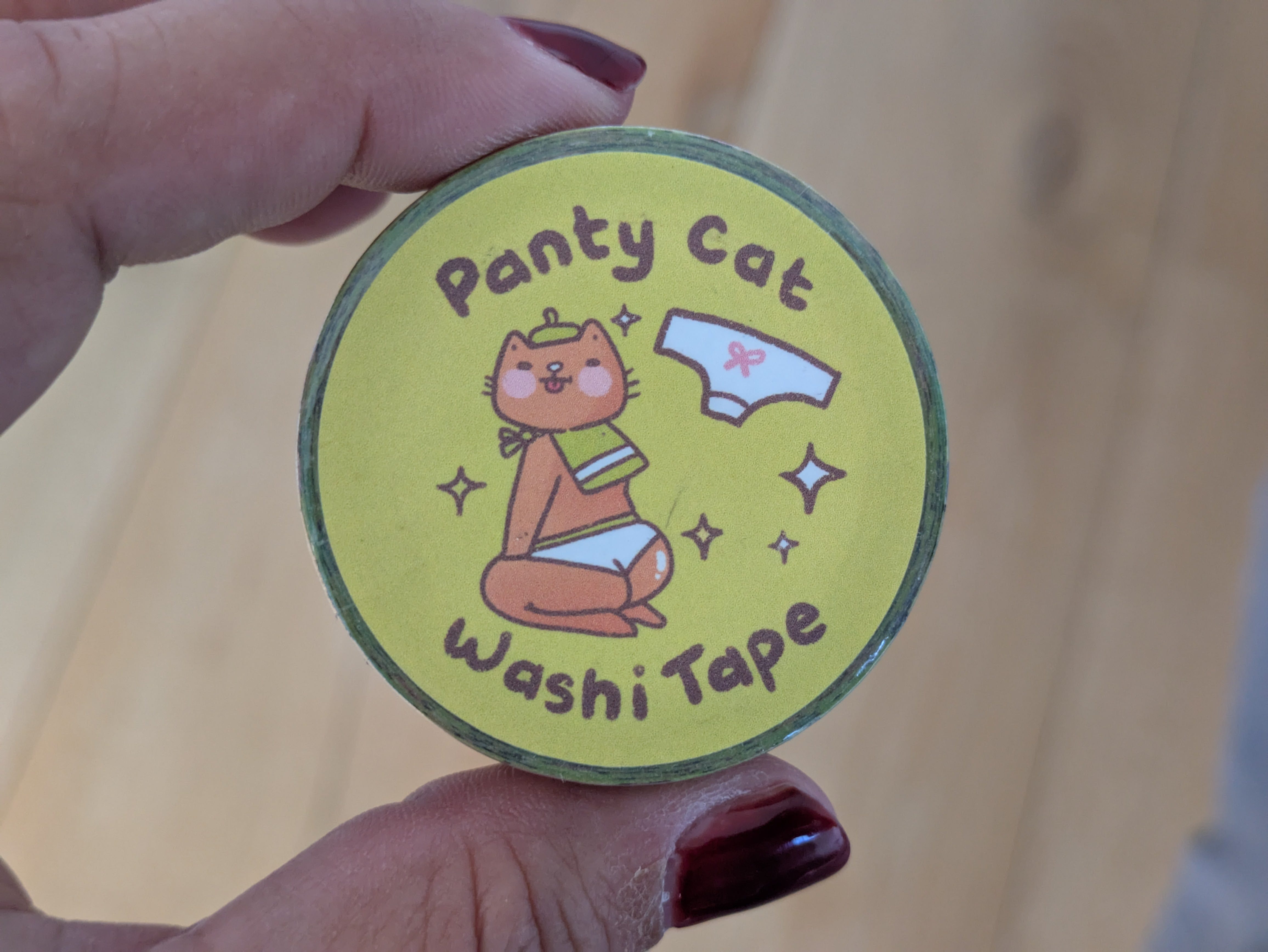
“Oh no, where is the panty cat washi tape?” Kass said, looking around the table.
I scratched the back of my head. “I think I left it on the kitchen counter,” I said. Kass gave me her standard disappointed Kass look and when we got back to the house in Notting Hill that night we spent a lot of time sticking the panty cat tape on every envelope. In five years I hope I’ll remember why there is a cat’s ass in women’s underwear on this letter I just got in the mail.
No posts
Comments
Nothing yet. Say the first thing.
Sign in to join the conversation.