
There are no working-class memoirs from Britain’s occupation force in Germany’s second-largest city, Hamburg, apart from my dad’s Love Among the Ruins. It’s a brilliant read about life observed from the lower ranks when hope was reborn from the ashes of war.
The creators of much of our popular literary, journalistic and cinematic culture are from the upper middle class or society’s entitled set. They have moulded a myth about Britain during the Second World War, cast from their privileged position in society. The working class are archetypal, a backdrop used for comedy, whinging, dead bodies, or examples of a Tommy who learns through battle that democracy is worth fighting for.
My dad, who was from the lower rungs of the working class, didn’t experience war like someone from the middle class. He didn’t hate Britain. But he did detest the people who owned it and those who managed it for them.
My father’s experiences in the Second World War were not about patriotism or duty. They were about surviving it and returning to a peacetime that included the construction of a modern Welfare State. The reason our working-class history during the Second World War was rewritten by popular culture is to keep us obedient in an increasingly unequal and authoritarian society governed for the benefit of its highest income earners.
Chapter 4
A coffee house on the banks of ruin
When August came, the residents of Hamburg sweltered within the skeleton of their defeated city. Record temperatures scorched the northern hemisphere, and the city’s ruins were bleached grey by the sun. At night, in the sultry dark, the sound of wild dogs barking rode through shattered windows on humid breezes that floated in from the Baltic.
In the dwindling days of summer, Hiroshima and Nagasaki were incinerated by atomic explosions that ended the Second World War in the Pacific. All nations were now at peace with their fellow man. In Germany, it certainly didn’t feel like civilisation was in harmony with itself. Europe was divided between the Soviet army and the Allied forces in an uneasy détente. Anarchy and hunger threatened Western Europe. Political grievances, black-market turf wars, and old scores against collaborators were settled at midnight with a loaded revolver. Peace in Europe was as uncomfortable as a suit too small in the shoulders.
While the puppet-masters – the banks, the politicians and the generals – pulled strings behind the scenes and shifted the continent politically and financially, I was being tugged deeper into Friede’s world. I orbited her like a faithful satellite, while she tentatively introduced my good character and name to her closer girlfriends. She smuggled me into their conversations and inflated my generosity and kind nature.
‘Look what he brought my family: a whole kilo of cheese. He even found me tooth powder to clean my teeth. This Tommy always tries to converse in German, even when he mixes up the words.’
Among her friends, I was becoming known as the Brit who wasn’t looking for a quick shag underneath the linden trees. At the beginning of our courtship, I was left to linger in the background. Friede kept me ignorant and oblivious to most of her everyday world. She was still uncertain about the depth or distance our friendship would travel. Friede purposely kept me apart from her friends. She was afraid they might reveal confidences to me about her life or disapprove of her dating a foreign occupier.
In late August, I was introduced to her friend Gerda. The two had been friends since early childhood. Gerda was the first friend Friede made when she was sent to live with her foster parents in Hamburg’s working-class Altona district. Both girls lived in the same apartment block, and from the day they met, Gerda acted as her bodyguard against gossipers and bullies. Friede’s friend was a peroxide blonde who was physically pretty and emotionally and intellectually uncomplicated. Past or future tense meant little to Gerda because she lived without introspection. To her, one day you were born, and many years later you died. It was the in-between living that mattered to her.
I took them both out for coffee to a riverbank café in the Blankenese district. It was an area popular with occupying forces because its restaurants still functioned with pre-war efficiency. An old and shuffling maître d’ brought us to our table. Friede remarked that the café had been in business since the days of the Kaiser.
‘When I was about ten, my mother and her boyfriend Henry brought me here. It was filled with stuffy Nazis. I see the uniforms are different, but the cakes remain the same.’
‘Hush, Friede,’ said Gerda. ‘I have never been here, so it is all new for me.’
It was a beautiful outdoor restaurant for a well-to-do crowd. Money, not ideology, was its political stripe. That was why it survived the Kaiser’s abdication, the assassination of democracy, and Hitler’s bloody end. Regardless of who was in power, the menu at the café remained the same: Vienna coffee, Sachertorte, and VSOP brandy. The café welcomed occupation as it did every historical event: with a cash-only policy.
It was a warm, cloudless day and the restaurant tables were crowded with loud British troops and their female companions. It looked like there was an equal portion of officers and enlisted men chatting and flirting with young German women. Although the occupation command frowned upon fraternisation, it was almost impossible to enforce. The occupiers were young men who had endured five years of war, privation, and the threat of obliteration. So, irrespective of HQ’s fear that contact with the civilian population would lead to an outbreak of venereal disease, corruption in the ranks, and a diminished capacity to keep order in Germany, nothing was ever really done to enforce the regulation.
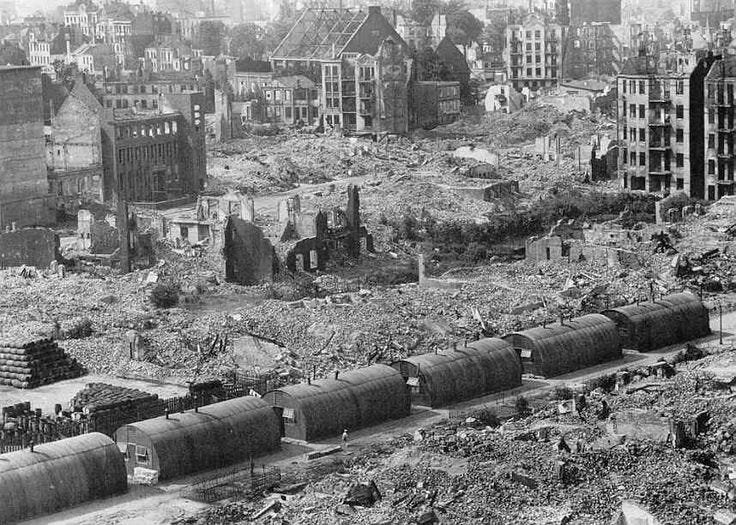
The atmosphere at the café was as carefree as a summer’s day before the war. But that was because everyone was facing the river. No one dared turn towards Hamburg’s skyline, where it was Gomorrah, the day after Lot had packed up and left. Hamburg was no more than a putrefying animal body. Underneath the city’s mountains of ash, cement, bricks, and burned beams were the mummified corpses of some 30,000 bombing victims. They had perished during the RAF firebombing raids in July 1943.
‘Last year, you could still smell it,’ Friede noted as she put on fashionable sunglasses.
‘Smell what?’ I asked, while her friend Gerda looked out towards the river, uninterested.
‘The stench from decaying bodies trapped underneath the city’s wreckage,’ she replied. ‘Last summer, you needed to place a handkerchief sprinkled with eau de cologne against your face to stop the odour of rotting flesh from getting into your nostrils. It was overpowering. Even in the winter of 1944, how do you say, the taste, is that the right word? The taste of death overpowered winter’s frigidness. Hamburg is a tomb,’ she concluded morbidly.
The waiter arrived and set down our order at the table. He was dressed in an immaculate white coat, black tie, and dark trousers. He bowed and scraped before me and fawned over the two women. Contemptuously, I imagined he had displayed the same amount of servility when his customers had been Gestapo officers with their dates.
I offered the ladies a cigarette from my Player’s pack, which they both hungrily accepted. I placed my cigarettes on the table. With Hollywood gallantry, I lit our cigarettes. I was about to bring the match to my smoke when Friede suddenly blew it out.
‘Don’t forget, it is bad luck being the third one to be lit.’
‘I don’t think we have to worry about snipers any more. Do we?’
Gerda laughed: ‘Both of you should be careful of Cupid; he is the only one who will get you two into trouble.’
Gerda slurped her coffee piled high with fresh cream, while Friede used a spoon to savour each mouthful of rich butter fat. Her friend smiled and laughed at my jokes, even if she couldn’t fully understand them. Friede intently observed how I treated Gerda and was obviously making mental notes of whether I was being kind or cruel. For some time, we talked about music. The two women were famished to know about American singers, swing bands, and whether I had any of their phonographs.
‘Do you have Benny Goodman?’
‘I adore Tommy Dorsey.’
‘What about “Pennsylvania 6-5000”?’
‘Glenn Miller,’ I told them, ‘is very popular.’
I suggested we should all go to a dance held at one of the Air Force clubs in the near future: ‘We can hear swing music played by some great bands?’
Considering I didn’t know how to dance, it was a bold offer, so I quickly changed the subject. I suggested as an alternative that I bring some phonographs over to Friede’s mother’s apartment. ‘We can listen to some good music and make it our own private party.’
‘I would still rather go out dancing,’ Friede said, disappointed.
The afternoon passed quickly and pleasantly as everyone skirted unsettling incidents from the past or our precarious present. Only once did I let the conversation drift into uncharted waters, when I foolishly asked Gerda if she had any brothers or sisters. Gerda’s eyes grew dark. ‘Two,’ she answered dejectedly. ‘I have not seen my brother Erwin since 1942. He was in the Africa campaign. He was taken prisoner by the British. At least he is safe because he is a POW in Britain.’ Gerda stopped her narrative and asked, ‘Could I have another cigarette? Bitte.’
Her younger brother, Hans, hadn’t been as lucky because he had fought on the Eastern front. When I closed the lid of my lighter, she resumed the story. He was at Stalingrad and couldn’t endure the brutality. He tried to desert to the Russians. Unfortunately, Hans failed in his attempt to surrender to the Reds. He was caught by his own side, who subjected him to a front-line court-martial. Found guilty of cowardice and desertion, Hans was sentenced to death. The verdict was carried out within minutes of the judgement. He was strung up on a telegraph pole - a sign hung around his neck which read: Coward.
The waiter arrived with our bill. He presented it on a silver tray placed obsequiously before me. He officiously swept crumbs from the table with a shiny brass-handled brush. There was a hasty servility to his movements. Other soldiers with their German girls were eager to pay for coffee by the river. I stubbed my cigarette into the ashtray and tried to leave a fat tip on the table, but Friede commented out loud: ‘That is just foolish, Harry. That stupid waiter is already rich on Tommy’s money; better to give him half and we can enjoy the rest somewhere else.’
I picked up part of the gratuity and sheepishly thrust it back into my trouser pocket. When I stood up, I noticed Gerda had hastily gathered up spare sugar cubes from the coffee saucers and put them into her pocket.
The three of us walked along the riverbank. The water was sluggish and covered with a sheen of petrol. The sterns of scuttled naval ships perched themselves above the waterline like markers leading towards the dockyards. Off in the distance, the harbour was still. It was a testament to the air war against the city. The port was now only broken awnings and collapsed steel cranes resting derelict across docking slips. We strolled on a path along the Alster. It was an exquisite walkway decorated with ancient trees and ornate benches. The sky was clear, the sun warm, but there was a dusky smell in the air coming from the ravaged city beyond.
We walked with Gerda to a black market where she could barter cigarettes for sausage. The market was in the ruins of the working-class district, near the docklands. As we walked, dust blew up from the bomb craters where buildings had once stood. All around me were gaping holes in the cityscape, as if a giant animal had bitten a chunk of flesh from a carcass. In other places, ziggurats of debris formed, where buildings had caved in onto the street. In some spots, a giant bulldozer had brushed ruined neighbourhoods into heaps as one would rake leaves for burning.
Everywhere, there was a loud, monotonous clicking and scraping sound coming from old women pecking through the rubble. They were known as the ‘brick Omas’ (‘Oma’ being German for grandma). They scavenged around the wrecked streetscapes looking for salvageable masonry to rebuild the sacrificed city. The old women wore rags and torn aprons over their clothing. Brick dust coated their hair and faces, while their hands were blistered and cut from handling bomb debris that they gathered in neat piles and placed along the roadway. They worked without complaint, reminding me of the Israelites building Pharaoh’s necropolis. Sometimes, scores of old women were killed when they tripped an unexploded bomb trapped in the wreckage.
In the background, amid the industrious Omas, lurked a pack of men in various stages of deformity. A man missing a leg hobbled around on a dubious crutch that barely kept him upright. Beside him stood an armless man whose shirtsleeves looked like sails empty of wind. There were several other men whose heads were wrapped in dirty bandages. These war victims huddled around broken concrete as if waiting for the old women to reclaim them as the other refuse in the street. The uncontaminated scent from my crisp RAF uniform stirred them from their crippled indolence.
‘Tommy, cigarette für einen Kameraden.’
‘Tommy, chocolate bitte, für meine Kinder.’
‘Tommy, Tommy,’ went the chorus of maimed men living in the shadows of burnt-out buildings.
We quickened our pace and rushed away from these men. We soon approached the black market where Gerda wished to trade. All around the haphazard, open-air market, thuggish-looking men guarded the perimeter from thieves and the occupying authorities. Generally, the British turned a blind eye to this commerce of survival. However, on occasion, especially if the market was dealing in liquor or medicine, a less-than-honest bureaucrat, officer or NCO demanded a kick-back to keep the business permit ‘official’, so to speak.
I bade goodbye to Gerda and uncoordinatedly kissed her cheek. Friede spoke rapidly and lovingly in German. When they finished talking, Gerda called out: ‘Tschüss, Puppe.’
‘I imagine she’ll do all right in there,’ I said. ‘She’s quick-witted and no fool. I like her.’
‘If anyone wants to live in Germany, they cannot be a fool. As for Gerda, I trust her with my life and would a hundred times over. She would never betray me, or stab me in the back for money, man, or country. Gerda is not complicated, but she is beautiful in her simplicity. I have other friends, who you shall meet, who are different, but I need them just the same to make me complete.’
‘What did she just say to you?’
‘Oh, that,’ Friede said, laughing. ‘Gerda said, “See ya, doll.” We must really begin to work on your German,’ she added.
'Doll?' I asked, puzzled. Friede replied in a tone that was impatient and peeved that some of her private life was being opened up to an outsider.
She explained that it was a pet name. Friede’s mother, out of guilt for making her live with foster parents, bought her daughter expensive clothes. It made the other children who lived in the working-class district think Friede resembled a princess or a doll, fallen on hard times.
Thank you for reading and supporting my Substack.
Your support helps keep me housed and allows me to keep Harry Leslie Smith’s legacy alive.
Living with cancer and lung disease makes life more challenging, especially during this cost-of-living crisis. Every bit of support goes a long way. Below, I’ve included a tip jar. It helps pay the rent and keeps a candle burning for The Harry’s Last Stand Project.
Over the last 18 months, I’ve worked to complete my dad’s The Green and Pleasant Land, the unfinished history of his generation’s youth that Harry left behind.
The manuscript is now complete, apart from a few minor edits. It traces his life from his birth in the Barnsley slums in 1923 to Labour’s landslide victory in the general election of July 1945, and the birth of Britain’s Welfare State.
No posts
Comments
Nothing yet. Say the first thing.
Sign in to join the conversation.