
Martin Clancy (formerly of In Tua Nua, now Trinity and Insight) came to Galway yesterday (Thursday 27 November 2025) to give a talk about his music AI initiative AI:OK, as part of the Institute for Creativity series. I was invited to respond as a panel member. Here are some of the things he said, some of my responses, and some more thoughts I didn’t get a chance to mention, or that came up in discussion after.
First, AI:OK is interesting and potentially important. The concept is a badge, like a food safety mark or a fair trade mark, which says “this music was ethically created, with regard to AI”. The hope is that consumers basically don’t want to be fooled by AI-generated music, and they’ll trust this badge to help them choose their music. And the hope is that the industry will be made to see that it is in their interest.
Martin gave a big Christmas tree of a talk, with many interesting baubles hanging off it, which I would have liked to take each of them down and look at it for a while. But there was and is limited time.
Is AI:OK a good idea? Yes, but everyone in Silicon Valley knows that good ideas are easy, execution is hard. Martin has the experience and the connections to maybe execute this. A lot of details seem to be missing so far, but I think it’s on purpose. The idea is to establish the concept, and get some stakeholders to agree in principle, and then get them to define the details.
So, for example, I asked where this badge would actually go - does it attach to a song, or an album, or an artist, or a record label? Or an AI system, which might be used by different artists? Martin’s answer: he was educated by the Christian Brothers, and as a result, he doesn’t like “theological questions”. I don’t know if the Patrician Brothers have a school of thought of their own, but I’m confident they left zero traces of it in my thinking. Anyway, my question was rather practical. Can this thing be shown in, for example, a Spotify playlist? That’s to be determined.
(Martin claims, and deserves, some credit for thinking about the impact of AI on the music ecosystem around 10 years ago. But as he almost admitted - at the time, it was a hypothetical, hence perhaps a theological question.)
There is a certain genre of person who believes:
AI products are crap, so it will go away;
AI is unprofitable, so it will go away;
AI is environmentally unsustainable, so it will go away.
All of these are as false, or as lacking in nuance, as the hype narratives we hear from AI companies. We are faced with huge problems and huge changes, and people cope by this type of motivated reasoning.
These people will go on to say that if a piece of music is AI:OK, then it must be “AI:Zero” - no AI is OK. This is again false, based on the misunderstanding that AI implies large, stolen datasets. Now some AI systems do involve large, stolen datasets, for example Suno and Udio which provide “prompt to audio” functionality (P2M). In those cases I think AI:Zero would be a reasonable response. The only good P2M system is a dead one.
But that is far from representative of AI. The reality is that if you started hearing about AI or AI music in 2023, then AI is much broader than you think. Where the AI uses a training set, it may be legal (like in Logic Pro’s drummer) or illegal (like Suno/Udio, or you might like to call them Sudio); it may be large (again, like Suno/Udio) or small and custom (like in the Savery & Weinberg chapter, in Martin’s book, or the “human becomes a live dataset” briefly mentioned by Alex Braga here). Similarly, AI doesn’t necessarily imply large compute costs.
But my most important point, against the AI:Zero position, is that AI doesn’t have to involve training sets at all. Where there is no training set, instead the programmer of the AI works to distil their own ideas - effectively, a music creation process - into an explicit procedure. That programmer is involved in programming, but is also involved in creation, or better yet - to quote the title of a book by Whitelaw - Metacreation. Probably the majority of AI researchers, for the majority of the history of the field, worked more like this, rather than through a training paradigm.
The field has for decades been characterised by two main opposing schools of thought, which can be called connectionism and symbolic AI. Connectionism means neural networks, the dominant paradigm since 2010 or so. But many experts think good old-fashioned symbolic AI is due for a comeback.
Every technology has influenced music and has had its nay-sayers. Brian May of Queen created the live version of Brighton Rock with an extreme echo effect, which became a part of the music which the musician has to respond to. In my mind even this is on the spectrum of generative music, and there is no sharp dividing line between this and complete band-in-a-box generative AI systems. Artists have always taken advantage of new technologies - sometimes using it as intended, sometimes the opposite, always making it work for them. For the best artists, that is fine. For mediocre artists, people who lack vision, instead the technology tends to control them.
Martin thinks of music AI as a microcosm of the issues raised by AI in general. I agree, because this is the story of my research career. I started doing evolutionary computation and computer music, but I gradually realised the AI techniques I was using were of interest in themselves, and had applications outside music.
Now, of course the issues faced by musicians are faced by graphic designers, writers, film-makers, and others too. The music industry is perhaps more lawyered-up than the graphic design industry, so we are seeing the legal aspects here first, eg in Suno/Udio lawsuits. But graphic designers are probably the most vulnerable to losing their incomes. We have seen some AI artists in the charts, but that is just displacing one fake artist with another. We’ve seen Spotify using AI to pad their playlists, but streaming royalties are low, and this can be stopped with payola-like laws. I don’t think we’re seeing small bands, who make small money through concerts and t-shirts, losing out to AI. I don’t think we’re seeing lots of musicians who used to earn a side income writing for tv losing out to AI. I think I see Suno/Udio more as a moral and artistic problem than a financial one.
(Speaking of film - thanks to the 4 Guys 1 Mic podcast, where I also had a very interesting conversation not long ago, focussing firstly on AI impacts on film, but becoming broader. That episode is here.)
The two biggest offenders in AI music are Suno and Udio, both trained on stolen datasets, which might be retrospectively legalised thanks to record company deals. Of course nothing they do can retrospectively remove their immorality.
Anyway, both basically work at the audio level. You input text, and they produce an mp3. They tend to be attractive to people who don’t want to get their hands dirty with music composition, they just know what they like. (But maybe a new version of Suno enables MIDI output? I heard this, but didn’t check it out yet. I can’t keep up.) At most, typical Suno/Udio users exert control by uploading their own music as a seed, or by iterating the text prompt.
In contrast, some AI systems work at a symbolic level. This tends not to be visible to consumers, but musicians know the difference, because the symbolic level means talking about a MIDI representation or something similar, which is used internally in Max/MSP, Pure Data (Miller Puckette is another author in Martin’s book), Ableton or Logic. The point is that a musician can take the output of a symbolic system and work with it. It can become part of their artistic process. I use Logic Pro’s Drummer system sometimes, which outputs MIDI, which allows me to customise it.
Some people say Suno/Udio are “democratising” musical creation. I used to think of my evolutionary music research that way too. In interactive evolution, the user listens to a population of say 16 melodies and marks the good ones, or the least-bad ones; then the system discards the worst, recombines the best, mutates, and shows the new population. You don’t need to make any edits, but you need to make a lot of judgements. Still, you are “in the loop” because you are working inside the system, not just receiving a monolithic output to be accepted or rejected. Here’s a simple system I cooked up with Claude, for use in open days and public outreach.
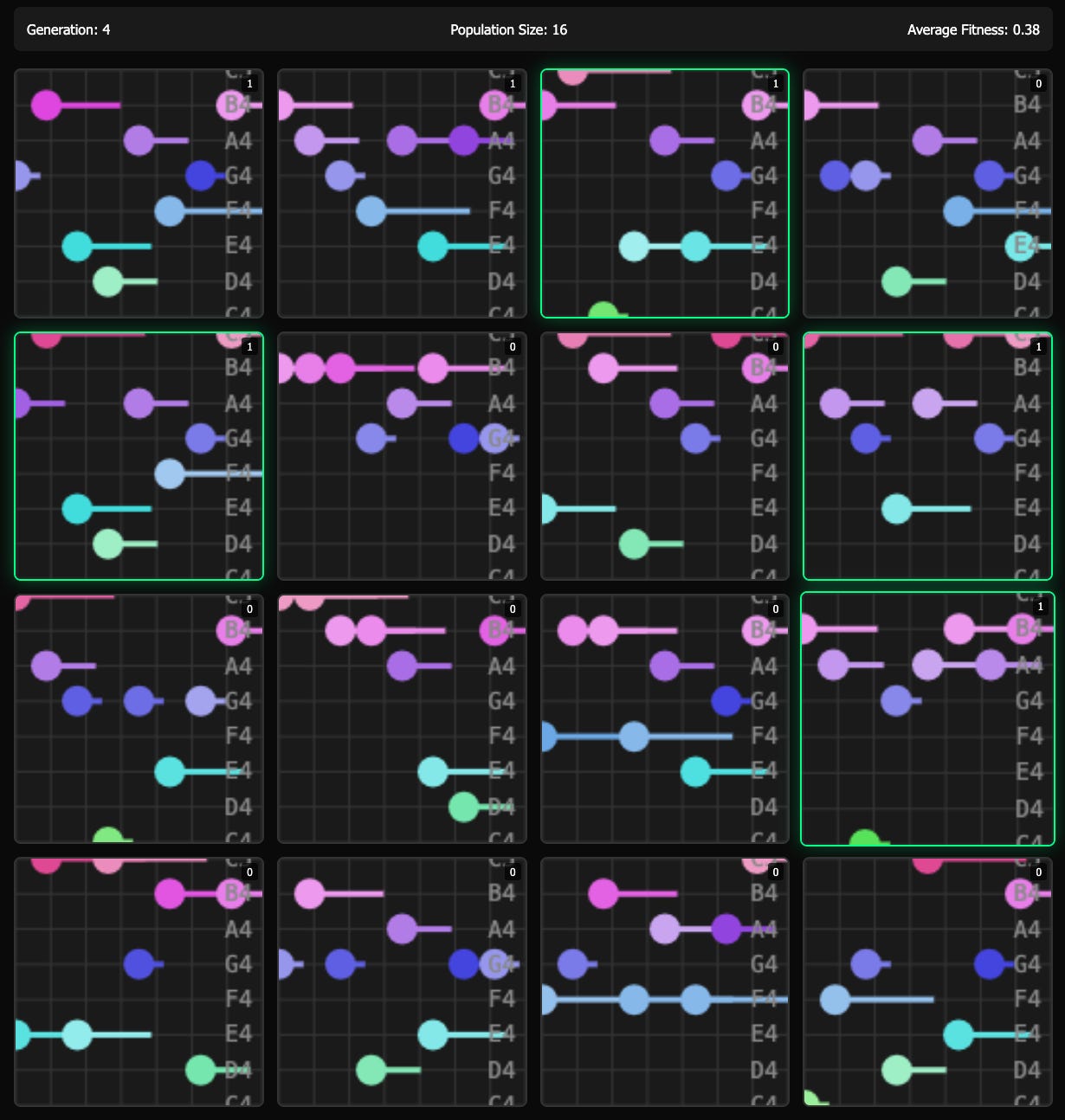
However, my thinking has changed a bit on this over the years. I realised that even if the metacreation part - designing the system - is a lot of fun, still creating music by hand is fun too. It’s like a huge, open-ended puzzle with an aesthetic reward. There might be some parts worth out-sourcing, but you need to be pretty sophisticated to know when your out-sourcing is taking away from the music, instead of adding to it.
I might fondly imagine a user diligently using this type of tool to haltingly express the musical ideas which they don’t have enough skill or training to express by hand, perhaps a more realistic scenario is a music executive sitting in an office using these tools to produce a few hundred tracks in a particular style to be added to playlists, to help reduce Spotify’s royalties payments.
In connection with good old-fashioned AI, I mentioned David Cope, a pioneer of AI music, and one of the authors in Martin’s book. I proposed him as an example of an artist and programmer creating an AI system without relying on a large stolen dataset. I know this much is true. But I’m not sure if Cope is a good example, because Cope has always been dogged by criticism that his system (Experiments in Musical Intelligence, or Emy) tends to imitate and quote from source materials a bit too closely. In response, Cope tells a good story: some Chopin experts in Moscow listened to and were unimpressed with Emy’s imitation of Chopin’s style, saying Chopin wouldn’t have done something the way Emy did. But David Field, whom Chopin was inspired by, was himself unimpressed with Chopin’s style, and said he himself wouldn’t have done something the way Chopin did. And as Cope goes on to say, Emy follows the time-honoured tradition of imitation and quotation among artists, and our tradition of learning by imitation in musical education. And this is a common point made by advocates of AI music systems (not to say, of the devil): all human musicians learn by imitating other musicians, so why shouldn’t AI do the same?
I think they, and equally Cope in the interview above, are missing an important difference. When we train humans by asking them to copy, we can rely on two things (1) they have their own ego, life experiences, etc, and they will take all they learn and then produce something individual to them; and (2) they are just one person, so their impact is actually limited. Because we can train an AI system and then run it zillions of times, that copying process has a much bigger and more damaging impact. If each AI system was limited to produce, say, 10 or 100 works, comparable in size to the lifetime output of one composer, it would be a lot less scary.
So, just like in many other cases, we now see that there were always flaws in our thinking, but they were hidden, in practice, until AI exposed them. Which just goes to show that theological questions can turn out to be very practical in the end.
No posts
Comments
Nothing yet. Say the first thing.
Sign in to join the conversation.