

Hello,
Welcome to Cultural Capital. In The Times this week I wrote about the decline of casual conversation and the role of sociable cities in creating and sustaining liberal values:
Cities are schools of tolerance. They provide what you might term a kind of “stranger exposure therapy”, offering repeated small collisions with people unlike oneself. Snatched conversations in shops, taxis and restaurants represent valuable incursions across the lines of class, culture and race; each one a needle puncture to the social membranes that separate the human tribes. My interaction with my Uber driver briefly humanised a part of city life that can easily seem anonymous. Such conversations can be banal in themselves but these things add up. A complex modern society can hardly function without some shared sense of humanity on the part of its citizens.
I should also say I’ll be in conversation about my forthcoming book The New Dark Ages (which is terrifyingly out in less than four weeks) at a couple of events in the autumn.
I’ll be in conversation with Callum McDonald in Edinburgh on the 9th of September.
And I’ll be at Conway Hall in London on the 5th of September.
Looking at all the pictures used to promote these events I somewhat regret that all the publicity photographs of me for the book were taken outside in the middle of the London heatwave. I look drained and sweaty. But perhaps this communicates a sense of rage and despair at the decline of literacy.
Is tech the next woke?
To me Katherine Dee is the most interesting sceptic of the present anti-tech backlash. She argues that moral panic about smartphones and tech is the next “woke”. This is an interesting framing:
we’ll eventually have a “Woke 1.0”-style culture war about technology. I mean, it’s just been in the water for a long time. Just like we’ve always had backlashes against feminism, we’ve also always had techlashes— but I mean, a techlash that has the features of peak woke. Moral panics, opportunists selling “workshops” about how to stay human.
I am (you will probably not need reminding) ultra woke on this issue. I think the moral panic about screens is entirely justified (AI-written books, a reality TV president destroying democracy, declining IQ etc). At the same time it is definitely true that a lot of the witch hunts about AI do have a strong 2020s vibe about them. The idea that this is our next culture war is an interesting one. Though I wonder how many people outside of the Silicon Valley true believers are really “anti-woke” on tech? I would guess there is less of a 50-50 split on this issue than on the last culture war.
Wolf Solent
I am reading what is surely one of the most eccentric classic novels of the twentieth century: Wolf Solent by John Cowper Powys. I first read it in my early twenties and have a memory of it being odd. The memory was correct. I’ve not read anything quite like it.
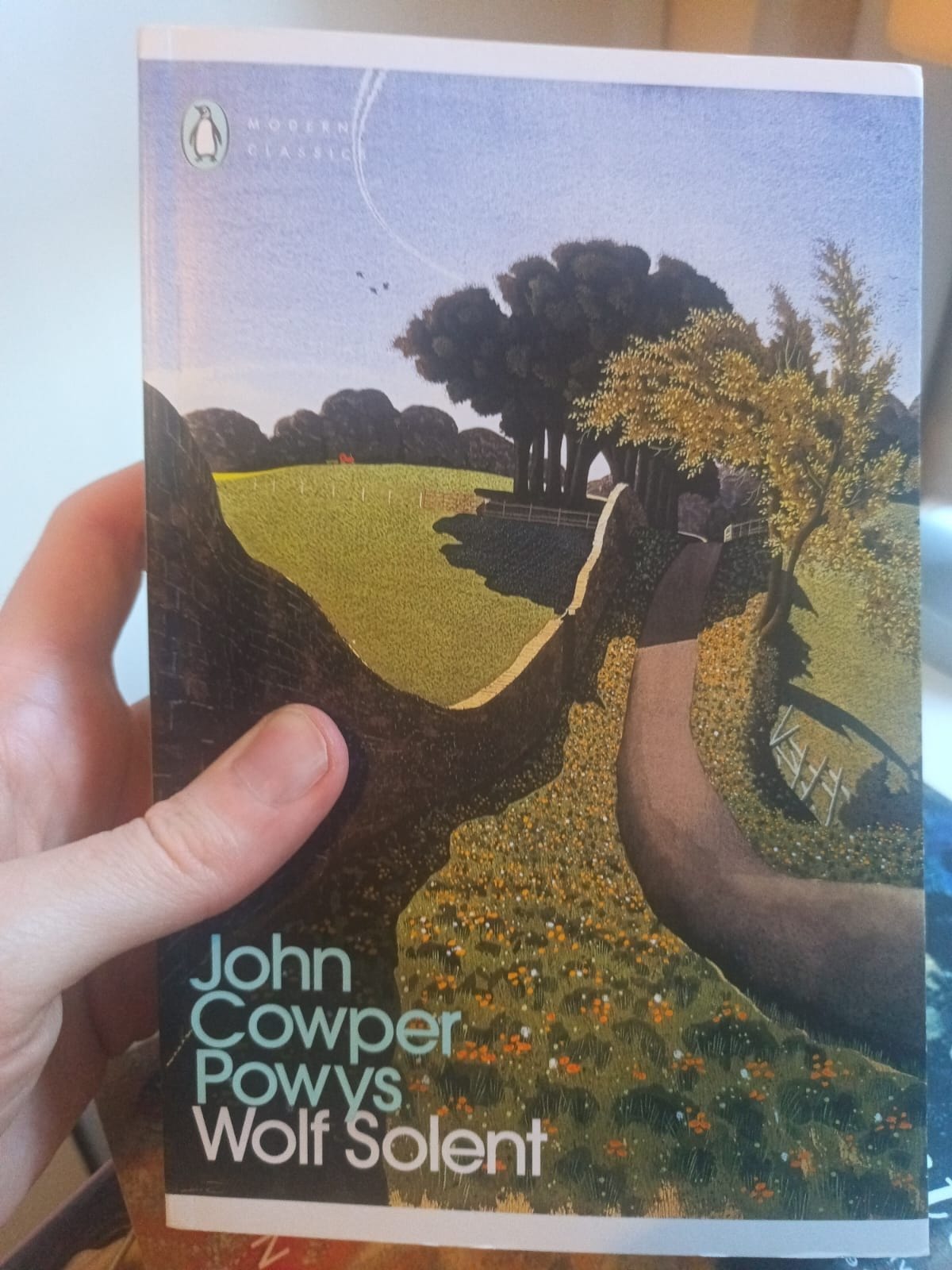
The eccentrically named hero Wolf Solent is a teacher who leaves his job after cracking under the pressure and performing what he calls a “malice dance” in front of his pupils. He takes up a job in his ancestral village where a Satanic local squire employees him to work on a history of lewd and profane goings-on in Dorset.
This is only the beginning of the weirdness. Wolf Solent is written at a relentless and slightly hectoring pitch of visionary mysticism. It contains gorgeous, superabundant quasi-animistic descriptions of the Dorset countryside.
There’s a strong gothic strain: beautiful maidens, incestuous old booksellers, demoniac country squires. It also contains an almost twee obsession of English country life: bread and butter, afternoon tea, cosy libraries. This unusual combination of preoccupations produces some bizarre sentences:
It was the memory of [the incestuous old bookseller’s] obsessed expression – that expression of concentrated erotic insanity, directed towards universal matter, as he had caught it from under the man’s wrinkled forehead across the blue tea-cosy.
Somewhat against my better judgement I’m quite swept up in it.
Among the thugs
Leo Robson talks to Bill Buford, author of Among the Thugs, a classic study of football hooliganism that was the cause of a huge cultural panic in Britain in the 80s and 90s. It’s amazing that it seems to have almost entirely faded now. A lot of commentary suggested hooligans were disaffected victims of society. Buford argued it was more of a meme:
I began to learn how widespread the crowd violence was. It was almost like it was the thing that everybody wanted to do. I came to think of it as basically a style thing or a fashion thing, in the same way that at different times, especially in Britain, there have been epochs of lad culture, like the Mods and Rockers, riding Vespas or Lambrette. Now they were wearing Lacoste shirts and beating the shit out of each other. Why? Because it was what the lads then did. It was fun.
This was the time of Margaret Thatcher—and the assumption was that they were the disenfranchised looking to vent unhappiness or their disgust with the state of things, and were obviously impoverished. In fact, nothing could be further from the truth. There certainly were people who were disenfranchised, and there were a few people who were not so stable in the head—no question. But the basic culture was a very confident lads’ culture where most of the people were making money and had money to spend. A lot of them were builders. There were some lawyers. There were painters.
Vocational education
This is very interesting piece by Daisy Christodoulou about the current hoohaa about academic vs vocational training that is going on in the UK.
She points out that a lot of middle class commentators tend to talk as if vocational jobs like being a plumber or an electrician are obvious careers for students who can’t “handle” traditional academic subjects. But the idea of manual work as a dumping ground for academic failures is not only patronising. It is also not true:
Their thought process seemed to be as follows: students who struggle with academic learning will be “good with their hands”. So we can therefore get the 30-40% of students struggling to get five good GCSEs to do vocational courses instead. We’ve then conveniently solved two problems: we’ve solved the problem of disaffected teens turned off by academic learning, and we’ve created a pipeline of future technical specialists.
The problem is that there is not a one-to-one match between these two cohorts. Of course, we can all think of a student who hates the classroom but comes alive in the workshop. But that is an anecdote, not data, and to the extent we have relevant data, it suggests that academic aptitude and being good with your hands have a modest positive correlation, not a negative one. And a lot of the most valuable vocational courses have quite challenging academic demands: the electrical installation course requires knowledge of algebra and trigonometry, plus mastery of a wiring regulations handbook that is twice as long as Pride and Prejudice.
What if Freud was right?
I am a deep Freud sceptic. The more read about him (I started out years ago from a place of relative sympathy) the more I think the man was just an outrageous charlatan. This, fortunately, is the dominant view nowadays. As Scott Stossel writes it in this great piece in the Atlantic, ‘“A recent history of neuroscience states baldly that “Freud had nothing novel or insightful to say about how the brain worked.”’ This sounds about right to me.
But, Stossell writes, a neuroscientist named Mark Solms is trying to rehabilitate Freud. He not only thinks Freud was right about the unconscious but also about psychotherapy:
Solms’s second explicit claim is, if anything, even more provocative. There is abundant evidence, he writes, that psychoanalysis and its offshoots “are astoundingly effective”—in some cases, he argues, “as dependable as, say, insulin is at managing type 1 diabetes, or as the HPV vaccine is at preventing cervical cancer. These treatments are so well proven that it would strike most doctors as—to use a technical term—crazy not to deploy them by default.”
Solms’s unqualified endorsement of psychoanalysis is startling after decades of criticism. In support, Solms cites a number of studies and papers from the past 40 years to show that psychoanalytic-style talk therapy is more effective than antidepressants or electroconvulsive therapy for depression, or than antipsychotics for schizophrenia. He also cites research demonstrating that psychoanalysis has a robust “sleeper effect”—that is, symptoms continue to improve long after the treatment has ended.
This is interesting news for sceptics like me. But I still can’t help thinking that where Freud was right he was just systematising psychological ideas that were already wafting around in the air at the end of the nineteenth century anyway. And as Stossell says, “Solms is highly selective in what he cites, and elides a lot of nuance (and sometimes directly contradictory evidence) in service of his case for psychoanalytic-style therapy and against other forms of therapy”.
Close readings
Regular readers will know that I am a devoted fan of Mark Ford and Seamus Perry’s LRB poetry podcast. This episode on Keats’s Eve of St Agnes is one of their best ever. I love how excited they are about the poem.
Worth saying that it’s a bit fiddly to listen to: you have to pay to listen to whole episodes. And the Ford/Perry episodes get dumped into a feed with a lot of other LRB podcasts but it’s very much worth persevering.
Kingsley Amis on the secret of a happy marriage
I really enjoyed this old BBC Radio 4 interview with Kingsley Amis on BBC Sounds.
I love how infuriated he is by the misuse of the word oblivious which apparently once implied you’d forgotten something rather than that you were completely unaware of it. This battle is now totally lost.1
He says (and he may not be the ideal person to give advice on the subject) that a secret of a happy marriage is having people to gossip about. This strikes me as wise. Presumably the secret of an unhappy marriage is being the person other people gossip about.
Drinking coffee
The great luxury of my life is reading in bed every morning with a banana and whole cafetiere of coffee for breakfast. I am glad to learn from this interesting New Scientist podcast that coffee is good for cardiac health and reduces your risk of dementia and Parkinson’s disease. Counterintuitively coffee (consumed in moderation) also reduces stress.
Until next week,
James
My most valuable piece of Amis pedantry is that the word jejune is not French and should be pronounced juh-joon.
No posts
Comments
Nothing yet. Say the first thing.
Sign in to join the conversation.