
Hello!
In The Times I wrote about Britain’s unfortunate addiction to whimsy exemplified by the media indulgence of the (in my view) not particularly funny comedy candidate Count Binface:
It’s often been remarked that this tendency to unseriousness is connected to post-imperial decline. A nation that can’t be taken seriously shows itself superior to the world by laughing at it. I tend to agree. Certainly, self-deprecation often betrays inner unease. Britain resembles a star athlete gone to seed uncomfortably making jokes about his weight. Worse, our national humour is increasingly laced with an unconvincing strain of smugness. “We don’t take ourselves too seriously over here in Britain!” is the message. “What must they make of this in America!”, someone will invariably chortle at election time footage of a cabinet minister sharing a platform with a man in a fox costume.
But here is one of the weird things about writing a column. I thought I was just letting off steam about an inconsequential topic in an amusing manner. But my denunciation of Count Binface is arguably the single most controversial article I have ever published. If you look at the below the line comments you will see everyone is utterly furious with me.
Count Binface himself has written to The Times to object (rather pompously I think).
We live and learn.
More on the evils of whimsy
The inspiration for this week’s column came partly from a Kingsley Amis essay on Edward Lear in which he discusses “the arch, twee, whimsical etc tendency that so disfigures English literature, humour, even character” and which he believes stretches back as far as Shakespeare.
Kingsley Amis’s bluff “I’m just a man of the people” act gets a bit tedious. His basic view (helpfully re-iterated in almost every essay) is that anyone who likes any art that is at all difficult or made before the nineteenth century is an insufferable pseud.
But for sheer unreasoning vitriol I did love his essay on the Victorian nonsense poet Edward Lear:
I pass over the courtship of the Yonghy-Bonghy-Bo and the doings of the Dong with the luminous nose – the very titles ought to set any decent, trustworthy person wincing and grimacing – and come to one of the great nadirs of our national intellect and feeling, The Pobble Who Has No Toes. In the course of fishing for his Aunt Jobiska’s runcible cat with crimson whiskers:
The Pobble swam fast and well,
And when boats or ships came near him.
He tinkledy-binkledy-winkled a bell . . .Just typing those lines has upset me, brought me to the verge of panic like the sight of Woody Allen or Spike Milligan, made me consider resigning from the human race. More rationally, perhaps, they conjure up a vision of innumerable wool-clad, amber-beaded aunts and cousins all squealing, ‘Oh I say darling how perfectly super and spiffing and side-splitting!’ It is against that that we are fighting.
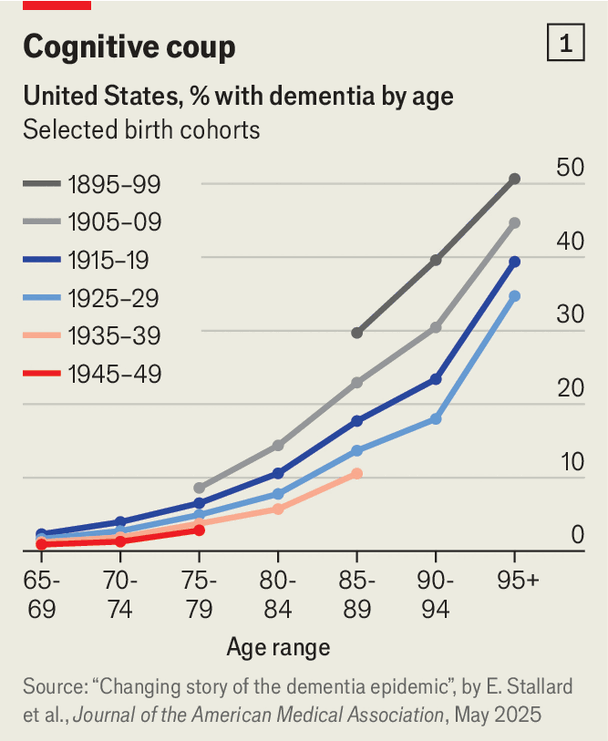
How dementia is being defeated
The Economist reports that the incidence of dementia is falling rapidly. This is quite amazing: “40 years ago three in every ten Americans aged 85-89 had dementia, by 2024 just one in ten had it”.
Lifestyle is a huge factor. Education, exercise and eating well can override genetic risk factors:
Roughly 25% of the population carries a single copy of a gene known as ApoE4, which is associated with a risk of getting Alzheimer’s (much the most common of the dozens of diseases that can cause dementia) that is 2-3 times greater than the norm. For the 2-3% of the population with two copies of this gene, the risk is 10-15 times greater.
Yet many people without these genes get dementia and many who have them do not. The search for other causes of the condition was given a boost in the 1970s in North Karelia, a remote and hard-living region of Finland which had one of the world’s highest rates of heart attacks. To reduce this scourge, health authorities discouraged smoking, monitored blood pressure and encouraged healthy eating. The public-health campaign eventually cut deaths from heart attacks by 84%. An unexpected benefit, says Tiia Ngandu, a researcher at the Finnish Institute for Health and Welfare, was the opportunity for researchers to examine some 40 years of detailed health records for a large population.
The result was a groundbreaking series of observational studies showing that high blood pressure, high cholesterol, obesity and poor fitness in mid-life all increased the risks of dementia 20 years later.
Best description of snow I’ve ever read
Last week for some seasonally inappropriate reason VS Naipaul’s description of falling snow in his novel The Mimic Men popped into my head. I looked it up and it turns out it’s as stunningly good as I remember. The narrator, a recent immigrant to Britain has never seen snow before:
It went dark in the room, and I noticed that the light outside was strange. It was dead, but seemed to have an inner lividness. Then it began to drizzle. An unusual drizzle: I could see individual drops, I could hear them strike the window.
Hectic feminine footsteps thumped up the stairs. My door was pushed open; and Lieni, half her face washed and white and bare, a bit of cosmetic-smeared cottonwool in her hand, said breathlessly, ‘I thought you would like to know. It’s snowing.’
Snow!
Screwing up her eyes, compressing her lips, she dabbed at her cheeks with the cottonwool – big hand, big fingers, small piece of cottonwool – and ran out again.
Snow. At last; my element. And these were flakes, the airiest crushed ice. More than crushed: shivered. But the greater enchantment was the light. I went out to the dark passage and stood before the window. Then I climbed up and up towards the skylight, stopping at each floor to look out at the street. The carpet stopped, the stairs ended in a narrow gallery. Above me was the skylight, below me the stair-well darkening as it deepened. The attic door was ajar. I went in, and found myself in an empty room harsh with a dead-fluorescent light that seemed artificial. The room felt cold, exposed and abandoned. The boards were bare and gritty. A mattress on dusty sheets of newspapers; a worn blue flannelette spread; a rickety writing-table. No more.
Standing before the window – crooked sashes, peeling paintwork: so fragile the structure up here which lower down appeared so solid – I felt the dead light on my face. The flakes didn’t only float; they also spun. They touched the glass and turned to a film of melting ice. Below the livid grey sky roofs were white and shining black in patches. The bombsite was wholly white; every shrub, every discarded bottle, box and tin was defined. I had seen. Yet what was I to do with so complete a beauty? And looking out from that room to the thin lines of brown smoke rising from ugly chimneypots, the plastered wall of the house next to the bombsite tremendously braced and buttressed, looking out from that empty room with the mattress on the floor, I felt all the magic of the city go away and had an intimation of the forlornness of the city and of the people who lived in it.
What is great (at least to me) about this passage is his description of the way heavy snow clouds change the quality of light, something rarely mentioned in standard literary descriptions of snow (and certainly never described as well as it is here). But when you read this passage you see he has captured something very true and essential about snow. Truly great writers see the world as it is not as other people have seen it.
This is amazing writing but Mimic Men is not Naipaul’s best novel. I’d start with Miguel Street which is my all-time favourite collection of short stories.
Terrible AI fliers
This is an amazing compilation of godawful AI-generated fliers. I’ve spotted a few AI-generated posters and shop fronts around London recently. It always seems so obvious to me but perhaps people don’t care.
The default mode of AI-generated graphic design is a kind of horrifyingly crowded maximalism. This one of Pikachu, Sponge Bob, Elon Musk and Donald Trump surrounded by horrible piles of meat is is typically eyeball-meltingly ugly:

These posters have an interesting similarity to AI writing which produces hideous-to-read prose in which every single sentence is trying to be most important and urgent sentence.
AI seems to have no powers of discrimination, of discerning which information is most important and ordering it accordingly. So every sentence (or every corner of a picture) just screams very loudly at the same time.
I also liked this poster for sheer incomprehensibility.
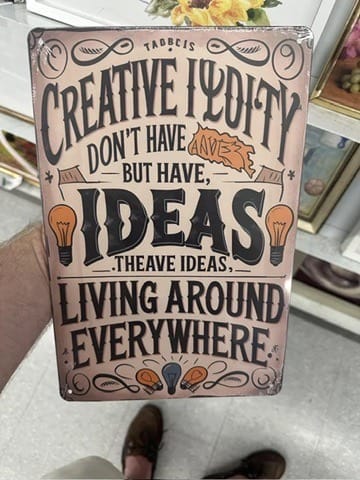
“CREATIVE ILDITY[?] DON’T HAVE [incomprehensible] BUT HAVE IDEAS THEAVE IDEAS. LIVING AROUND IDEAS”
Words to live by…
Michael Longley
Seamus Perry (possibly my favourite living critic) is in the LRB writing persuasively on the merits of the Irish poet Michael Longley. This from Longley’s poem “Butchers” sounds very much up my street. As Perry explains, “the ghosts of the murdered being ferried away to the afterlife by Hermes.” But the lansdcape is Ireland not classical Greece:
who led them
Along the clammy sheughs, then past the oceanic streams
And the white rock, the sun’s gatepost in that dreamy region,
Until they came to a bog-meadow full of bog-asphodels
Where the residents are ghosts or images of the dead.
I love this sort of thing. Perry also has an interesting thing on the perils of poetry that is “merely exquisite”:
Longley recognised that one peril of such writing is that it might become merely exquisite. In a handsome poem addressed to Allen he thanked his friend for a critical vigilance that ‘scanned for life-threatening affectation/My latest “wee poem”’. It would be surprising had he avoided such pitfalls all the time, and I’m not sure he did: ‘the sea asters/Purple golden-hearted/Scruffy loveliness’ might almost be Walter de la Mare. But more typically there is a sense of being grounded, quotidian and prosaic (‘I’m thinking of the huge beech tree in our garden’), which mitigates against such a danger. He remained Larkinian enough to be able to begin one poem ‘I open a can of peas,’ and self-ironising enough to write another which duly lamented the arrival of electricity at Carrigskeewaun, while celebrating the domestic virtues it made possible: ‘I mourned the death of gaslight,/But oh, how the electric blanket warmed my soul!’
Tolstoy on publishing a book
I’ve finished Anna Karenina. What a great, great book. It gets better and deeper as it goes on.
Near the end I was amused to come across this passage about what it’s like to publish a book. Hard not to feel this is informed by bitter personal experience on the author’s part:
Sergei Ivanovich expected the appearance of his book to make a serious impression in society and cause, if not a revolution in scholarship, at least a great stir in the scholarly world.
This book, after careful polishing, had been published last year and sent out to the booksellers.
Asking no one about it, responding with reluctance and feigned indifference to his friends’ questions about how the book was doing, not even asking the booksellers how the sales were, Sergei Ivanovich watched keenly and with strained attention for the first impression his book would make in society and in literature.
But a week went by, a second, a third, and there was no noticeable impression in society. His friends, the specialists and scholars, sometimes mentioned it, evidently out of politeness. But his other acquaintances, not interested in a book of learned content, did not speak to him about it at all. And in society, which especially now was busy with other things, there was complete indifference. In literature, too, for a whole month there was not a word about the book.
Sergei Ivanovich calculated in detail the time needed to write a review, but a month went by, then another, and there was the same silence.
Only in the Northern Beetle,¹ in a humorous feuilleton about the singer Drabanti, who had lost his voice, were a few scornful words said in passing about Koznyshev’s book, indicating that it had long since been condemned by all and handed over to general derision.
Finally in the third month a critical article appeared in a serious journal. Sergei Ivanovich knew the author of the article. He had met him once at Golubtsov’s.
The author was a very young and sickly feuilletonist, quite pert as a writer, but with extremely little education and timid in his personal relations.
Despite his complete contempt for the author, Sergei Ivanovich set about with complete respect to read the article. The article was terrible.
The feuilletonist had obviously understood the whole book deliberately in a way in which it could not possibly be understood. But he had selected his quotations so cleverly that for those who had not read the book (and obviously almost no one had read it) it was completely clear that the whole book was nothing but a collection of highflown words, which were also used inappropriately (this was indicated by question marks), and that the author of the book was a completely ignorant man. And it was all so witty that Sergei Ivanovich would not have minded displaying such wit himself. That was the terrible thing.
Despite the complete conscientiousness with which Sergei Ivanovich tested the correctness of the reviewer’s arguments, he did not linger for a moment over the shortcomings and mistakes that were being ridiculed – it was too obvious that it had all been selected on purpose – but at once began involuntarily to recall in the smallest detail his meeting and conversation with the author of the article.
‘Did I offend him in some way?’ Sergei Ivanovich asked himself.
And remembering that, when they had met, he had corrected the young man in the use of a word that showed his ignorance, he found the explanation of the article’s meaning.
After this article came a dead silence, both printed and oral, about the book, and Sergei Ivanovich saw that his work of six years, elaborated with such love and effort, had gone by without leaving a trace.
Nothing has changed.
Until next week!
James
No posts
Comments
Nothing yet. Say the first thing.
Sign in to join the conversation.