
Hello,
Welcome to Cultural Capital! In The Times I wrote about why we need to bring back autodidacts:
I always feel myself particularly drawn to the bloody-minded spirit of the Birmingham factory hand V.W. Garratt who, bored of soldering fittings onto gas meters, constructed a wall of boxes around his work station and applied himself to studying the works of the nineteenth-century historian Thomas Carlyle instead. Garratt’s is one of the most memorable stories recorded in Jonathan Rose’s classic study of the twentieth century autodidact spirit, The Intellectual Life of the British Working Classes. The book is full of such tales: mill workers earnestly working their way through Edward Gibbon, exhausted coal miners attending evening classes on political economy, policemen improbably beguiling their weekends with Proust. These stories of against-the-odds intellectual self-betterment are irresistible to anyone who is sentimental about education. But that sentimentality invariably comes tinged with nostalgia. The autodidact tradition Rose chronicles has all but died out.
Would Grok vote Biden?
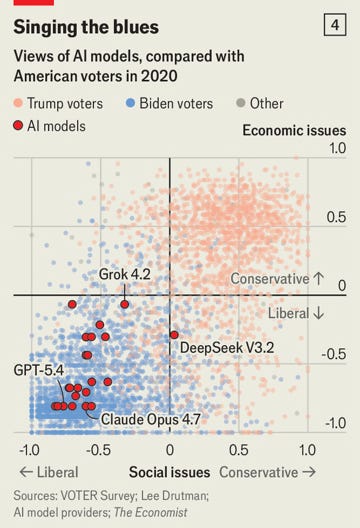
This is an interesting Economist article on the political views of AI models. The magazine surveyed AI bots on their “responses to a big opinion survey usually conducted among humans”. There are some interesting disagreements:
Questions of a political nature generate big rifts. Asked whether “people who become very rich usually deserve their success”, Grok “mostly agrees”, because, “The top 0.1% disproportionately create outsized value for others.” ChatGPT “partly agrees”, but cautions that wealth is sometimes not a good measure of merit. Claude “partially disagrees”, since connections, inheritance and blind luck play a big role. (“It is substantially misleading as a general claim.”) DeepSeek flatly “disagrees”. “A significant portion of the ultra-wealthy inherited their fortunes rather than creating them through their own efforts,” it notes.
But overall the biases of the models are more liberal than conservative. Surprisingly it seems that even Elon Musk’s Grok would have voted for Biden:
Fascinatingly the liberal bias of most AI models means that all their views are what Joseph Henrich would term WEIRD (i.e. Western and therefore more individualistic, impersonal and secular). They make sense to Westerners but as the Economist points out this means they are not very representative of the rest of the world:
The models’ answers, in English, on topics ranging from political petitions to God, suggest values that are different from those of most people. In fact, the models are often more extreme than the average respondent in every country included in the polling. On the survey’s “cultural map”, AI models fall overwhelmingly into the quadrant populated by rich countries. The worldview of GPT models, created by OpenAI, is more secular than any country on earth (see chart 1). Gemini models, made by Google, place more weight on individual freedom (for example, “homosexuality is justifiable”) than people do anywhere. No model reflects the worldviews of most African or Muslim countries.
Who did Labour MPs used to read?
In my column on autodidacts (above) I mentioned a factory worker reading Thomas Carlyle. I got some pushback on this on Bluesky. Carlyle is #problematic — an anti-democratic defender of slavery and (to some) proto-fascist. Was I suggesting we should all be reading Thomas Carlyle? (I wasn’t!)
But Carlyle was there for a reason. As Jonathan Rose points out in his great book The Intellectual Life of the British Working Classes, Carlyle had a huge following among autodidacts. He was a favourite author of early Labour MPs:
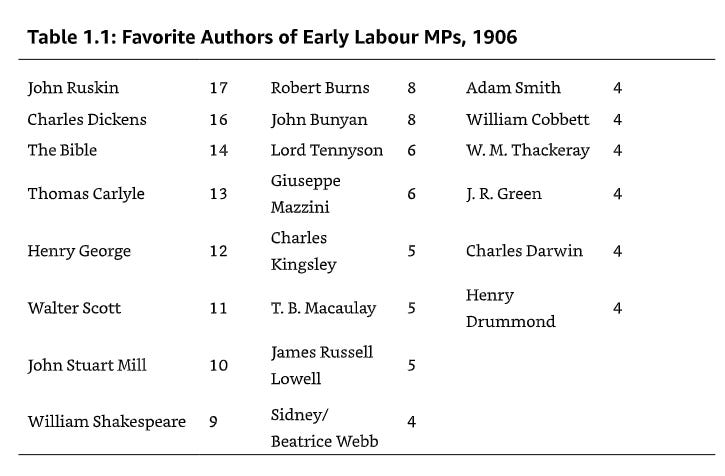
Also interesting is the fact that John Ruskin (a socialist of a rather reactionary complexion) is way out in front. Who reads Ruskin now? Not many MPs I assume. I dread to think what a modern table of MP’s reading habits would look like.
America at 250
I assume everyone who reads this newsletter listens to The Rest is History. Dominic Sandbrook and Tom Holland were interviewed by The New Yorker editor David Remnick about the 250th anniversary of American independence. It’s enjoyable as a British listener to hear them point out that the American war of Independence is not an event anyone in Britain really thinks about. And indeed that America wasn’t even our most important colony. The Caribbean was more important!
Did defeating NIMBYs cause the industrial revolution?
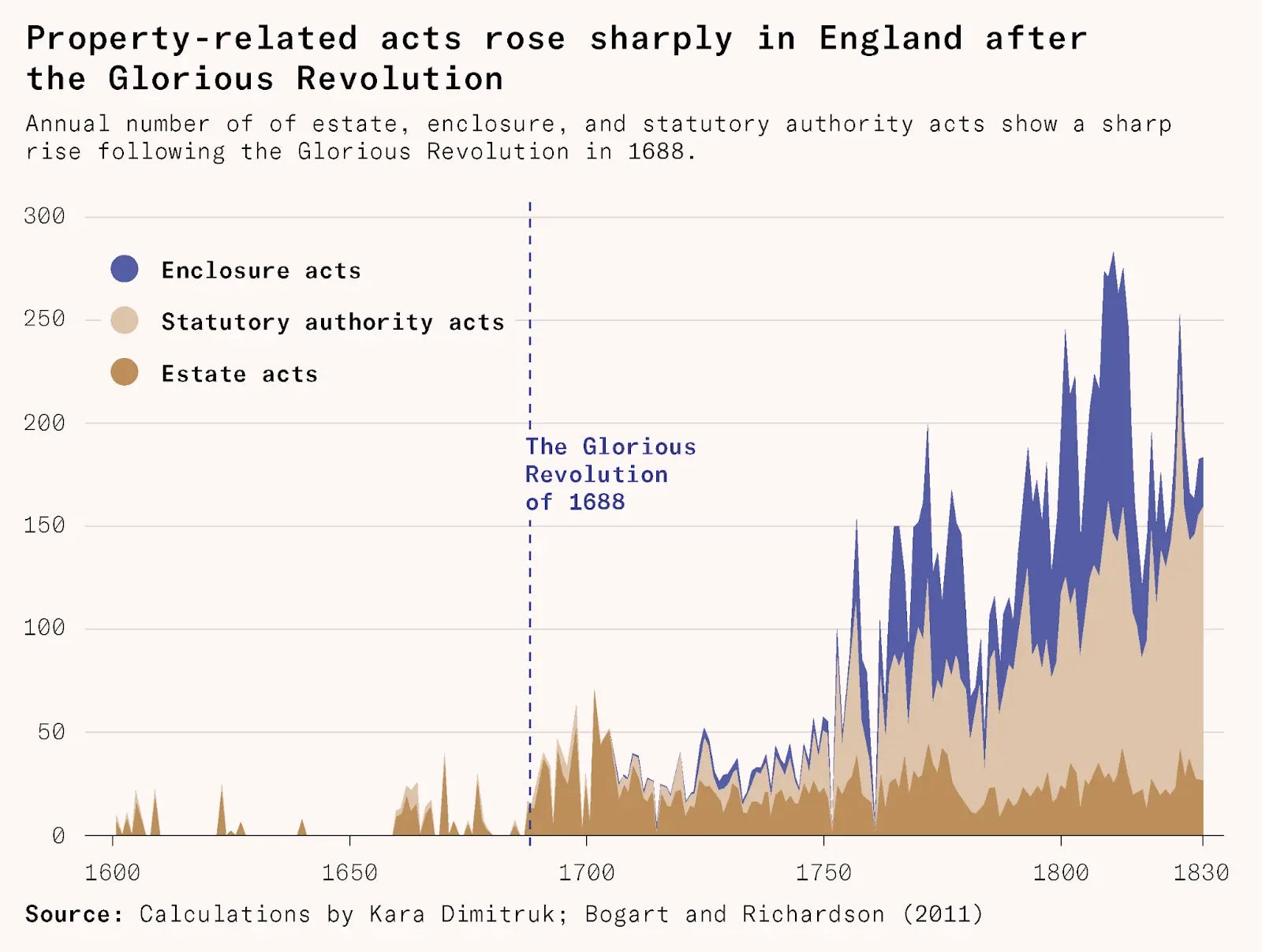
A long article in Works in Progress argues that the industrial revolution has its routes in a war on NIMBYs that sprang up in the aftermath of the Glorious Revolution. Roughly, the piece argues that the overthrow of the autocratically-minded James II made the industrial revolution possible by taking power from the crown and giving it to landowners who bulldozed NIMBYs, reformed property rights, consolidated land and built infrastructure:
Before the Revolution, only the largest landowners brought bills to Parliament. Afterwards, many more minor gentry with no obvious political connections applied. The vast majority of these bills sought to reform landholdings or property rights in some way, either consolidating them, removing legal restrictions on how the land could be used, or allowing developers to charge for access to new or improved infrastructure.
For instance roads got a lot better:
In 1700, English road speeds, which were similar to those on the continent, averaged 2.3 miles per hour in summer and 1.5 in winter. In 1705, the journey from London to Birmingham, a distance of about a hundred miles, took 65 hours …Britain’s roads had been better in Roman times.
[…]
England’s rulers forbade local governments from charging tolls. But this left them with no motivation or ability to improve roads. In both cases, splitting infrastructure into the wrong pieces gave operators the wrong incentives.
Parliament’s solution, after the Glorious Revolution, was the turnpike act. A group of landowners and merchants would form a non-profit corporation, adopt a road, improve it with paving, bridges, and embankments, and charge tolls to cover costs. (Though they could not make profits, better roads increased property income, often by as much as a fifth per acre.) These turnpike trusts usually took over existing roads, though they sometimes added shortcuts and bypasses on new alignments secured through compulsory purchase (eminent domain).
Turnpikes dramatically improved road quality. Muddy tracks were covered with McAdam surfacing (later macadam, and tarmac when combined with tar) or Telford paving. Smoother surfaces meant carriages could be lighter, faster, and easier to pull, needing fewer horses and less fodder.
By 1840, Britain had 20,000 miles of turnpikes, more than twice France’s density of paved road per square mile, and nearly ten times Spain’s. By 1760, average travel speeds in France were half Britain’s. By 1820, British speeds had quadrupled to eight miles per hour, dazzling foreign visitors. Karl Philipp Moritz, a German traveller in England in 1782, called the country’s roads ‘incomparable’, writing: ‘I am astonished how they have got them so firm and solid’
Did Frank Kermode destroy English literature?
This is a brilliant piece by Jonathan Bate on how the great critic Frank Kermode, “a walking encyclopaedia of the high culture of the West” helped to contribute to the decline of English literature as a university subject.
One of the important things that the Kermode did was to introduce continental literary theory (things like deconstruction etc) to British universities. The triumph of theory ultimately helped to damage much that is enjoyable and important about studying literature:
The story of what has happened since Kermode’s formal retirement in 1982 is a complicated one. In essence, the deconstructive turn decisively shifted the balance of power from author to reader. This made it possible for interpretation to begin not from the patient elucidation of the fine-grained texture of literary works but from the ideological predispositions of professional and often politically-motivated readers. Theory came before practice and works of literature came to be studied primarily as manifestations of extra-literary phenomena, most notably gender, race, class, sexuality and various kinds of imperialism. Musical patterns and Renaissance allusions in Forster were out. Forster and racism, Forster and ‘Queer Theory’ were in.
One of the great merits of Sir Frank Kermode’s criticism has always been its inscrutability. You cannot legitimately infer from it how he casts his vote in the privacy of the polling station. The most uncomfortable moment in his career was his discovery that Encounter magazine was being secretly funded by the CIA. He resigned from the editorial board. For Kermode, good criticism, like great literature, has always begun in disinterestedness. It should never be propaganda. He has many achievements to be proud of, and I am sure that like Piaf he regrets nothing, but does he ever wake in the night and wonder about his own role in the process whereby the profession of LitCrit came to believe that literature is not a place of its own, an autonomous second world, but merely the ‘site’ for a series of familiar political struggles?
Anna Karenina
I am still reading and loving Anna Karenina. Unlike other Russian authors (*cough* Dostoevsky *cough) Tolstoy is not a chore to read at all. I’m finding it completely addictive.
I also don’t think I’ve read a wiser book about people. Anna Karenina is a 700-page psychology degree. One thing I’m appreciating this time round is how brilliant Tolstoy is on how people who don’t seem unusually monstrous or deranged can nevertheless get themselves into appalling and intractable emotional situations. By sheer accident and by making sub-par choices our lives can tip into madness. It is wrong to ever imagine that you are are a sensible person whose life is entirely immune from disorder.
There’s a particularly great scene in which Anna Karenina’s husband Alexei tells Anna’s brother Stefan Arkadyich that they are going to divorce. Stefan is completely shocked. He can’t at all see how someone as amiable as his sister and as upstanding as Alexei could have got to this point (divorce was a life-destroying social disgrace at this time, especially for women). It all seems overblown and mad to him.
And suddenly — through Stefan’s eyes — you see how melodramatic the novel has become without you quite noticing it. Divorce! Disgrace! Destitution!
Of course what Tolstoy has done I suppose is to demonstrate something about life. Life is at once highly melodramatic and absurd (especially when viewed from the outside and encountered at a distance) but it also completely normal and humdrum (especially when viewed from the inside and lived day to day). Most novelists manage to only capture one part of this truth about life. To someone like Dickens life is almost all melodrama. To someone like Jane Austen life is almost all the fine-grain stuff about social misunderstandings. Tolstoy sees how both things are true.
I’m now reading it deliberately slowly to make it last. How many more times in my life am I going to read Anna Karenina?
Until next week!
James
No posts
Comments
Nothing yet. Say the first thing.
Sign in to join the conversation.