
Hello,
Welcome to Cultural Capital. In The Times I wrote a “personal essay” about “books and me”:
I was, everyone who met me agreed, an intensely, even freakishly bookish kid. In almost every photograph my mum has of me as a child I am reading a book: a small, abstracted, weirdly professorial character with an unflattering bowl-cut, lost in solemn contemplation of … what? Terry Deary’s Horrible Georgians? Or (does anyone else my age remember this) Temmi and the Flying Bears? Perhaps it is that all-time artistic masterpiece, Stephen Biesty’s Cross-Sections Castle. Family life proceeds chaotically in the background of these pictures. Birthdays are celebrated with candles and wrapping paper, scratchy school uniforms are pulled on for the first time, my sister (still a much more dynamic person than I am) pogo sticks around the kitchen. I appear oblivious to any of it. I lived much more in books than in the world. Initially, my reading was a source of parental pride; by my teens I was getting concerned lectures about the importance of “social skills”.
My reading has been all over the place recently. I’ve been dipping in and out of various literary essays and diaries. I’m also reading Joe Saramago’s horrifying novel Blindness in which everyone in the world goes blind, a recommendation from my Times colleague Charlotte Ivers who read it on holiday (!?) It’s great but it’s not cheering.
I liked this line from Kenneth Tynan’s diaries, of a self-sabotaging but also widely disliked acquaintance: “He’s his own worst enemy — but only just”.
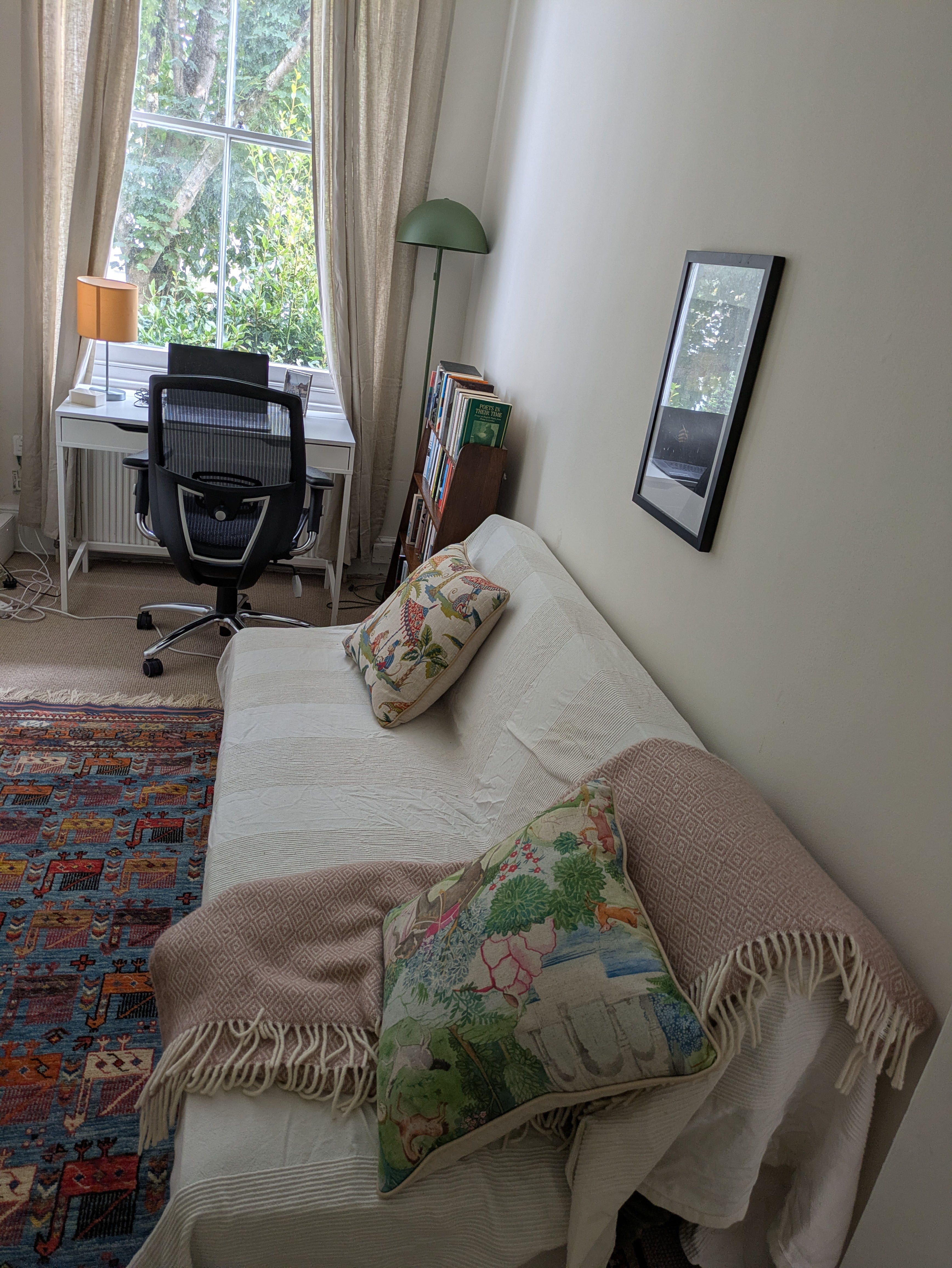
I also really enjoyed getting to do India Knight’s interview feature “me and my desk” in which she talks to various authors about their desk. As a preview: here is my desk. Please appreciate the new carpet (the old one was black):
How chicken conquered the world
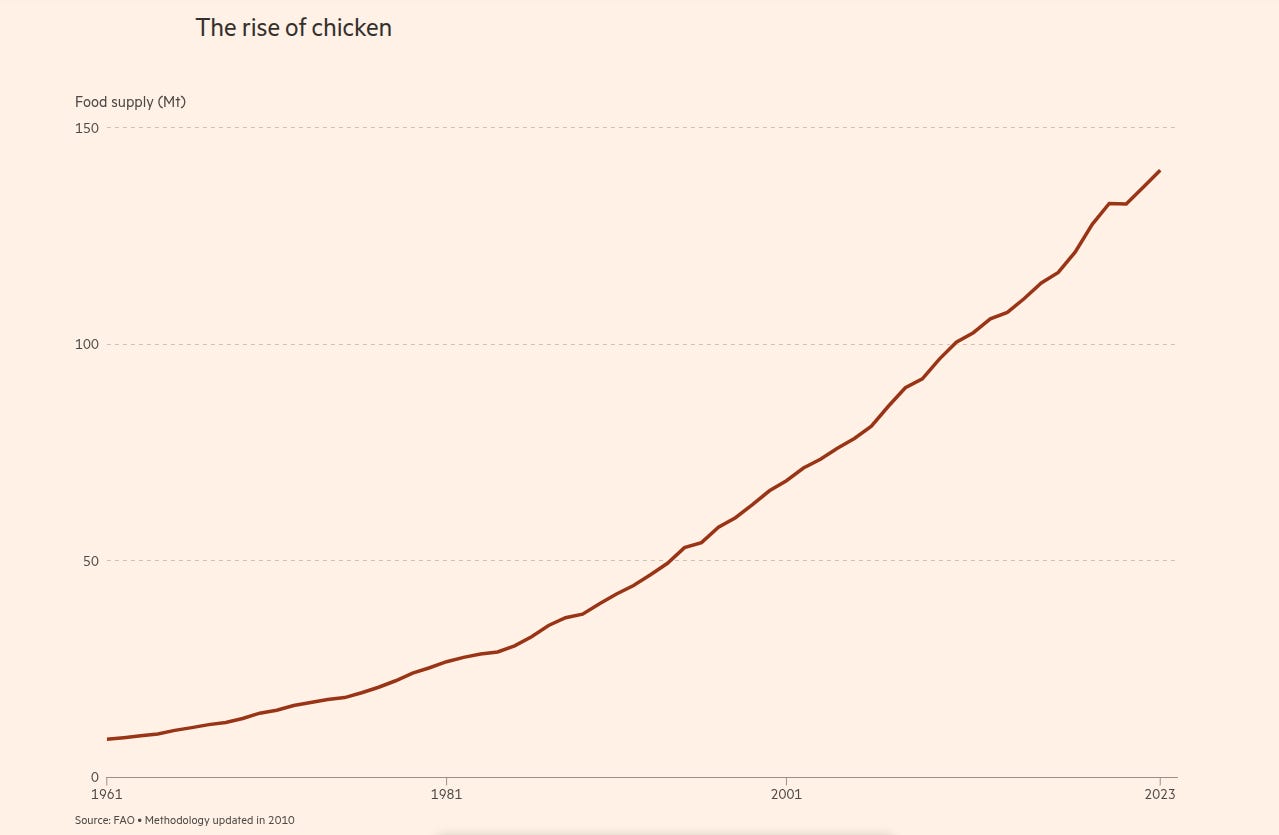
An interesting FT piece on how chicken (once an unpopular meat) has taken over the world and become the world’s most popular source of protein thanks to its “structural advantages”:
Chicken’s longer-term advantages are structural: the bird is cheap, feed-efficient, quick to produce and faces fewer cultural or religious restrictions than pork or beef. It is gaining share from rival meats in mature markets such as Japan, Canada and parts of Europe, while across large swaths of Asia, Africa, the Middle East and Latin America it is already the preferred protein.
Globally, production has been growing at about 2 to 2.5 per cent annually in the past two decades, but has in the past three to four years accelerated to more than 3 per cent … The shift is visible in the companies that once built their businesses around other foods. McDonald’s, long defined by beef burgers, said in its latest annual report that chicken was a global category roughly twice the size of beef and growing faster. It has expanded McCrispy, its fried chicken sandwich, to nearly all its major markets.
50 Places to Live in London
A very fun piece by the food writer Angus Colwell about 50 places he would like to live in London.
None of them are really plausible options for a normal person but I always love reading other people’s opinions about London:
If there is an objective answer to the best area in London, it is Marylebone. It’s not quite my thing, but if I were trying to show someone new to the city the dignity and beauty possible in London, I would take them here. Good shops, good restaurants, good apartment buildings, all suffused with the clinical hum of private healthcare, which you could no doubt afford if you lived here.
To me the bit of London I would show off to a visitor is probably gentrified Hackney around London Fields and Broadway Market. It’s obviously appallingly (and to some unforgivably) Boho. But it is nice to walk around there feeling like you’re in a Richard Curtis film set in the 2020s.
What is art?
Jonathan Bate is great on Tolstoy’s “hilarious and in many ways wrongheaded” book What is Art? which denounces a lot of the things we would usually think of as art (including possibly War and Peace):
Indeed, for Tolstoy the fact that you have to be educated for years before you can appreciate something is not an argument in its favour but a reason to be suspicious of it. He takes the example of Wagner and gives a hilarious description of what it was like to sit through a performance of Siegfried. And he’s equally harsh about many of the acknowledged masterpieces of Western art: Beethoven’s late string quartets and Ninth Symphony, the poetry of Baudelaire and Mallarmé, the plays of Ibsen, even Michelangelo’s Last Judgement. Even - this has its own comic aspect - War and Peace and Anna Karenina come under suspicion. He is perfectly prepared to apply the axe to himself.
What survives in his canon are works that either advance this sense of human brotherhood or have a kind of class-free accessibility: Harriet Beecher Stowe’s Uncle Tom’s Cabin, the book that did so much to advance the abolitionist cause; Dickens the social reformer, especially A Tale of Two Cities and A Christmas Carol; Victor Hugo; the biblical story of Joseph and his brothers; a peasant painted by Millet; a folk song sung well. Quite some leveling: a peasant song may be greater art than an opera; a story told by a child may succeed where a technically dazzling symphony fails.
The Genius of Kenneth Tynan
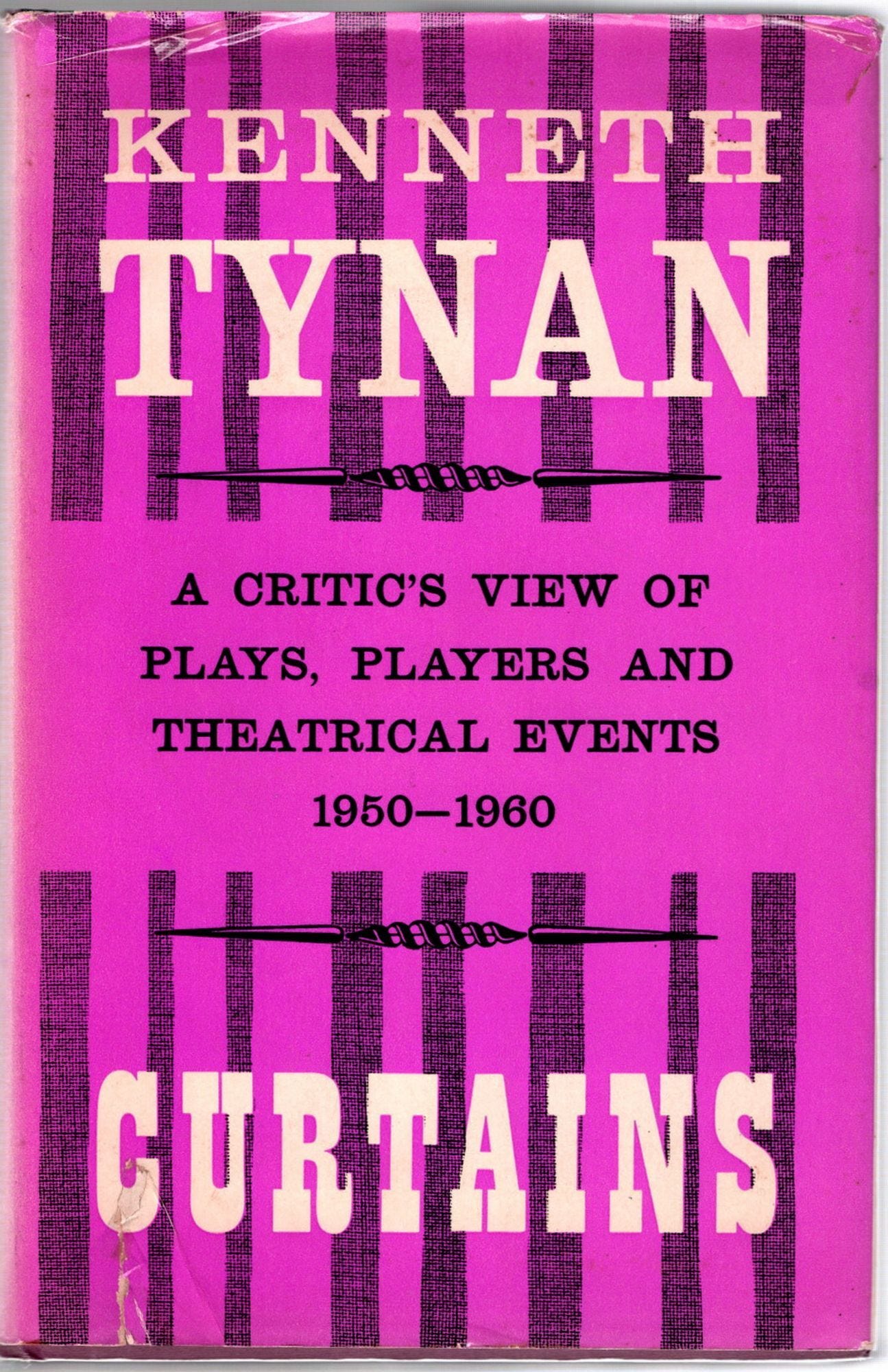
On holiday last week I was totally engrossed by Kenneth Tynan’s collection of theatre reviews Curtains (mentioned in the newsletter the other week). He is just a dazzling writer. Here are a few of my favourite bits.
On early fame:
To be famous young and to make fame last — the secret of combining the two is glandular: it depends on energy. Someone once asked Demosthenes what was the most important quality in an orator: ‘Action,’ he said. And the second? ‘Action.’ And the third? ‘Action’. So with a talent.
On what it means to be a sophisticated writer
William Congreve is the only sophisticated playwright England has ever produced; and, like Shaw, Sheridan, and Wilde, his nearest rivals, he was brought up in Ireland. By sophisticated I mean genial without being hearty, witty without being smug, wise without being pompous, and sensual without being lewd. These attributes, now to be seen in John Gielgud’s revival of The Way of the World, rarely coincide in an Englishman who has not had the benefit of a Dublin education or, at the very least, of an industrious French governess.
On why plays are like parties:
Every play is a party, at which the author is host and the characters are guests. In The Merchant of Venice Shakespeare got his invitations badly mixed up, and the party rapidly disintegrates. In one corner Shylock is pulling a knife on Antonio; around the dinner-table, slightly flown with wine, sits a gayer group, headed by Portia and Bassanio; while in the window-seat, oblivious of the rest, Lorenzo and Jessica raptly smooch. The three plots simply do not jell, and no producer is to blame when the play comes to pieces in his hands—I doubt whether all the King’s Men, Shakespeare’s own company of actors, could put them together again. Hugh Hunt’s production fails, but it fails intelligently, attractively, and forgivably.
On German characters on the English stage:
In English plays, good Teutons are Teutons who express themselves with the utmost awkwardness, using only the shortest words: e.g., “I am here now three days. There is hate.” The bad Teuton gives himself away every time by the presumptuous fluency with which he speaks English. “You will forgive me if I indulge myself in a cognac before dinner? It is—how do you say?—unsmart, but, in the words of one of my country’s proverbs, it kennels the black dog of despair.” Any Teuton who talks like that will be up to no good before the act is over; if German, he will probably turn out to be a spy.
What makes a great Shakespearean actor:
“Word-music” is a great maker of reputations. Give an actress a round, resonant voice and a long Shakespearean part, and she will have to enter smoking a pipe to avoid being acclaimed. And everyone will forget (a) that the same voice could turn last year’s Hansard into poetry, and (b) that what Shakespeare demands is not verse-speaking but verse-acting. A golden voice, however angelic, is not enough. When ever a climax looms up, the actor faces a choice between the poetry and the character, the sound and the fury, because you cannot rage mellifluously or cry out your eyes in tune. Edmund Kean, Irving, and Olivier, on whom our whole tradition of heroic acting rests, have one thing in common: they have all been repeatedly accused of lacking poetry.
On Katherine Hepburn:
The part is nearly unactable; yet Miss Hepburn took it, acted it, and found a triumph in it. She glittered like a bracelet thrown up at the sun; she was metallic, yet reminded us that metals shine and can also melt.
Irish vs English playwrights:
“Bloody sparklin’ dialogue,” said a pensive Irishman during the first interval of The Quare Fellow—and sparkle, by any standards, it amazingly did. The English hoard words like misers; the Irish spend them like sailors; and in Brendan Behan’s tremendous new play language is out on a spree, ribald, dauntless, and spoiling for a fight. In itself, of course, this is scarcely amazing. It is Ireland’s sacred duty to send over, every few years, a playwright to save the English theatre from inarticulate glumness
The importance of plot in the theatre vs the novel:
In the novel, Plot works only a seven-hour day; but in the theatre it must work overtime, from dawn to dusk, nudging and sheep-dogging the action into its predestined fold.
Barbara Everett on poetry and the Civil War
The other book I’m reading is Barbara Everett’s collection of essays Poems in Time. I loved this observation from her splendid piece on Andrew Marvell. It’s all about how Marvell lived at a crucial point in time as the medieval sense of history (determined by the Bible) turned into the modern sense of history (determined by secular politics).
She also thinks there was something archetypal about the politics of the mid seventeenth century that was a rich resource for poets:
Writers of the mid-seventeenth century were both privileged and burdened by living through a phase of history so critical as to seem almost archetypal. Political history in the penumbra of the Civil Wars, from about 1640 on to about 1690, can appear to be ‘complete’, as though statecraft were an experience as finite as chess, and as though everything that could possibly happen in political organisation actually occured then, once and for all. The most intelligent and conscious writers of the time seem almost to have recognised this archetypal quality of their experience … for the experience of the time always, at its deepest, moves towards the dream-like, tragic or mythical. The greatest case of course is Paradise Lost…
And on a related note, isn’t Marvell good:
He hangs in shades the orange bright,
Like golden lamps in a green night;
And does in the pomegranates close
Jewels more rich than Ormus shows.
He makes the figs our mouths to meet
And throws the melons at our feet,
But apples plants of such a price,
No tree could ever bear them twice.
Throws the melons at our feet!
Interestingly Ormus = Hormuz as in Strait of Hormuz.
Until next week!
James
No posts
Comments
Nothing yet. Say the first thing.
Sign in to join the conversation.