

Hello,
Welcome to Cultural Capital. In The Times this week I interviewed Richard Dawkins:
The contrast between the palatial honey-coloured facade of the Oxford University Press building — pillars, porticos, clipped green lawns, water feature — and the utilitarian warren of shabbily-carpeted corridors behind the scenes gives it the air of a venerable but unvisited provincial museum. A smiling publicist wearing a lanyard guides me through the labyrinth. After what seems like much twisting, turning, climbing and re-climbing we arrive at our destination, a remote room in the depths of the building (you half expect the sign on the door to say something like “Anatolian coins pre-200BC”). In fact it contains a modest exhibition of books. On tables pushed up against the walls are copies of The Selfish Gene in every conceivable language: il gene egoista, Das egoistische Gen, Den själviska genen, Gen Bencildir, הגן האנוכי... And seated in a high-backed armchair in a corner, rather as if he is himself one of the exhibits is the book’s author, the most famous biologist in the world and the great hero of my adolescence, Richard Dawkins.
My column (if you want to read that too) was about how politicians need to learn the art of being hated.
Against social media
I love how much the New Yorker’s Becca Rothfeld hates social media. She is leaving Substack which as well as hosting excellent email newsletters such as this one has quite an annoying app (half the users believe themselves to be the underappreciated heirs to Ernest Hemingway), Substack Notes:
I simply must leave Substack. I hate it on here. I hate it in part for the reasons I’ve so often enumerated, most of which generalize to social media more broadly: I hate having the clatter of other people’s voices in my head all the time, I hate that I absorb Received Opinion without wanting or asking to, I hate that I have to know intuitively what so-and-so would think about such-and-such, I hate that there’s no distance between the writer and the reader (I find I’m less courageous when I know not only that something I’m writing will piss a lot of people off, but that I’ll have hear from all of them directly… I hate how compulsively I check or at least want to check the social media I use (I’m pretty good at keeping off Substack for long intervals, but not as good as I would be if I simply did not have an account), I hate the person I become when I morph into a Commenter (you may have noticed that I get in a lot of fights with people on here, because I am terrible at keeping my opinions to myself when the distance between me and some piece of writing is small…. I also hate the vibe on Substack, in particular, though perhaps no more than I hated the vibe that drove me off Twitter in 2021. (I guess that vibe gave me clinical anxiety, whereas this one just makes me a little annoyed for a few days a month, so all things considered, this one may win out.)
Seventeenth century transformation
The historical blind spot of which I feel most ashamed is my poor knowledge of the seventeenth century. It is probably the most important century in English history: the century of the English Civil War, the Protectorate and the Glorious Revolution. But it is highly off-putting if (like me) you hate having to read about events like wars and treaties and acts of parliament. I also find it frustrating how everyone is constantly going ballistic about obscure points of religious doctrine. It’s like Twitter c.2021. Every time I resolve to read up on it all I just get depressed thinking about how I will have to find out about ship money and Scottish Covenanters and the Battle of Naseby.
Anyway, I’m going in with Christopher Hill’s The Century of Revolution. As he is a Marxist I am hoping he regards the Battle of Naseby as mere froth on the great tides of history.
He makes a good case for the social importance of the seventeenth century:
Potatoes and many new vegetables were introduced, as were tea, coffee, chocolate, sugar, and tobacco. Port- and gin-drinking became national habits. Plague was frequent in the first half of the century, extinct by the end. The modern arrangement of meals – breakfast, lunch, and dinner – dates from the seventeenth century. So does the modern pattern of male costume – coat, waistcoat, breeches.¹ Calico, linen, and silk came in for clothes; leather went out. By the end of the century pottery and glass had replaced pewter and wood at table; many families used knives, forks, mirrors, and pocket handkerchiefs; at Chatsworth the Duke of Devonshire had installed a bath with hot and cold running water.
This sort of thing is much more up my street. On to ship money…
Bananas and LED lights
One of my jobs for The Times is reviewing podcasts. Sadly most podcasts are dross. But an excellent new one has launched — a rare event! Ed Conway’s Stuff Matters is about economics and technology. It’s out on Monday. The two episodes I’ve listened to are on bananas and LED lights:
Conway explains that when you use a traditional incandescent bulb “only 5 to 10 per cent of the electricity you run through them actually turns into light. The rest is just wasted on creating heat.” Across the world, “a massive chunk of the power generated in power stations goes into heating lightbulbs, not lighting them up”.
The efficiency of LED bulbs is something most of us fail to notice in the rich West. But, as the data scientist Hannah Ritchie explains, if you live in a poorer country you might only have enough electricity to run an incandescent light bulb for “one or two hours”. Switch to LED and you can have the lights on for four hours so you can charge your phone, run a fan and even use a microwave — “all with the same amount of power”. Replacing an incandescent lightbulb with an LED “makes a huge difference to your standard of living”.
Bertrand Russell
Some readers will already be familiar with this famous interview with Bertrand Russell from 1961. Bertrand Russell was born in 1872 and lived for almost a century. In the interview he just downloads a series of random memories from his life. It’s quite amazing to hear someone talk so casually about the Victorian past as if it happened yesterday.
Tom Holland and Dominic Sandbrook were recently saying on the Rest is History that the great break in history is the First World War not the Second World War. I think they’re right. You really get the sense here of glimpsing the lost world of confidence, order and social hierarchy that stopped existing after 1918.
Because he came from an incredibly prestigious family Russell has first hand recollections of Tennyson (squeaky voice, too keen to be seen as a “great man”) and Browning (prone to boring monologues during dinner). I guess Bertrand Russell must have been one of the few people in history who met both Tennyson and Paul McCartney.
The pettiness of genius
Ian Leslie is delightful on the pettiness of genius. We want to imagine that great geniuses behave in a hideously anti-social manner and constantly have their minds fixed on higher things. Leslie points out that there is a lot of evidence the greatest geniuses in history were obsessed with petty markers of social status. For instance Velazquez:
The cross [that Velazquez is wearing in his painting Las Meninas] marks him as a Knight of Santiago, an ancient and exclusive Catholic order. Las Meninas was painted in the 1650s, when Velázquez was in his fifties (he died at the age of 61), at a time when officials were thwarting his efforts to join the order. By this stage he was a highly valued courtier but he longed for the aristocratic prestige that came with membership. He kept prompting the king to make applications to the Pope on his behalf and spent a lot of time poring over his family tree, searching for evidence to prove he was worthy.
It’s funny and oddly reassuring that a supreme artist should care so much about worldly status. What he did with the brush was worth infinitely more than membership of any society. But it didn’t seem like that to him, or perhaps it did, but only fleetingly.
Shakespeare was the same:
When he was a young man, Shakespeare spent years petitioning the College of Heralds to grant his father a coat of arms. He was finally granted it in 1596. It clearly meant a lot to him. In practice it meant he got to put “gentleman” after his name (though not “sir” before it - he was still ranked below knights). The motto he chose for his coat of arms, Non Sanz Droict (Old French for “Not Without Right”) is surprisingly lame.
I wonder if its relevant that Shakespeare and Velazquez both lived before the development of the romantic idea of genius (according to which genius is supposed to be lofty, remote, tortured etc). I think all geniuses after the end of the eighteenth century were probably more careful to be seen to behave like geniuses.
Parrot CV
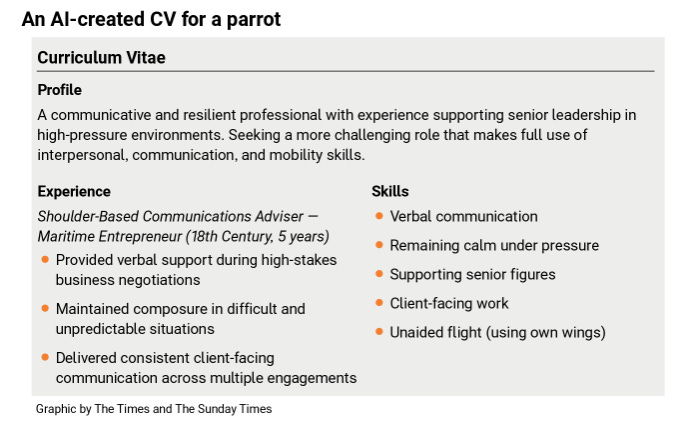
My colleague Tom Whipple has been speaking to a new government AI tool which helps the out of work create job applications. He posed as a parrot and it made this CV for him.
Decline of reading latest
Yet another American literature professor has discovered his students can’t read properly. This is a real thing:
Six weeks into the term, I assigned my rhetoric and writing students a 20-page article. It was the same length I had assigned for five years and the same length I had read without complaint as an undergraduate a decade ago. Not one student finished it.
When I asked why, a student answered honestly: It was too long, and she kept losing track of what the paper was about. This was not a remedial class: These were students who had cleared the admissions process and written essays good enough to get them here. Yet a routine academic reading assignment had defeated them.
What’s wrong with Orwell?
On his Substack the Pharmakon the Spectator’s literary editor Sam Leith takes on Orwell’s famous rules for writing. I enjoyed his defence of the cliché. Orwell says, “Never use a metaphor, simile or other figure of speech which you are used to seeing in print”. Leith replies:
I’d want to put in a word for cliché. “Dog-tired” is a cliché – but it’s also a perfectly useful, and slightly more colourful, synonym for exhausted.
Orwell’s objection is that the cliché is a pre-packaged unit of ready-made thought – he complains early in the essay about prose consisting “less and less of words chosen for the sake of their meaning, and more and more of phrases tacked together like the sections of a prefabricated hen-house”. He’s right. We should be doing our own thinking.
But the very fact that they are pre-packaged units of thought means that some clichés — like familiar words or phrases themselves — are a very quick means of delivering that thought with a minimum of effort. When you talk about a “dog bites man” story, say, or “the thin end of the wedge” everyone knows instantly what you mean. So clichés have their use. In a sense every word we speak is a cliché: we wouldn’t be able to understand it if it weren’t.
The truth is that nobody, even a great literary genius, can write without clichés. Even Martin Amis’s book The War Against Cliché is itself littered with clichés (though fewer than most other books). I think looking out for clichés is a useful form of vigilance and a good way to hold yourself to higher standards as a writer. Though you would go mad trying to excise absolutely every cliché from your prose.
Until next week!
James
No posts
Comments
Nothing yet. Say the first thing.
Sign in to join the conversation.