
You’ve heard it said that religion is the opiate of the masses. But truly I tell you, it’s easier for a camel to go through the eye of a needle than to argue someone out of their religion—or, for that matter, their opiate.
As a religious person myself, I’ve spent most of my life denying this uncomfortable truth. The cognitive dissonance in my evangelical mind arose as early as seventh grade biology, when my teacher gave an evolutionary explanation as to why males are generally attracted to different parts of the female body, cashing it out in terms of reproductive potential—a jarringly compelling example to a young guy trying to figure out why he had just started seeing his friend Molly in a whole new light.
Things didn’t work out with Molly, but the explanatory power of natural selection stuck, kicking off more than a decade of wrestling with such science-versus-religion questions. Before I could drive, I’d read the full Bible three times through, front-to-back, successfully resisting the urge to merely skim Leviticus or those harrowing genealogies, scribbling in pseudoscientific explanations for bizarre biblical phenomena as I went. Even with my “Intelligent Design” books in hand, the Bible presented itself as frighteningly non-scientific. By high school my tastes had evolved (oops) to the likes of C.S. Lewis and Tim Keller, who were very thoughtful and spiritually enlivening—but still not answering some of my more technical science-vs-religion questions. It wasn’t until I was immersed in the vibrant philosophy cultures of Princeton and Oxford that my palette really started to develop, leading me to folks like Alvin Plantinga, Richard Swinburne, and my adviser Hans Halvorson—academic philosophers whose arguments for “Christian theism” seemed deeply practical relative to surrounding debates concerning the metaphysical reality of quarks.
Looking back, I can appreciate how high-stakes it had all become. Sometimes, when I’d engage someone in a debate about God, my sympathetic response would surge as if I were about to fight—my heart racing, my attention sharpening—even as my demeanor remained calm and collected. Only in retrospect can I admit that there was a lot on the line for me: if I was wrong, or if I changed my mind on certain hot-button issues, that could put me at odds with my family and certainly with my church community, many of whom were and still are my closest supports. And that’s not to mention the whole issue of “losing my salvation.” I’m sure I sometimes went too far, and I wish I could apologize to the folks I misled or put down in my zeal to be right. Still, I’m grateful for every one of those conversations, each serving as an amateur form of exposure therapy that encouraged me to navigate big emotions, listen more carefully, and think more critically about some big questions.
Like other things in my life, this fight-or-flight reaction probably peaked in college, when I was one of three undergraduates participating in a graduate seminar with Peter Singer, arguably the most influential moral philosopher of our time and a highly vocal critic of theism and religion. We were in the weeds of yet another debate about whether it’s possible to ground moral values in a world without God when it came time for me to respond and, and—I couldn’t. Sure, I had a decent argument ready to go. But my heart was racing, my mouth was so dry that I literally couldn’t get the words out; it’s like my body was telling me: you are being threatened. Beneath the radar of my conscious awareness, my fate seemed to somehow be on the line, not to mention my community and self-image. I left the seminar that day feeling like a failure, both as an aspiring philosopher and as an aspiring Christian. Much more than Singer’s argument, it was my body’s physiologic response that disturbed me, forcing me to concede that I wasn’t the impartial sojourner for truth that I’d imagined myself to be. I was, like everyone else, a fearfully and wonderfully made mess of body, tribe, people, and place.
Which is all to say, it’s very hard to argue someone out of religion.
Now how about opiates?
Historically, at least in the West, addiction has often been construed as a problem of disordered reasoning. Ancient Greek philosophers such as Aristotle identified behaviors like excessive drinking as expressions of akrasia, or the failure of rational judgment to master carnal desire. As Greek thought merged with early Christian thought, medieval influencers including St. Augustine carried this idea further, framing such failure as a consequence of sinful attachment; habitual vice began to be understood as a sort of spiritual captivity in which the will became increasingly unable to choose the rational good without divine intervention. While Enlightenment ideas challenged the religious framework of this model, they arguably thrust reason even further into the spotlight, labelling addictions as threats to individual autonomy and rational self-governance.
Today, modern medical perspectives shy away from this emphasis on the primacy of reason and willpower in overcoming addiction. For better or worse, eighteenth-century physicians such as Benjamin Rush, the father of American psychiatry, argued that addiction is a bodily disease that, like other diseases, belongs to the domain of medicine. This gradual shift perhaps helped galvanize the 20th century quest to elucidate the mechanisms underlying addiction, from Freudian models of unconscious conflict to pharmaceutical myths of chemical imbalance up to current views of disordered brain circuits and executive dysfunctioning. While contemporary clinicians might pragmatically move among these various models depending on the patient in front of them, the idea that addiction can be adequately explained as a problem of disordered reasoning alone has fallen out of favor.
Rather than arguing with someone in the throes of addiction, clinicians instead often begin by attempting to gauge where someone is in terms of their own understanding of their habit. There are several different approaches, but the most popular is probably the Transtheoretical Model, also referred to as the “Stages of Change,” which names various phases of growth in order to frame recovery as a gradual process rather than as a single come-to-the-light experience. In precontemplation, a person may not yet recognize their drug use as a problem. In contemplation, they acknowledge it’s an issue, but they’re still conflicted about changing. Preparation involves making plans and maybe some small steps toward recovery, and action involves actually seeking treatment and working to modify behaviors. In maintenance they work to sustain these changes as part of their recovery, and if they do relapse, the goal is to re-frame the setback as part of the recovery process and as an opportunity for learning, as opposed to the end of the road.
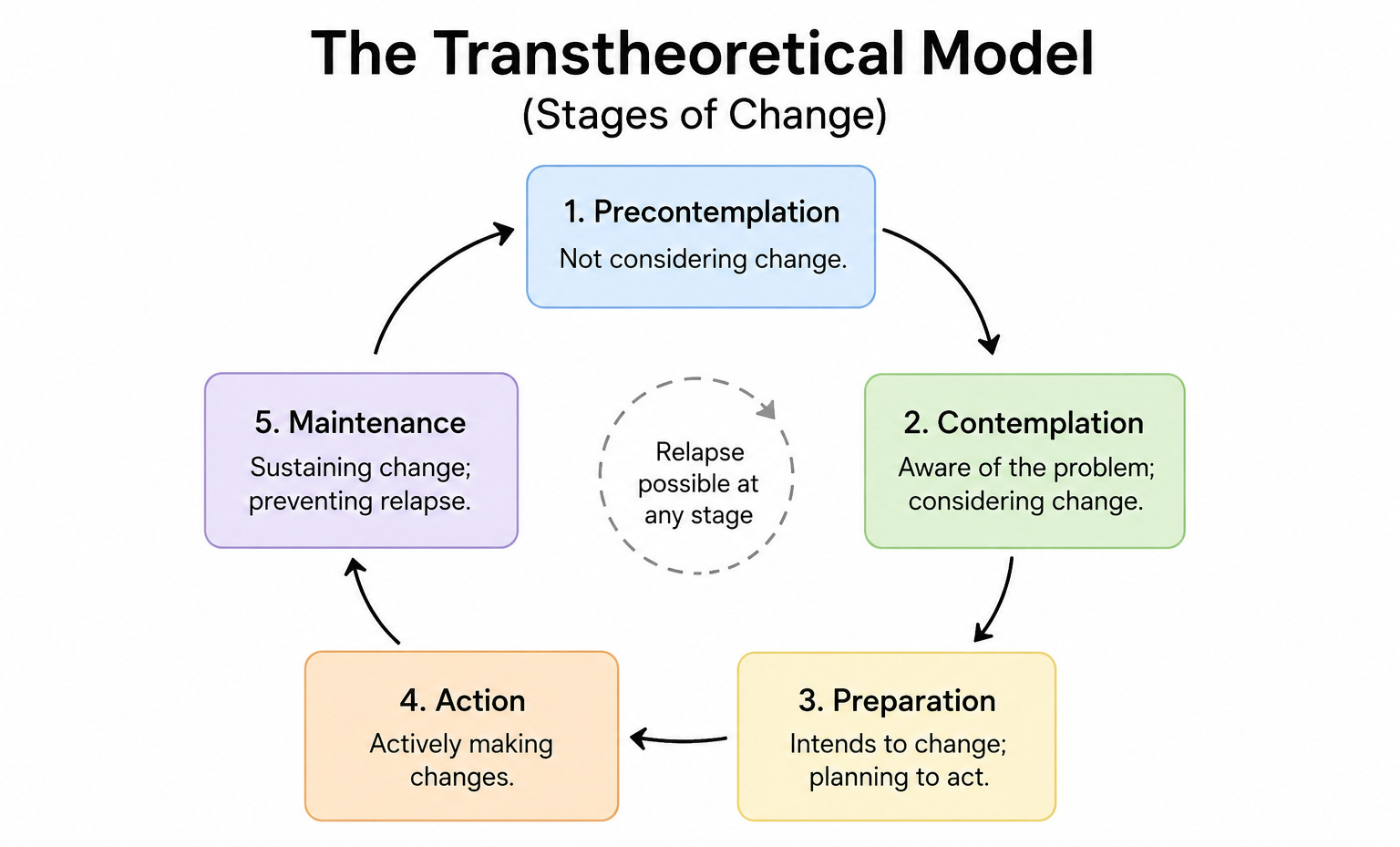
Depending on which stage the person might find themself in, the clinician or counselor often then tailors their response accordingly—and it still doesn’t look like an argument. Rather than preaching that “you should do X because of Y,” the clinician asks questions to elicit the motivation within: How have these painkillers affected your relationships? What do you enjoy about them, and what worries you? Where do you see yourself in five years if nothing changes? This style of therapy, known as “motivational interviewing,” is less like Hegel and more like Socrates; it’s not about giving correct answers so much as nudging folks into living the questions for themselves. And when people arrive at honest answers that they fully believe, they may be more likely to embody them.
Before we get any more lost in our ivory tower of theory, though, hopefully we can take a step back and appreciate that this idea of meeting folks where they’re at isn’t unique to addiction medicine. When we take our toddler to the pediatrician, for example, we’re asked to recount all sorts of strange new skills: Is she pointing yet? Can she stack blocks? Does she respond to her name? The goal is to determine if she’s at her “developmentally appropriate” level, meaning to make sure there’s nothing wrong that might be delaying her growth as a person, especially anything that might be addressed now so as to spare her unnecessary suffering later. As parents, we similarly expect different behavior from our kids at different ages; we aren’t worried that our toddler can’t do complex division, but we should be asking a lot of questions if our teenager is using a binkie. Whether through professional training or parental intuition, we come to realize that change happens in stages, and that to ignore this reality would be to set ourselves up for needless disappointment and ineffective attempts at promoting growth.
As an aspiring Christian and young psychiatrist, I’ve found myself more and more inclined to apply these lessons from developmental psychology to my understanding of my own and others’ journeys of faith. There are yet again many models out there, but one that I find particularly compelling is that of James Fowler, a Methodist minister who grounded his model in the work of pioneers such as Jean Piaget, Erik Erikson, and Lawrence Kohlberg.
Fowler argues that faith, not unlike our cognitive abilities or fine motor skills, tends to develop through recognizable and predictable stages across our lifespan. Early faith is more intuitive and heavily shaped by imagination, family, and authority figures, whereas adolescence tends to usher in a more conventional faith grounded in social belonging and shared beliefs. In young adulthood (or later), our faith tends to be challenged and reshaped by questioning and critical reflection, becoming less conventional and more personal, or individuated. This stage can be especially harrowing, and many people lose their religion somewhere in the throes. If we manage to re-emerge from this dark night of the soul, whether in the same sect or not, we tend to do so with a greater comfort with mystery, paradox, and complexity. Many people of mature faith remain comfortably in this phase for most of their lives, with few probably advancing into the final stage—a rare embodiment of faith characterized by radical compassion and identification with the whole of humanity, as perhaps exemplified by revolutionary figures like MLK Jr, Dorothy Day, Gandhi, or Jesus himself.
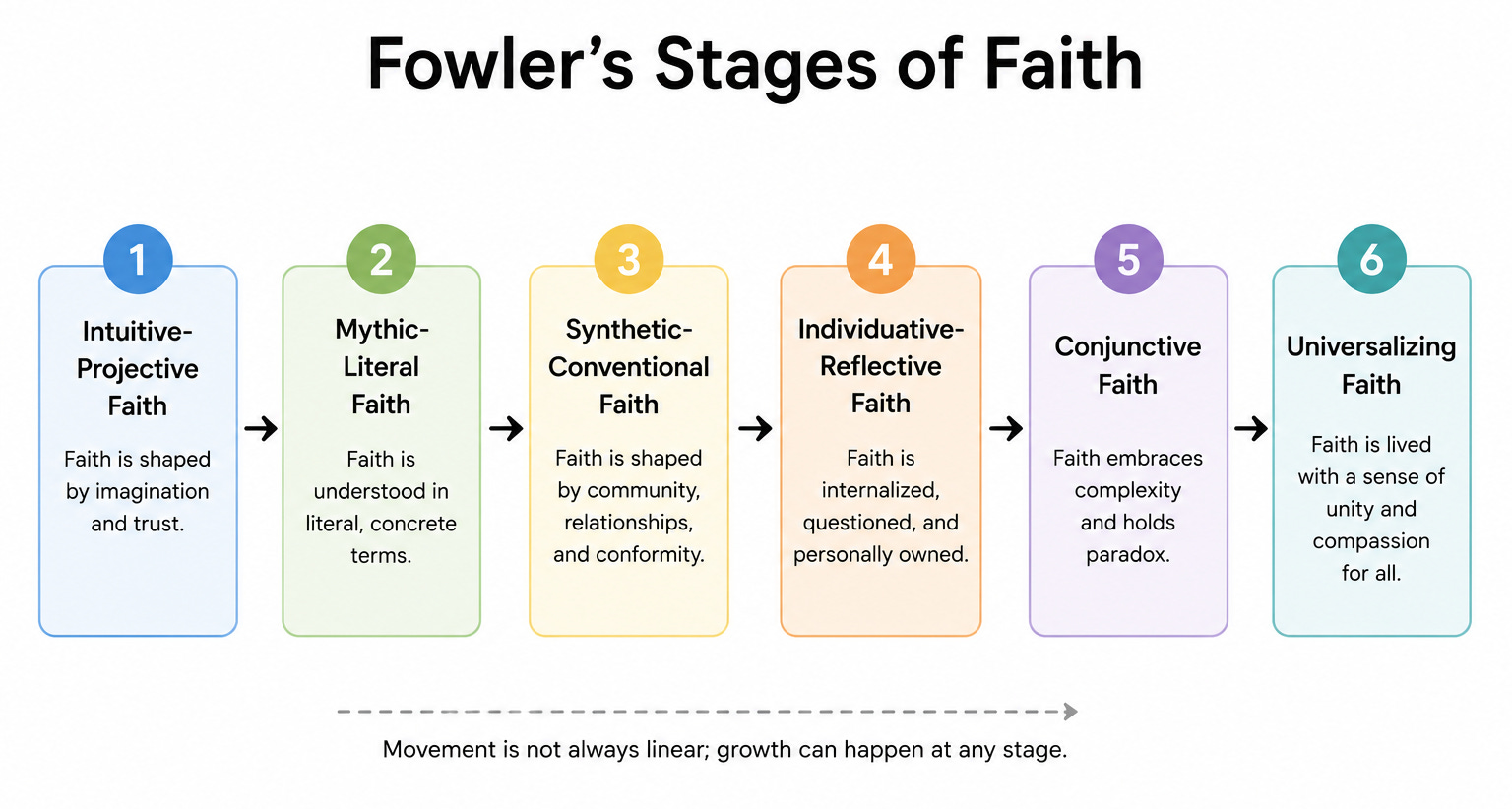
I recently came to appreciate the practical value of this model through conversations with one of my best friends, Ryan. Several years ago, we’d gotten into an argument that more or less exposed how we’d grown apart in our faith. With this model in hand, we now agree that I was probably in the process of transitioning from one stage of faith to another, and Ryan wasn’t in a good place to walk through that with me. I felt isolated by his response, and maybe a bit abandoned. But a few years later, a tragedy in Ryan’s own life precipitated a similar shift—and given he’d seen me go through the movement at a safe distance, it became a deep point of connection for us. He felt comfortable speaking transparently about his questions and doubts with me, and though we each came to our own conclusions, we once again found ourselves in a similar stage of faith and friendship, stronger than ever before.
For many friends, children, parents, and spouses, navigating such a transition can seem daunting and even threatening to the relationship—think of all those stories of one person losing their religion before then losing their marriage. This reasonable fear can have the unfortunate effect of stunting the faith development of either or both people, which in turn can leave room for resentment to grow. But as evidenced in my experience with Ryan, there are ways to move through these seasons together, even if at a more careful distance, such that reconciliation remains possible when the time is right. Asking questions (as opposed to giving answers) can allow that future possibility to remain open and perhaps even encourage it to unfold. And thinking about faith in developmental terms can give us patience (and give others patience with us!) to remain curious rather than prescriptive.
Before racing to throw all our friends and family into some stage of faith below our own (“Oh, ye of little faith…”), I think it’s helpful to sit with some of the caveats and tensions of this model. On the one hand, it isn’t relativistic in the sense that we need to regard all stages of faith as equally congruent with the highest ideals of a given religious faith; the final stage is probably regarded as exceptionally rare, strenuous, and noble for good reason. On the other hand, it’s important to be humble and not to fool ourselves into thinking that we’re so high above our raising.
Like in the prior model for addiction, folks may settle on any one of these stages and perhaps never progress further. Some people remain precontemplative of their drug use until it kills them; others manage to live lives full of seemingly incessant relapses that still arc in the direction of beauty and redemption. Similarly, maybe our grandparents had religious beliefs that would strike us as concrete, exclusionary, and at times self-sabotaging—and yet, their lives were dripping with compassion and generosity in other domains. Often our stated “formal” beliefs come apart from the way we actually live our lives anyway, for better or worse. (I can say from experience that “turn-or-burn” Baptists can be great neighbors, while the couple with all the social-justice bumper stickers can be insufferable.) My point is, it can be challenging to locate ourselves in some stage without falling into the complacency of relativism on one side or arrogance about our spiritual maturity on the other. And in the end, it’s still just an oversimplified model of faith—not the terrible, beautiful mess of faith itself. We’re all pilgrims.

If we can manage to strike this delicate balance, I think that invoking such models when navigating important differences can be both liberating and motivating. When I talk with someone who has yet to even identify their drug use as a problem, I’m less inclined to jump to judgment and instead better equipped to explore the question with them: I’m hearing that you don’t think your drinking is a problem for you. What in your life leads you to think this way? Similarly, when my friend appeals to a Bible verse to defend a belief that I think is harmful, I’m less inclined to criticize their values and instead better equipped to explore how these values might align with or depart from what they’re sharing: I’m hearing that you take the Bible very seriously. What in the text cues you into thinking that this verse applies to our present moment?
As you can imagine, those of us wrestling with addiction and those of us wrestling with faith often come prepared with what we’ve been told is the “right” answer—or the answer we would like to be true, regardless of whether or not we truly believe it. I say this as someone who loves getting the answer right. But an honest question offered from a place of curiosity (instead of certainty) and compassion (instead of judgment) can sit with someone for longer than the duration of that particular conversation, as evidenced in my friendship with Ryan. When I reflect on shifts in my own journey with both harmful habits and stages of faith, it’s only now that I can appreciate how pivotal certain experiences and conversations had been in precipitating a change, and usually long before I’d conceded the change for myself.
Beyond the pragmatic result of keeping open a possibility that might not otherwise come to pass, I believe that this approach is also worthwhile to the extent that it’s an exercise in faith itself. To play the long game—to trust that someone else will be led into the questions for themselves, and that we aren’t the ones primarily responsible for saving each other—this is an act of faith, not of pure reason. Regardless of whether the person across from us changes their beliefs or behavior, to attempt (however sloppily or unsuccessfully) to assume this posture of humble curiosity is to attempt to let go of my own sense of control over the situation, to detach the value of the act from the outcome and to instead let the act itself serve as the offering. In my own faith, I’ve come to understand this posture as an act of worship.
Reflecting back now on some of my previous science-versus-religion insecurities reminds me of the final chapter of The Deathly Hallows, when an adult Harry Potter rubs his lifelong scar, appreciating that it hasn’t hurt since the day Voldemort died. These days, I absolutely love debates about science and religion, now that it’s less like spiritual warfare and more like playing with Legos. As theo-bro as it sounds, there are few things I enjoy more than grabbing a beer and riffing responsibly about weird things like divine action through quantum phenomena, the bearing of evolutionary psychology on spiritual practice, the neuroscience of confabulation, and so on. I’m not an expert on any of these issues, but that’s probably what makes them so fun: I’m a passionate amateur and a loyal fan, cheering on my favorite teams from the sidelines. These are wonderful and potentially fruitful conversations worth having.
But, thankfully, my soul isn’t on the line.
And if I could talk to my younger self, I wouldn’t tell him to not be afraid, and I certainly wouldn’t scare him with all these theories—sometimes more “explanatory power” isn’t helpful. I like to think that I’d instead tell him something that echoes what I’m still singing about: you don’t need all the answers, but you do need to live faithfully into the questions. Better yet, I hope I wouldn’t say anything at all, given this is all still his adventure and no longer mine.
This reflection is a continuation of my 15-part series on faith and addiction, with each piece corresponding to a song on my album Rotations. You can listen to the record here.
No posts
Comments
Nothing yet. Say the first thing.
Sign in to join the conversation.