
It’s the 9th hour and Jesus is dying. His heart is still beating, but it doesn’t have as much fluid to pump; he’s lost a lot of blood from the scourging and the nails, and he’s severely dehydrated. His organs are demanding more oxygen even as his respiratory muscles are failing, each breath requiring him to drag his body upward against the nails to open his lungs. To make matters worse, he probably has some dangerous electrolyte imbalances that threaten to destabilize his heart’s normal rhythm. There’s no way to know the exact mechanism of his death, with asphyxiation, hypovolemic shock, and fatal arrhythmia at the top of our differential, but we can reasonably assume some combination culminates in a terminal cardiac event. As his heart muscle is starved of oxygen, parts of it die, crippling its ability to circulate blood. Once circulation stops, the organs fall like dominoes: the brain goes dark within seconds, heart and lung tissue follow in minutes, and kidneys, liver, and gut soon after. Now, at the cellular level, the irreversible process of necrosis is in full swing—without oxygen, cells burn through their last energy, their membranes rupture, and they spill their contents into surrounding tissue, each one a tiny, messy death that multiplies until no living tissue remains. The death of a single organism is, physiologically speaking, the death of literally trillions of individual cells.
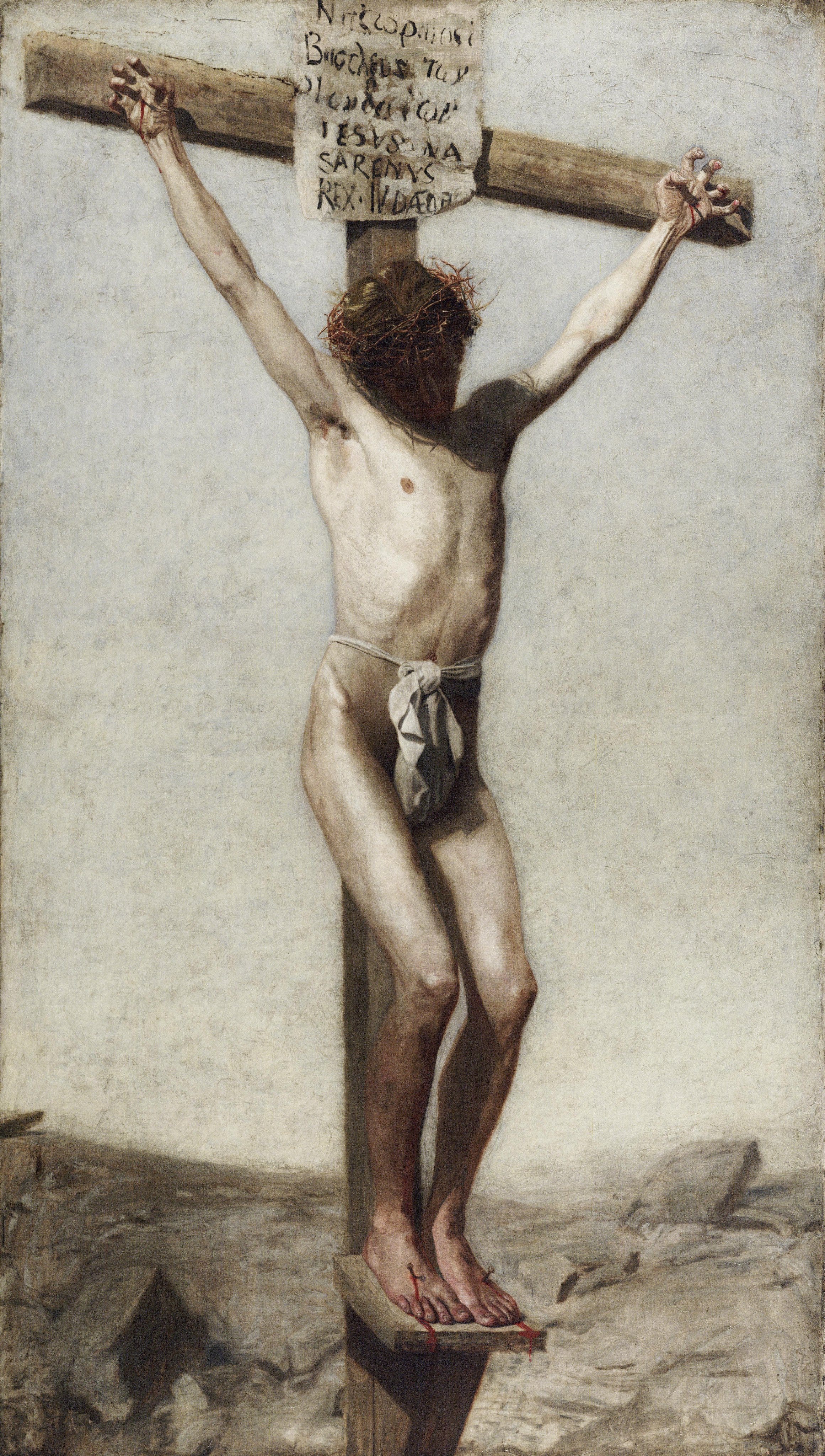
What a terrible way of talking about Jesus’ crucifixion. Prior to medical training, my mental model of his death was simpler, dare I say normal, more like an on-or-off light switch than a swirling mess of entropic chaos involving the emulsification of trillions of independent living entities. As a result, to affirm that Jesus rose from the dead seemed to only require bending a single “law of nature”—extraordinary, to be sure, but at least simple. Now it seems about as complicated as repackaging Pandora’s box, or rewinding the Big Bang. Unfathomably unlikely by any empirically rigorous model of our universe, quantum be damned.
And yet, as a churchgoer, I try to affirm this seeming impossibility, week after week:
For our sake he was crucified under Pontius Pilate,
he suffered death and was buried,
and rose again on the third day
in accordance with the Scriptures.
He ascended into heaven
and is seated at the right hand of the Father.
He will come again in glory
to judge the living and the dead
and his kingdom will have no end.
To be clear, I don’t carry the supernatural bent of the Creed into my clinical work, or at least not in the most obvious way. If my patient lost all brain stem function and their body somehow lay lifeless for three days without any medical support, I wouldn’t tell the family, “Well yes, he’s dead, but I’m familiar with another case in which the patient actually bounced back, better than ever…” Not only would that require me to throw out pretty much all my training, but to offer false hope would add cruel and unusual insult to an already fatal injury. Plus I’d have to ignore my own lived experience which, as far as I can tell, has been totally devoid of any evidently supernatural phenomena that couldn’t be better explained without some appeal to the divine—though not for want of wanting. For as long as I can remember, I’ve wanted to experience something supernatural, having participated in hundreds of charismatic Christian worship services throughout high school and into college, even praying as a teenager that God would send a demon just so I’d be convinced of their reality. (Thankfully the jury is still out on that one.)
And yet here I am, standing up every Sunday to proclaim alongside my fellow churchgoers that Jesus died, was buried, and rose again.
I don’t engage with apologetics much anymore, but I do think there are some impressive attempts to make Jesus’ bodily resurrection more palatable to the modern mindset. One focuses on the weirdness of the way the Gospels tell it: if this were supposed to be just another resurrection myth, then why is it written in the style of an eye-witness account, with mundane details and emphases on historical timestamps, which were so atypical for the time? Another one: if you’re trying to convince an ancient patriarchal audience of a miracle, then why would you choose two discredited women as your primary witnesses? And finally, why would all these folks who probably knew Jesus personally be so willing to die for some neighborhood Jewish teacher, unless they themselves were fully convinced of his resurrection?
I think these are all interesting points, but they have strong counterpoints, too. For starters, maybe we’re overestimating how “journalistic” these accounts really are, misconstruing the authors’ attempts at mere verisimilitude as case-reporting. The Gospels were probably written decades after the original events, and mostly in Greek (not Aramaic), with a clear theological agenda. Maybe ancient audiences were used to women being the first on the scene to prepare bodies for burial, making their roles as the initial but not final witnesses less jarring. Some of the Gospels might’ve been written for communities who already believed the story anyway. And regarding martyrdom, well, plenty of cults have their martyrs, and we don’t know how most of the disciples actually died. Which is all to say, I’m not sure that even the best arguments for such an extraordinary event have the sort of extraordinary evidence that might be warranted. I know there are many more arguments out there, but to be honest, in my admittedly brief and pretentious tenure as a philosophy student at Princeton and Oxford, I didn’t encounter any no-hold-’em slam dunk argument that made the resurrection all that much easier to believe. Over time, though, I’ve come to think that maybe that’s the whole point.
In looking for reasons to believe something so hard-to-believe, I worry that my fellow churchgoers and I risk undermining the very thing we’re actually trying to cultivate within ourselves: faith. “Faith”, by most conventional definitions, is trust or belief precisely in the absence of evidence. If in making a case for Christ’s resurrection we’re actually trying to find evidence to make ourselves feel more confident and less vulnerable, we might actually be jeopardizing faith’s transformative power. I personally tend to think that faith is much closer to the opposite of some sort of philosophical or scientific inquiry—more like participating in a relationship than conducting an investigation.
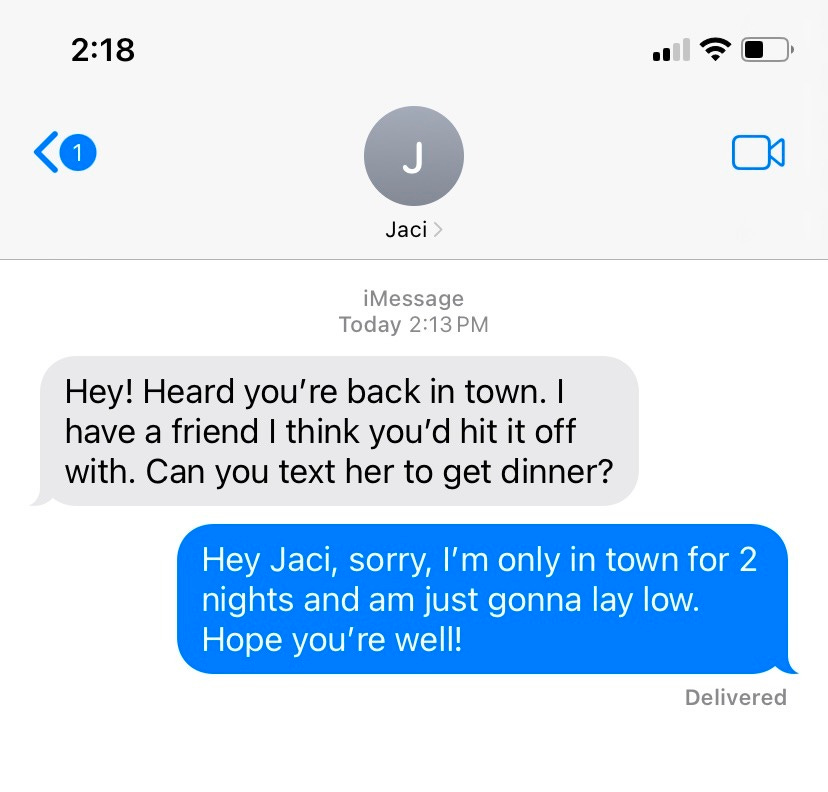
Obviously one of the chief relationships in my life is my marriage to Torrey. Torrey and I were actually set up on a blind date by Jaci, a mutual friend, while I was still living in Nashville. Jaci’s request was simple: could you text this girl and ask her to meet for dinner? Which, given I’d never been cut out for hook-up culture, landed more like: any chance this girl could be the one? (A bit much, I know.) Sure, there was some evidence in favor of texting her, especially given that Jaci knew me well. But on the whole, I really didn’t think there was any real chance it would work out. I’d recently gotten out of a romantic relationship with a long-time friend, I lived out-of-state, I was making almost no money, and I had zero intention of settling down anytime soon. Based on the available evidence, I should’ve said no. But I said yes, and my reason was simple: if I don’t try, I’ll never know.
This is one of many examples from my life when simply answering the question based on the evidence at hand would’ve actually pre-determined the answer, precluding me from the alternative:
No date with Torrey. No falling in love with Torrey. No coast-to-coast Facetimes, no cross-country rendezvous, no backyard wedding in the mountains, no honeymoon in Alaska, no moving all our things into a UHaul about the size of our new Manhattan apartment, no midnight arguments, no morning coffee make-ups, no touring the country by Prius with our broken dog Lola, and certainly no baby Rosey June. Following the evidence would’ve changed the trajectory of my life in ways that are now inconceivable to me.
As silly as it sounds, and as someone who sadly hasn’t had any particularly mystical experiences beyond those afforded by the spiritual technology of live music, I now try to approach the question of Jesus’ resurrection in a similar way. The actual event is hidden to history, but between some clever arguments and the cultural climate into which I was born, the question remains on the table as a genuine question, as opposed to some bizarre conspiracy or fringe cult—though it probably was at some point, and I’m sure new spinoffs are being imagined even now. I know I have to respond to the question, as not answering the question is an answer of its own; like a truck driver unsure of which exit to take, I’d be making the decision by not making it at all. And so I decide to make the turn, and I keep making the turn because, in doing so, I have found myself living into a story whose depth and richness I personally can’t imagine myself living without. Now the evidence of Christ’s resurrection is apparent to me everyday, even if that evidence doesn’t count for others, who get to make the decision for themselves.
With this in mind, what impresses me most about Jesus’ earliest followers isn’t so much that they believed after having seen him but that they managed to have faith despite having seen him. What on earth was their leverage? Was the paradox any less paradoxical, and if so, what greater paradox did they encounter? Maybe that’s really what makes them saints. I have no idea. Perhaps I’ll find out one day, but in the meantime, I’ll be over here seeing patients and writing songs. That seems to be where my faith is leading me.
Speaking of patients and/or patience, this post is part of a blog series about the opioid crisis, so what on earth does all this have to do with addiction? A whole lot, I think.
While medication is very important in some substance use disorders, especially when opioids are involved, many folks in the throes of addiction still start with the infamous 12 Steps, an arguably archetypal pattern of recovery cashed out in unabashedly spiritual terms. It was Bill Wilson, an American stockbroker wrestling with alcoholism, who wrote down the original steps in 1939 after meeting with Dr. Bob Smith, a small-town Ohio physician, to start Alcoholics Anonymous (AA). Interestingly, Wilson had recently had one of those “white light” mystical experiences that I covet to this day and afterward read The Varieties of Religious Experience (1902) by the physician-philosopher William James—the same book that I, too, found particularly helpful in navigating my own adult faith journey. As I’ve shared before, I probably wouldn’t exist without these steps, given my folks met in AA. So thank you, Bill. Both of you.
Even if you’ve never been to a meeting, you’re probably familiar with the steps:
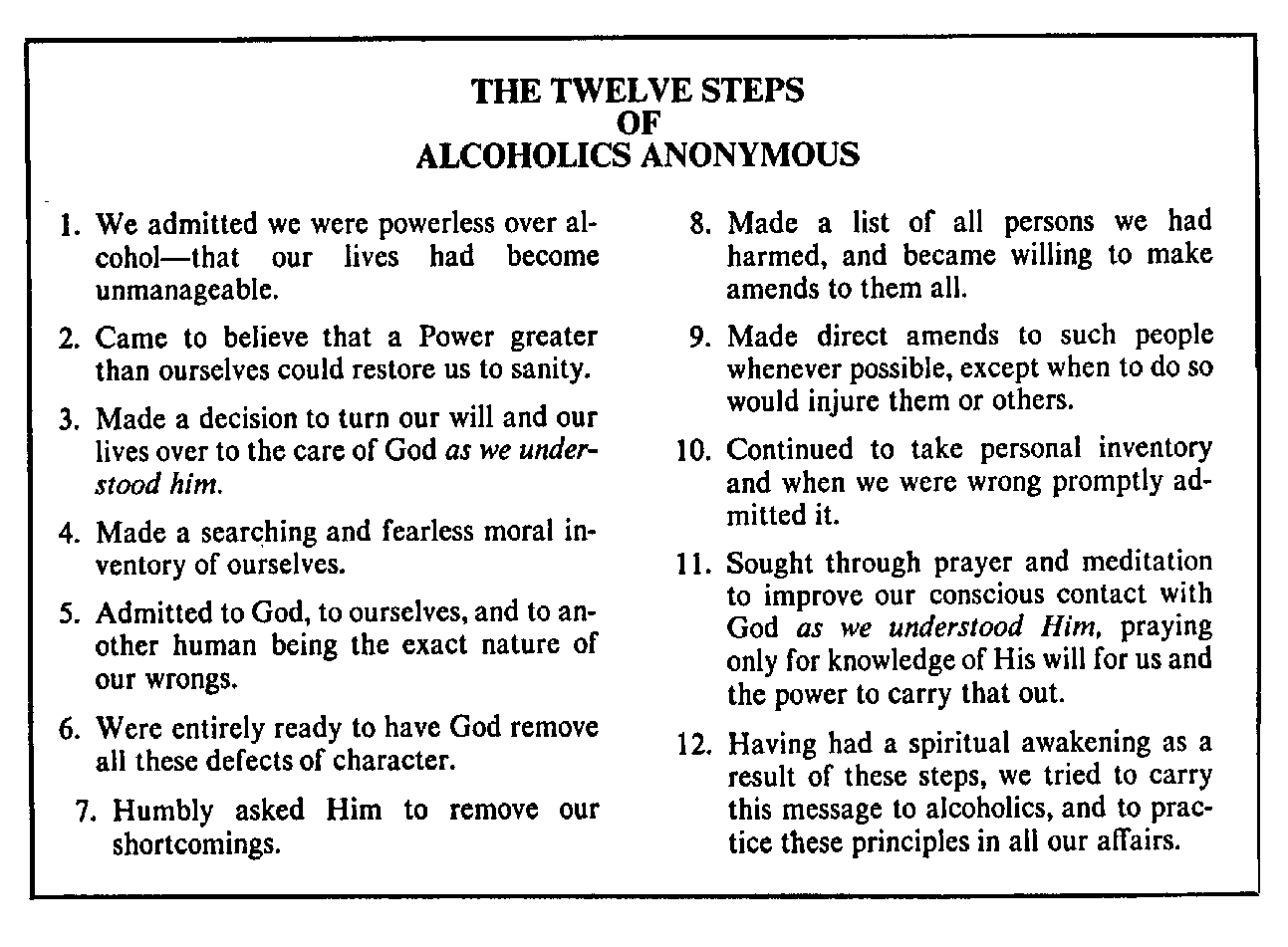
I fortunately have yet to repeat my family’s struggle with alcohol and opioids, but as a human being, I’ve certainly wrestled with my own small forms of addiction, of harmful habits that seem to spiral out of my control. When caught in the cycle and confronted with the reality of so many failed attempts, I’m tempted to weigh the evidence and conclude that sustained recovery is impossible. And maybe, like Step 1 so famously and spiritually maintains, I’m actually powerless to break the cycle on my own. But I still have to believe, and probably without solid evidence in my own life, that my recovery is still somehow possible, even if that requires a power beyond myself. To that extent, at least, recovery from addiction seems to require some sort of faith, of looking beyond the evidence and thereby enabling a reality that otherwise couldn’t come to pass. This is American Pragmatism at its finest, and arguably a role for faith that both the religious and non-religious among us can get behind.
I started this post with a picture of crucifixion, so it’s only right that I end with a comment on resurrection. I wonder if my fellow churchgoers and I, not unlike us family members of those struggling with addiction, have occasionally lost the plot. What if faith wasn’t supposed to come from miracles, but miracles from faith? And what if resurrection isn’t about explaining how the dead come back to life, but about having the courage to risk trust when the evidence is lacking? Maybe it’s really there, in medicine as in faith, that new life begins.
No posts
Comments
Nothing yet. Say the first thing.
Sign in to join the conversation.