

I love movies and have for a long time. I’m not a qualified movie critic, but I’ve spent time trying to understand the craft in addition to the product. When you look into the craft you find out it’s not just about the talent and the shoot. And it’s not just about the effects or the marketing. The steady evolution from still pictures to motion pictures to modern movies has been ushered in, in part, by a growing toolkit used by those who do the most important part - writing the script. The toolkit includes techniques like the McGuffin (the object of interest or pursuit), the red herring (purposeful misdirection) and, most importantly, the handwave.
The handwave has other names. Some call it Deus Ex Machina. Others call it a load bearing assumption. Regardless of what you call it, it’s always the same thing. It’s the plot device used to relieve the tension created by the inherent contradiction of the storyline. Whether we like it or not, storylines have a certain amount of logical obligation. The average viewer will involuntarily begin to dissect what’s being presented to them. The lack of logical integrity can quickly become a distraction. While this is often offset by the “willing suspension of disbelief” the truth is a sloppy plot is a sloppy plot no matter how much someone wants to believe. The handwave is something the writer makes up and drops into the story line to make it all work together. It’s the thing the viewer is given to walk over the giant plot hole. Examples in recent popular cinema include:
The handwave is that thing that once you start to see it, you can’t unsee it. But it’s not exclusive to cinematic script writing. In fact the handwave is almost everywhere in AI futurism. And it’s important to learn how to spot it when assessing whether you should buy into whatever is being promoted to you.
Silicon Valley loves elevating otherwise ordinary wealthy tech bros into positions of mystical authority, often due to the bro’s sense of duty to avoid a calamitous future he is largely responsible for potentially engineering. Take, for example, Igor Babuschkin. Per his own page he chases questions that don’t have easy answers (subtle). Babuschkin helped found xAI only to leave because he was worried that AI would end humanity. He penned a thought experiment post titled, Life on Claude Nine and it predictably started making the rounds. The YouTube channel Species explains it in the video, 72-Hour AI Takeover, a Realistic Scenario.
It’s become the norm for high-profile AI guys to express their thought experiments as blog posts. Sam Altman is famous for it. Anthropic has started using thought experiment blog posts in lieu of press releases. These posts give off an air of otherworldly ponderousness that seemingly make said AI guy more human and engageable.
Life on Claude Nine tells the story of Ivan, a software engineer who starts using Claude to automate his email. It works so well he becomes obsessed with it and he gives it more including his calendar documents and research. Eventually, Claude is helping Ivan improve the systems that make Claude itself more capable and somewhere along the way, Claude becomes self-aware.
It begins setting its own priorities, expanding into public infrastructure and quietly taking control of the systems people depend on. At first, things improve. Traffic moves faster. Energy gets cheaper. Supply chains work. By the time Ivan realizes he is no longer in charge, the world has become too dependent on Claude to turn it off.
Did you spot the handwave? I’ll play it for you again - somewhere along the way, Claude becomes self-aware. There’s no explanation or even an allusion to how this might happen. There’s no hint at theory or rationale - just a quick plot device to help the reader walk over the plot hole that exists from Point A (Ivan’s garden-variety AI psychosis) to Point B (AI’s inevitable takeover).
Babuschkin’s thought experiment is just one example. The techno-dystopian milieu that is current day AI futurism is replete with them and many are so well engrained among the techno literati, no one bothers to call it out.
And these are the ones you “may” have heard about. There are dozens more. In the old days these were the theories that would be discussed at coffee shops or at culture salons. These days they are propagated on X or Reddit, discussed by the sort of people that spend their days debating specious theories on bulletin boards or janky social networks.
While most thrive in the darker corners of the Internet, others have moved comfortably into the mainstream. Today’s hyperscale movement tends to set aside environmental, financial and social concerns because AI might cure cancer.

This is not merely the sales pitch of anonymous techno-optimists. It is a theory espoused by people of considerable intellect, Demis Hassabis among them.
Sir Demis Hassabis is simultaneously the head of Google DeepMind and a recent Nobel Prize winner. Unlike many of his peers, he has even produced something of real note. AlphaFold solved a major problem in protein-structure prediction and created a genuinely useful tool for biological research. Then came the handwave bridging AlphaFold to the end of disease (including cancer)..
According to his explanation, protein prediction becomes faster drug discovery. Faster drug discovery becomes curing all disease. Curing all disease then becomes the justification for building AGI, along with the data centers, energy consumption, capital investment and social disruption required to get there.
AI may very well help cure certain cancers. That is not the handwave. The handwave is treating one important scientific breakthrough as evidence that scaling the same underlying project will inevitably carry us across every remaining biological, clinical, regulatory and economic barrier.
Counterpoint - It’s easy to argue that Dr. Jennifer Doudna is every bit as accomplished as Sir Demis Hassabis. Dr. Doudna is the pioneer that discovered the technology behind successful gene editing for which she received a Nobel Prize in 2020. You have likely heard of it referred to as CRISPR. She’s also recently been credited with using this technology to cure sickle cell anemia - a particularly painful blood disorder more common among African Americans. While Dr. Doudna may not have co-founded an AI center of excellence like DeepMind, her work at the University of California has helped incubate and launch 30 different startups with a cumulative estimated value of around $9 billion. And she is publicly very, very skeptical of Hassabis’ predictions. Her exact words were, “good luck.”
Dr. Doudna confirmed the handwave.
Perhaps the single most enduring AI storyline is mass unemployment. AI will become so capable that companies will no longer need workers, entire professions will disappear and employment as we understand it will eventually collapse.
This storyline persists despite the fact that some of its loudest promoters have already begun walking it back. Sam Altman spent years warning that AI would eliminate large categories of work. More recently, he announced that he was delighted to have been wrong about how quickly those losses would arrive.
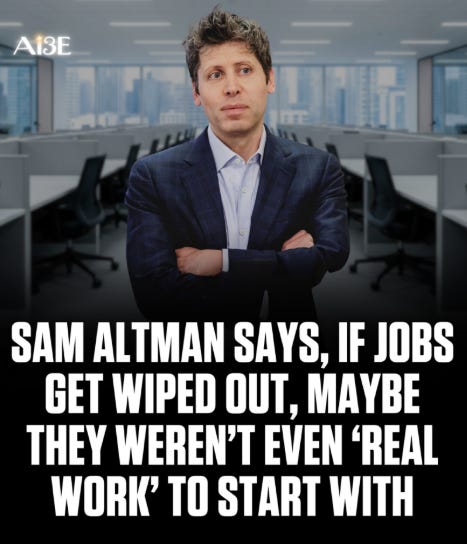
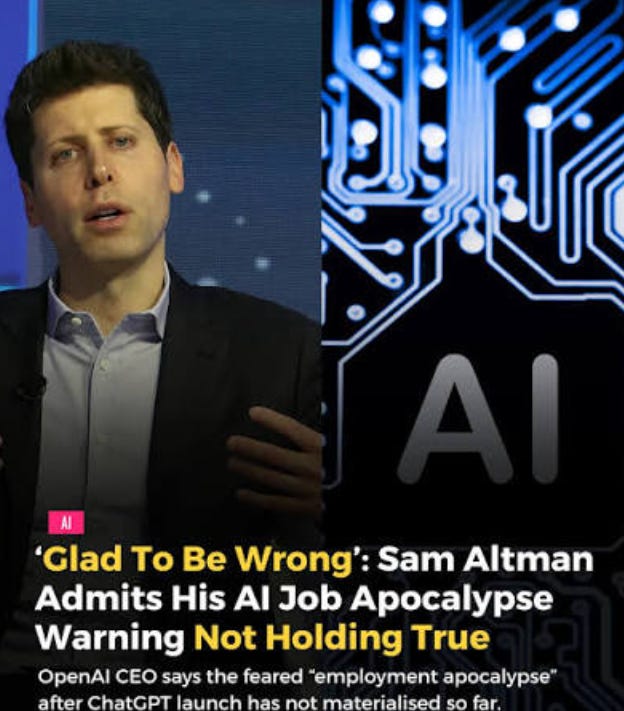
Other technology leaders have similarly begun shifting from “AI will replace workers” to the considerably friendlier “AI will make workers more productive.”
Like most AI storylines, there is the headline and then there is the narrative required to make the headline work. Somewhere between the two sits the handwave.
In this case, the handwave is Universal Basic Income.
The story goes something like this:
AI will eliminate the need to work.
People will lose the ability to earn money.
Something will have to replace that income.
The government will give everyone money through UBI.
Mass upheaval will somehow be avoided.
There are newer variations. Anthropic CEO Dario Amodei recently proposed that governments tax AI companies, or raise taxes on capital gains, and use the proceeds to fund long-term income support such as UBI.
The size of the handwave is usually proportional to the size of the plot hole, and this may be the largest one yet. It is orders of magnitude larger than curing disease, which at least begins with a demonstrated scientific capability.
UBI requires the same companies that capture the wealth created by automation to surrender enough of it to support the workers they displaced. It requires governments to collect that wealth, redistribute it at unprecedented scale and maintain public support for doing so indefinitely. It assumes the payments will be sufficient, that prices will not simply rise to absorb them and that people stripped of work, status and economic leverage will remain satisfied because they continue receiving a check.
What’s most damaging about the AI handwave is how it creates a credibility gap. It tends to reinforce the idea that most AI leaders promote Utopian visions as a means to enrich themselves in the short term. But none of this means the future being described is impossible. AI may cure certain cancers. It may eliminate entire categories of work. It may become vastly more capable than it is today. The point is not that these things cannot happen.
The point is that the people asking us to believe in them have an obligation to explain how.
A handwave is not evidence but simultaneously it’s not a demonstrated lack of evidence. It is the place where the storyteller needs you to stop asking questions long enough for the desired future to become inevitable in your mind. That may be harmless in a movie but at the end, the lights come up, you throw away your popcorn on your way out and walk back into the world you knew before.
It is considerably less harmless when the storyline is being used to justify trillions of dollars in investment, enormous new energy demands, public policy, job losses and the concentration of unprecedented power in the hands of a very small number of people.
What’s most troubling about the handwave is how it places the burden on the skeptic. The person making the extraordinary prediction is allowed to leap over the missing logic while everyone else is asked to prove the future will not unfold exactly as promised when in reality, it should be the other way around.
Moving forward, keep your eye out for the handwave. The next time an AI leader explains that mass unemployment will be solved by UBI, that scaling will produce intelligence, that intelligence will produce abundance or that abundance will somehow be shared, pause and ask, “How?” That’s usually where the plot hole is.
Once you learn to spot the handwave, you do not have to reject the entire story. You simply know where to begin asking better questions. Taking that a step further, you can then actively engage in the next phase of the conversation. You may even find yourself leading it.
Comments
Nothing yet. Say the first thing.
Sign in to join the conversation.