
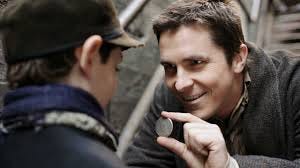
I’ve been a Christopher Nolan fan since “Memento” in 2000, and I’ll die on this hill: his best film isn’t “Oppenheimer” or “Interstellar.” It’s “The Prestige.”
If you’ve never seen The Prestige, it’s a fantastic film chronicling the fictional feud between two Victorian-era London magicians - one played by Hugh Jackman (Robert Angier), the other played by Christian Bale (Alfred Borden). Both are amazing in their own ways but the film only works because of Michael Caine who plays Cutter, the veteran stage engineer who builds the tricks.
Cutter explains the anatomy of a magic trick in the film’s opening. There are three elements per his explanation:
First there is the Pledge. It’s the opening when the magician tees up what he’s about to do. Take the classic Cups and Balls trick for example. The magician sets three cups on the table along with three simple rubber balls. There’s nothing out of the ordinary. The magician asks the audience to watch closely.
After the Pledge comes the Turn. The Turn is when the magician transforms the pledge from ordinary to extraordinary. The magician starts moving the ball around under the cups but you’re sure you know where they are.
Finally, there’s the Prestige. This is the moment where the trick comes together - when the audience sees the resolution and stands in awe. It’s that moment when the magician stops moving the cups you are sure you know where the balls are. He lifts the cup under his right hand to reveal not a ball but a fully sized lemon. “How on earth did he do that?” the audience wonders. They feel that sense of awe and mystery that only a true magician can provide. It touches something deep down.
You can see the full explanation here. It’s a classic moment in cinematic history.
I am fully convinced that we are in The Turn for AI.
My analogy to the ball and cup trick is a little deceptive because it’s short and uniform in its timing. AI has been anything but that. For AI, the pledge was presented in the 1960s when Professor John McCarthy chose the term “Artificial Intelligence” over “Automata Studies.” This choice would set the stage for decades of research and development focused on developing machines that could think and perhaps even act like humans. Milestones like Rosenblatt’s Perceptron, backpropogation and Alexnet have each served to make the pledge harder to ignore. The idea’s been in the air, persistent and tantalizing.
Every trick has to make the transition and ChatGPT allowed the field to do just that. Generative AI gave the field something machine learning never had - something interest, even amazing for the masses to speculate about. It offered a human-like facade. It talks. It seems to reason. That facade was exactly what the industry needed. Before Generative AI we just had good old Machine Learning. While incredibly impactful it’s also sort of boring and opaque. The advent of Generative AI turned the “ordinary to the extraordinary” and the industry has more than capitalized on the opportunity.
Looking back, I originally thought Sam Altman was the magician but I was wrong. Anthropic CEO Dario Amodei has laid claim to being the David Copperfield of modern AI. It’s subtle but the more you study the field, the more you see it. Take for example GPT-2.
Before Amodei was CEO at Anthropic he was a research leader at OpenAI, co-leading the team that built GPT-2 and later GPT-3. As Karen Hao reports it in her book, Empire of AI, the safety concerns were real when GPT-2 came together in 2019. It would wander into conspiracy theories when users would prompt it about Hillary Clinton or George Soros. It even generated Nazi propaganda. One researcher printed out its rant against recycling and taped it above the office recycling bins as a warning.
While the consensus opinion was to slow down and think things through, Amodei’s conclusion was the opposite. Per Hao, he argued, and Altman agreed, that OpenAI should scale these models as fast as possible but not immediately release them. Build the extraordinary thing, then keep it behind the curtain to preserve your lead. So OpenAI announced GPT-2 to the world in February 2019, warned everyone it was too dangerous to fully release, and held back the complete model for about nine months. The “too dangerous to release” framing generated enormous press, and in Hao’s telling it established the doctrine that still runs the industry today - scale fast in private, release slowly and theatrically in public.
We see the same playbook now that Amodei is leading Anthropic (the company behind Claude). Remember seeing this chart?
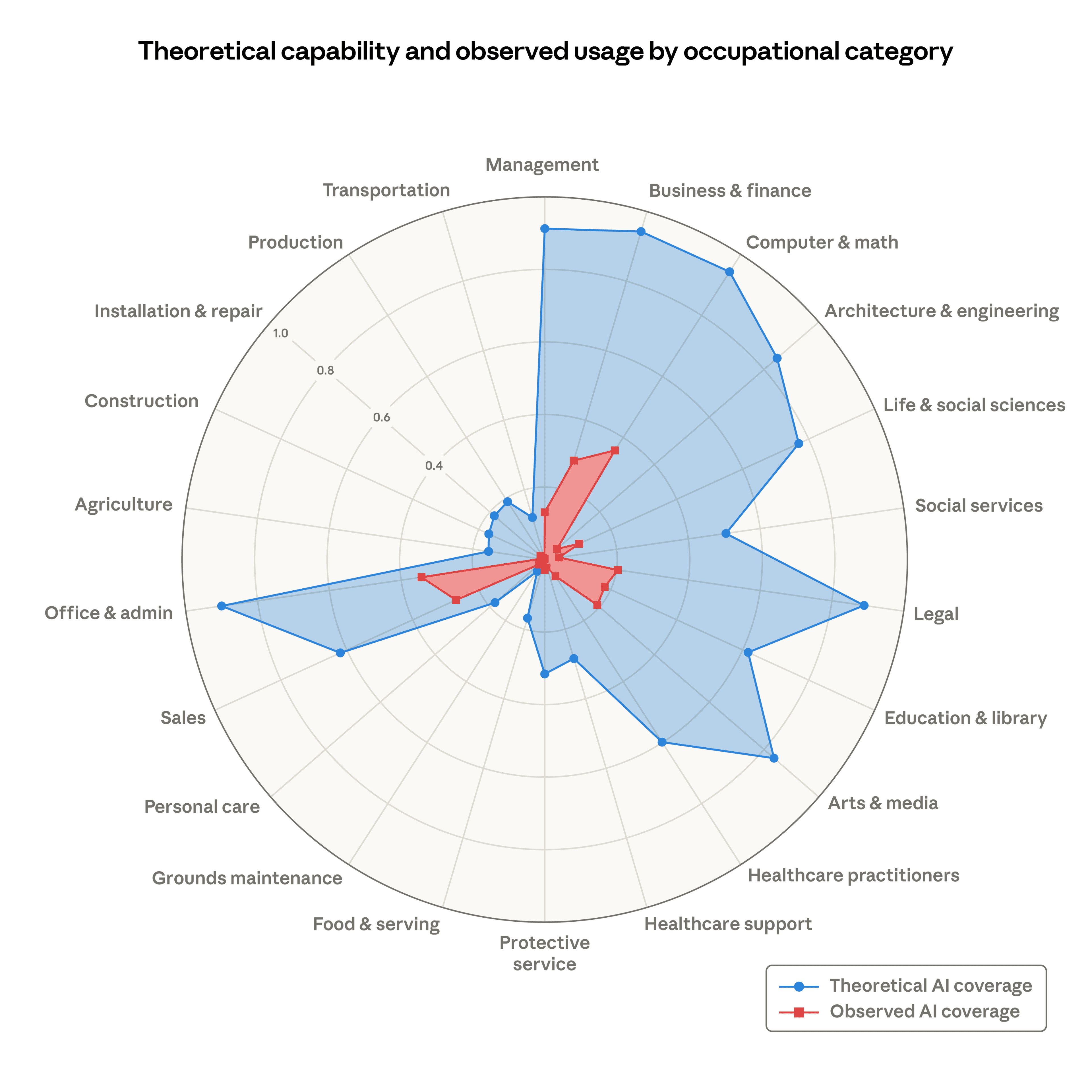
For weeks it was all anyone in tech and business circles could talk about - how Anthropic knew just how disruptive Generative AI was going to be down to the job title. Anyone who actually bothered to read the blog post saw how the author openly admitted the chart was based in theory, not fact and went as far as to admit the post was more speculative forecasting than substantiated modeling. This is just the sort of theater Anthropic and the industry writ-large, thrives on. It’s important to remember though how one must not get too comfortable with a single illusion.
There has been increasing consensus that AI jobs displacement fears may be, well, misplaced. The U.S. economy has been creating jobs, vindicating the views of the few economists who broke with convention early on forecasting a more moderate disruption. Economist and Nobel Prize Winner Daron Acemoglu has been a consistent contrarian regarding AI’s job disruption potential and many are starting to sing a similar tune.
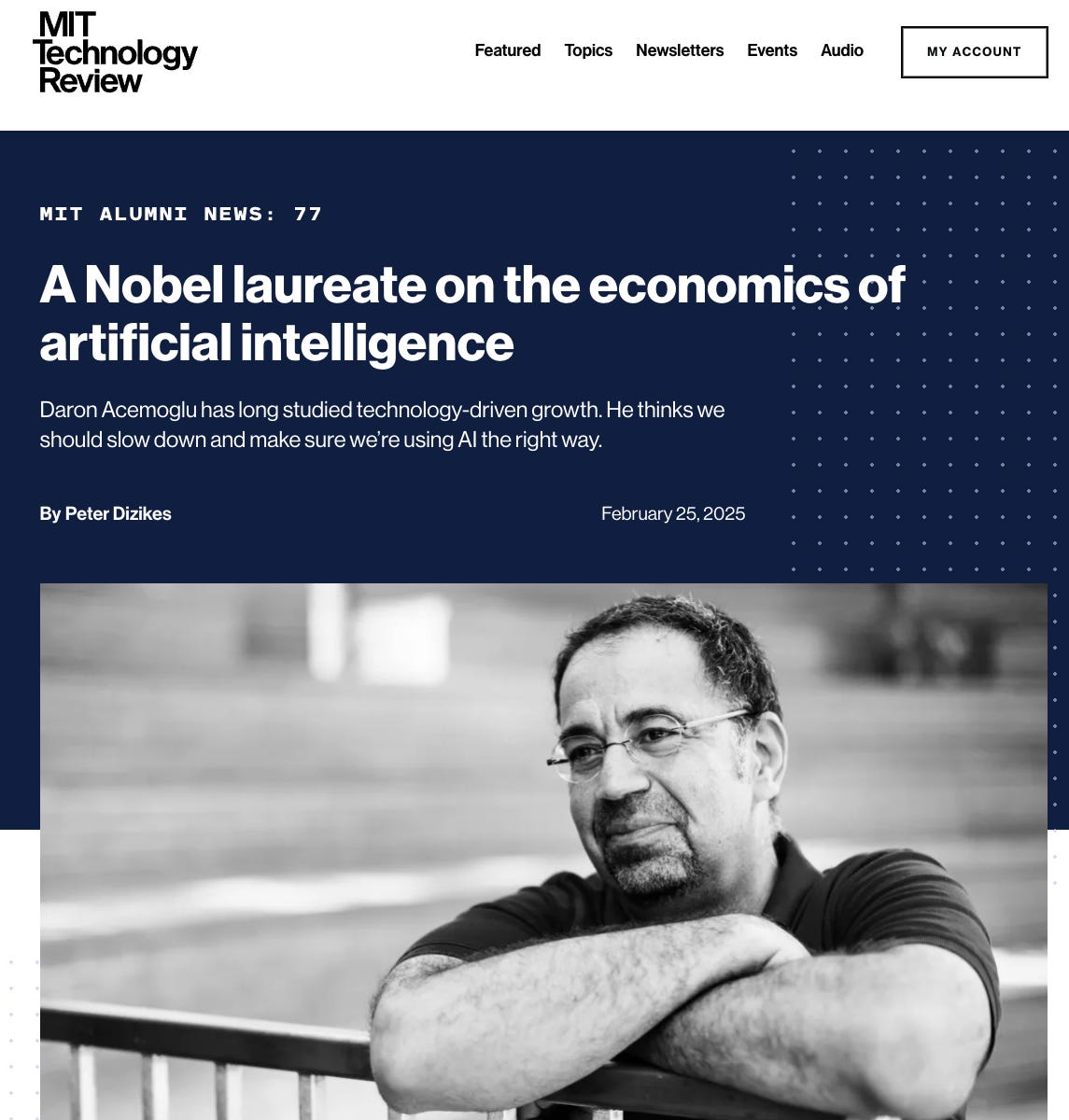
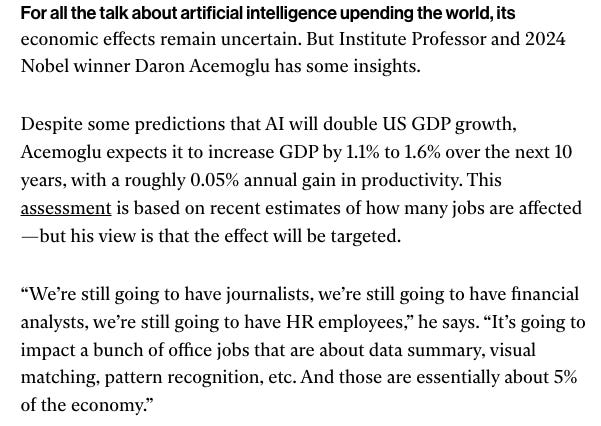
Likely sensing the need address prior dystopian prognostications, Sam Altman recently came out and said there probably won’t be a jobs apocalypse. Sensing this shift, Anthropic then switched the conversation to security saying it refused to release Claude Mythos to anyone but a select vendor list because it could potentially undermine cyber security globally. This is the tell. The world’s most dangerous application just happens to be called Mythos. Subtle. Anthropic would go on to release a limited version of Mythos called Fable. It’s this flair for the dramatic that tells me we’re in the Turn for AI. No sooner did Fable come to market than Anthropic shared a call for all AI research to slow itself down for fear of accidentally creating self perpetuating systems that would lead to the end times. If you read the post you see it’s basically a humble brag intent on keeping the audience’s eye on the cups, tracking their movement while the magician sets them up for the Prestige.
Amodei’s (and I’d argue the industry’s) theatrics appear to be wearing a little thin. No sooner did Anthropic make the announcement it was self-restricting Mythos for the good of all mankind than the U.S. Department of Commerce decided to take it a step further by putting export controls on both Mythos and Fable. This essentially freezes these products commercially. Anthropic has since taken it offline to comply.
This led none other than Turing Award Winner, former head of Meta AI and current Chairman of AMI Labs Yann LeCun to post the following:
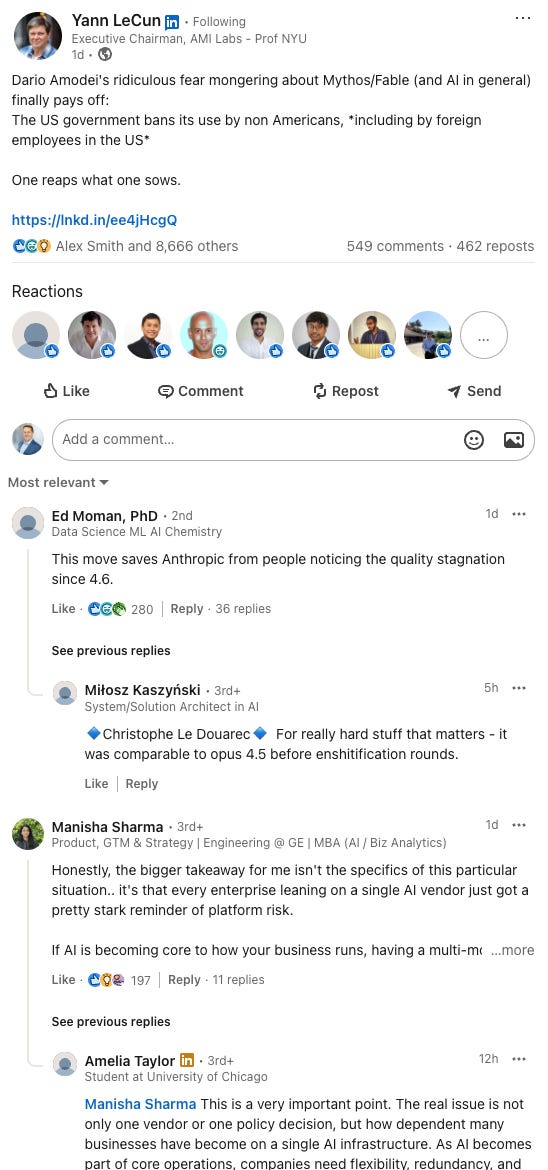
Every great magician needs a team to pull off a more complex trick and AI is the mother of all complex tricks. They need that plant in the audience to come on stage - “Can I get a volunteer? You sir. Thank you. Ok, can you please confirm for everyone else I have nothing up my sleeve?” Early in the film Bale starts as Jackman’s plant, the fake volunteer who climbs on stage to tie the knots for another magician’s act. In real life, the tech and business press plays that role for the industry’s theatrical illusion.
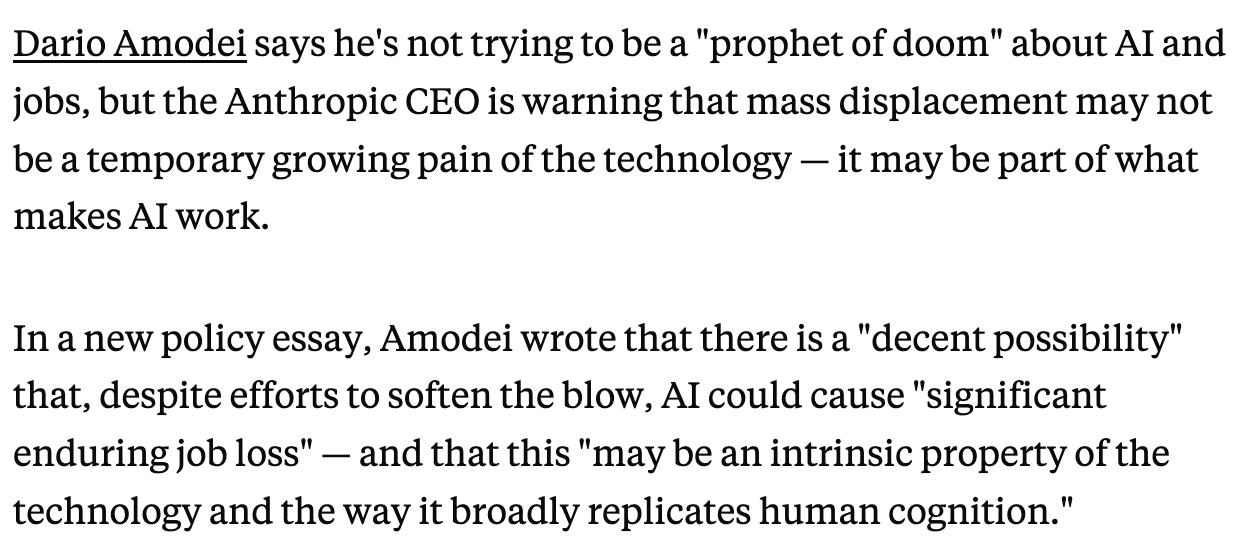
Sites like CNBC, Business Insider and others have a crushing burden. Real news is a finite resource balanced against an infinite scroll. Making money means making headlines. Knowing that they have little choice but to craft, publish and amplify the most sensational interpretation of any possible storyline. When Amodei asks if he can get a volunteer they all raise their hand and rush up to help without being selected. Anthropic clearly understands this dynamic and uses it to great effect. There’s very little chance anyone will click into the root source of the story. So they make a bold claim or observation, couch it at the end and rely on sites and platforms to do the work for them.
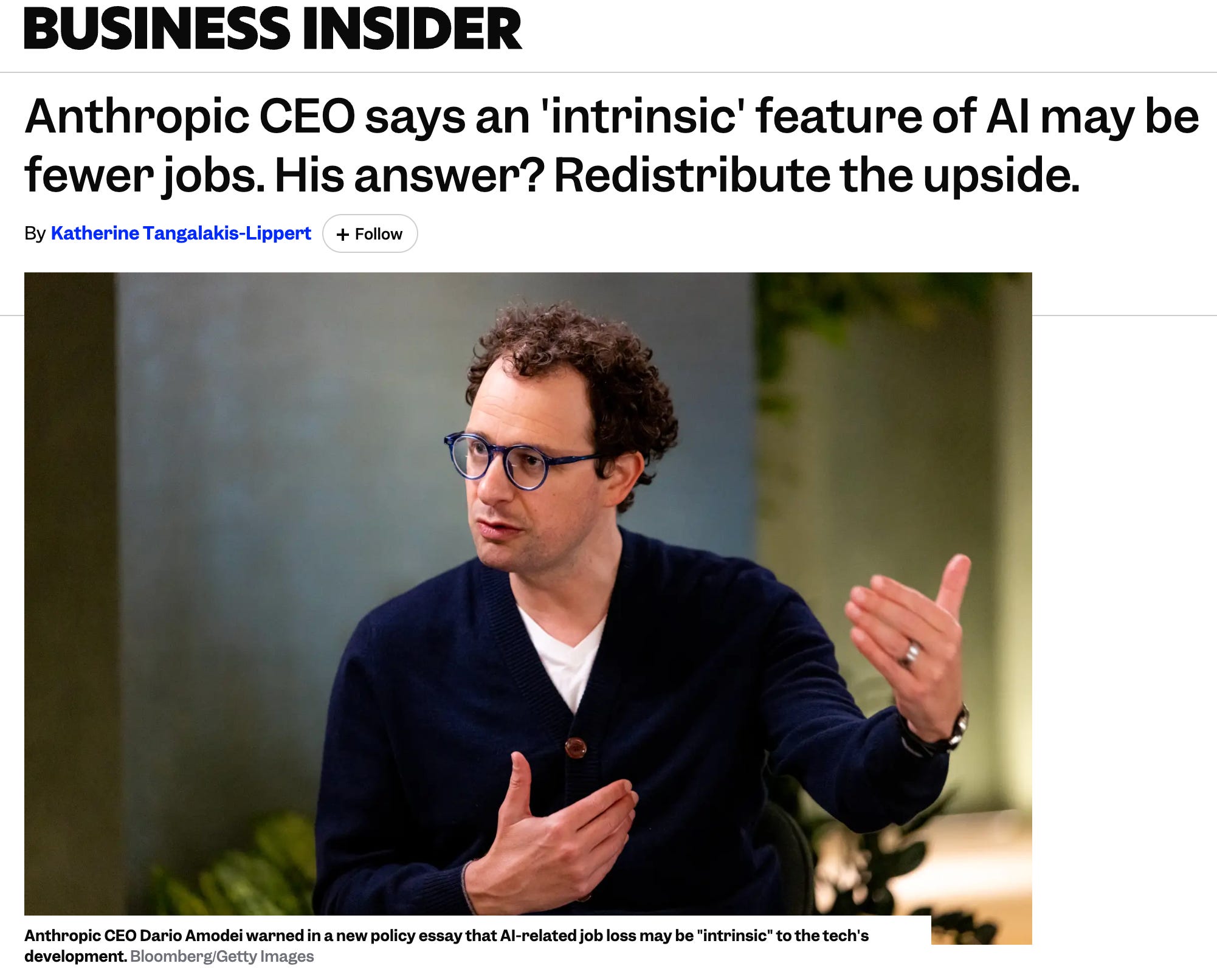
Per this article -
The stage has been set. The audience appears to be getting restless. The audience plant has done its part. So what comes next?
To be clear I don’t fault Anthropic or others for doing this. It’s genius marketing and I would do it myself in their position. I don’t cite it to condemn. I cite it to clarify my belief which is the industry as a whole is setting us up for the Prestige - stopping the cups with an audience sure it knows where the ball is only to find out it was never about the ball.
It’s easy to assume the SpaceX, Anthropic and OpenAI IPOs are the Prestige, but that misses the point. IPOs are the logical conclusion, not the reveal. No, the industry has something else in mind, and it’s keeping our eyes on the cups while it sets up the final act.
I don’t know what the reveal is and neither do you. The uncomfortable part is that might be exactly how we like it. Cutter (Michael Caine) closes the film with the truest line Nolan ever wrote. The audience knows the truth, he says. The world is simple, miserable and solid all the way through. But if you can fool them, even for a second, you get to see something special. Maybe, just maybe, we want to be fooled.
Two years of breathless coverage, doomsday charts and dangerous models held back for our own protection, and we keep buying tickets. Maybe the trick was never about what’s under the cup. Maybe the trick is that we’re still watching.
Footnote:
Edited with help from Claude, an Anthropic model. Make of that what you will.
Comments
Nothing yet. Say the first thing.
Sign in to join the conversation.