
This flash fiction piece entitled Red Shoes is a prose version of the teaser to my one-hour pilot, What Phoebe Finds. It is the backstory, so to speak. I hope you enjoy reading it as much as I enjoyed writing it!
Red Shoes
The museum glows in the meticulous grounds lighting adorning the sprawling property in the Catskills, the forested foyer to upstate, where city dwellers and artists go to escape. At times it seems not a soul is in sight. This is one of those times.
Hank is finishing up for the night, maybe longer. He’s no city dweller. No artist either. Hank’s a custodian as his door nameplate reads. But custodian sounds too important to him. Yeah, he’s entrusted with the care of the place. He used to feel like that too, responsible, proud, but not since his mother passed. Since then, he’s been merely the janitor, and that not for long.
A banner hangs in the special exhibits room announcing ICONIC MOVIE PROPS. The four displays are nearly sacred in their respective spaces. One: an umbrella, opened, hangs upside down, tethered to the ceiling. An exhibit label on the wall next to it states: FRED ASTAIRE’S UMBRELLA FROM SINGING IN THE RAIN, 1952. Two: a walking cane with its label stating: KRIS KRINGLE’S CANE IN MIRACLE ON 34th STREET, 1947. Three: an antique sled whose label reads: ROSEBUD FROM CITIZEN KANE, 1941.
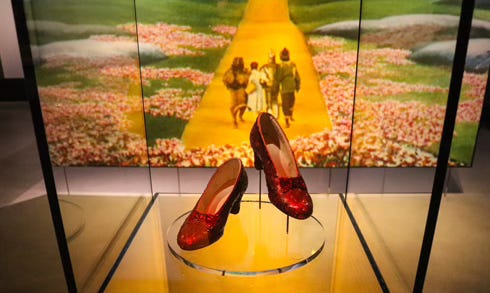
But they all pale in comparison to the sparkly display in the center, undeniably the crowned jewel of all movie memorabilia, encased in glass of course. No label needed (because you know it when you see it) but it’s labeled nonetheless: THE RUBY SLIPPERS FROM THE WIZARD OF OZ, 1939.
Next to the pair in all their scarlet splendor is a photo of a handsome man posing with multiple pairs of the sequined shoes. The exhibit label reads: DESIGNER ADRIAN AND THE SEVEN PAIRS USED ON SET. And next to that, a handwritten notecard: “For your unwavering commitment. Enjoy the last of seven! ~ Adrian” with no exhibit label to explain or even hint at whose commitment earned such an extravagant gift.
But Hank knows. His mother was Adrian’s devoted assistant, until she had to hang up her dreams of becoming a wardrobe supervisor. A single mom in L.A. in the 1940’s had only one choice: to return to her small town and have her son under the roof of her parents to support her.
Hank’s lanky, skittish body hovers examining the shoes, nose close to the glass, like he’s done every night since she passed. “This is it,” he whispers to himself, then reviews the plan in his head. First, check the offices to ensure the coast is clear. Second, power down the security control system. Third, turn on flashlight. And finally, get the shoes and flee.
Hank walks swiftly, turns a corner and out of nowhere comes Jed the security guard, burly, affable, and usually someone Hank enjoys bumping into, but not literally. Not now. He nearly jumps out of his skin when his body collides with Jed.
“Whoa Hank! Didn’t mean to scare ya!” Jed tries to settle Hank’s jitters.
“Nah it’s al…right,” Hank speaks with a block stutter. Jagged pauses. He’s had it for as long as he can remember. Never bothered him much. A janitor need only be seen, not heard.
“You’re sure burnin’ the midnight oil!” Jed quips.
“Yeah, just catchin’ up from when I … was out sick. The power cut …”
“—cut out, yeah, I see that,” he feels obligated to finish Hank’s sentence, “Let’s have a look.”
They check the security panel together. Jed flips a lever and turns it back on, “That’s odd. Workin’ fine now!”
Hank offers up a weak defense, “Had me stumped but I’m no ex … pert.”
“I’ll have the company run checks tomorrow. You be safe. Have yourself a good night.”
“Yep, you too. And happy anni … versary to you and Vera!” Hank really liked Vera. She made the best meatloaf when Jed had him over to watch the Mets, or the Giants, or the Rangers, depending on the time of year.
“Thanks! I’ll let her know,” Jed can’t help but notice something off about Hank’s demeanor. Lack of eye contact. Sweating. He asks, “You okay, buddy?”
“Yeah.” Just yeah. This is more talking than he’s done in days.
“Alrighty then, we’re all locked up. Just leave out the side, ya got that?”
Hank vaguely nods and smiles, wanting to give the talking a rest, but also not commit to something untrue to his friend. He had parked near the front. The side door was not an option.
Jed goes to leave but stops, turns and smiles, adding “You know, your mom’s shoes are the main event in the exhibit.”
Hank chokes up, “Yeah, she woulda ... she’d like that.” Jed pats Hank on the shoulder and leaves. A moment passes and Hank hears the side door slam shut, peeks out the glass window and spots Jed getting into his truck and leaving.
With renewed urgency, he heads to the office, kills the power again, bolts to the hall, smash-and-grabs the shoes, plus the notecard and photo (because why not) then flees right quick. As he escapes, a rebellious red sequin detaches from the pair and topples onto the floor, to be found later by the police, submitted as evidence to the insurance company, and four decades later referenced by the auction house when the pair resurface from a forgotten barn and screen-matched for sale. Going once, going twice, SOLD for forty-one million dollars. But Hank, long gone by then, sees none of it. That’s okay though. Where he is, the streets are paved with gold.
No posts
Comments
Nothing yet. Say the first thing.
Sign in to join the conversation.