
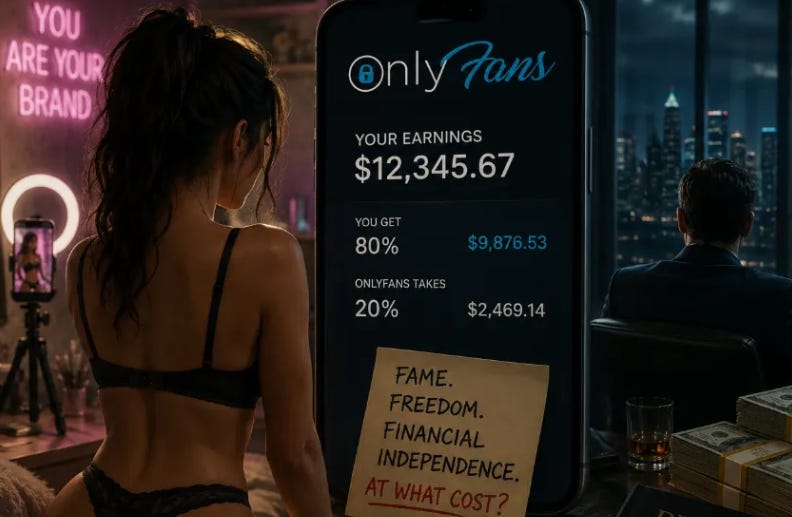
In 2021, a publicist pitched me on a story on the economics of OnlyFans. He wanted me to interview his client, a semi-famous performer who was making millions of dollars a year sharing content on the subscription-based online platform.
At the time, I didn’t know much about OnlyFans. I knew that many women were creating risqué content there, but OnlyFans was also in the middle of a PR blitz that said the company was moving away from strong sexual content.
I was curious, so I said I’d do the interview.
A few days later, I started researching my subject and quickly realized her performances involved more than stripteases. For many writers, the realization that the subject they were about to interview was making pornographic content would not be a problem. But for me, it presented issues—some ethical and others practical (I was writing for an online publication that was, in some ways, conservative).
After thinking it over for a few days, I decided to proceed with my interview with Brin (a pseudonym).
We met over Zoom and spoke for an hour. In some ways, it was like meeting a celebrity. I’ve interviewed famous subjects in the past—a member of the Eagles, a Marvel movie star, several politicians, Ken Burns, etc.—and it felt the same.
Brin was in her twenties and beautiful. She had already amassed more than ten million dollars in her short career. I knew from the photos her PR rep had sent (and my own research) that Brin was attractive, but she was also smart and charming, something I hadn’t expected. (I’ve seen Boogie Nights, and was expecting someone more like Roller Girl.)
Like other interviews with celebrities over the years, I did my best to pretend I knew what I was doing. Be friendly but professional. Ask important questions. Maintain good eye contact and nod when appropriate.
Brin was comfortable talking about herself and her industry. She had a boyfriend who was also a business partner, and OnlyFans was not their first business endeavor. (Their previous ventures were not in sex work.) She spoke of her industry in such glowing terms—adjectives like “empowering” were peppered throughout—that at times I found myself nodding along.
The interview went well, overall. But the story was killed for reasons I’ll explain later.
Since my interview with Brin, OnlyFans has only grown. It’s not an exaggeration to say the brand is a household name. Even people who have never visited the website have likely heard of performers such as Lily Phillips, the OnlyFans model from the UK who made history (and went viral) after having sex with 101 men in one day.
To say that the growth of OnlyFans has been meteoric might sound like a cliché, but it’s true.
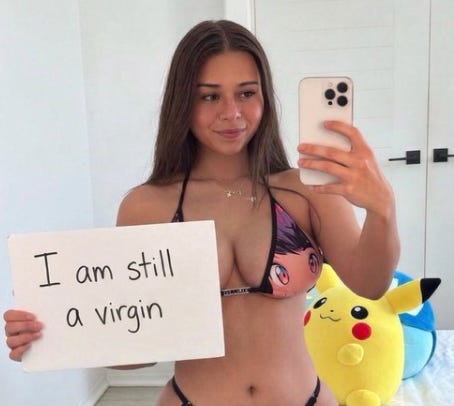
In 2017, the platform had 100,000 registered users. By 2021, the company boasted 188 million. In 2026, the estimate is close to 500 million.
The revenue growth has been just as impressive. In 2019, gross annual revenue stood at $270 million. By 2023, the total was $6.6 billion. The 2026 estimated revenue is $8 billion.
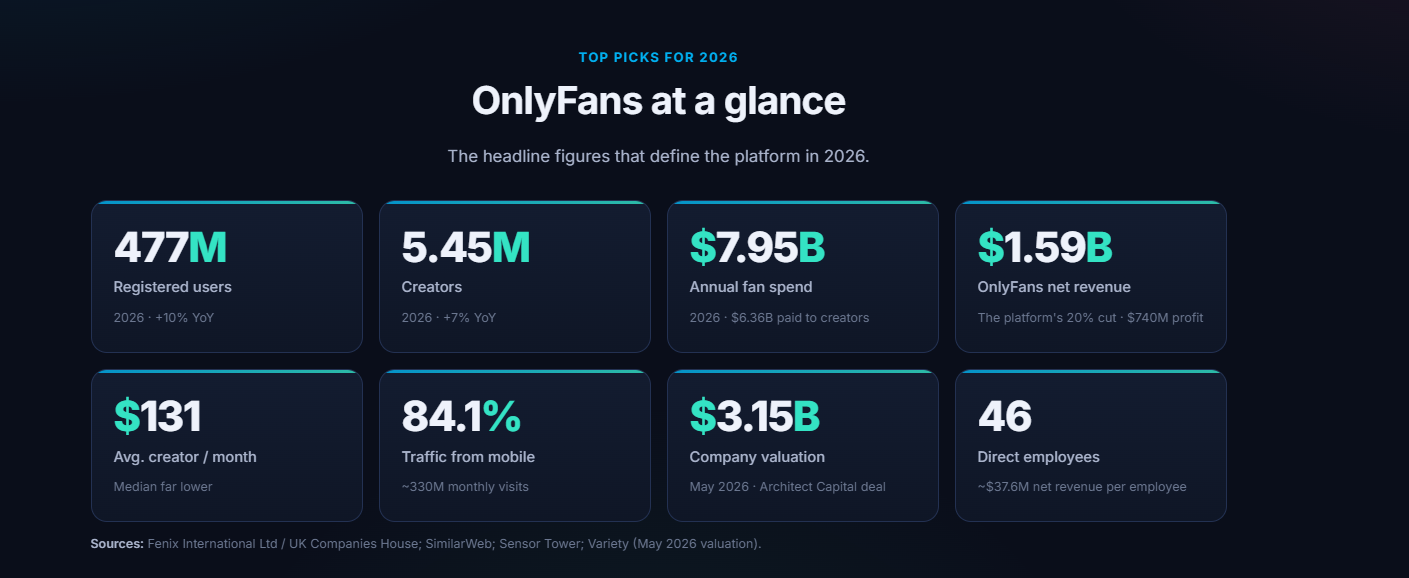
Performers like Phillips and Sophie Rain (pictured below), the 20-year-old professed Christian who grossed $43 million in a single year while advertising sexual purity, have made fortunes off the platform. Industry reports say that some 300 performers make more than $1 million annually—and they are not the only ones making bank.
Content creators on OnlyFans retain 80 percent of their earnings, while the remaining 20 percent goes to the platform, which had been owned by Ukrainian-American entrepreneur Leonid Radvinsky. A computer programmer by training, Radvinsky acquired a controlling stake in 2018 and by 2024 had collected $630 million in dividends, according to The Financial Times.
Radvinsky died in March 2026 following what his family described as a lengthy battle with cancer. He was 43.
The rise of OnlyFans occurred at a unique time in history.
In 2020, in response to the COVID-19 pandemic, governments worldwide implemented stay-at-home orders while simultaneously injecting massive amounts of money into the economy. Over the span of just 26 months, the Federal Reserve expanded the money supply by nearly 50 percent, pouring $7 trillion into the economy from February 2020 to April 2022.
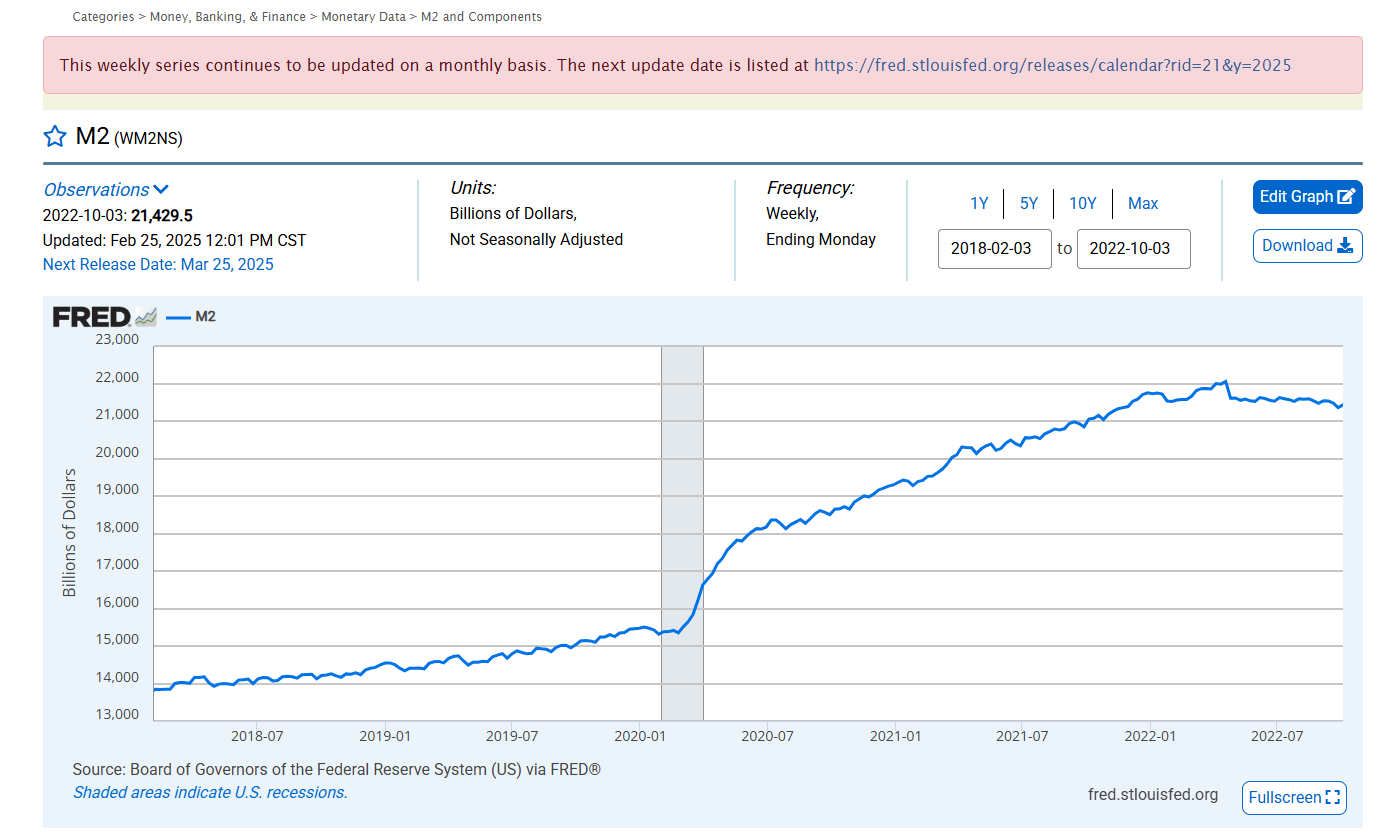
Everyone knows what happened next. The price of assets exploded. Stocks went up. The price of land and gold and cryptocurrencies went up. Inflation followed. This is a familiar cycle—and a predictable one—to people familiar with the Quantity Theory of Money.
The idea that “easy money” breeds inflation and financial instability is hardly new. What has been explored less is the idea that loose monetary policy breeds loose morals. The famed economics writer Henry Hazlitt argued, “there is a striking decline in both public and private morality” during every great inflation.
Some might argue that the explosion of OnlyFans occurred merely by coincidence during the largest monetary expansion in U.S. history—and they might be right. But the economic historian Andrew Dickson White (1832–1932) might disagree if he were alive today.
White, a Yale-educated abolitionist and diplomat who co-founded Cornell University, was deeply interested in French history and collected a wealth of primary sources during his travels through Europe. In 1912, he published Fiat Money Inflation in France, a historical analysis of France’s disastrous experiment with paper money during the French Revolution.
White concluded that the erosion of sound money led to a corresponding “breaking down of the morals” of France.
“Out of the inflation of prices grew a speculating class; and, in the complete uncertainty as to the future, all business became a game of chance, and all businessmen, gamblers. In city centers came a quick growth of stockjobbers and speculators. ... In this mania for yielding to present enjoyment rather than providing for future comfort were the seeds of new growths of wretchedness...”
To be sure, the idea that monetary policy in any way helped produce the rise of OnlyFans is purely speculative. I’m not offering a model. I am merely pointing out that some prominent economists have historically linked loose monetary policy with loose morals.
And even this argument raises its own challenge: morality is inherently subjective and difficult to define, and economics offers little direct guidance on the matter.
While economics helps us understand incentives, trade-offs, and consequences—all essential to analyzing human behavior—questions of morality belong primarily to religion, ethics, and philosophy. Markets themselves are neither moral nor immoral. They are simply mechanisms through which people exchange goods and services, a point prominent economists have long recognized.
“It is not the fault of the entrepreneurs that the consumers, the people, the common man, prefer liquor,” the economist Ludwig von Mises observed, “to Bibles and detective stories to serious books, and that governments prefer guns to butter.”
In this sense, OnlyFans is simply offering a service in high demand, “providing the consumers with those things they ask for most intensely,” in Mises’s words.
This brings me back to the economics of OnlyFans. Estimates suggest that roughly 1.4 million American women perform on the platform. It would be easy to attribute OnlyFans’ success solely to the morals of those selling sexual content. But that ignores the other side of the market: the enormous demand for what they’re selling.
Performers can earn millions of dollars only because untold numbers of consumers are willing to put their credit cards down to pay for their services. To borrow Mises’s reasoning, it is not the fault of performers that consumers prefer OnlyFans to Substack.
This is not to encourage or condone the sex trade, but to illustrate that performers are responding to powerful financial incentives created by consumer demand. If there is a moral problem with OnlyFans, it does not rest solely with performers. It also rests with the consumers who sustain the market.
Comments
Nothing yet. Say the first thing.
Sign in to join the conversation.