

...I have been both a speed reader and a voracious reader, consuming books with wide-eyed wonder and pleasure. I don’t mean this unkindly, but I used to assume the reason people treasured the Bible was simply because they hadn’t read much else.
Compared to Shakespeare, Dickens, and any number of great writers and their books, the Bible seemed ancient and—rather than timeless—hopelessly outdated. There were a few spots of illumination and poetry, but otherwise it didn’t seem especially well written.
Most of all, like the Bhagavad Gita and even Homer’s Odyssey, Bible stories seemed frankly ridiculous. (The exception is Noah’s Ark, which I has the bones of a great I rewrote from the hilarious perspective of the animals.)
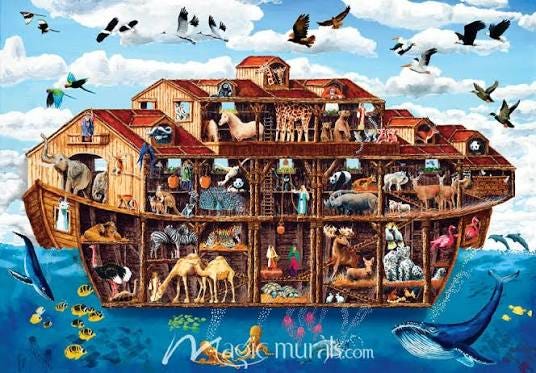
Storytelling has evolved in the last two thousand years.
I only began to comprehend the spell the Bible casts on its readers when the doors to the spiritual realm opened and I started understanding consciousness and how it works.
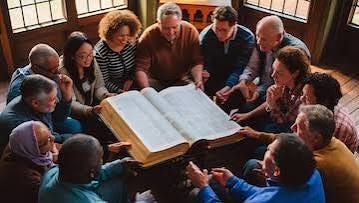
Give any text to a million people.
Tell these people—with comical certitude—that it is the inerrant Word of God.
Invite them to study this text and mine it for nuggets of otherworldly wisdom.
The result will be a mind-blowing phenomenon.
The power of the Bible grows with each and every consciousness connecting to it in this way. Belief shapes reality. Over the centuries, as more people were told that the Bible was the only Word of God, the more this became true for people.
It is the same for the Koran. Most Muslims understand that you might be a Christian or Jewish until… you’ve read the Koran in its original Arabic. Then everyone recognizes a profound beauty that could have only come from God.

From a writer’s perspective, the wealth of Shakespeare’s talent always seemed otherworldly.
It is impossible that these rich, gorgeous texts—shining an incandescent wisdom on our human condition—emerged from a mere mortal walking here on Earth.
No holy text comes close to the light that is the works of Shakespeare.
Seth said that all great talent is accumulated over many lifetimes. (This is why, if you want to learn the piano or plant medicine at age eighty, your lessons will not be wasted.) At first, I thought this explained Shakespeare. But no.
Even a hundred lifetimes of accumulated talent could not explain the magic found in Shakespeare’s legacy of textual riches.
That’s when I realized the obvious.
Shakespeare’s canon is channeled material from very High Light.
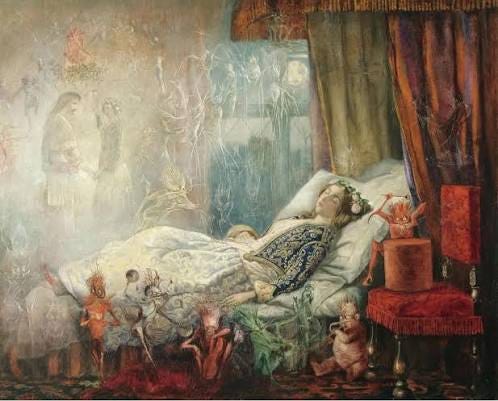
Shakespeare was as clear a channel as Paul Selig, who channels the Guides Melchizedek, or Jane Roberts, who channeled Seth. I wonder if he knew he was a channel—or if the Divine flow from his pen to paper appeared as mysterious to him as it does to the centuries of scholars studying these words.
Interestingly, I was recently told that Shakespeare’s canon was intended to lift humanity from the distortions woven into Christianity and the other Abrahamic religions: Islam and Judaism.
There is only one path to God.
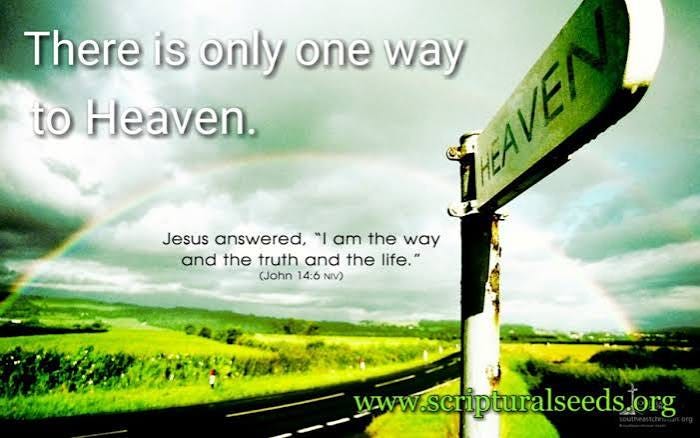
Hahaha. Crazy, right?
God is All That Is. God is the energy of creation. God is love. God is the emanating force of consciousness.
Every individual has their own path up. And when this path is viewed from above, it becomes an incandescent work of art. Like Shakespeare’s plays.
Heaven is reserved only for people who adhere to this or that belief.
And when you examine these beliefs, you see how limiting they are—designed with the sole purpose of keeping you small and, more often than not, afraid. As if the powers orchestrating mischief on Earth did not want you to know that you are an eternal soul. That there is no end to your existence.
“Heaven” is multidimensional. Mother Earth, this physical plane, has an incomprehensible vastness and complexity; it exists inside an infinitely more complex Spiritual Realm. In this realm, All That Is includes all people and trillions of other kinds of beings, existing throughout all time.
That hell exists anywhere but in an individual’s mind.

Hell is a concept developed long ago by deeply religious people desperate to convey to average folks what it is like to live without a felt connection to God/Source Light.
The worst thing they could think of was a consuming fire. The idea of hell was born. And this dumb and destructive playground for fear is, unbelievably, still perpetuated to this day.
That sin exists anywhere but in an individual’s mind.
The punishment of sin has always been the sin itself—and the way it separates you from God/Source Light. God/Source does not punish people for sins. God/Source is infinitely… ah, bigger than that.
Spiritual wisdom is prodigiously littered throughout Shakespeare’s sonnets and plays.
Just for fun, I asked AIs for their favorites. Here are some of the ones that jumped out at me.
1. On Prayer: Words Without Heart
My words fly up, my thoughts remain below.
Words without thoughts never to heaven go.
—Hamlet, Act 3, Scene 3
Authentic prayer requires alignment. If your heart isn’t in it, the words don’t travel. And something we’ve all witnessed—performative spirituality is empty. (Don’t make me name names…)
2. On Love: The One That Never Wavers
Love is not love
Which alters when it alteration finds,
Or bends with the remover to remove.
O, no! it is an ever-fixed mark,
That looks on tempests, and is never shaken;
It is the star to every wandering bark,
Whose worth’s unknown, although his height be taken.
—Sonnet 116
True love is not transactional. It is a transformational spiritual teacher. Sonnet 116 is an ode to the power of Metta meditation. Love and its transformational power do not depend on the receiver’s behavior.
👉 A Life-Changing Metta Meditation Practice
3. On the Soul: The “Sinful Earth”
Poor soul, the centre of my sinful earth,
Why dost thou pine within and suffer dearth,
Painting thy outward walls so costly gay?
—Sonnet 146
Why do we lavish so much attention on the fleeting pleasures of the material realm? All the while, our soul itself is starving. The sonnet concludes that by reversing this, we transcend death itself:
And Death once dead, there’s no more dying then.
Of course, in their great wisdom, Melchizedek reminded us that while we are here on the physical plane, we should not forget its pleasures:
Lying in the arms of a lover. Bathing in a warm sea. The taste of a strawberry.
We do not need to reject the material world, but rather experience it more fully without forgetting what we are.
4. On Mercy: The Quality That Blesses Both Giver and Receiver
The quality of mercy is not strained;
It droppeth as the gentle rain from heaven
Upon the place beneath: it is twice blest;
It blesseth him that gives and him that takes.
—The Merchant of Venice, Act 4, Scene 1
Again, the power of Metta meditation. The idea that what you bless blesses you back. Blessing other people changes your consciousness. It alters your light.
👉 A Blessing for You and the World
5. On Virtue Over Vengeance
The rarer action is
In virtue than in vengeance: they being penitent,
The sole drift of my purpose doth extend
Not a frown further.
—The Tempest, Act 5, Scene 1
Forgiveness is the highest form of power, but we only discover the gifts of forgiveness by exercising it.
6. On the Nature of Self-Knowledge
To thine own self be true,
And it must follow, as the night the day,
Thou canst not then be false to any man.
—Hamlet, Act 1, Scene 3
The endless positive repercussions of authenticity. I cannot tell you how many times I’ve heard people restrict themselves, make themselves small, for fear of what other people might think of them. Time and again, I’ve pointed out that you imagine people are thinking about you, but they are really wondering what they will have for dinner.
7. On the Mystery of Reality
“There are more things in heaven and earth, Horatio,
Than are dreamt of in your philosophy.”
—Hamlet, Act 1, Scene 5
Reality is far greater than what our minds can comprehend. Exactly!
8. On the Fleeting Nature of Life
“We are such stuff
As dreams are made on, and our little life
Is rounded with a sleep.”
—The Tempest, Act 4, Scene 1
Our physical existence is fleeting. Perhaps that is not something to fear. Perhaps it is what makes this strange, beautiful experience of being alive so precious.
9. On the Gifts of Adversity
“Sweet are the uses of adversity.”
—As You Like It, Act 2, Scene 1
Planet Earth is a great school when you understand that each and every adversity is your teacher.
Shakespeare continues to open doors. Doors into love, mercy, the magnificent mystery surrounding us.
And that is what great spiritual writing does.
A Special Gift: I’m offering a free animal reading with every purchase of my book, The Spiritual Dog.
If you’d like a glimpse into your own animal companion’s soul, this is for you.
👉 Order The Spiritual Dog here
To claim your reading:
Simply send a picture of your companion, along with their name, age, info about housemates (human & animal), and anything else you’d like to share or ask, to:
Email: jaejflowers@gmail.com
No posts
Comments
Nothing yet. Say the first thing.
Sign in to join the conversation.