
Neo-Nazi protagonists?
I have two new essays out, both reviews, both nearly provocative.
The first is for The New York Review of Books on the playful, surrealist novels of Icelandic author Sjòn. His latest, Red Milk, sets fabulism aside to dramatize the radicalization of a real founder of Iceland’s neo-Nazi Party in the 1950s. Considerations: Can radicalization be rationally narrated? If society were, indeed, to “nudge” such individuals “in a different direction,” is liberal tolerance up to the task…? I’m a big fan of Sjòn’s work, though as a pessimistic American I differed on the answers to some of these questions.
I also wish I’d gotten to write more about his Codex 1962 trilogy, which might be my favorite of his novels, and which reminded me of The Master and Margarita even before I learned that Bulgakov’s classic is, in fact, one of Sjón’s own favorite books. But there’s a global paper shortage—severe enough, I hear, to affect publisher decisions at the Frankfurt Book Fair—and word counts are real, so my Codex 1962 run-down had to go.
You can read the review here.
The other piece is a review of Big Kiss, Bye-Bye by Claire-Louise Bennett, whose work I’ve also admired for many years. Her third book plugs very interestingly—if not intentionally—into the recent “heteropessimism” debates that have engulfed literary (and hetero dating) discourse:
Big Kiss has a plot—or at least a central relationship. The man in the wheelchair is Xavier, a former “private banker” who has become “more or less bedbound” due to his advanced age. Shortly after giving him her book, the unnamed narrator refuses to kiss him, precipitating an unexpected breakup. […] The setup—a mismatch of sexual desire—places us in a quandary much more familiar to contemporary fiction than Bennett’s earlier investigations of class, domesticity, and writing. In a cishet context, can men and women ever be reconciled in matters of sex? Can they ever be just friends?
The rest is here at 4columns.
(P.S. I also reported on the astronomical 39% tariffs Trump levied against Switzerland back in August for Foreign Policy and the Inside Europe podcast. The tariff was ‘calculated’ based on a spurious trade deficit largely driven by a surge in gold exports, which is to say stateside investor panic. Gold remains at an all-time high.)
What else to read—on bed rest?
I recently had to spend about three weeks in bed. “Good thing you’re a reader,” said a friend when I got the news to close up shop. (She was joking. What else would I be?)
I have relied heavily on Alan Hollinghurst and the Russian classics, which is to say, fat tomes. Hot take: Tolstoy, pretty good. Though I most recently finished The Death of Ivan Ilych, which is slim. I’m also really enjoying Die Höllanderinnen by Dorothee Elmiger, who just won the 2025 Deutscher Buchpreis. Watch for the English translation, because it’s excellent.
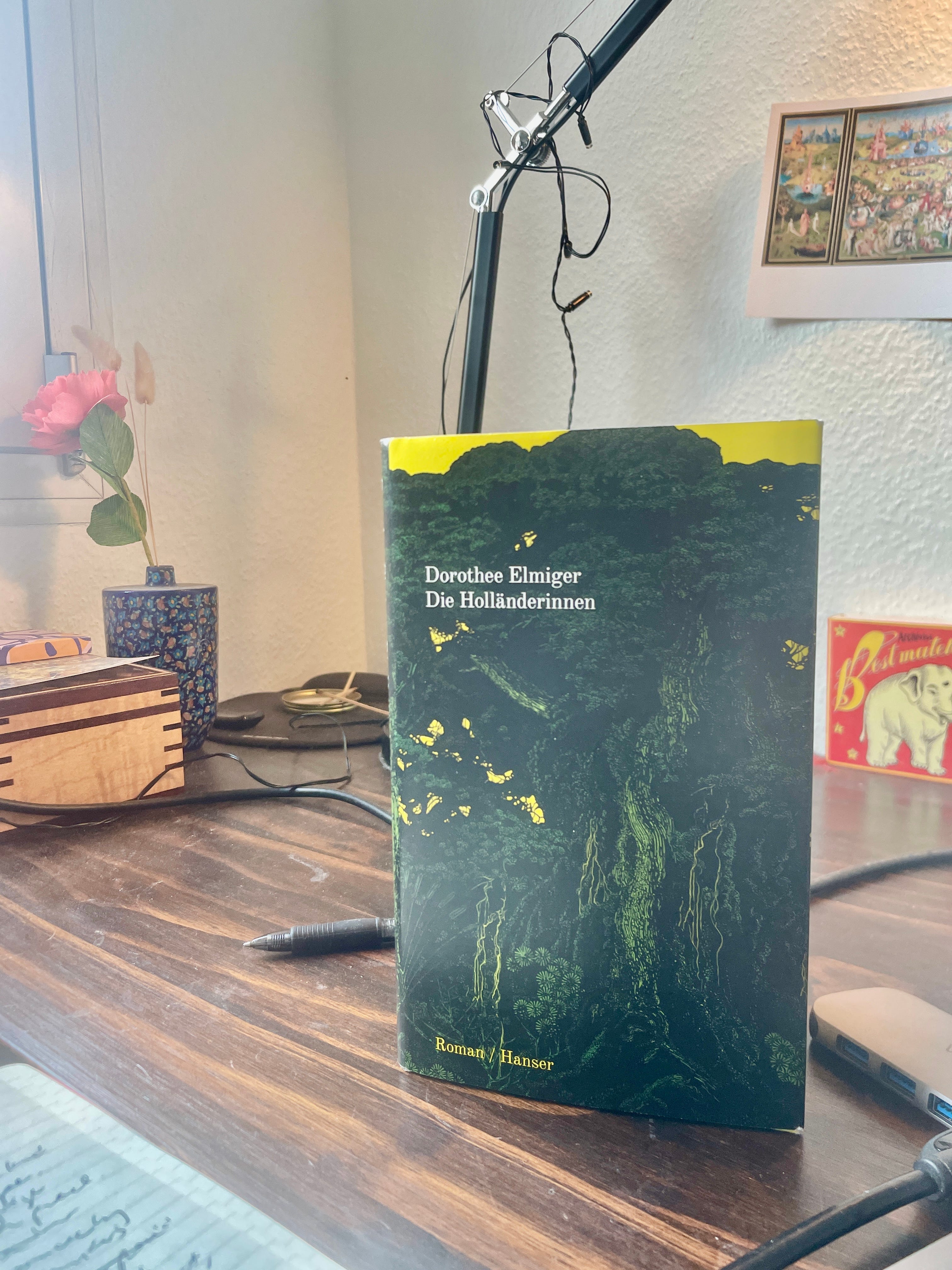
Then there are the books I’m teaching, my favorite of which is Elvia Wilk’s Death by Landscape. (Her discussion of the “eerie” or the “new weird” applies really well to Elmiger’s book, by the way.) Unfortunately for my students, I’ve had to teach a few classes online. Luckily they still get to be in the classroom together, while I hover over them on Zoom, Big-Brother style, dictatorially leading discussions and – more fun – writing prompts.
Present circumstances remind me that in New York I once lived for three years in a furnished apartment owned by the 92 year-old spouse of Kurt Vonnegut’s former literary agent. She wrote a pseudonymous memoir called An Interesting Condition. It sat for years on the bookshelves alongside first editions of Edgar Allen Poe, one of which I broke. Who chooses Poe over the memoirs of her adventurous 92 year-old landlady? You make some pretty stupid choices in your 20s.
A CASE FOR COMEDY, OR AT LEAST IRONY
I’ve also been reading a number of contemporary novels, most of which I’m writing about, so I’ll leave my thoughts on those for a later update. I did, however, dip into the Booker Longlist with a title I saw a few people recommending here on Substack. I spent good Swiss Francs on this book. I was hoping to be temporarily transported from my bed. As I told another writer friend, the book was impeccably structured and crafted—really, there were things to admire—but the writing style turned out to be so ultimately soul-crushing and humorless that I literally burst into tears. The question for the cultural critics among you: Were these the hysterical tears that prescribed rest can induce? Could they possibly be noble tears of literacy? Could they spring, maybe, from the wellspring of our desire to read actually good books with a spark of survivalism (i.e., irony) when the rest of the world is in the gutter?
I’m not joking, I was totally despondent! The point is, life is tragic, life is serious, but also ridiculous. It is tragic because it is ridiculous. Just look at Tolstoy. Or Bulgakov.1 Ivan Ilych died because he bruised his side on a tacky curtain rod. It’s something to keep in mind if you set a novel in nice restaurants or on a sunny beach. Or really anywhere a character is at leisure to notice things like curtain rods.

Bonus quote I just came across in Venus in Furs: “Gogol, the Russian Molière, says—where? well, somewhere—‘the real comic muse is the one under whose laughing mask tears roll down.’ A wonderful saying.”
No posts
Comments
Nothing yet. Say the first thing.
Sign in to join the conversation.